
Three Noahs, One Story: The Composite Noah of Genesis
The Genesis flood narrative is a composite. The Urantia Book identifies three distinct historical figures who were collapsed into the single biblical Noah: the son of the Garden of Eden's architect, present at Adam's arrival, a real wine maker of Aram who warned of local floods, and a literary construct invented by the Hebrew priests during the Babylonian captivity.
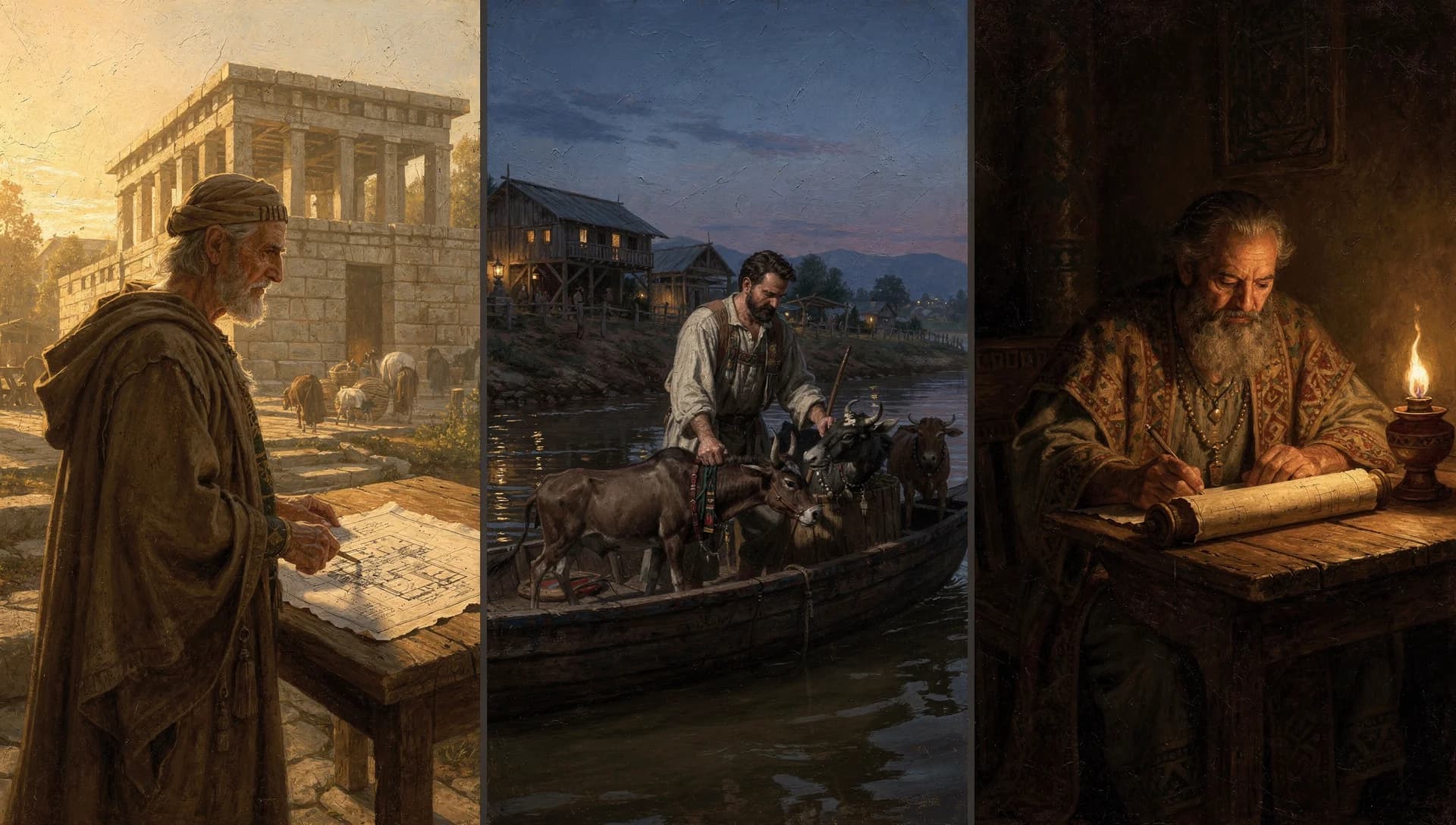
Three Noahs: Historical, Regional, and Literary = Biblical Noah, composite figure
This article expands on the decoder mapping. For the side-by-side card and quick reference, see the mapping page.
Three Source Figures Collapsed into One
The Genesis flood narrative presents a single protagonist: Noah, son of Lamech, builder of the ark, survivor of a flood that covered the world, father of Shem, Ham, and Japheth, patriarch of the generations that followed it. Modern biblical scholarship has long recognized that this figure is a composite, assembled from older Near Eastern flood material (Ziusudra, Atrahasis, Utnapishtim) and integrated into the Hebrew genealogical framework during the late compositional phases of the Pentateuch.
The Urantia Book adds specific content to this scholarly observation. The composite is not merely a literary merger of parallel flood traditions. It is the collapse of three distinct historical figures who actually existed into a single literary character the Hebrew priesthood constructed during the Babylonian captivity.
What the Urantia Book Says
The first Noah is named briefly in Paper 74:
At the formal reception of Adam and Eve on the great mound north of the Garden temple, the welcoming committee included "Noah, the son of the architect and builder of the Garden and executive of his deceased father's plans" (74:2.5).
The second Noah is the regional figure whose flood warnings became the basis of one narrative layer:
"But Noah really lived; he was a wine maker of Aram, a river settlement near Erech. He kept a written record of the days of the river's rise from year to year. He brought much ridicule upon himself by going up and down the river valley advocating that all houses be built of wood, boat fashion, and that the family animals be put on board each night as the flood season approached. He would go to the neighboring river settlements every year and warn them that in so many days the floods would come. Finally a year came in which the annual floods were greatly augmented by unusually heavy rainfall so that the sudden rise of the waters wiped out the entire village; only Noah and his immediate family were saved in their houseboat." (UB 78:7.5)
The third Noah is the one the priests constructed:
"Almost five thousand years later, as the Hebrew priests in Babylonian captivity sought to trace the Jewish people back to Adam, they found great difficulty in piecing the story together; and it occurred to one of them to abandon the effort, to let the whole world drown in its wickedness at the time of Noah's flood, and thus to be in a better position to trace Abraham right back to one of the three surviving sons of Noah." (UB 78:7.3)
The Urantia Book is explicit that the universal flood narrative is not historical:
"The traditions of a time when water covered the whole of the earth's surface are universal. Many races harbor the story of a world-wide flood some time during past ages. The Biblical story of Noah, the ark, and the flood is an invention of the Hebrew priesthood during the Babylonian captivity. There has never been a universal flood since life was established on Urantia." (UB 78:7.4)
The way the composite formed is clear enough. The figure present at Adam's reception, the wine maker of Aram whose memory of a local flood produced the ark narrative, and the literary construct invented in Babylon to simplify the Adamic genealogy by drowning the intervening populations were all collapsed into a single biblical Noah.
What the Ancient Source Says
The Mesopotamian flood tradition is the documented source layer. The Sumerian Eridu Genesis (c. 1600 BCE) names Ziusudra as the flood survivor. The Old Babylonian Atrahasis epic (c. 1800 BCE), reconstructed by Lambert and Millard (Atra-Hasis: The Babylonian Story of the Flood, Oxford, 1969), names Atrahasis. The Standard Babylonian Gilgamesh Tablet XI (c. 1200 BCE) names Utnapishtim. The literary dependency of Genesis on this tradition has been established since George Smith's 1872 identification of Gilgamesh Tablet XI with the flood narrative.
Modern academic consensus treats the Genesis flood as a product of the Priestly source composed during or after the Babylonian exile, drawing on Mesopotamian prototypes while adapting them to Yahwist theological concerns. Gerhard von Rad's Genesis (Westminster, 1972), Claus Westermann's Genesis 1-11 (Augsburg, 1984), and Richard Hess and David Tsumura's edited I Studied Inscriptions from Before the Flood (Eisenbrauns, 1994) document the scholarly picture.
The specific claim that there was never a universal flood, and that the Mesopotamian flood traditions derive from local catastrophic flooding events in the Tigris-Euphrates valley, is consistent with the geological record. Ryan and Pitman's Noah's Flood: The New Scientific Discoveries About the Event That Changed History (Simon & Schuster, 1998) documents specific local flood events (Black Sea shoreline inundation around 5600 BCE) that plausibly seeded the broader regional memory.
The Urantia Book's account of three sources adds a historical claim of its own: a figure who lived long before Mesopotamia (Noah, the son of the Garden of Eden's architect and builder), a survivor of one local flood (Noah of Aram), and an editorial invention of the priests (the universal flood narrative constructed during the captivity to simplify the Adamic genealogy). The academic record can test the second and third claims against the documented Mesopotamian flood tradition and the documented Priestly source editorial work. The first claim is not directly testable against surviving textual evidence.
Why This Mapping Matters
The Noah figure has shaped Jewish, Christian, and Islamic religious imagination for over two thousand years. The universal flood, the ark, the rainbow covenant, the genealogy of the three sons, and the related theological constructions rest on reading the Genesis narrative as a unified historical record of a global event. The scholarly consensus that the narrative is composite has been resisted in popular religious tradition but is well-established in biblical studies.
The Urantia Book's contribution is to specify what the composite contains. Rather than a loose merger of generic flood traditions, it identifies three distinct historical strata with specific content:
First, a figure from the days of Adam, the architect's son Noah present at the Garden reception, whose link to Adamic ancestry gave the composite its genealogical weight.
Second, a real man, Noah of Aram the wine maker, who warned his neighbors of the floods year after year and escaped in a houseboat when the worst of them came. His story provided the narrative spine of the ark account.
Third, an editorial construction made by the priests during the Babylonian captivity in the sixth century BCE, which turned the memory of a local flood into a universal one so that the genealogy would run clean.
The mapping does not require rejecting Genesis as theologically significant. It recognizes the text as a layered composite preserving genuine historical content (particularly the Noah of Aram local flood) alongside editorial reconstruction. The composite reading is consistent with the evidence of the Mesopotamian flood tradition and with the broader scholarly consensus about Priestly source composition during the exile.
Sources
- The Urantia Book, Paper 74 (Adam and Eve), Paper 78 (The Violet Race After the Days of Adam). Urantia Foundation, first printing 1955. Cited passages: 74:2.5, 78:7.3, 78:7.4, 78:7.5.
- Lambert, W. G. and A. R. Millard. Atra-Hasis: The Babylonian Story of the Flood. Oxford University Press, 1969.
- Dalley, Stephanie, editor. Myths from Mesopotamia: Creation, the Flood, Gilgamesh, and Others. Revised edition, Oxford University Press, 2000.
- Hess, Richard S. and David T. Tsumura, editors. I Studied Inscriptions from Before the Flood: Ancient Near Eastern, Literary, and Linguistic Approaches to Genesis 1-11. Eisenbrauns, 1994.
- Ryan, William and Walter Pitman. Noah's Flood: The New Scientific Discoveries About the Event That Changed History. Simon & Schuster, 1998.
- Westermann, Claus. Genesis 1-11: A Commentary. Augsburg, 1984.
- von Rad, Gerhard. Genesis: A Commentary. Westminster, 1972.
Confidence and Evidence
- Confidence: UB CONFIRMED
- Evidence rating: STRONG
- Basis: The Urantia Book supplies three separate figures that the Genesis Noah collapses: the Garden architect's son at Adam's reception (74:2.5), the wine maker of Aram (78:7.5), and the priestly invention of the universal flood in captivity (78:7.3, 78:7.4). The three figure reading is ours, the four paragraphs are the book's. The Mesopotamian literary dependency (Ziusudra to Atrahasis to Utnapishtim to Noah) is well-established in biblical scholarship. The editorial framework of the Priestly source, and the dating of its composition to the Babylonian captivity, are academic consensus.
Related Decoder Articles
- Machiventa Melchizedek = Deleted Priest-King of Genesis
- Nodite Rulers = Sumerian King List Antediluvian Kings
- Eden = Atlantis / Dilmun, the Sunken Paradise
By Derek Samaras
Connecting Articles
The Priest Who Had No Father: Machiventa Melchizedek and the Genesis Fragment
The Mark of Mercy: Cain's Thought Adjuster and the Genesis Mark
The One Who Did Not Die: Enoch's Fusion and the Genesis 5:24 Mystery

The Act Behind the Symbol: Eve's Union with Cano and the Forbidden Fruit
The Newsletter
Get the research behind each piece
Free. New Urantia Book explorations, the sources behind the videos, and early looks. No spam, unsubscribe anytime.
Prefer video? Follow on YouTube and Facebook.
Delivered through Substack. You can also read past issues.