
The Paradise Beyond the Western Sea: Celtic Otherworld and the First Eden
Celtic tradition preserves a persistent image: a paradise land beyond or beneath the western sea where death does not come. Tír na nÓg, Hy-Brasil, Avalon. The Urantia Book identifies the historical substrate: the first Garden of Eden, submerged under the eastern Mediterranean approximately 34,000 years ago, preserved in Celtic memory as one of several downstream traditions of the motif of a paradise lost beneath the waves.
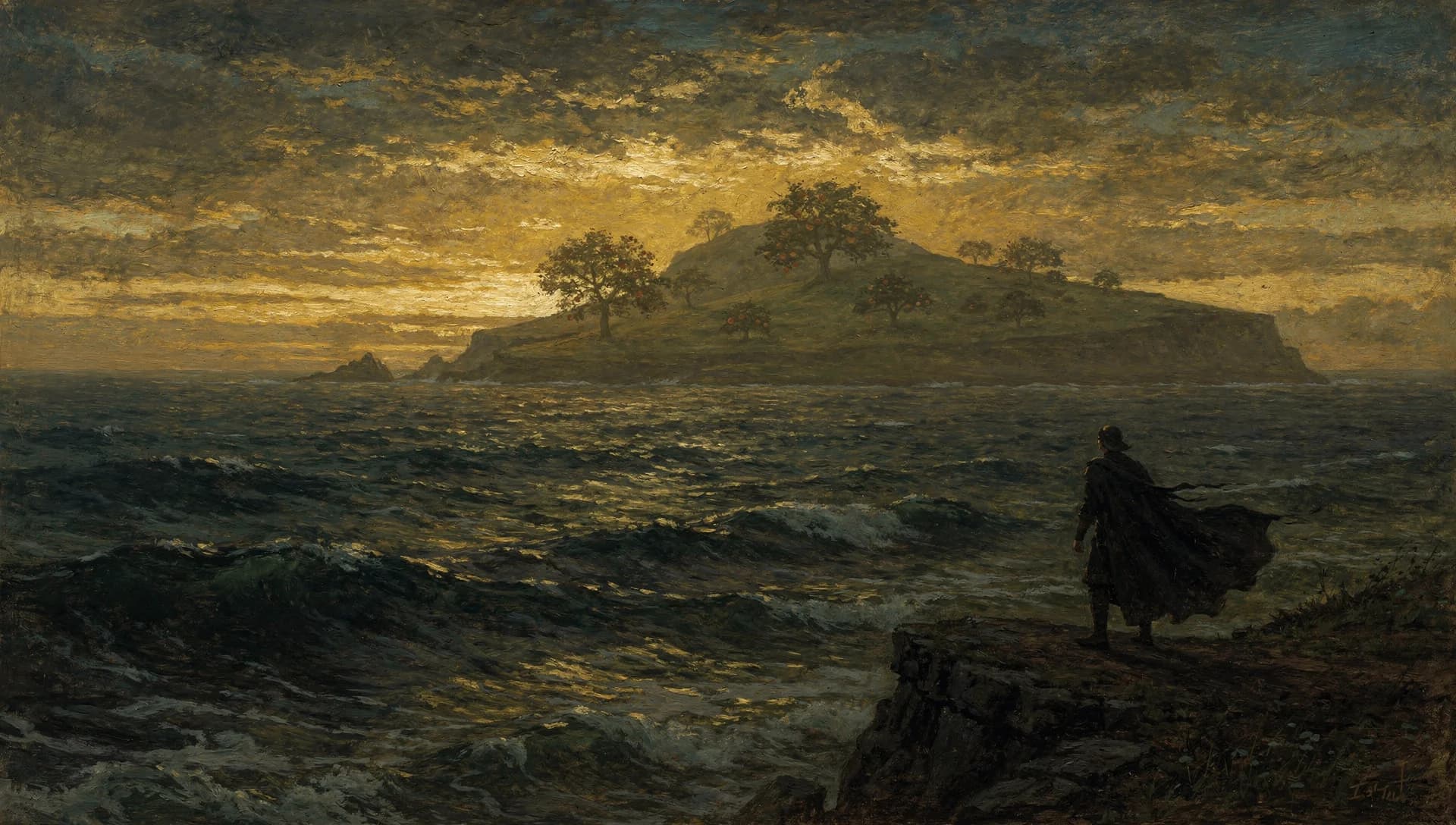
The first Garden of Eden, submerged under the eastern Mediterranean = The Celtic Otherworld: Tír na nÓg, Hy-Brasil, Avalon: paradise beyond or beneath the sea
This article expands on the decoder mapping. For the side-by-side card and quick reference, see the mapping page.
The Paradise Over the Sea
Celtic tradition preserves, across many separate strands, the image of a paradise land located beyond or beneath the sea. Tír na nÓg (the Land of Youth) is the Irish name. Hy-Brasil is the Irish phantom island that appears on medieval maps as persisting somewhere west of Ireland into the nineteenth century. Avalon is the Arthurian paradise where Arthur was taken after his final battle. Emain Ablach (the Island of Apple Trees) is the broader Celtic term for the paradise isle. The Fortunate Isles of the classical Mediterranean tradition, also accessible through the Atlantic, are the Greek preservation of the same motif.
The features these Celtic traditions share are consistent: a land in the west, reached only through ritual or spiritual means, free from sickness and death, inhabited by beautiful superhuman beings, associated with apples or other fruit-bearing trees. The image is not a generic mythological paradise; it is a paradise tradition set firmly in the west, over or beneath the sea, and bearing fruit.
The Urantia Book identifies the specific historical event that these traditions preserve.
What the Urantia Book Says
Paper 73 describes the first Garden of Eden's location and submergence:
"The committee on location was absent for almost three years. It reported favorably concerning three possible locations: The first was an island in the Persian Gulf; the second, the river location subsequently occupied as the second garden; the third, a long narrow peninsula—almost an island—projecting westward from the eastern shores of the Mediterranean Sea." (UB 73:3.1)
The submergence event is specified:
"The peninsula had been overrun by these lower-grade Nodites for almost four thousand years after Adam left the Garden when, in connection with the violent activity of the surrounding volcanoes and the submergence of the Sicilian land bridge to Africa, the eastern floor of the Mediterranean Sea sank, carrying down beneath the waters the whole of the Edenic peninsula." (UB 73:7.1)
"But still older vestiges of the days of Dalamatia exist under the waters of the Persian Gulf, and the first Eden lies submerged under the eastern end of the Mediterranean Sea." (UB 78:7.7)
The broader sunken-paradise tradition's persistence across world religions is addressed in the companion Eden-Atlantis-Dilmun decoder article. The Celtic variant is one preservation of this broader distributed memory.
The Celtic geographic perspective adds a particular feature. From the Irish perspective, "the west" extends across the Atlantic toward the Americas, and the sunken paradise sits in the Atlantic rather than in the Mediterranean. This is a geographic transposition but structurally consistent with the Eden memory. The historical fact (a paradise land submerged westward) is preserved; the location shifts depending on the receiving culture's orientation. For Celtic-British traditions looking west, the sunken paradise is transposed into the Atlantic. For Mediterranean traditions, it remains in the Mediterranean (Atlantis) or at the edge of the known world (the Fortunate Isles).
What the Ancient Sources Say
The Celtic Otherworld traditions are preserved across multiple textual layers. The earliest Irish material (the Immrama or "voyage tales," including the Immram Brain, "The Voyage of Bran") dates from the seventh or eighth century CE but preserves considerably older oral tradition. The Welsh tradition preserves related material in the Mabinogion and related sources. The Arthurian Avalon tradition develops in the twelfth and thirteenth centuries through Geoffrey of Monmouth and the subsequent romances.
The principal features the Celtic tradition consistently preserves include:
First, a western location. The Otherworld is not a diffuse spiritual realm; it lies westward, typically beyond or beneath the sea. Multiple Celtic texts describe sea voyages to it.
Second, absence of death and sickness. The Otherworld is characterized by the absence of mortality. Time behaves differently there; a traveler who spends what seems a day in the Otherworld may find centuries have passed in the ordinary world.
Third, fruit-bearing trees. Apples are the characteristic Otherworld fruit (hence "Avalon" from the Welsh afal, apple, and "Emain Ablach," Island of Apple Trees). That feature aligns with the tree of life framework the Urantia Book identifies for the first Eden.
Fourth, superhuman inhabitants. The Otherworld is inhabited by distinct classes of superhuman beings (the sidhe, the Tuatha Dé Danann in their residence after withdrawal, and the beautiful women associated with Otherworld visits). The Urantia framework of the corporeal staff and their Amadonite descendants provides the historical substrate.
Fifth, access through ritual or spiritual means. The Otherworld is not reached by ordinary travel; it requires the right occasion (Samhain), the right state of mind (trance, dream, illness approaching death), or an intermediary (the Otherworld emissary who conducts a chosen hero across).
John Carey's Ireland and the Grail (Celtic Studies Publications, 2007) and A Single Ray of the Sun (1999) treat the Irish Otherworld tradition in detail. Proinsias Mac Cana's work (Celtic Mythology, 1970) provides the broader comparative Celtic framework. Richard Cavendish's King Arthur and the Grail (Weidenfeld & Nicolson, 1978) treats the Avalon tradition's development.
The scholarly reconstruction treats the Celtic Otherworld as a culturally particular development of broader Indo-European otherworld traditions. The western location and the submerged or over-the-sea character are treated as Celtic adaptations reflecting the geographic orientation of the insular Celtic cultures. The Urantia framework suggests that these features (western location, submerged or over-the-sea character, superhuman inhabitants, fruit-bearing trees) trace back to a specific historical event (the first Eden's submergence) that the Celtic tradition preserves with its characteristic geographic transposition to the Atlantic.
Why This Mapping Matters
The Celtic Otherworld traditions are often treated as a purely Celtic religious and cultural development, reflecting the island geography of Irish, Welsh, and Scottish cultural imagination. The Urantia Book's framework places these traditions within the broader pan-Eurasian distribution of traditions telling of a sunken paradise in the west that preserve memory of the first Eden's submergence.
The mapping has real interpretive consequences. Celtic Otherworld traditions are not isolated cultural constructions; they are the westernmost preservations of a shared deep-memory tradition that extends across the Mediterranean (Atlantis, the Fortunate Isles), the Mesopotamian (Dilmun), the Biblical (Eden), and the Chinese (Kunlun, in the westward-paradise orientation treated in the companion decoder article). The Celtic preservation is structurally consistent with the broader family of sunken-paradise traditions.
The feature the Celtic tradition preserves (the westward Atlantic location) is the cultural transposition. The underlying historical event (a paradise land submerged westward) is shared across all the downstream traditions. Celtic cultural imagination, positioned at the westward edge of the Eurasian continent, naturally reoriented the shared memory's geographic reference toward the Atlantic rather than the Mediterranean.
The Arthurian Avalon has structural features that align with the Eden substrate. Avalon is an apple-bearing paradise (the Welsh afal etymology). It lies across the water. It is where kings go rather than die. The Urantia framework identifies the underlying substrate: Avalon preserves memory of the first Eden, reached through the Arthurian literary development.
The mapping's broader significance is that it places Celtic religious imagination within the same distributed-memory framework that connects multiple world paradise traditions. The Irish Tír na nÓg, the Welsh Avalon, the Mediterranean Atlantis, the Sumerian Dilmun, the Chinese Kunlun, and the Biblical Eden are not independent cultural creations. They are downstream preservations of a single historical event (the first Eden's submergence approximately 34,000 years ago), each shaped by the geographic orientation and religious conventions of the receiving tradition.
Reading the Celtic Otherworld traditions alongside the Eden-Atlantis-Dilmun mapping provides a clear framework for understanding why the image is so consistent across cultures that had no direct contact. The Urantia framework identifies the common origin; each tradition preserves its own cultural coloration of the shared substrate.
Sources
- The Urantia Book, Paper 73 (The Garden of Eden), Paper 78 (The Violet Race After the Days of Adam). Urantia Foundation, first printing 1955. Cited passages: 73:3.1, 73:7.1, 78:7.7.
- Immram Brain maic Febail (The Voyage of Bran Son of Febal). Edited and translated by Séamus Mac Mathúna, Max Niemeyer, 1985.
- Carey, John. Ireland and the Grail. Celtic Studies Publications, 2007.
- Carey, John. A Single Ray of the Sun: Religious Speculation in Early Ireland. Andover and Aberystwyth, 1999.
- Mac Cana, Proinsias. Celtic Mythology. Hamlyn, 1970; revised 1983.
- Cavendish, Richard. King Arthur and the Grail: The Arthurian Legends and Their Meaning. Weidenfeld & Nicolson, 1978.
- Loffler, Christa Maria. The Voyage to the Otherworld Island in Early Irish Literature. Salzburg Studies in English Literature, 1983.
- Sims-Williams, Patrick. Irish Influence on Medieval Welsh Literature. Oxford University Press, 2011.
Confidence and Evidence
- Confidence: INFORMED SPECULATION
- Evidence rating: MODERATE
- Basis: The Urantia Book documents the first Eden's westward-Mediterranean submergence in Paper 73:7.1 and places it within a broader pan-Eurasian sunken-paradise memory tradition. The Celtic Otherworld tradition preserves the features (western location, a setting over or beneath the sea, fruit-bearing trees, superhuman inhabitants) that align with the Eden substrate. The Celtic transposition to the Atlantic is consistent with the orientation of the receiving culture.
Related Decoder Articles
- Garden of Eden = Atlantis / Dilmun, the Sunken Paradise
- Andite Traditions of Eden = Chinese Kunlun Mythology
- Tuatha Dé Danann = Adamic-Andite Arrival in Ireland
By Derek Samaras
Connecting Articles
The Longest Memory: Australian Aboriginal Dreamtime and the Primordial Teaching-Ancestors
The Final Adjudication: Ragnarok and the Pending Verdict

We Come From One: African First-Family Traditions and the Sangik Origin
The Sky God Who Withdrew: African High-God Traditions and the Salem Teaching Layer
The Newsletter
Get the research behind each piece
Free. New Urantia Book explorations, the sources behind the videos, and early looks. No spam, unsubscribe anytime.
Prefer video? Follow on YouTube and Facebook.
Delivered through Substack. You can also read past issues.