
The Seed of the Infinite Within: Tathagatagarbha, Atman, and the Thought Adjuster
Tibetan Mahayana Buddhism teaches that every sentient being carries Tathagatagarbha, the Buddha-nature, an indwelling seed of enlightenment identical in essence with ultimate reality. The Urantia Book names the Hindu atman as the closest approximation of the Thought Adjuster, the actual divine fragment of the Universal Father that lives in the human mind. The Tibetan teaching refines the older Upanishadic atman and preserves the same cosmological content the Urantia revelation states outright.
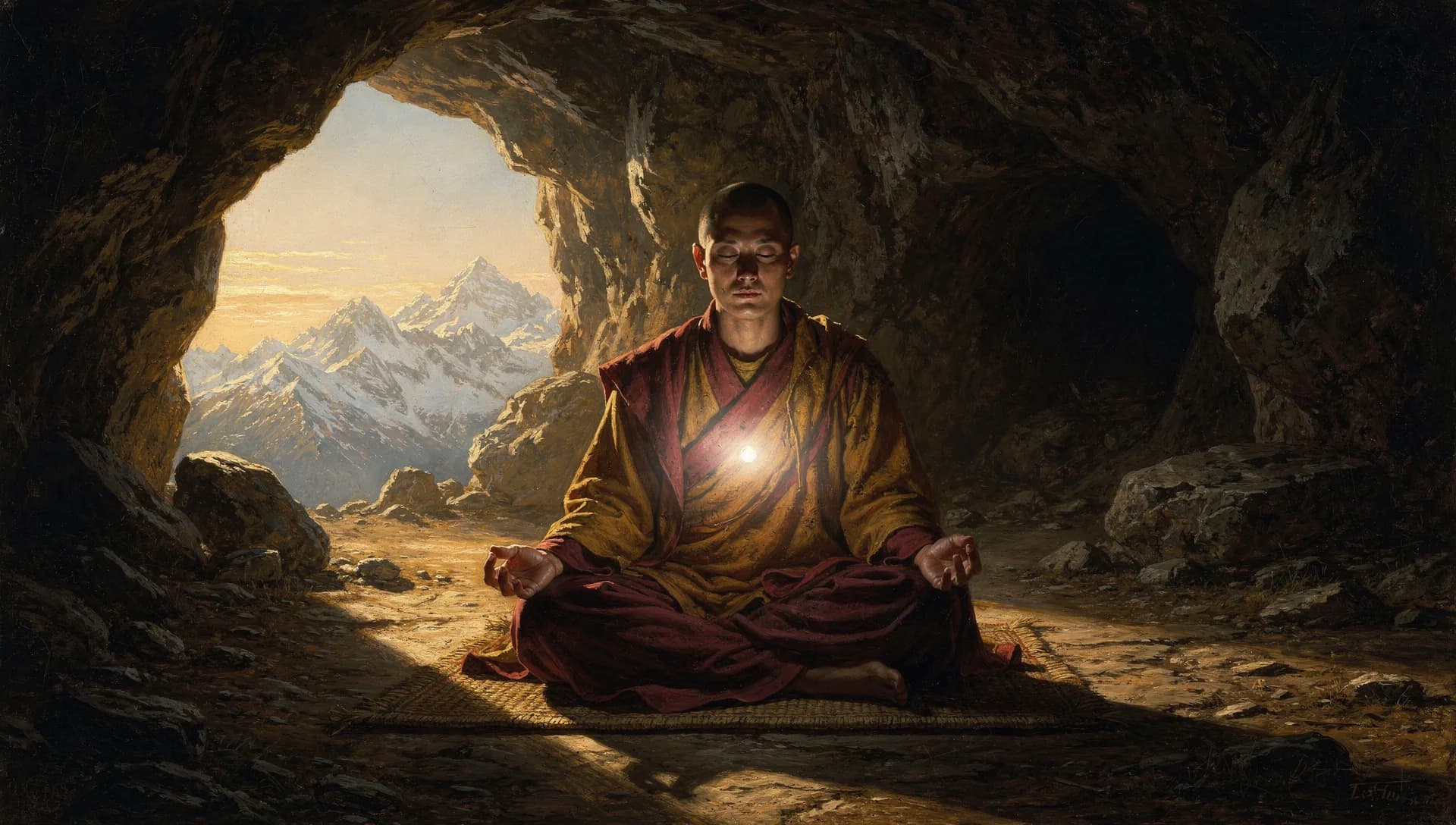
Thought Adjuster indwelling and the divine fragment = Tibetan Tathagatagarbha (Buddha-nature) and the Upanishadic Atman
This article expands on the decoder mapping. For the side-by-side card and quick reference, see the mapping page.
The Indwelling Divine Seed
Mahayana Buddhism, and especially the Tibetan Kagyu and Nyingma lineages, teaches that every sentient being carries Tathagatagarbha, "the embryo of the Thus-Gone." In English the term is usually given as Buddha-nature. This indwelling seed shares its essence with the Dharmakaya, the absolute reality. Liberation, on this account, is not the acquiring of something new from outside. It is the recognition of what is already there.
The teaching appears in the Indian Mahayana source texts: the Tathagatagarbha-sutra, the Srimaladevi-sutra, the Ratnagotravibhaga. Tibetan philosophy then elaborated it across centuries into the developed doctrine the Kagyu and Nyingma schools preserve today.
The older Hindu Upanishadic tradition had taught much the same shape. The atman, the indwelling self, shares its essence with Brahman, the absolute. The Tathagatagarbha teaching is the Buddhist refinement of that Upanishadic insight. It resolves a real tension between the Buddha's original anatman (no-self) teaching and the later recognition that some positive ground of liberation had to be named for the path to make sense.
The Urantia Book identifies this whole tradition as an approximation of what the revelation describes directly.
What the Urantia Book Says
The Urantia Book makes a direct identification of the Hindu atman with the Thought Adjuster:
"In the conception of the atman the Hindu teachers really approximated an appreciation of the nature and presence of the Adjuster, but they failed to distinguish the copresence of the evolving and potentially immortal soul." (111:0.4)
The Thought Adjuster is the actual spirit fragment of the Universal Father that indwells the human mind:
"THE presence of the divine Adjuster in the human mind makes it forever impossible for either science or philosophy to attain a satisfactory comprehension of the evolving soul of the human personality. The morontia soul is the child of the universe and may be really known only through cosmic insight and spiritual discovery." (111:0.1)
The Adjuster's role in the cosmic-evolutionary process is laid out plainly:
"The material mind of mortal man is the cosmic loom that carries the morontia fabrics on which the indwelling Thought Adjuster threads the spirit patterns of a universe character of enduring values and divine meanings—a surviving soul of ultimate destiny and unending career, a potential finaliter." (111:2.2)
So is the Adjuster's relation to the mortal will and to moral choice:
"Material evolution has provided you a life machine, your body; the Father himself has endowed you with the purest spirit reality known in the universe, your Thought Adjuster. But into your hands, subject to your own decisions, has been given mind, and it is by mind that you live or die. It is within this mind and with this mind that you make those moral decisions which enable you to achieve Adjusterlikeness, and that is Godlikeness." (111:1.4)
The universal reach of the indwelling-spirit concept across world religion is also acknowledged:
"The concept of a soul and of an indwelling spirit is not new to Urantia; it has frequently appeared in the various systems of planetary beliefs. Many of the Oriental as well as some of the Occidental faiths have perceived that man is divine in heritage as well as human in inheritance." (111:0.2)
The atman tradition's nearness to the actual reality is therefore stated in the Urantia Book itself. The Tibetan Tathagatagarbha, as the Mahayana refinement of the same atman insight, extends and clarifies the older teaching while preserving the same cosmological content.
What the Ancient Sources Say
The Tathagatagarbha doctrine is preserved across a substantial body of Indian Mahayana and Tibetan Buddhist text. The principal Indian sources are three.
The Tathagatagarbha-sutra (composed roughly 200 to 250 CE) presents the Buddha teaching that all beings carry the embryo of Buddha-nature even when it is covered by defilements. The text uses nine similes to picture the relationship: a lotus flower with a Buddha at its center, a grain of rice in its husk, gold buried in the ground, an embryo in the womb.
The Srimaladevi-simhanada-sutra (fourth century CE) elaborates the Tathagatagarbha as the basis for both samsara and nirvana. It is the substrate that carries beings through rebirth and also the ground from which liberation arises.
The Ratnagotravibhaga (also called the Uttaratantra-sastra, attributed to Maitreya-Asanga, fourth to fifth century CE) is the principal systematic treatise. It presents seven vajra-topics, including the three jewels, the essence of Buddhahood, awakening, enlightened qualities, and enlightened activity. Its core claim is that Buddhahood is not produced. It is revealed when the adventitious defilements are removed.
S. K. Hookham's The Buddha Within: Tathagatagarbha Doctrine According to the Shentong Interpretation of the Ratnagotravibhaga (State University of New York Press, 1991) is the most substantial English treatment of the Tibetan reception. Hookham documents the Kagyu and Nyingma reading, the Shentong or "other-emptiness" view, which holds that Tathagatagarbha is actually, positively existent rather than only a useful conventional designation.
David Seyfort Ruegg's La théorie du tathāgatagarbha et du gotra (Ecole française d'Extrême-Orient, 1969) is the foundational scholarly treatment of the Indian background. Ruegg traced the doctrine to the Mahayana sutras and to its structural continuity with the Upanishadic atman.
The Tibetan philosophical development of Tathagatagarbha through the Shentong lineage runs from Dolpopa Sherab Gyaltsen (1292 to 1361) to Taranatha (1575 to 1634) to Jamgon Kongtrul (1813 to 1899). The Gelug school, founded by Tsongkhapa (1357 to 1419), preferred the alternative Rangtong or "self-emptiness" reading, treating Tathagatagarbha as conventionally existent but ultimately empty of inherent existence. The Shentong-Rangtong tension echoes a similar debate inside Indian Vedanta between positive and negative readings of atman.
The Upanishadic atman tradition from which the Tathagatagarbha doctrine grew is documented in the classical Upanishads (composed roughly 800 to 500 BCE), especially the Brihadaranyaka, Chandogya, Isha, Katha, Mundaka, and Mandukya. The principal teaching is given in the mahavakyas, the great statements: tat tvam asi ("thou art that," Chandogya 6.8.7), ayam atma brahma ("this atman is Brahman," Mandukya 2), prajnanam brahma ("consciousness is Brahman," Aitareya 3.3), aham brahmasmi ("I am Brahman," Brihadaranyaka 1.4.10).
The Tibetan preservation of the Tathagatagarbha doctrine across the Kagyu, Nyingma, and Jonang schools represents a continuous institutional tradition that elaborated the teaching in sophisticated philosophical form while keeping the core content of the Indian Mahayana substrate intact.
Why This Mapping Matters
The Urantia Book's identification of the Hindu atman with the Thought Adjuster at 111:0.4 is unusually direct. It gives an explicit textual anchor rather than asking the reader to infer a structural parallel. The Urantia Book states that the Hindu atman teachers "really approximated an appreciation of the nature and presence of the Adjuster." This is one of the relatively few places where the text names a particular world religious concept as a real approximation of cosmic reality, instead of describing the general substrate-preservation pattern at work behind every tradition.
The Tibetan Tathagatagarbha, as the Mahayana refinement of that atman tradition, extends and clarifies the original Upanishadic insight in ways that improve on it.
First, the Tathagatagarbha doctrine addresses the relationship between the indwelling seed and the continuing personality. The Upanishadic atman tradition had a persistent difficulty here. How does atman, the indwelling self that is identical with Brahman, relate to the empirical personality (jiva) that experiences samsara? The Tathagatagarbha teaching distinguishes the pure indwelling buddha-nature from the defilements that adventitiously obscure it. That gives a more articulated account of the relationship between the indwelling divine and the empirical continuity, which the Urantia framework documents as the relationship between the Thought Adjuster and the evolving morontia soul.
Second, the Tathagatagarbha doctrine is universal in scope. All sentient beings carry Buddha-nature, not only human beings. That aligns more closely with the Urantia Book's universal personality endowment than the sometimes brahmanical focus of the older Upanishadic tradition. Thought Adjusters indwell all normal human beings of moral decision-capacity across the inhabited worlds of the cosmic administration. Tathagatagarbha preserves this universal endowment more accurately than some forms of the older teaching.
Third, the Tibetan Shentong interpretation preserves the positive existence of the Tathagatagarbha against the negative-emptiness reduction that the Rangtong reading favors. The Urantia Book's teaching that the Thought Adjuster is an actual spirit fragment of the Universal Father, not a conventional designation or a mere absence, lines up with the Shentong position. The Shentong tradition's positive-existence reading of Tathagatagarbha keeps the cosmological reality of the underlying truth that the Urantia framework describes directly.
The Tibetan preservation through the Kagyu, Nyingma, and Jonang philosophical traditions is an institutional continuation of the original insight that the Urantia Book identifies at 111:0.4. The atman, Tathagatagarbha, and Adjuster continuum is one of the clearest cross-cultural preservations of accurate cosmological content in the history of world religious thought.
What about the Buddhist no-self (anatman) teaching? It is sometimes read as contradicting Tathagatagarbha. It does not contradict the Urantia framework. The Urantia Book distinguishes three things: the personality, which persists and survives in the morontia progression; the Thought Adjuster, the indwelling divine fragment; and the evolving morontia soul, which emerges from the mind's cooperation with the Adjuster across the mortal and morontia experience. The Buddhist no-self teaching correctly denies any permanent, unchanging, independent ego-self of the kind that ordinary human experience naively posits. The Tathagatagarbha doctrine correctly affirms a genuinely cosmic ground of being that indwells all sentient beings. Both are accurate within their respective domains. The empirical ego-self is rightly denied by anatman. The cosmic indwelling divine is rightly affirmed by Tathagatagarbha.
The mapping's significance is this. Tibetan Buddhist Tathagatagarbha teaching should be read not only as Buddhist philosophy and theology but as the most refined preservation of the cosmic insight that the Urantia revelation states outright. The Tibetan tradition's long philosophical labor has produced one of the most accurate and sophisticated renderings of the Thought Adjuster reality available in any non-UB religious tradition.
Sources
- The Urantia Book, Paper 111 (The Adjuster and the Soul). Urantia Foundation, first printing 1955. Cited passages: 111:0.1, 111:0.2, 111:0.4, 111:1.4, 111:2.2.
- Hookham, S. K. The Buddha Within: Tathagatagarbha Doctrine According to the Shentong Interpretation of the Ratnagotravibhaga. State University of New York Press, 1991.
- Ruegg, David Seyfort. La théorie du tathāgatagarbha et du gotra: études sur la sotériologie et la gnoséologie du bouddhisme. Ecole française d'Extrême-Orient, 1969.
- Williams, Paul. Mahayana Buddhism: The Doctrinal Foundations. Routledge, second edition 2009.
- King, Sallie B. Buddha Nature. State University of New York Press, 1991.
- Takasaki, Jikido. A Study on the Ratnagotravibhaga. IsMEO, Rome, 1966.
- Zimmermann, Michael. A Buddha Within: The Tathagatagarbhasutra. International Research Institute for Advanced Buddhology, Soka University, 2002.
- The Principal Upanishads. Translated and edited by S. Radhakrishnan, Allen and Unwin, 1953.
Confidence and Evidence
- Confidence: UB CONFIRMED
- Evidence rating: STRONG
- Basis: The Urantia Book explicitly identifies the Hindu atman as an approximation of the Thought Adjuster at 111:0.4. The Tibetan Tathagatagarbha is the Mahayana Buddhist refinement of the atman tradition, traceable through documented Indian Mahayana sources to the Upanishadic substrate. The Shentong interpretation of Tathagatagarbha preserves the positive-existence aspect that matches the Urantia Book's teaching that the Adjuster is an actual spirit fragment rather than a conventional designation.
Related Decoder Articles
- Bardo Thödol = Mansion World Progression
- Bön Shenrab = Pre-Buddhist Salem Layer
- Brahmanic Monotheism = Salem Priestly Preservation
Byline: Derek Samaras | Urantia Book Network | April 2026
Connecting Articles
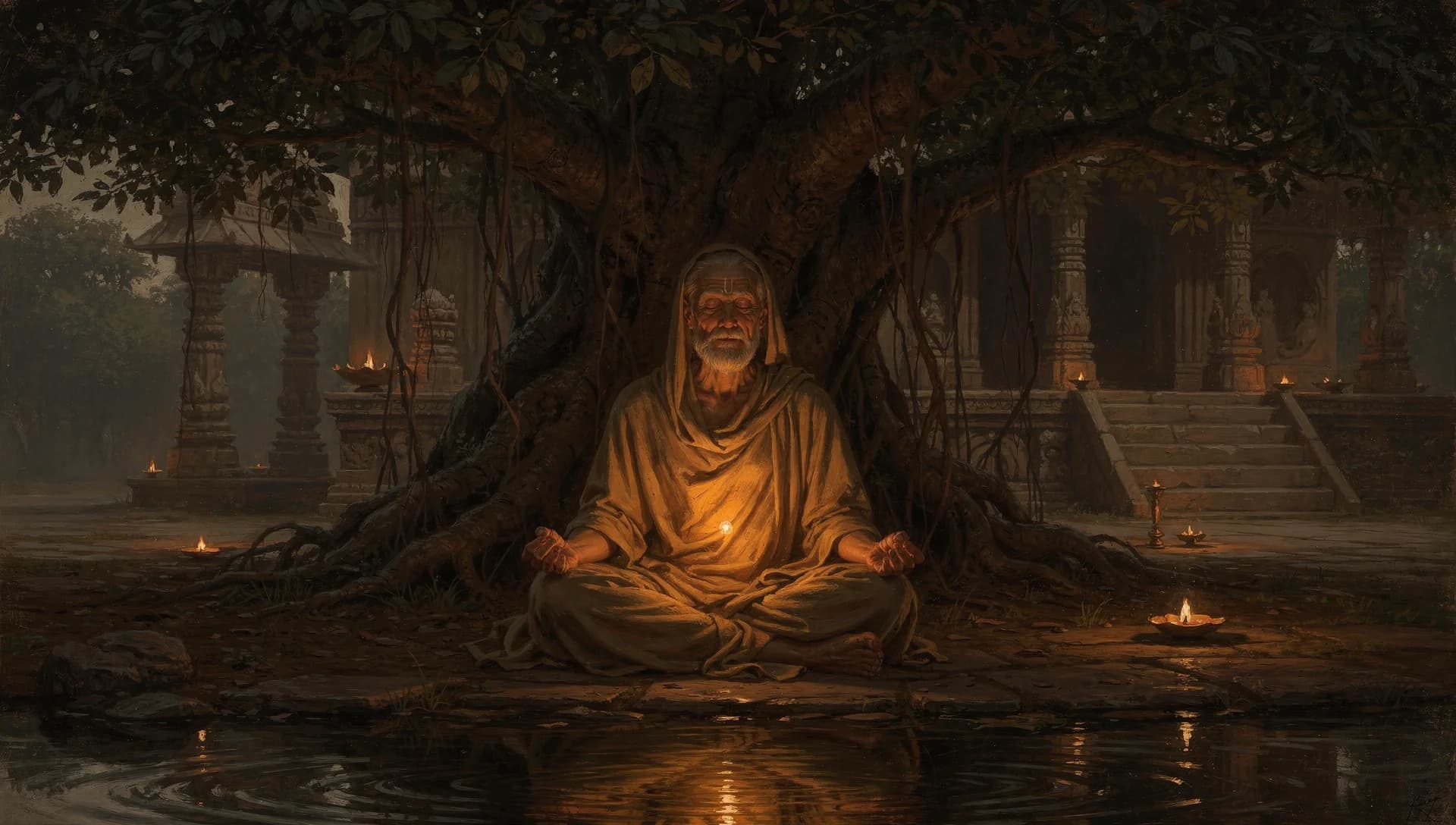
The Inner Fragment: The Hindu Atman and the Thought Adjuster

The Mark of Mercy: Cain's Thought Adjuster and the Genesis Mark

The Spark Within the Body: Orphic Brotherhood and the Thought Adjuster in Greek Dress

Two Realities, Two Names: Yang and Yin as Soul and Spirit
The Newsletter
Get the research behind each piece
Free. New Urantia Book explorations, the sources behind the videos, and early looks. No spam, unsubscribe anytime.
Prefer video? Follow on YouTube and Facebook.
Delivered through Substack. You can also read past issues.