
The Primordial Teacher Before Buddha: Tonpa Shenrab, Yungdrung Bön, and the Salem Layer in Tibetan Religion
The Yungdrung Bön lineage of pre-Buddhist Tibet traces itself to Tonpa Shenrab Miwoche, a primordial enlightened teacher who predates Buddha Shakyamuni and taught the original dharma. The Urantia Book documents Andite cultural transmission through Tibet and a Salem missionary enterprise that reached the remotest tribes of Eurasia. Tonpa Shenrab preserves the pre-Buddhist Salem teaching layer beneath the later Buddhist overlay, a parallel to the Brahmanic, Taoist, Io-Maori, and druidic preservations elsewhere.
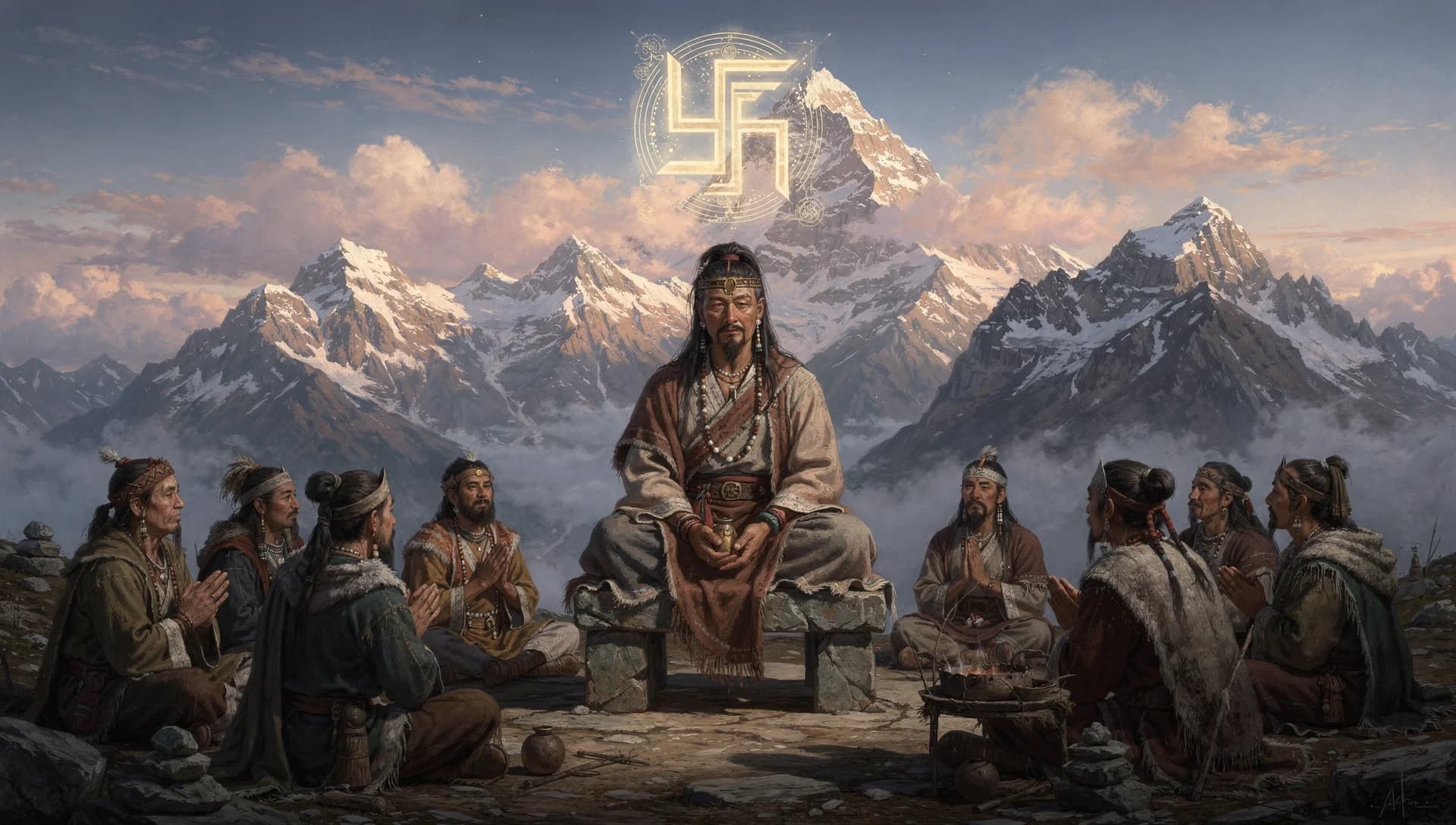
Pre-Buddhist Salem teaching layer in Tibet = Bön tradition of Shenlab Miwoche, the primordial teacher
This article expands on the decoder mapping. For the side-by-side card and quick reference, see the mapping page.
The Pre-Buddhist Tibetan Layer
Yungdrung Bön, "Eternal Bön" or "Everlasting Bön," is the pre-Buddhist religious tradition of Tibet. It preserves itself as a continuous lineage running back through the historical Tibetan kings and, by its own account, into the prehistoric period when Tonpa Shenrab Miwoche, "Teacher Shenrab the Great Man," first gave the original dharma. The Bön tradition places that teaching well before the historical Buddha Shakyamuni. Shenrab is the primordial enlightened teacher, and his original teaching was given in Olmo Lungring, a paradisal kingdom at the cosmic center.
The Bön corpus carries a great deal of pre-Buddhist material. There are sky-burial origin stories, a sacred-mountain cosmology centered on Mount Kailash, cosmic-egg creation accounts, and a nine-vehicle path of liberation. There is pre-Buddhist ritual practice as well: shamanic exorcism and healing techniques, Tibetan divination systems, and funerary rites that long predate the Buddhist arrival. And there is a distinct theology centered on Tonpa Shenrab as primordial teacher, with canonical texts whose doctrine differs from what the later Tibetan Buddhist synthesis carried in.
The Urantia Book identifies the historical mechanism that explains all this.
What the Urantia Book Says
The Urantia Book documents Andite cultural transmission through the Central Asian and Himalayan corridor at UB 78:5.6 and across UB 79:1.1-8. The migrating Andites carried commerce, urban life, and elevated cultural content from Egypt through Mesopotamia and Turkestan to the rivers of China and India (79:1.4), with the Tibetan and pre-Aryan zones receiving substantial Adamic-Andite biological and cultural input through this broader Asiatic penetration.
The pre-Aryan Andite material that entered the Tibetan substrate would have included what the Adamic-Andite lineage carried forward: pre-rebellion Dalamatian teaching, Adamic-era religious culture, advanced agricultural, metallurgical, and astronomical knowledge, and a leaning toward monotheistic religion.
The later Salem missionary enterprise, founded by Machiventa Melchizedek in the twentieth century BCE, reached into the same Tibetan region:
"THE early teachers of the Salem religion penetrated to the remotest tribes of Africa and Eurasia, ever preaching Machiventa's gospel of man's faith and trust in the one universal God as the only price of obtaining divine favor." (UB 94:0.1)
The Urantia Book is candid about how hard it was to keep that monotheistic content alive in tribal contexts:
"But the task was so great and the tribes were so backward that the results were vague and indefinite. From one generation to another the Salem gospel found lodgment here and there, but except in Palestine, never was the idea of one God able to claim the continued allegiance of a whole tribe or race." (UB 93:7.3)
The pattern the Urantia Book documents across world traditions is consistent, though it is less tidy than a guarded priestly secret. Salem content survives by being taken up into whatever older system receives it, which is the tendency the revelators state directly: "There was always a tendency for the new doctrine to become absorbed into the older body of religious teaching and magical practice" (UB 93:7.4). The Tibetan preservation of Tonpa Shenrab as a primordial enlightened teacher predating the historical Buddha fits that shape. The pre-Buddhist Bön tradition holds the older layer that Tibetan Buddhism later overlaid.
China is the clearest case: Lao-tse "built directly upon the concepts of the Salem traditions when he declared Tao to be the One First Cause of all creation" (UB 94:6.3). India is the instructive counter-case, where the Brahman priests rejected the Salem gospel and worked to combat its teachers (UB 94:1.5, 94:1.7), and the Melchizedek contribution still reached later Hinduism through the Vedic ritual it had already modified (UB 94:4.1). The Io preservation in Polynesia through the tohunga whare wananga is treated in the companion Io-Maori article. Bön extends the pattern into the Himalayan and Central Asian zone.
What the Ancient Sources Say
Yungdrung Bön has been documented across substantial scholarly and insider literature. David Snellgrove's The Nine Ways of Bön: Excerpts from gZi-brjid (Oxford University Press, 1967) is the foundational scholarly treatment. Snellgrove laid out the nine-vehicle path of the Bön canon and worked through what is distinctive about the Bön teachings when set beside the parallel Buddhist Nyingma materials.
Per Kvaerne's The Bön Religion of Tibet: The Iconography of a Living Tradition (Serindia, 1995) gives a systematic account of current Bön institutional practice. Kvaerne pays close attention to how pre-Buddhist content has been preserved despite the heavy institutional pressures Bön has faced during its long coexistence with Tibetan Buddhism.
Samten Karmay's The Arrow and the Spindle: Studies in History, Myths, Rituals and Beliefs in Tibet (Mandala Book Point, 1998) and his earlier Treasury of Good Sayings: A Tibetan History of Bon (Oxford University Press, 1972) document the historical and textual material of the tradition, again with an eye on the pre-Buddhist substrate.
Scholars have looked closely at the distinctive Bön content. Sky-burial origin narratives, the Tibetan funerary practice of exposing corpses for vulture consumption, are traced in the Bön tradition to Tonpa Shenrab's original teaching rather than to any later Buddhist introduction. The cosmic-egg creation accounts diverge from standard Buddhist creation cosmology. The sacred-mountain cosmology centered on Mount Kailash is shared in part with Hindu and Jain preservations but takes a distinctively Bön form. All of this counts as ancient material.
The Tonpa Shenrab biography is elaborated at length in the Bön canon. The mdo 'dus (compiled sometime before the tenth century CE, with earlier oral tradition behind it), the gZer-mig (a substantial hagiographical text), and the gZi-brjid (the long-version hagiography in twelve volumes) together make up the principal biographical corpus. They present Shenrab as an enlightened teacher whose dharma predates the historical Buddha Shakyamuni and differs in content from the later Buddhist teaching.
The Olmo Lungring tradition places Shenrab's original teaching in a paradisal homeland to the west. Bön sources treat Olmo Lungring as a real geographic location, though where exactly is contested. Some sources point to the western Tibetan and Central Asian region, others read it as a symbolic paradise. The western paradisal homeland motif has structural parallels with the Buddhist Shambhala (the hidden kingdom that preserves the pure teaching), the Chinese Kunlun paradise, and the broader pan-Eurasian memory of a paradisal homeland in the west.
The Buddhist overlay of Tibet from the seventh century CE onward, beginning with the introduction of Indian Buddhism under Emperor Songtsen Gampo, continuing through the Padmasambhava mission under Emperor Trisong Detsen, and consolidating in the Sakya, Kagyu, Gelug, and Nyingma schools, transformed the religious landscape. Bön survived the transformation in two ways. It absorbed some of the Buddhist theoretical and doctrinal framework (today's Yungdrung Bön works within that framework while preserving its own ritual and canonical material), and it kept a separate institutional identity from the Buddhist schools.
Why This Mapping Matters
Read against the Urantia Book, the Bön claim that Tonpa Shenrab is a primordial teacher carries real historical weight. It is not just retrospective legitimation.
The Urantia Book describes Andite cultural transmission carrying substantial pre-Adamic and pre-rebellion content into the Tibetan substrate. The later Salem missionary enterprise carried twentieth century BCE monotheism into that same substrate. On this framework, the Bön preservation of Tonpa Shenrab as a primordial enlightened teacher is a genuine memory of the pre-Buddhist Salem-derived layer.
The claim that Shenrab predates the historical Buddha is plausible on these terms. Machiventa founded Salem around 1900 BCE, during the life of Abraham, well before Buddha Shakyamuni in the sixth century BCE. The Salem teaching reached Tibet long before Buddhist teaching did. That gives roughly twenty-five centuries of Salem-derived material being preserved in the Tibetan substrate before the Buddhist overlay began.
What Tonpa Shenrab is traditionally credited with teaching also lines up. The original Bön teaching includes an enlightened teacher figure (Shenrab himself), a unitary cosmic principle distinct from the later Buddhist no-self and dependent-arising doctrines, and a strong ethical and moral content. That monotheistic and enlightenment-centered shape closely parallels the Salem content the Urantia Book describes as the substance of Machiventa's mission.
The Olmo Lungring tradition has further significance here. The motif of a paradisal homeland in the west turns up across multiple traditions. The Hebrew Eden, located east in the Hebrew sources but west when read from Tibet. The Greek Hesperides. The Chinese Kunlun. The Celtic Tir na nOg. The shared pattern is consistent with a shared substrate memory of the Edenic homeland the Urantia Book describes at UB 73-74, with each region interpreting that pre-dispersal memory through its own geography.
The continuous Bön institution, surviving the long Buddhist overlay, has given us rare documentary access to pre-Buddhist religious culture. The Bön canon, the preserved ritual practice, and the continuing Yungdrung Bön lineage together preserve a great deal of pre-Buddhist material that would otherwise have been lost when Buddhism assimilated the rest.
For Tibetan religious studies, the practical upshot is this. The Bön claim about Tonpa Shenrab should not be read primarily as retrospective legitimation (the modern critical scholarly position) or as literal history about a named historical teacher (the traditionalist insider position). It should be read as preserved religious history that corresponds, in substance, to the Salem-derived transmission the Urantia Book describes as an actual missionary enterprise into pre-Buddhist Tibet. The Bön preservation joins the Taoist, Brahmanic, Io-Maori, and druidic preservations as parallel instances of a single cross-cultural pattern.
Sources
- The Urantia Book, Paper 78 (The Violet Race After the Days of Adam), Paper 79 (Andite Expansion in the Orient), Paper 93 (Machiventa Melchizedek), Paper 94 (The Melchizedek Teachings in the Orient). Urantia Foundation, first printing 1955. Cited passages: 78:5.6, 79:1.1-8, 93:7, 94:0.1.
- Snellgrove, David. The Nine Ways of Bön: Excerpts from gZi-brjid. Oxford University Press, 1967.
- Kvaerne, Per. The Bön Religion of Tibet: The Iconography of a Living Tradition. Serindia, 1995.
- Karmay, Samten G. The Arrow and the Spindle: Studies in History, Myths, Rituals and Beliefs in Tibet. Mandala Book Point, 1998.
- Karmay, Samten G. The Treasury of Good Sayings: A Tibetan History of Bon. Oxford University Press, 1972.
- Martin, Dan. Unearthing Bon Treasures: Life and Contested Legacy of a Tibetan Scripture Revealer. Brill, 2001.
- Baumer, Christoph. Bon: Tibet's Ancient Religion. Weatherhill, 2002.
Confidence and Evidence
- Confidence: INFORMED SPECULATION
- Evidence rating: MODERATE
- Basis: The Urantia Book documents Andite cultural transmission through Tibet at UB 78:5.6 and 79:1, and the global reach of the Salem missionary enterprise at UB 94:0.1. The Bön claim that Tonpa Shenrab is a pre-Buddhist primordial teacher, dated to the Salem missionary era, is plausible on this framework. The cross-cultural pattern of Salem-derived content preserved in restricted priestly transmission beneath later polytheistic or philosophical overlays runs consistently across the Taoist, Brahmanic, Io-Maori, druidic, and Bön cases.
Related Decoder Articles
- Bardo Thödol = Mansion World Progression
- Lao-Tse's Tao = Salem Content Preserved in China
- Io Maori = Salem High-God Hidden Tradition
Byline: Derek Samaras | Urantia Book Network | April 2026
Connecting Articles
The Sky God Who Withdrew: African High-God Traditions and the Salem Teaching Layer
Seven Teachers, One Preparation: The Axial Age and the Salem Continuity
The Vow to Stay: Bodhisattva Ideal and the Salem Missionary Commission
The Good God of Ireland: Dagda and the Salem High-God Imprint
The Newsletter
Get the research behind each piece
Free. New Urantia Book explorations, the sources behind the videos, and early looks. No spam, unsubscribe anytime.
Prefer video? Follow on YouTube and Facebook.
Delivered through Substack. You can also read past issues.