
Two Monarchs, One Pattern: Asoka and Ikhnaton Among the Great Civil Rulers
The Urantia Book names only two civil rulers specifically in the company of the greatest religious reformers between Melchizedek and Jesus: Ikhnaton of Egypt and Asoka of India. Both used political authority to advance spiritual reform. Both changed the religious history of their respective continents. The comparison is direct and deliberate.
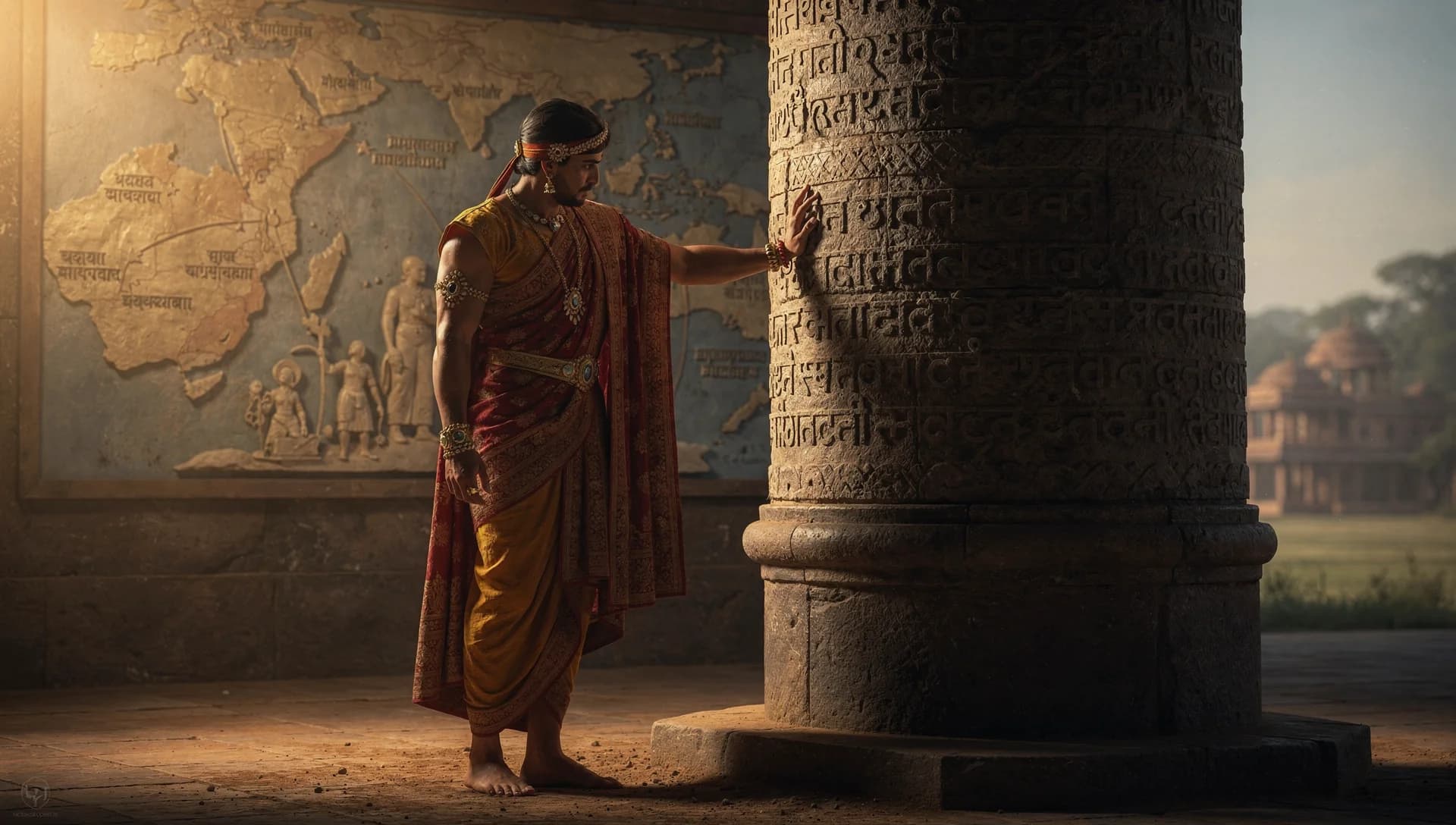
Remarkable civil ruler, compared to Ikhnaton of Egypt = Emperor Asoka, Buddhist monarch of India
This article expands on the decoder mapping. For the side-by-side card and quick reference, see the mapping page.
The Specific Comparison
The Urantia Book names only a small number of civil rulers explicitly in its treatment of world religious history. Ikhnaton receives extensive treatment in Paper 95 (see the companion decoder article on Ikhnaton). Asoka receives a more compressed but direct treatment in Paper 94, and the specific comparison to Ikhnaton is made explicitly:
"Buddhism prospered because it offered salvation through belief in the Buddha, the enlightened one. It was more representative of the Melchizedek truths than any other religious system to be found throughout eastern Asia. But Buddhism did not become widespread as a religion until it was espoused in self-protection by the low-caste monarch Asoka, who, next to Ikhnaton in Egypt, was one of the most remarkable civil rulers between Melchizedek and Michael." (UB 94:9.1)
The phrase "next to Ikhnaton in Egypt" is deliberately comparative. The Urantia revelation is placing Asoka at the second-highest tier of civil rulers between the Machiventa Melchizedek incarnation (c. 1886 BCE) and the Michael Bestowal (approximately 7 BCE to 30 CE). Only two rulers receive this level of comparative naming. Both used political authority to advance programs of religious reform. Both produced historically consequential outcomes that shaped the subsequent religious life of entire subcontinents.
What the Urantia Book Says
The broader context of Asoka's achievement is described:
"The spread of Buddhism from its homeland in India to all of Asia is one of the thrilling stories of the spiritual devotion and missionary persistence of sincere religionists. The teachers of Gautama's gospel not only braved the perils of the overland caravan routes but faced the dangers of the China Seas as they pursued their mission over the Asiatic continent, bringing to all peoples the message of their faith." (UB 94:9.2)
The specific Asoka achievement that the Urantia Book emphasizes is the conversion of Buddhism from a modest Indian reform movement into a continental-scale religious tradition. Under Asoka's patronage, Buddhist missionaries were systematically sent across Asia: to Ceylon (where they established what became Theravada Buddhism), to Burma and Southeast Asia, to Central Asia and eventually to China, to the Hellenistic kingdoms following the Alexander campaigns. The geographic spread of Buddhism that Asoka enabled reshaped the religious map of half the world.
The companion Gautama-Salem decoder article establishes the Salem-Melchizedek substrate that Gautama's original teaching preserved. Asoka's patronage ensured that this substrate, in its Buddhist reformulation, reached populations that otherwise would have had no contact with the Salem tradition. The historical significance is therefore soteriological: Asoka's political action made available to hundreds of millions of people a religious tradition preserving substantial fragments of the Salem gospel, at a time when direct Salem missionary work had largely ceased.
The Ikhnaton comparison is theologically precise. Both rulers attempted to use political authority to advance religious reform. Both operated in the narrow cultural windows when such reform was possible. Both achieved initial success. Both saw their reforms substantially compromised or reversed after their deaths. Ikhnaton's Amarna monotheism was suppressed by the subsequent Egyptian priestly reaction; Asoka's pure Buddhist reform was progressively ritualized and mythologized across the subsequent centuries.
But the comparison is not primarily about the fate of the reforms; it is about the quality of the rulers' spiritual and political achievement. Ikhnaton and Asoka are named together because both represent the relatively rare pattern of a civil ruler using genuine political power for genuine spiritual reform without the corruption of personal ambition or dynastic consolidation. Both ruled in ways that the Urantia assessment credits as genuinely motivated by spiritual conviction rather than political calculation.
What the Ancient Sources Say
Asoka the Great (Ashoka Maurya, reigned c. 268-232 BCE) is one of the best-documented ancient rulers. His own inscriptions, carved on rocks and pillars across the Mauryan Empire, provide primary-source evidence of his reign, his conversion to Buddhism, and his specific religious and ethical policies. Romila Thapar's Aśoka and the Decline of the Mauryas (Oxford University Press, 1961; revised 1997) remains the principal modern scholarly treatment. Charles Allen's Ashoka: The Search for India's Lost Emperor (Little, Brown, 2012) provides the accessible recent account.
Asoka's biography includes specific features that support the Urantia Book's assessment:
First, genuine moral conversion. After the Kalinga War (approximately 260 BCE), in which his conquest caused massive casualties, Asoka underwent a documented moral crisis. His subsequent Edicts express genuine remorse: "When an unconquered country is conquered, people are killed, they die, or are deported. The Beloved of the Gods finds this very pitiable and grievous." This is not formulaic regret; it is specific acknowledgment of the moral weight of his own political actions.
Second, sustained ethical reform. The Asokan Edicts document concrete programs: the planting of shade trees along roads, the digging of wells, the establishment of medical care for humans and animals, the prohibition of certain cruel animal sacrifices, the promotion of religious tolerance among competing sects, the appointment of dharma-officers (Dhamma Mahamatras) to monitor ethical life across the empire.
Third, missionary systematization. Asoka sent Buddhist missionaries across Asia and into the Hellenistic West. Asokan inscriptions record missions to the Greek-speaking kingdoms (Seleucids, Ptolemies, Antigonids, the kingdoms of Magas of Cyrene and Alexander of Epirus). The specific naming of Hellenistic rulers in Asokan inscriptions (Asokan Rock Edict 13) is historically remarkable; most ancient inscriptions do not acknowledge foreign rulers so directly.
Fourth, religious tolerance. Asoka's Edicts explicitly encourage tolerance among Buddhist, Jain, Ajivika, and Brahmanical traditions. Rock Edict 12 states: "The Beloved of the Gods, King Priyadarsi, honors both ascetics and householders of all religions... Whoever praises his own religion due to excessive devotion, and condemns others with the thought 'Let me glorify my own religion,' only harms his own religion."
The Ikhnaton comparison holds on most of these features. Ikhnaton also underwent apparent moral conversion (from the conventional Egyptian polytheism to the Aton monotheism). Ikhnaton also pursued sustained religious-ethical reform through political authority (the Amarna reformation). Ikhnaton also attempted to use royal authority to propagate a specific theological framework. The differences are substantial (Ikhnaton's reform was narrower geographically and collapsed after his death; Asoka's spread across continents and persisted for centuries), but the structural pattern is the same.
Why This Mapping Matters
The pattern of "civil ruler using political authority for genuine spiritual reform" is historically rare. Most ancient rulers used religion instrumentally for political consolidation. Most religious reformers operated without political authority. The combination, in the form Ikhnaton and Asoka achieved, is genuinely unusual.
The Urantia Book's specific naming of only these two civil rulers in the two millennia between Machiventa and Michael (UB 94:9.1) identifies them as the principal historical examples of this pattern. The claim is not that no other ancient ruler ever supported religious reform; it is that Ikhnaton and Asoka are the paradigmatic cases, the ones whose combination of political power and spiritual motivation produced the most consequential historical outcomes.
The comparison also identifies something about the Urantia evaluative framework. The criterion is not strict doctrinal correctness. Ikhnaton's Amarna monotheism was Salem-derived but failed politically. Asoka's Buddhist patronage supported a tradition that preserved Salem fragments but had substantially drifted from the original Salem gospel. Neither ruler's theology is the Urantia Book's own theology. But both rulers are recognized as having genuinely served the purposes of spiritual reform in their historical contexts, using political authority well, and producing consequential historical outcomes. The Urantia evaluative criterion is the quality of the ruler's genuine commitment and the consequential impact of their reform, not the doctrinal purity of their religious framework.
This reading has practical implications for how political-spiritual leadership should be evaluated. The Ikhnaton-Asoka pattern (genuine conversion, sustained ethical reform, missionary propagation of the reformed tradition, religious tolerance within the reformed framework) is an achievable pattern. The historical record shows it is possible. The Urantia Book validates it as a legitimate and significant form of spiritual work in the world. Contemporary political leaders who might pursue something like this pattern would be following a documented tradition with real historical precedents.
The mapping's significance is that it names Asoka as directly comparable to Ikhnaton in the Urantia evaluative framework, places both within the broader Salem-derived transmission history, and establishes that Buddhism's Asian-scale spread was enabled by an exceptional act of political and spiritual leadership. Asoka is therefore a figure whose historical significance the Urantia Book treats as cosmically substantial, not merely politically significant.
Sources
- The Urantia Book, Paper 94 (The Melchizedek Teachings in the Orient), Paper 95 (The Melchizedek Teachings in the Levant). Urantia Foundation, first printing 1955. Cited passages: 94:9.1-5, 95:5.1-13.
- Thapar, Romila. Aśoka and the Decline of the Mauryas. Oxford University Press, 1961; revised 1997.
- Allen, Charles. Ashoka: The Search for India's Lost Emperor. Little, Brown, 2012.
- Gombrich, Richard F. Theravada Buddhism: A Social History from Ancient Benares to Modern Colombo. Routledge, 1988.
- Strong, John S. The Legend of King Aśoka: A Study and Translation of the Aśokāvadāna. Princeton University Press, 1983.
- Basham, A. L. The Wonder That Was India. Sidgwick & Jackson, 1954; revised 1967.
- Nikam, N. A. and Richard McKeon, editors and translators. The Edicts of Asoka. University of Chicago Press, 1959.
Confidence and Evidence
- Confidence: UB CONFIRMED
- Evidence rating: STRONG
- Basis: The Urantia Book explicitly names Asoka and Ikhnaton as the two outstanding civil rulers between Melchizedek and Michael (UB 94:9.1). The historical record for Asoka is exceptionally well-documented through his own inscriptions and subsequent scholarly reconstruction. The parallel pattern between Asoka's Mauryan reform and Ikhnaton's Amarna reform is supported by academic comparative analysis.
Related Decoder Articles
- Salem Missionaries = Ikhnaton / Akhenaten
- Salem Gospel Almost Revived in India = Gautama Siddhartha
- Salem Monotheism in Chinese Form = Lao-tse's Tao
By Derek Samaras
Connecting Articles
The Best Godless Philosophy: What Buddhism Achieved and What It Missed
The Future Buddha: Maitreya and the Promise of Michael's Return
The Amun-Cult Travels South: Egyptian Religious Transmission into Kush, Nubia, and Ethiopia
The Prophet Egypt Murdered: Okhban and the Four Great Prophets
The Newsletter
Get the research behind each piece
Free. New Urantia Book explorations, the sources behind the videos, and early looks. No spam, unsubscribe anytime.
Prefer video? Follow on YouTube and Facebook.
Delivered through Substack. You can also read past issues.