
The One First Cause: Salem Monotheism in Lao-tse's Tao
In the sixth century BCE, a great wave of spiritual awakening swept across the civilized world. Among its principal Chinese figures was Lao-tse, who declared the Tao to be the One First Cause of all creation. The Urantia Book identifies this formulation as the most sophisticated Salem-derived monotheism produced anywhere in the ancient East.
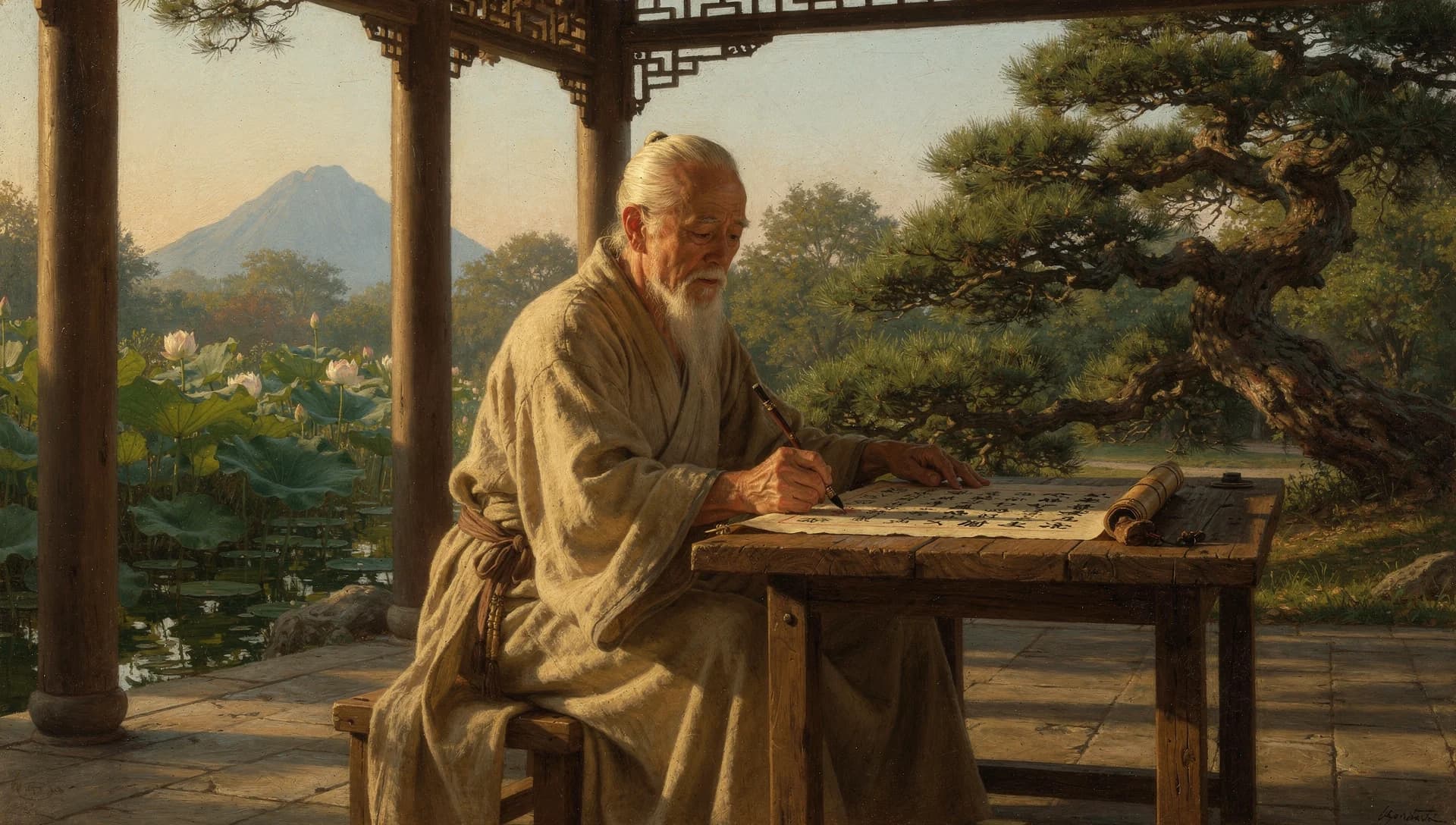
Salem monotheism in Chinese form = Lao-tse's Tao, the One First Cause
This article expands on the decoder mapping. For the side-by-side card and quick reference, see the mapping page.
The Century When the World Woke Up
The sixth century BCE produced Lao-tse and Confucius in China, Gautama Buddha in India, Zoroaster in Persia, the Hebrew prophets of the Babylonian captivity in Mesopotamia, and the early pre-Socratic philosophers in Ionian Greece. The coincidence has been noted by every student of comparative religious history. Karl Jaspers, in The Origin and Goal of History (Yale University Press, 1953), gave the phenomenon its now-standard name: the Axial Age.
The conventional academic explanation treats the Axial Age as a convergence of independent developments. Rising literacy, expanding urban economies, increased intercultural contact, the breakdown of older tribal religious forms, and parallel psychological pressures produced, in separate civilizations, parallel spiritual and philosophical responses.
The Urantia Book's account of the same century is specific and causal. The sixth-century awakening was not coincidental. It was a deliberate intervention by the Salem missionary organization (acting under instructions that trace back to Machiventa Melchizedek himself) to preserve and renew the Salem monotheistic tradition across the civilized world at a moment when that tradition was in danger of being lost. Lao-tse's Tao was one of the principal Chinese outcomes of that deliberate intervention.
What the Urantia Book Says
The historical account of the sixth-century intervention is given in Paper 94:
"About six hundred years before the arrival of Michael, it seemed to Melchizedek, long since departed from the flesh, that the purity of his teaching on earth was being unduly jeopardized by general absorption into the older Urantia beliefs. It appeared for a time that his mission as a forerunner of Michael might be in danger of failing. And in the sixth century before Christ, through an unusual co-ordination of spiritual agencies, not all of which are understood even by the planetary supervisors, Urantia witnessed a most unusual presentation of manifold religious truth." (UB 94:6.1)
"This unique century of spiritual progress was characterized by great religious, moral, and philosophic teachers all over the civilized world. In China, the two outstanding teachers were Lao-tse and Confucius." (UB 94:6.2)
Lao-tse's achievement is described with direct reference to the Salem tradition:
"Lao-tse built directly upon the concepts of the Salem traditions when he declared Tao to be the One First Cause of all creation. Lao was a man of great spiritual vision. He taught that man's eternal destiny was 'everlasting union with Tao, Supreme God and Universal King.' His comprehension of ultimate causation was most discerning, for he wrote: 'Unity arises out of the Absolute Tao, and from Unity there appears cosmic Duality, and from such Duality, Trinity springs forth into existence, and Trinity is the primal source of all reality.'" (UB 94:6.3)
The specificity is striking. Lao-tse is credited with a formulation that anticipates both the Trinity doctrine and the metaphysical sequence of Absolute → Unity → Duality → Trinity → cosmic manifestation, a sequence the Urantia revelation itself elaborates in its technical theology. The Urantia Book treats this not as coincidence but as evidence that Lao-tse was working within a genuine Salem-derived revelatory substrate.
The deeper theological content is made explicit:
"But the popular Taoism of twentieth-century Urantia has very little in common with the lofty sentiments and the cosmic concepts of the old philosopher who taught the truth as he perceived it, which was: That faith in the Absolute God is the source of that divine energy which will remake the world, and by which man ascends to spiritual union with Tao, the Eternal Deity and Creator Absolute of the universes." (UB 94:6.8)
The Urantia Book's judgment on the subsequent fate of Lao's teaching is pointed:
"The teachings of Lao have been lost to all but a few in the Orient, but the writings of Confucius have ever since constituted the basis of the moral fabric of the culture of almost a third of Urantians." (UB 94:6.11)
And on the mythologization process that affected both teachers:
"Like many other spiritual and moral teachers, both Confucius and Lao-tse were eventually deified by their followers in those spiritually dark ages of China which intervened between the decline and perversion of the Taoist faith and the coming of the Buddhist missionaries from India." (UB 94:6.12)
Lao-tse's original teaching, in the Urantia account, was a sophisticated Salem-derived monotheism centered on a personal Supreme Being addressed by the Chinese-language term Tao. The subsequent Taoist tradition progressively depersonalized this core, eventually producing the modern Taoism that has, in the Urantia Book's assessment, "very little in common" with Lao-tse's original teaching.
What the Ancient Source Says
The Daode jing attributed to Lao-tse is one of the most widely translated texts in world literature. The Mawangdui manuscripts discovered in 1973 in Hunan province pushed back the textual evidence to the second century BCE. The Guodian bamboo slip manuscripts discovered in 1993 date to roughly 300 BCE, establishing that a stable core of the text existed by the late fourth century BCE. Rudolf G. Wagner's A Chinese Reading of the Daodejing (SUNY Press, 2003) and the Ames-Hall translation (Ballantine, 2003) provide the modern scholarly framing.
The Daode jing's opening line, "The Tao that can be spoken is not the eternal Tao" (道可道,非常道), has been treated across the interpretive tradition as indicating a negative-theology approach to the ultimate: the Tao as beyond articulation, beyond form, beyond definite predication. Wing-tsit Chan's A Source Book in Chinese Philosophy (Princeton University Press, 1963) catalogues the technical vocabulary and its philosophical development.
The passage the Urantia Book quotes, "Unity arises out of the Absolute Tao, and from Unity there appears cosmic Duality, and from such Duality, Trinity springs forth into existence, and Trinity is the primal source of all reality," corresponds to Daode jing Chapter 42: "The Tao gives birth to one; one gives birth to two; two gives birth to three; three gives birth to the ten thousand things" (道生一,一生二,二生三,三生萬物). The Chinese is compressed and philosophically elliptical. The Urantia Book's rendering preserves the structural metaphysics (Absolute → Unity → Duality → Trinity → cosmic manifestation) in language that exposes the theological content.
Scholarly debate about Lao-tse's historicity has been ongoing since at least the work of Arthur Waley (The Way and Its Power, 1934). The Shiji (Records of the Grand Historian, by Sima Qian, c. 100 BCE) records the traditional biography: Lao-tse as an archivist at the Zhou court who met Confucius, wrote the Daode jing when departing westward through the pass, and disappeared. The historicity of the biographical details is contested. The historicity of the Daoist philosophical school and its late-sixth or fifth-century BCE origin is not.
A. C. Graham's Disputers of the Tao (Open Court, 1989) and Benjamin Schwartz's The World of Thought in Ancient China (Harvard University Press, 1985) provide the principal interpretations of early Daoist thought. Both treat the Tao as the technical Chinese philosophical concept for the ultimate reality, the source of all things, the pattern of right action.
The conventional academic explanation for the sixth-century BCE Chinese philosophical flowering treats it as a response to the breakdown of Zhou feudalism, the Warring States political chaos, and the need for new intellectual frameworks to replace the failing ritual-political order. These factors are real. The Urantia Book does not dispute them. What the Urantia Book adds is the claim that the content of Lao-tse's teaching, particularly its sophisticated monotheistic metaphysics, reflects the Salem missionary tradition's input rather than a purely internal philosophical development.
Why This Mapping Matters
The Axial Age phenomenon is one of the central puzzles of comparative religious history. Why did sixth-century BCE produce Lao-tse, Confucius, the Buddha, Zoroaster, the exilic Hebrew prophets, and the first Ionian philosophers, all within a single century? The conventional academic answer (parallel response to parallel sociopolitical conditions) is underdetermined by the evidence: the parallel conditions would have to produce the parallel results with remarkable fidelity, and the philosophical content of the Axial Age teachers shows substantive parallels (high-god orientation, ethical rigorism, concern with transcendent reality) that are difficult to account for by mere contextual similarity.
The Urantia Book's account supplies a specific common cause. The sixth-century Chinese, Indian, Persian, Hebrew, and Greek philosophical-religious teachers were not independent responses to parallel conditions. They were coordinated outputs of a single coordinated intervention by the Salem missionary organization, undertaken at Machiventa Melchizedek's direction to preserve the revelatory substrate at a moment of danger. The "unusual co-ordination of spiritual agencies" the Urantia Book names in 94:6.1 is the causal mechanism.
Lao-tse's Tao, on this account, is not a distinctively Chinese philosophical development. It is the sixth-century Chinese-language formulation of the same Salem monotheistic tradition that produced, in the same century, the consolidation of Hebrew monotheism during the Babylonian exile, the Zoroastrian systematic dualism, the Buddhist refinement of the Indian tradition, and the rational monotheism of the first Greek philosophers. The Tao's particular features (the emphasis on the One First Cause, the metaphysical sequence, the practical ethics of non-coercion, the focus on spiritual union with the ultimate) are the Chinese-specific shape the common teaching took when it reached a culture with the Singlangton substrate already in place.
The mapping therefore establishes that the Tao concept has a clear historical genealogy: Singlangton's primordial One Truth → the long Chinese high-god tradition (Shang-ti / Tian) → the sixth-century Salem missionary reinforcement → Lao-tse's philosophical formulation. Each stage adds and preserves content. The Urantia Book's account allows us to read the Daode jing not as a culturally isolated philosophical curiosity but as one node in a global network of revelation preservation across the millennium preceding Michael's bestowal.
Sources
- The Urantia Book, Paper 94 (The Melchizedek Teachings in the Orient). Urantia Foundation, first printing 1955. Cited passages: 94:5.8, 94:6.1, 94:6.2, 94:6.3, 94:6.7, 94:6.8, 94:6.11, 94:6.12.
- Lao-tse. Dao De Jing: A Philosophical Translation. Translated by Roger T. Ames and David L. Hall. Ballantine, 2003.
- Lau, D. C., translator. Tao Te Ching. Penguin Classics, 1963.
- Wagner, Rudolf G. A Chinese Reading of the Daodejing: Wang Bi's Commentary on the Laozi with Critical Text and Translation. State University of New York Press, 2003.
- Graham, A. C. Disputers of the Tao: Philosophical Argument in Ancient China. Open Court, 1989.
- Schwartz, Benjamin I. The World of Thought in Ancient China. Harvard University Press, 1985.
- Chan, Wing-tsit. A Source Book in Chinese Philosophy. Princeton University Press, 1963.
- Jaspers, Karl. The Origin and Goal of History. Translated by Michael Bullock. Yale University Press, 1953.
- Waley, Arthur. The Way and Its Power: A Study of the Tao Te Ching and Its Place in Chinese Thought. Allen & Unwin, 1934; reprinted Grove Press, 1958.
Confidence and Evidence
- Confidence: UB CONFIRMED
- Evidence rating: STRONG
- Basis: The Urantia Book names Lao-tse directly and attributes his Tao formulation to the Salem missionary tradition. The metaphysical passage quoted (Unity → Duality → Trinity → cosmic manifestation) corresponds to Daode jing Chapter 42. The sixth-century BCE Axial Age phenomenon is a documented academic puzzle; the Urantia account supplies a common-cause mechanism consistent with the synchronic distribution of the Axial Age teachers.
Related Decoder Articles
- Singlangton, Yellow Race Spiritual Leader = "One Truth" → Tao
- Returning Good for Evil = Lao-tse Anticipates Jesus
- Salem Missionaries' Purest European Teaching = Cynics
By Derek Samaras
Connecting Articles
The Prophet Who Almost Got There: Gautama Siddhartha and the Salem Gospel
The Priest Who Had No Father: Machiventa Melchizedek and the Genesis Fragment
The Memory That Reached Japan: Machiventa and the Shinto Substrate
The Pharaoh Who Preached One God: Ikhnaton and the Salem Mission
The Newsletter
Get the research behind each piece
Free. New Urantia Book explorations, the sources behind the videos, and early looks. No spam, unsubscribe anytime.
Prefer video? Follow on YouTube and Facebook.
Delivered through Substack. You can also read past issues.