
The Best Godless Philosophy: What Buddhism Achieved and What It Missed
The Urantia Book's assessment of Buddhism is unusually direct: it is the best godless philosophy ever invented by mortal man. Not a dismissal; a substantive compliment. Buddhism achieved extraordinary ethical and meditative depth without the concept of a personal God. The same text identifies exactly what Buddhism missed.
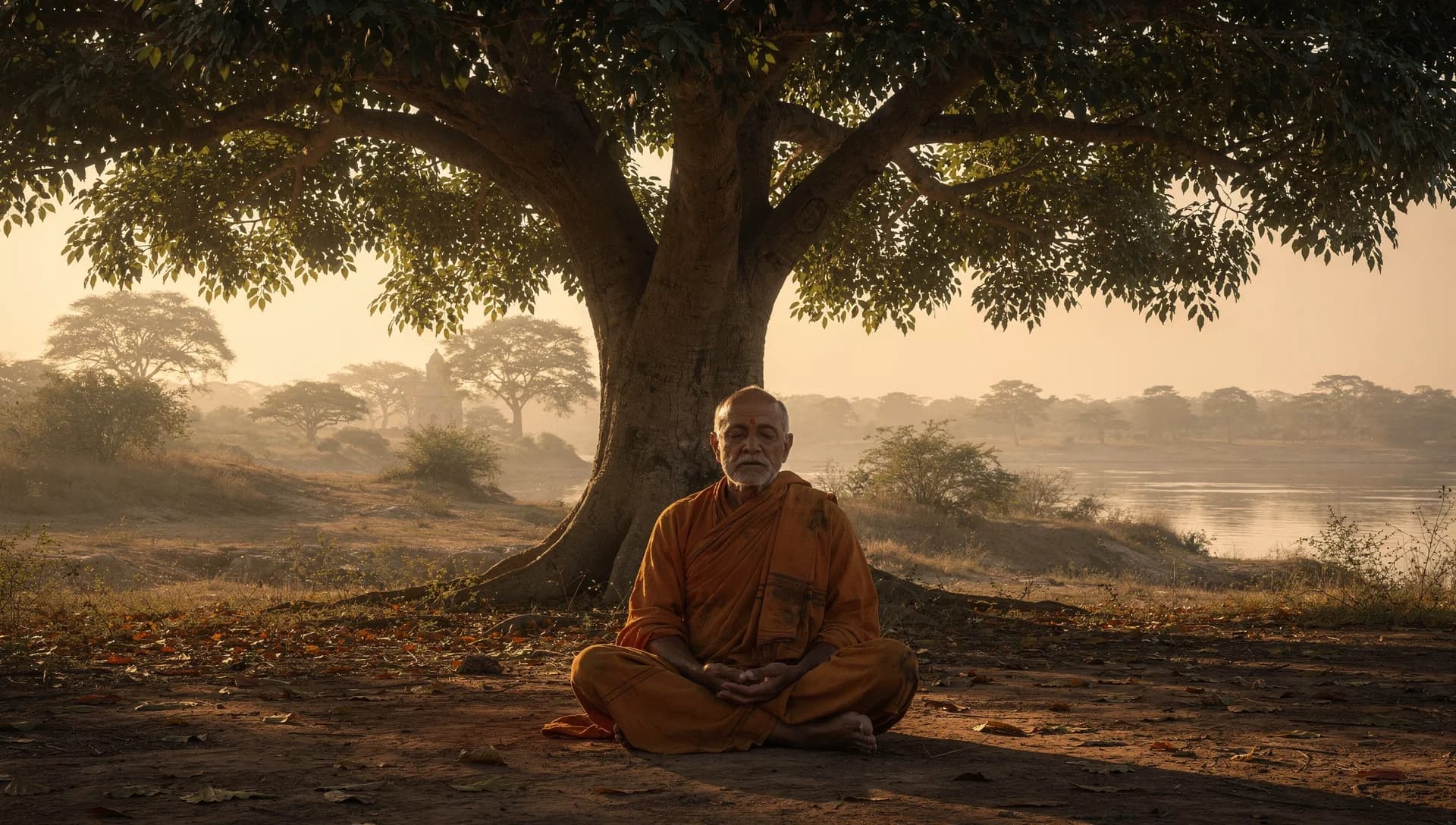
Best godless philosophy on the planet = Buddhism as spiritual philosophy without personal deity
This article expands on the decoder mapping. For the side-by-side card and quick reference, see the mapping page.
The Compliment
The Urantia Book's treatment of Buddhism is unusually balanced. It names Gautama's achievement with real respect, identifies Buddhism's preservation of Salem-derived fragments, and names the one feature Buddhism lacks. The assessment in Paper 94:8.18 is compact:
"The great truth of Siddhartha's teaching was his proclamation of a universe of absolute justice. He taught the best godless philosophy ever invented by mortal man; it was the ideal humanism and most effectively removed all grounds for superstition, magical rituals, and fear of ghosts or demons." (UB 94:8.18)
This is the most direct evaluation of a major world religion the Urantia Book offers. It is not dismissive. It is not sycophantic. It identifies an achievement ("best godless philosophy ever invented") and at the same time a limitation ("godless"). The compliment is real; the limitation is real; both are named plainly.
What the Urantia Book Says
The achievement side of the assessment is developed in Paper 94:
"Siddhartha hardly believed in the immortality of the human personality; his philosophy only provided for a sort of functional continuity. He never clearly defined what he meant to include in the doctrine of Nirvana. The fact that it could theoretically be experienced during mortal existence would indicate that it was not viewed as a state of complete annihilation." (UB 94:8.16)
"According to the original teachings of Gautama, salvation is achieved by human effort, apart from divine help; there is no place for saving faith or prayers to superhuman powers. Gautama, in his attempt to minimize the superstitions of India, endeavored to turn men away from the blatant claims of magical salvation. And in making this effort, he left the door wide open for his successors to misinterpret his teaching and to proclaim that all human striving for attainment is distasteful and painful." (UB 94:8.17)
The limitation is named:
"The great weakness in the original gospel of Buddhism was that it did not produce a religion of unselfish social service. The Buddhistic brotherhood was, for a long time, not a fraternity of believers but rather a community of student teachers. Gautama forbade their receiving money and thereby sought to prevent the growth of hierarchal tendencies." (UB 94:8.19)
The broader framework is clear. Buddhism correctly diagnosed real human problems (suffering, desire, the wheel of rebirth). Buddhism correctly identified real remedies (ethical practice, meditative cultivation, renunciation of blind craving). Buddhism correctly rejected real errors in the surrounding religious environment (Vedic ritualism, caste exclusion, magical-superstitious practice). What Buddhism did not do was identify the positive spiritual relationship with a personal Father God that the Salem tradition had originally taught.
The Urantia assessment treats this gap not as the failure of a bad religion but as the limitation of a genuinely impressive philosophical achievement. Buddhism is in the first rank of human ethical and philosophical systems; it is not in the first rank of human religious traditions in the Urantia sense of religion (which requires the personal God-relationship). The two categorizations are both accurate and neither cancels the other.
The Mahayana tradition's preservation of part of the Salem substrate is noted:
"This philosophy also held that the Buddha (divine) nature resided in all men; that man, through his own endeavors, could attain to the realization of this inner divinity. And this teaching is one of the clearest presentations of the truth of the indwelling Adjusters ever to be made by a Urantian religion." (UB 94:11.5)
The Mahayana Buddha-nature doctrine preserves, in non-theistic philosophical vocabulary, a truth the Urantia Book articulates in theistic terms (the indwelling Thought Adjuster). The two frameworks are not identical, but the Mahayana preservation is recognized as a clear preservation of a specific revealed truth, expressed in the non-theistic vocabulary that Buddhism developed.
What the Ancient Sources Say
The scholarly treatment of Buddhism's relationship to theism is complex. Traditional Western scholarship often treated Buddhism as "atheistic" or "non-theistic" in a straightforward sense, emphasizing Gautama's deliberate silence on metaphysical questions about the existence of God or gods.
More recent scholarship has complicated this reading. Richard Gombrich's What the Buddha Thought (Equinox, 2009) argues that Gautama's attitude toward theistic questions was more nuanced than the traditional atheistic framing suggests. Gautama was silent on certain metaphysical questions not because he rejected theistic claims but because he considered them distracting from the soteriological urgency of addressing suffering directly. The "unanswered questions" (avyakata) of the Pali Canon include whether there are gods, whether there is a creator, and related theistic queries.
Buddhist tradition has been consistently ambivalent about theistic categories. Theravada Buddhism maintains a relatively non-theistic framework at the philosophical level while incorporating extensive devotional practice directed toward the Buddha and the bodhisattvas. Mahayana Buddhism develops elaborate cosmological hierarchies including dharmakaya (the ultimate dharma-body of the Buddha) that function in ways structurally parallel to theistic concepts. Pure Land Buddhism (treated in the companion decoder article) is essentially devotional-theistic in practice, directing faith and prayer to Amitabha Buddha as a savior figure. Tibetan Vajrayana Buddhism has a rich pantheon of deities (though officially categorized as expressions of emptiness rather than independent supreme beings).
The scholarly recognition of Buddhism's achievement as an ethical-philosophical system is extensive. Peter Harvey's An Introduction to Buddhism (Cambridge University Press, 2013) treats the ethical teaching in depth. Damien Keown's The Nature of Buddhist Ethics (Palgrave Macmillan, 1992) argues for the sophistication of Buddhist moral philosophy and its comparability to Western virtue-ethics traditions.
The claim that Buddhism is "the best godless philosophy ever invented" is a strong evaluative claim. The Urantia Book is placing Buddhism ahead of other non-theistic systems: Confucian ethics, Stoic philosophy, modern secular humanism, Marxist materialism, and various other non-theistic moral frameworks. The comparison is implicit but the ranking is specific. Buddhism achieves the highest ethical-philosophical outcome any non-theistic framework has produced.
Why This Mapping Matters
The Urantia Book's assessment resolves a tension in the contemporary religious dialogue between Buddhism and theistic traditions. Buddhist apologists often defend Buddhism against Western critiques by pointing to its ethical depth and meditative sophistication. Theistic apologists often critique Buddhism by pointing to its lack of a personal-God framework. Both positions capture something real; neither alone is adequate.
The Urantia framework accepts both observations. Buddhism's ethical depth is genuine. Its meditative sophistication is genuine. Its preservation of specific Salem-derived truths (particularly the Mahayana Buddha-nature doctrine's parallel to the indwelling Adjuster concept) is genuine. And simultaneously, its lack of a personal-God framework is a genuine limitation, not a strength. The absence of the God-relationship limits Buddhism's capacity to facilitate the full mortal religious experience that the Urantia revelation describes.
This framework has practical implications for Buddhist practitioners and for interfaith dialogue. A Buddhist practitioner can honestly acknowledge that the tradition has produced the best non-theistic philosophical-ethical system in history. A theistic interlocutor can honestly acknowledge the same while also noting what a non-theistic framework necessarily cannot capture. The two acknowledgments are compatible; they describe the same tradition from different but both-accurate angles.
The Urantia recommendation for Buddhism is to receive the personal-God teaching the Jesus-Michael gospel represents:
"All Urantia is waiting for the proclamation of the ennobling message of Michael, unencumbered by the accumulated doctrines and dogmas of nineteen centuries of contact with the religions of evolutionary origin. The hour is striking for presenting to Buddhism, to Christianity, to Hinduism, even to the peoples of all faiths, not the gospel about Jesus, but the living, spiritual reality of the gospel of Jesus." (UB 94:12.7)
The prescription is not for Buddhists to abandon their tradition and become Christians. It is for Buddhism to receive the content it lacks (the personal-God teaching, the God-relationship) while preserving what it has achieved (the ethical depth, the meditative sophistication, the rejection of magical-superstitious practice). The fulfillment of Buddhism, on the Urantia account, is not its replacement by Christianity; it is its completion through the integration of the gospel content that Gautama almost received through the Bautan-contact moment at Benares (treated in the companion Gautama-Salem decoder article).
The mapping's significance is that it offers a way to honor Buddhism's real achievements while identifying its specific limitations and pointing toward the completion the Urantia revelation envisions. Contemporary Buddhists who encounter the Urantia Book find an assessment that is neither dismissive nor sycophantic but genuinely balanced, and that opens a clear path forward rather than requiring either the abandonment of Buddhist identity or the rejection of theistic claims.
Sources
- The Urantia Book, Paper 94 (The Melchizedek Teachings in the Orient). Urantia Foundation, first printing 1955. Cited passages: 94:8.16, 94:8.17, 94:8.18, 94:8.19, 94:11.5, 94:12.7.
- Gombrich, Richard F. What the Buddha Thought. Equinox, 2009.
- Harvey, Peter. An Introduction to Buddhism: Teachings, History and Practices. Second edition, Cambridge University Press, 2013.
- Keown, Damien. The Nature of Buddhist Ethics. Palgrave Macmillan, 1992.
- Gethin, Rupert. The Foundations of Buddhism. Oxford University Press, 1998.
- Williams, Paul. Mahayana Buddhism: The Doctrinal Foundations. Second edition, Routledge, 2009.
- Conze, Edward. Buddhism: Its Essence and Development. Revised edition, Harper & Row, 1959.
Confidence and Evidence
- Confidence: UB CONFIRMED
- Evidence rating: STRONG
- Basis: The Urantia Book evaluates Buddhism directly in Paper 94:8.18 as "the best godless philosophy ever invented by mortal man." The scholarly recognition of Buddhism's ethical-philosophical sophistication is extensive. The Urantia framework (genuine achievement plus a theological limitation) is internally coherent and matches the complex actual features of the Buddhist tradition across its major schools.
Related Decoder Articles
- Salem Gospel Almost Revived in India = Gautama Siddhartha
- Emperor Asoka = Buddhist Monarch Comparable to Ikhnaton
- Seven Adjutants / Chakras / Mother Spirit
By Derek Samaras

Connecting Articles
Two Monarchs, One Pattern: Asoka and Ikhnaton Among the Great Civil Rulers
The Prophet Who Almost Got There: Gautama Siddhartha and the Salem Gospel

Return Good for Evil: Lao-tse's Anticipation of Jesus
The Future Buddha: Maitreya and the Promise of Michael's Return
The Newsletter
Get the research behind each piece
Free. New Urantia Book explorations, the sources behind the videos, and early looks. No spam, unsubscribe anytime.
Prefer video? Follow on YouTube and Facebook.
Delivered through Substack. You can also read past issues.