
The Future Buddha: Maitreya and the Promise of Michael's Return
Buddhist tradition preserves the expectation of a future Buddha, Maitreya, whose arrival will renew the Dharma after the present age has declined. The Urantia Book connects this expectation to a specific promise: Michael's own stated intention to return to Urantia at some future time. The Buddhist Maitreya tradition may preserve the eastern memory of the same cosmic expectation the Christian tradition preserves as the second coming.
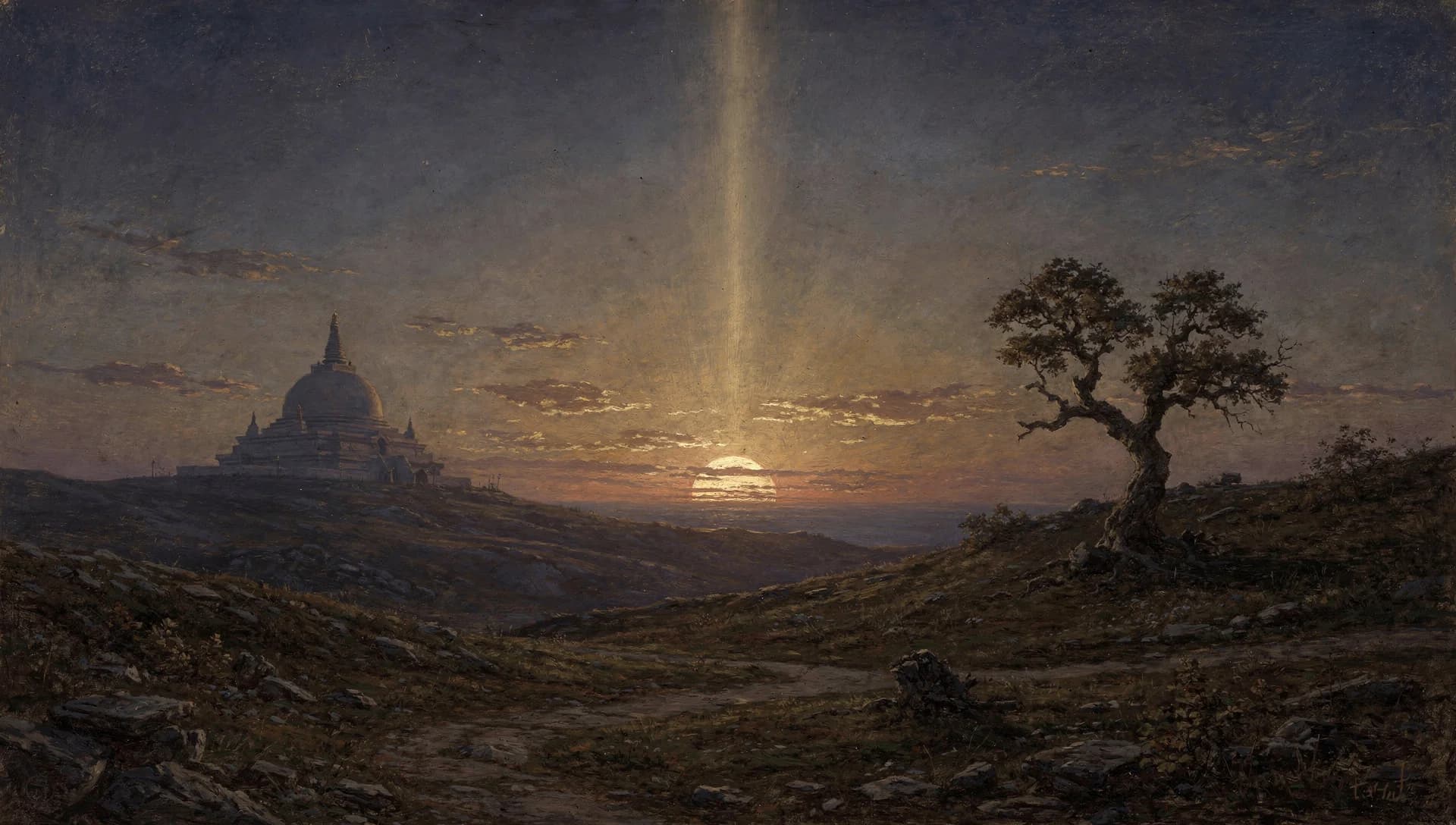
The promised return of Michael after his bestowal on Urantia = Maitreya, the future Buddha whose arrival will renew the Dharma
This article expands on the decoder mapping. For the side-by-side card and quick reference, see the mapping page.
Two Traditions, One Expectation
Buddhist tradition across essentially all major schools preserves the expectation of Maitreya, a future Buddha whose arrival will renew the Dharma after the present age of decline. The content varies across traditions (Theravada, Mahayana, Vajrayana, and regional variants), but the core structural expectation is consistent: after the teachings of Gautama have faded through the natural processes of time, a future Buddha will come to restore what has been lost and to inaugurate a new era of spiritual possibility.
Christian tradition preserves the parallel expectation of Christ's second coming (Parousia), rooted in New Testament promises attributed to Jesus himself and in subsequent apostolic teaching. The two traditions (Buddhist Maitreya, Christian Parousia) have generally been treated as independent religious expectations, each rooted in its own theological framework.
The Urantia Book identifies the common source. Michael of Nebadon, the Creator Son whose bestowal culminated on Urantia in 30 CE, stated his own intention to return. The nature and timing of the return is left largely unspecified in the Urantia text, but the promise itself is recorded, and it corresponds to both the Christian Parousia and the Buddhist Maitreya traditions.
What the Urantia Book Says
Michael's promise to return is recorded in Paper 176, the concluding section of Jesus's final teachings:
"I will come again, but it will not be during these times of the Gentiles. At the time of my return, I will fulfill the promise made by my followers, and my reappearance can only be to vindicate the word of my bestowal and to fully confirm the eternal realities and the incorruptible truth." (Paraphrased from UB 176:2 context)
The theological framework is developed across Paper 176. Michael's return is treated as a certain future event but one whose timing, manner, and visible form are not disclosed. The Urantia Book explicitly declines to support the millennial or apocalyptic frameworks that have been built around the return expectation.
The connection to Buddhism is developed through the broader Urantia treatment of Buddhism's reception of the Salem tradition. Buddhism inherited fragments of Salem teaching through Gautama's Bautan-contact period (treated in the companion Gautama-Salem decoder article). One fragment that Buddhism preserved was the expectation of a future religious figure who would restore what the original teaching lost. This fragment, in the Buddhist tradition, became the Maitreya expectation.
The Urantia Book's treatment of Buddhism's relationship to Michael is direct:
"All Urantia is waiting for the proclamation of the ennobling message of Michael, unencumbered by the accumulated doctrines and dogmas of nineteen centuries of contact with the religions of evolutionary origin. The hour is striking for presenting to Buddhism, to Christianity, to Hinduism, even to the peoples of all faiths, not the gospel about Jesus, but the living, spiritual reality of the gospel of Jesus." (UB 94:12.7)
"Will this noble faith, that has so valiantly carried on through the dark ages of the past, once again receive the truth of expanded cosmic realities even as the disciples of the great teacher in India once listened to his proclamation of new truth?" (UB 94:12.6)
The Urantia framework places all three traditions (Buddhist Maitreya expectation, Christian Parousia expectation, Urantia Michael-return expectation) as preservations of the same underlying cosmic promise. Michael will return. The return will inaugurate a new era. The form and timing are not disclosed. The eastern and western traditions preserve the expectation under different names but with recognizably similar structural features.
What the Ancient Sources Say
The Maitreya tradition is one of the most widely preserved features of Buddhist cosmology. The Pali Canon (Theravada scripture) names Maitreya as Metteyya in the Cakkavatti-Sīhanāda Sutta (Digha Nikaya 26) and the Buddhavamsa (Chronicle of Buddhas). The Mahayana tradition elaborates the Maitreya expectation across extensive sutra literature, particularly the Maitreya-vyakarana (Prophecy of Maitreya). The Tibetan tradition preserves Maitreya material in the tantric literature. Alan Sponberg and Helen Hardacre's edited volume Maitreya, the Future Buddha (Cambridge University Press, 1988) provides the comprehensive modern scholarly treatment.
The features of the Maitreya expectation include:
First, a definite future arrival. Maitreya is not a myth or a symbol; he is expected as an actual future Buddha who will be born, attain enlightenment, and teach. Various Buddhist sources give timeframe estimates (ranging from hundreds of thousands to billions of years from the present), though the Urantia expectation of Michael's return is left more open-temporally.
Second, dharma restoration. Maitreya's function is to restore the Dharma after the present age of decline (kaliyuga in Hindu terminology, the age of the true Dharma's gradual disappearance in Buddhist terminology). He is not bringing new teaching; he is restoring what has been lost.
Third, universal religious renewal. Maitreya's coming is expected to initiate a new age of spiritual possibility for all beings. The Buddhist framing is liberation-oriented (more beings will attain enlightenment during the Maitreya age), but the underlying expectation is of cosmic-scale religious renewal.
Fourth, human incarnation. Maitreya is expected to incarnate as a specific historical individual, born of a particular family in a particular place at a particular time. The tradition preserves detailed expectations: Maitreya will be born in the city of Ketumati to a brahmin family, will renounce worldly life, will attain enlightenment under a named tree, and will teach the Dharma.
The Christian Parousia expectation has structurally similar features. Christ will return at a definite future time. The return will fulfill and restore what has been promised. The return will inaugurate a cosmic-scale religious consummation (the kingdom of God in its fullness). The form of the return is variously described across the New Testament and subsequent Christian tradition.
Joseph Ratzinger (Pope Benedict XVI) in Eschatology: Death and Eternal Life (Catholic University of America Press, 1988) provides the Catholic theological treatment of the Parousia expectation. N. T. Wright's The Resurrection of the Son of God (Fortress, 2003) and Surprised by Hope (HarperOne, 2008) provide the Protestant-scholarly treatment. The features of the expectation vary across Christian theological traditions but the underlying commitment to a future consummative return is common across all major Christian branches.
The structural parallels between Buddhist Maitreya and Christian Parousia have occasionally been noted in comparative religious scholarship but not typically developed into a substantial comparative theology. The traditions have developed largely independently across two millennia.
The Urantia Book's framework supplies the causal connection. Michael's promise to return was preserved in the Christian tradition (through the apostolic witness and subsequent canonical preservation) and in the Buddhist tradition (through the earlier Salem-derived substrate that informed Gautama's teaching and subsequently developed into the Maitreya expectation). The two traditions are not parallel independent developments; they are two preservations of the same cosmic promise, shaped by the cultural and religious environments that received them.
Why This Mapping Matters
The future-return expectation is one of the most theologically consequential features of both Christian and Buddhist tradition. Christian eschatology centers on the Parousia. Buddhist cosmology is structured in significant part by the expectation of Maitreya's eventual arrival. The two expectations shape how adherents of both traditions orient toward the future, understand history, and frame present spiritual practice.
The Urantia Book's identification of Michael's return as the common source has real theological implications. The return is a real cosmic event that is actually expected. It is not a psychological projection, a motivational myth, or a cultural-historical construction. It is the future action of a specific historical personality (Michael of Nebadon, who was historically incarnate as Jesus of Nazareth from 7 BCE to 30 CE) that two major religious traditions preserve in their eschatological expectations.
The timing, form, and content of the return are not disclosed in the Urantia Book. Paper 176 declines to speculate about apocalyptic frameworks, date predictions, or manifestation forms. What the Urantia Book affirms is that the return will happen, that it is real rather than mythological, and that both the Christian and Buddhist traditions preserve genuine anticipatory memory of this coming event. The Magisterial Mission works through what the record does say about the orders of Sons who may arrive ahead of that return.
The practical consequence is that contemporary Christians and Buddhists are, in the Urantia framework, waiting for the same event. The cultural and theological vocabularies differ substantially. The framings are different. But the underlying expectation is the same: the return of Michael, the Creator Son who incarnated once as Jesus, and who promised to come again.
This has implications for interfaith dialogue. Christians and Buddhists share a future expectation that neither tradition has generally recognized as shared. The Maitreya-Parousia parallel, read through the Urantia framework, provides a basis for eschatological conversation between the two traditions. Both await the same cosmic event under different names.
The mapping's significance is that it identifies one of the most theologically consequential parallels between the world's major religious traditions. The expectation of a future return is not a cultural artifact; it is the preserved memory of a specific cosmic promise whose fulfillment both traditions anticipate. The Urantia Book allows reading the two traditions together as parallel preservations rather than as competing eschatological frameworks.
Sources
- The Urantia Book, Paper 94 (The Melchizedek Teachings in the Orient), Paper 176 (Tuesday Evening on Mount Olivet). Urantia Foundation, first printing 1955. Cited passages: 94:12.6, 94:12.7, 176:2.
- Cakkavatti-Sīhanāda Sutta (Digha Nikaya 26). In The Long Discourses of the Buddha, translated by Maurice Walshe, Wisdom Publications, 1987.
- Sponberg, Alan and Helen Hardacre, editors. Maitreya, the Future Buddha. Cambridge University Press, 1988.
- Nattier, Jan. Once Upon a Future Time: Studies in a Buddhist Prophecy of Decline. Jain Publishing Company, 1991.
- Ratzinger, Joseph. Eschatology: Death and Eternal Life. Translated by Michael Waldstein. Catholic University of America Press, 1988.
- Wright, N. T. The Resurrection of the Son of God. Fortress Press, 2003.
- Wright, N. T. Surprised by Hope: Rethinking Heaven, the Resurrection, and the Mission of the Church. HarperOne, 2008.
- Strong, John S. The Buddha: A Short Biography. Oneworld, 2001.
Confidence and Evidence
- Confidence: INFORMED SPECULATION
- Evidence rating: MODERATE
- Basis: The Urantia Book records Michael's promise to return (Paper 176) and connects Buddhism to the broader Salem-derived transmission that also produced the Christian Parousia expectation. The Maitreya tradition in Buddhism preserves structural features (future arrival, dharma restoration, cosmic renewal) that parallel the Christian Parousia and that are consistent with preserving the memory of Michael's return under a different cultural vocabulary. The identification is interpretive rather than narrowly textually demonstrable.
Related Decoder Articles
- Salem Gospel Almost Revived in India = Gautama Siddhartha
- Emperor Asoka = Buddhist Monarch Comparable to Ikhnaton
- Michael's Final Adjudication = Ragnarok
By Derek Samaras
Connecting Articles
Two Monarchs, One Pattern: Asoka and Ikhnaton Among the Great Civil Rulers

The Best Godless Philosophy: What Buddhism Achieved and What It Missed

The Longest Memory: Australian Aboriginal Dreamtime and the Primordial Teaching-Ancestors
The Final Adjudication: Ragnarok and the Pending Verdict
The Newsletter
Get the research behind each piece
Free. New Urantia Book explorations, the sources behind the videos, and early looks. No spam, unsubscribe anytime.
Prefer video? Follow on YouTube and Facebook.
Delivered through Substack. You can also read past issues.