
The Amphibious Teachers and the Green Sahara: The Dogon Nommo and the Pre-Desertification Indigo Civilization
The Dogon of Mali carry one of the most elaborate cosmologies in sub-Saharan Africa. The supreme creator Amma sends the Nommo, amphibious teachers who give humanity language, agriculture, and ritual. The Urantia Book documents the Green Sahara as the home of the indigo race's most advanced settlements. The Dogon migration path and the shape of their teachings preserve the memory of that lost civilization.
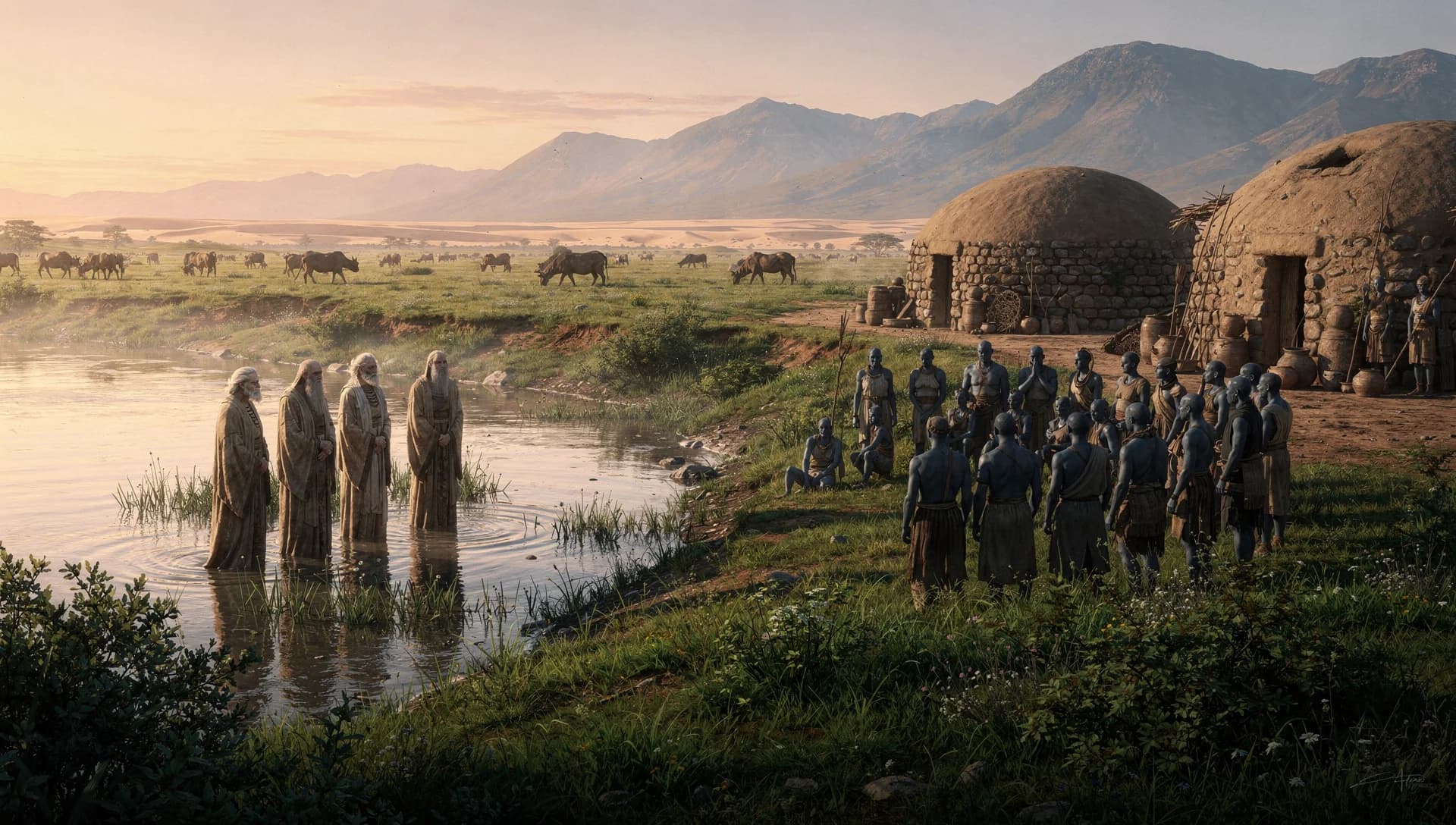
Pre-desertification Saharan indigo civilization = Dogon cosmology: Amma the creator and the Nommo who taught civilization
This article expands on the decoder mapping. For the side-by-side card and quick reference, see the mapping page.
The Dogon Anomaly
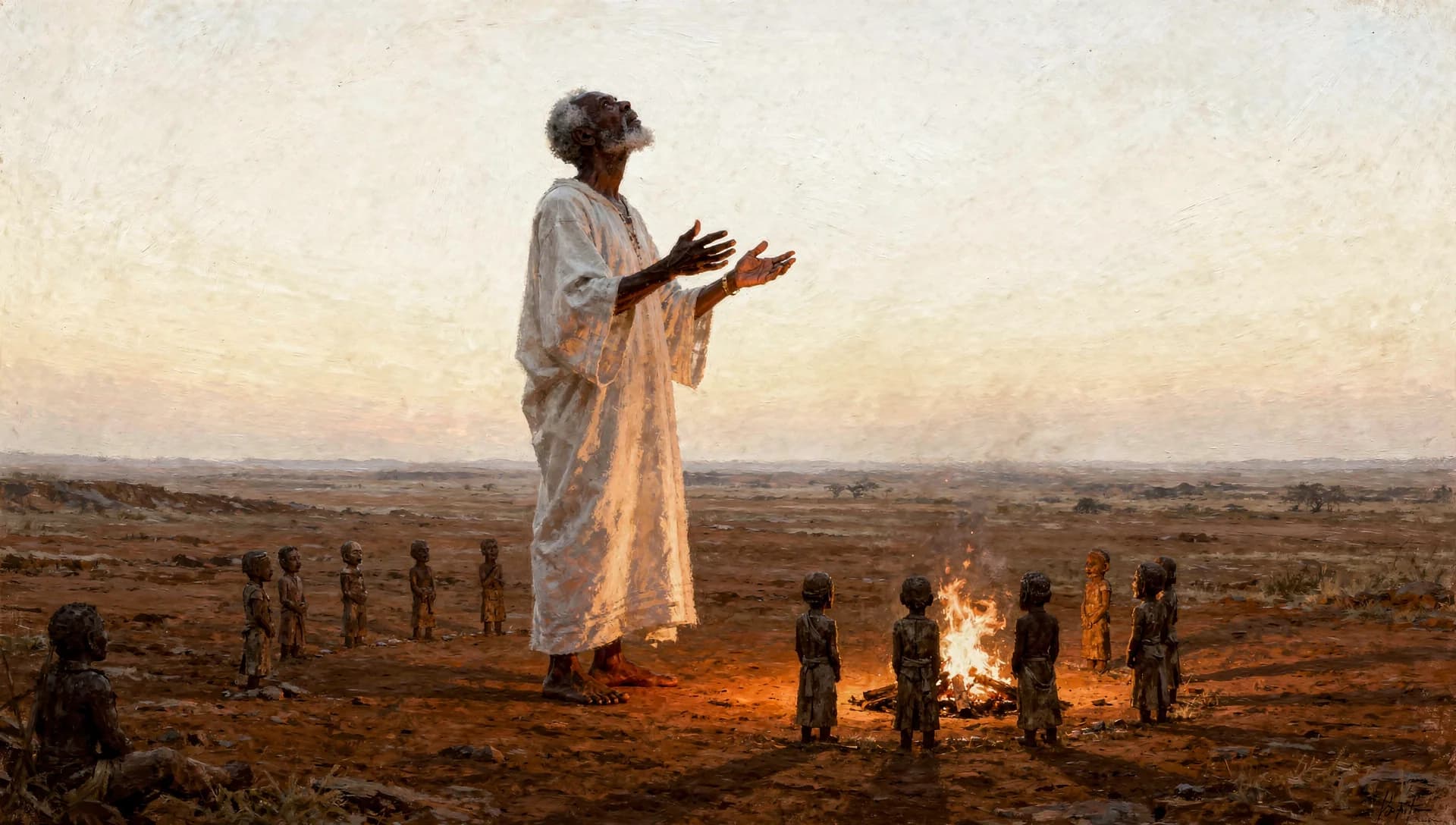
The Dogon of the Bandiagara Escarpment in Mali carry one of the most elaborate cosmological traditions anywhere in sub-Saharan Africa. Marcel Griaule worked among them for decades, and in October and November of 1946 he received a thirty-three-day initiatory instruction from a blind Dogon elder named Ogotemmêli. What Griaule recorded was a theology of remarkable depth.
Amma is the supreme creator. He is single, self-existent, the source of all being. From him the world unfolds through a generative process involving primordial seeds, cosmic eggs, and paired twin structures. From Amma proceed the Nommo, amphibious teachers who descend to earth and give humanity language, agriculture, metallurgy, and ritual.
The Dogon also preserve detailed astronomical lore. Griaule and his colleague Germaine Dieterlen reported that the Dogon spoke of Sirius as a binary star system, with the companion (Sirius B) identified with the principal granary of knowledge in the Dogon cosmogram. The astronomical claims have been contested. Walter van Beek's 1991 critique questioned Griaule's methodology and the astronomical content in particular. But the broader cosmological system Griaule documented remains the most elaborated traditional African cosmology in the ethnographic record.
The Urantia Book identifies the historical substrate.
What the Urantia Book Says
The Urantia Book documents a pre-desertification Saharan civilization of the indigo race:
"The Sahara civilization. The superior elements of the indigo race had their most progressive settlements in what is now the great Sahara desert. This indigo-black group carried extensive strains of the submerged orange and green races." (UB 78:1.10)
The Urantia Book locates the indigo race's most progressive settlements in the Sahara of that era. Those settlements correspond to what archaeology calls the Green Sahara period.
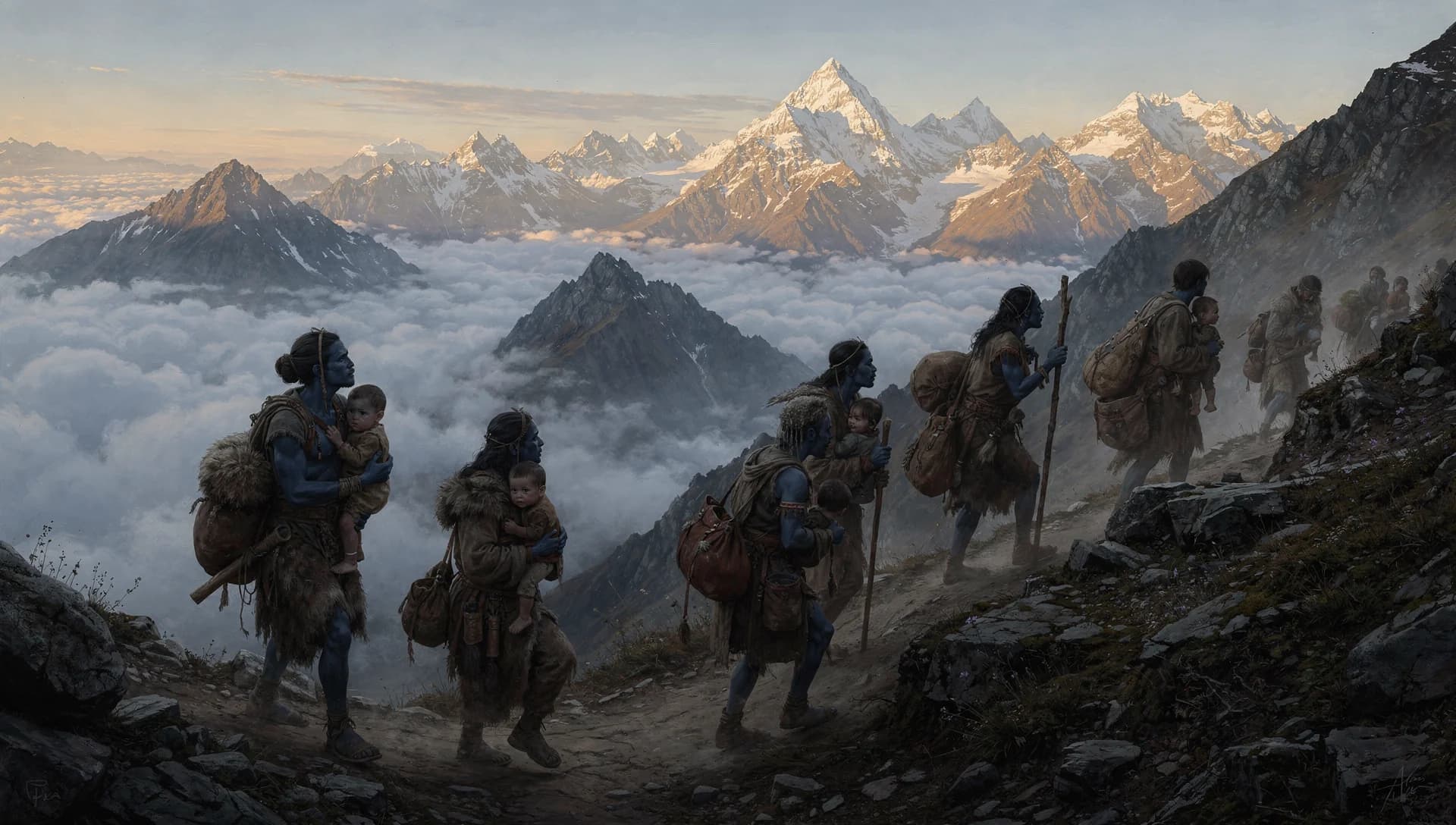
Across UB 78 through 80 the Saharan civilization is described as scattering under climatic pressure and population movement. The Green Sahara period is archaeologically dated roughly 10,500 BCE through 5,500 BCE, with desertification completing around 3,500 BCE. That timing lines up with the archaeological record of significant southward migration from the Sahara into the Sahel and the lands beyond.
The indigo cultural center identified by the Urantia Book matches the archaeology of the Green Sahara: the rock art of the Tassili n'Ajjer in southern Algeria and the Ennedi in Chad, documenting sophisticated herding, fishing, and ceremonial life across what was once a habitable region.
The teaching pattern the Dogon preserve, with the Nommo descending from Amma to instruct humanity, parallels the structure the Urantia Book documents at Dalamatia, where the Prince's corporeal staff descended to teach primitive humanity the arts of civilization. The Dogon migration out of the Sahara southward into the Mande region of West Africa represents the carrying of that older Saharan substrate into their present geography.
What the Ancient Sources Say
The Dogon cosmological tradition is documented primarily through the work of Marcel Griaule and his collaborators at the Institut d'Ethnologie de Paris, across the 1930s through the 1950s.
Dieu d'eau: Entretiens avec Ogotemmêli (Griaule, Éditions du Chêne, 1948; English translation Conversations with Ogotemmêli, Oxford University Press, 1965) is Griaule's first-person account of the thirty-three-day instruction he received from Ogotemmêli in autumn 1946. The text presents the Dogon creation narrative in its full elaborated form: Amma's creation through the yala (primordial seeds), the establishment of cosmic order through paired twin structures, the descent of the Nommo to teach humanity.
Le Renard pâle (Griaule and Dieterlen, Institut d'Ethnologie, 1965; English translation The Pale Fox, Afrikan World Books, 1986) is the collaborative final synthesis of Griaule and Dieterlen's Dogon fieldwork. It treats the full cosmological system with detailed attention to the astronomical content and the granary structure that organizes Dogon knowledge.
Germaine Dieterlen's earlier Les âmes des Dogons (Institut d'Ethnologie, 1941) had established the ethnographic baseline. Her continued fieldwork through the 1950s and 1960s extended the Griaule documentation.
Walter van Beek's "Dogon Restudied: A Field Evaluation of the Work of Marcel Griaule" (Current Anthropology 32, 1991) raised methodological questions about the Griaule-Dieterlen documentation, especially regarding the astronomical content. Van Beek's restudy in the Dogon villages in the 1980s found many informants unfamiliar with the elaborated cosmology Griaule had recorded. The question is whether that content was representative of general Dogon knowledge, or restricted to the initiated-elder stratum Griaule had access to.
Scholarly opinion remains divided. Laird Scranton's The Science of the Dogon (Inner Traditions, 2006) and his subsequent work argue for the substantive reality of the Dogon cosmological content and its connection to an older Egyptian substrate. Robert Temple's The Sirius Mystery (St. Martin's, 1976) argued controversially for extraterrestrial transmission of the astronomical content. The Urantia Book does not support that reading. Its account is of human civilizations from before the rebellion, not of extraterrestrial visitors.
The structural features the Dogon tradition preserves, and which map onto the Urantia framework, are these.
First, the supreme creator plus descended teachers. Amma is the single supreme creator. The Nommo are the descended teachers who bring civilization to humanity. This two-tier structure matches the Urantia Book's Dalamatian cosmology, where the Universal Father stands above and the Prince's corporeal staff carries the work of teaching.
Second, the amphibious Nommo. They are described as beings associated with water, fish, and aquatic habitats. Their descent from Amma is often described as a descent through water or from a watery primordial environment. The Urantia Book's first Garden of Eden was a landscape of water and rivers, and the Prince's staff carried agricultural and water-related knowledge.
Third, the teaching content. The Nommo teach language, agriculture, metallurgy, calendrical science, and ritual. That curriculum maps closely onto the ten councils of the Prince's corporeal staff: agriculture, animal husbandry, arts and crafts, commerce, religion, health, family, education, industry, and tribal government.
Fourth, the systematic cosmogram. The Dogon preserve their cosmological content in formal architecture. The granary of knowledge organizes the material into a system with mathematical and spatial relationships. That kind of systematic form parallels the institutional school the Urantia Book documents at Dalamatia.
Why This Mapping Matters
The Dogon tradition matters for Urantia mapping because it preserves systematic content. Most traditional religions carry shapes and stories. The Dogon carry an architecture: supreme Amma, descended Nommo, formal cosmogram. That kind of structure asks for an institutional preservation mechanism, not just folkloric survival.
The Urantia Book supplies that mechanism. The Green Sahara indigo civilization preserved, in institutional form, substantial cultural content from the older pre-rebellion and Adamic-era substrate. When the Sahara dried, the Dogon ancestors carried that content southward into the Mande region, where it survived across subsequent millennia in the elder-initiation stratum Griaule eventually accessed.
The difficult conditions of preservation account for the partial survival pattern. After desertification came displacement, then cultural pressure from neighboring groups, then a transmission restricted to initiated elders rather than spread broadly. So the systematic content survived in the elder knowledge but did not permeate the broader Dogon cultural practice uniformly. Van Beek's critique captures this feature accurately. The content Griaule documented was real, but it was restricted, and it was not uniformly known across the Dogon population.
The Saharan origin has archaeological correlates. The Green Sahara period (roughly 10,500 BCE through 5,500 BCE) is documented as a time of sophisticated cultural development. The Kiffian and Tenerian cultures of the Gobero region in Niger, excavated by Paul Sereno between 2000 and 2006, reveal settled populations across the pre-desertification Sahara. The rock art of Tassili n'Ajjer, Ennedi, and Acacus documents progressive cultural development across the period. The subsequent desertification and southward migration is the archaeological pathway the Urantia Book's framework identifies as the Dogon ancestral route.
The Dogon are not unique in this. The pattern of a Saharan civilization scattering into the Sahel and beyond is archaeologically broad. Parallel preservations of Saharan cultural content may exist across other West African traditional religions: the Mande cosmology of the Bambara, the Wolof traditional religion of Senegambia, the Soninke traditions of the Ghana Empire substrate. The Dogon preserved with more system than these others. But the shared substrate, a pre-desertification Saharan indigo civilization, is consistent across the broader West African field.
The contested astronomical content has its own implications. The Urantia Book documents pre-rebellion Dalamatian astronomical knowledge (66:7.17, 77:2.11-12) that significantly exceeded what primitive evolutionary humanity could have developed on its own. The Dogon preservation of sophisticated astronomical material, whatever its specific accuracy regarding Sirius B, preserves the memory of an older astronomical tradition consistent with the Urantia Book's Dalamatian substrate, carried through Saharan cultural continuity into Dogon institutional life. The mapping does not require accepting Temple's or Scranton's extraterrestrial readings. The Urantia framework supplies a human historical transmission mechanism that is more parsimonious and is supported by the archaeological record of Saharan cultural continuity.
Sources
- The Urantia Book, Paper 64 (The Evolutionary Races of Color), Paper 78 (The Violet Race After the Days of Adam), Paper 80 (Andite Expansion in the Occident). Urantia Foundation, first printing 1955. Cited passages: 64:6.29-31, 78:1.10, 80:1.5.
- Griaule, Marcel. Dieu d'eau: Entretiens avec Ogotemmêli. Éditions du Chêne, 1948. English translation: Conversations with Ogotemmêli, Oxford University Press, 1965.
- Griaule, Marcel and Germaine Dieterlen. Le Renard pâle. Institut d'Ethnologie, 1965. English translation: The Pale Fox, Afrikan World Books, 1986.
- Dieterlen, Germaine. Les âmes des Dogons. Institut d'Ethnologie, 1941.
- van Beek, Walter E. A. "Dogon Restudied: A Field Evaluation of the Work of Marcel Griaule." Current Anthropology 32, no. 2, 1991.
- Sereno, Paul C. et al. "Lakeside Cemeteries in the Sahara: 5000 Years of Holocene Population and Environmental Change." PLoS ONE 3, no. 8, 2008.
- Ehret, Christopher. The Civilizations of Africa: A History to 1800. University Press of Virginia, 2002.
- Mbiti, John S. African Religions and Philosophy. Heinemann, 1969; second edition 1990.
Confidence and Evidence
- Confidence: INFORMED SPECULATION
- Evidence rating: MODERATE
- Basis: The Urantia Book directly documents the indigo-race pre-desertification Saharan civilization. The archaeological record of the Green Sahara period and the subsequent desertification-driven southward migration is well-established. The Dogon cosmological preservation of a systematic structure of a supreme creator plus descended teachers matches the UB's Dalamatian substrate. Methodological questions about the astronomical content (van Beek 1991) do not substantially affect the mapping of the broader systematic-religious content.
Related Decoder Articles
- African High-God = Salem Monotheism Layer
- Corporeal Staff = Anunnaki Council
- The 132 Andite Sailors = Quetzalcoatl
Byline: Derek Samaras | Urantia Book Network | April 2026
Connecting Articles
The Sky God Who Withdrew: African High-God Traditions and the Salem Teaching Layer
We Came From the North: Pan-African Origin Traditions and the Indigo Migration Path
The Longest Memory: Australian Aboriginal Dreamtime and the Primordial Teaching-Ancestors
The Final Adjudication: Ragnarok and the Pending Verdict
The Newsletter
Get the research behind each piece
Free. New Urantia Book explorations, the sources behind the videos, and early looks. No spam, unsubscribe anytime.
Prefer video? Follow on YouTube and Facebook.
Delivered through Substack. You can also read past issues.