
Humanity Came From the Mountains: Himalayan Origin Traditions and the Andonic Homeland
Tibetan, Nepalese, and Bhutanese traditions place the origin of humanity in the high Himalayan valleys. The Urantia Book records that Andon and Fonta, the first human pair, emerged roughly 993,419 years ago in the southern Himalayan highlands, and that the Badonan tribes northwest of India carried the earliest human culture forward. The Himalayan origin traditions map onto a geographic claim the Urantia revelation documents directly.
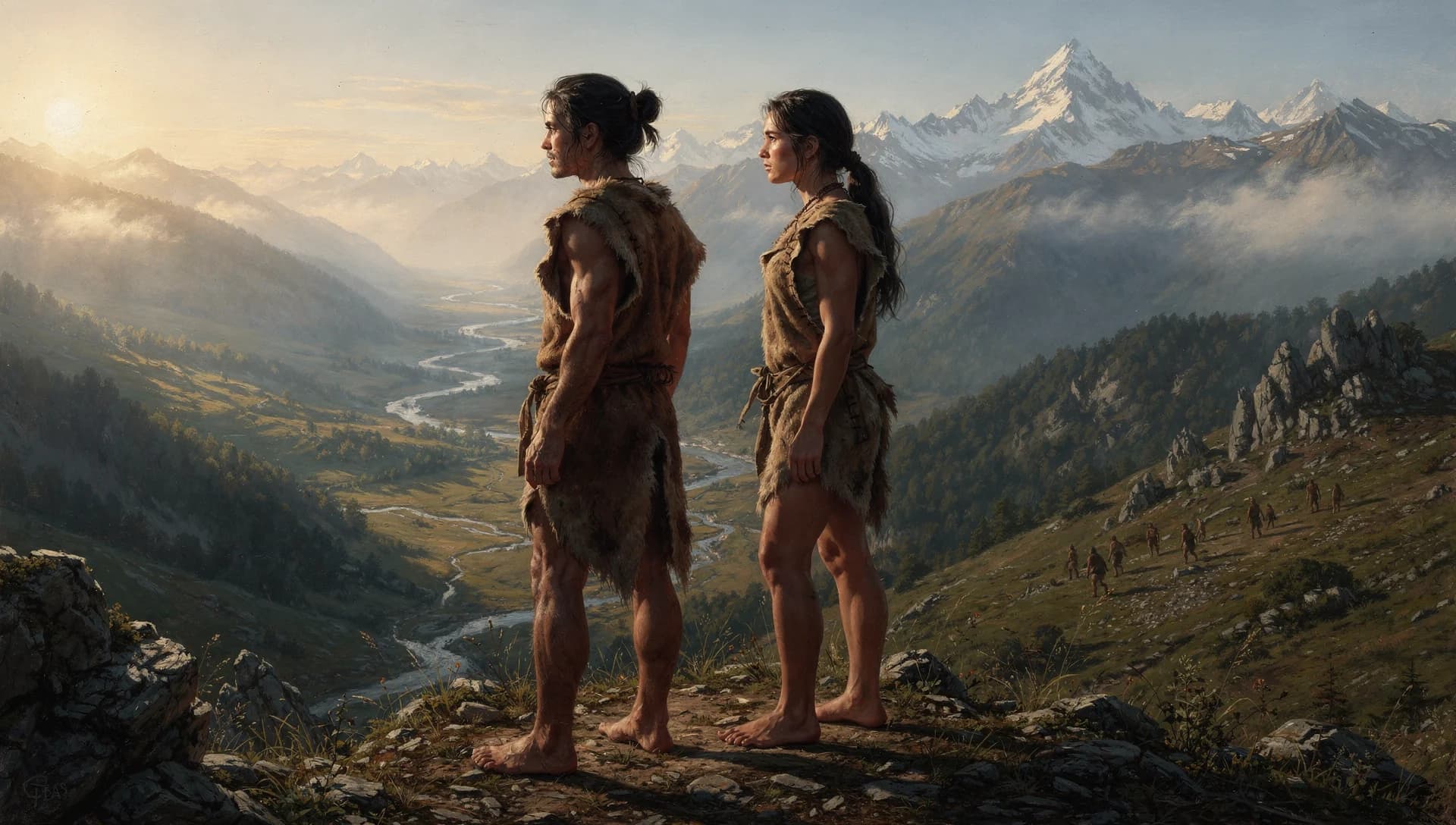
Andonic and Badonan Himalayan highland homeland = Himalayan creation traditions placing humanity's origin in the mountains
This article expands on the decoder mapping. For the side-by-side card and quick reference, see the mapping page.
The Himalayan Origin Pattern
A particular kind of origin story keeps showing up in the religious traditions of the Himalayan region. Humanity began in the mountains themselves, not by descending from the sky and not by climbing up from the underworld.
The Tibetan tradition traces the Tibetan people to a union on Gangpori, a sacred mountain in the Yarlung Valley, between a compassionate monkey ancestor (later identified as an emanation of Avalokiteshvara) and a mountain ogress. Nepalese traditions among the Newar, Sherpa, and Magar preserve mountain-origin accounts for their founding ancestors. Bhutanese tradition keeps Himalayan first-ancestor stories embedded in the broader Bön and Buddhist cosmology.
This pattern stands out from the more common shapes of origin myth. Most world traditions place the beginning of humanity in a paradisal garden (the Hebrew Eden, the Sumerian Dilmun, the Greek Golden Age plain), or in a celestial descent (the Norse gods producing humanity, the Maori sky father and earth mother), or in an emergence from below the ground (the Pueblo and Hopi sipapu, the Japanese cave origin), or in a first family on an open plain (most African traditions). The high mountain origin is its own thing, and the Urantia Book explains why.
What the Urantia Book Says
The Urantia Book places the origin of the first human pair in the southern Himalayan highlands. Andon and Fonta, the first human beings, emerged as twin offspring of pre-human parents:
"Man-mind has appeared on 606 of Satania, and these parents of the new race shall be called Andon and Fonta. And all archangels pray that these creatures may speedily be endowed with the personal indwelling of the gift of the spirit of the Universal Father." (63:0.2)
Their character is described as remarkable:
"In many respects, Andon and Fonta were the most remarkable pair of human beings that have ever lived on the face of the earth. This wonderful pair, the actual parents of all mankind, were in every way superior to many of their immediate descendants, and they were radically different from all of their ancestors, both immediate and remote." (63:1.1)
The twins eventually fled north from their original tribal territory:
"After Andon and Fonta had decided to flee northward, they succumbed to their fears for a time, especially the fear of displeasing their father and immediate family. They envisaged being set upon by hostile relatives and thus recognized the possibility of meeting death at the hands of their already jealous tribesmen." (63:2.1)
The Badonan tribes carried the original Andonic culture forward in the Himalayan highlands across long ages:
"During this long period of cultural decadence the Foxhall peoples of England and the Badonan tribes northwest of India continued to hold on to some of the traditions of Andon and certain remnants of the culture of Onagar." (64:2.4)
"Besides the Foxhall peoples in the west, another struggling center of culture persisted in the east. This group was located in the foothills of the northwestern Indian highlands among the tribes of Badonan, a great-great-grandson of Andon. These people were the only descendants of Andon who never practiced human sacrifice." (64:3.1)
The six Sangik races also originated within this same Himalayan zone:
"And now, among these highland Badonites there was a new and strange occurrence. A man and woman living in the northeastern part of the then inhabited highland region began suddenly to produce a family of unusually intelligent children. This was the Sangik family, the ancestors of all of the six colored races of Urantia." (64:5.2)
The Urantia Book also points to the regional fossil record:
"To the east of the Badonan peoples, in the Siwalik Hills of northern India, may be found fossils that approach nearer to transition types between man and the various prehuman groups than any others on earth." (64:3.4)
So the Urantia Book locates three connected events in one geographic zone: the appearance of the first human pair, the long Badonan cultural continuity, and the eventual Sangik racial origin. The mountain-origin traditions of the region preserve genuine memory of where humanity actually began.
What the Ancient Sources Say
The Tibetan mountain-origin tradition is preserved in the rGyal-rabs gsal-ba'i me-long (Clear Mirror of Royal Genealogies, fourteenth century CE) and in earlier manuscripts recovered from Dunhuang (ninth to eleventh centuries CE). The tradition locates the origin of the Tibetan people at Gangpori, a sacred mountain in the Yarlung Valley of central Tibet. The monkey ancestor (later identified as an emanation of the bodhisattva Avalokiteshvara) and the mountain ogress (rakshasi) produced six offspring, who became the founders of the Tibetan clans.
The cave associated with this account, the Zo-thang cave on Gangpori, is a real geographic site that has served as a pilgrimage destination throughout Tibetan history. The continuous identification of a physical origin site preserves cultural memory across deep time.
Alexander W. Macdonald's ethnographic fieldwork, collected in Essays on the Ethnology of Nepal and South Asia (Ratna Pustak Bhandar, 1975), recorded mountain-origin traditions across the Nepal, Tibet, and Bhutan cultural zone. Macdonald's documentation establishes the pattern as a distinctive feature of Himalayan religion in its own right, not as something imported from the surrounding regions.
Charles Ramble's The Navel of the Demoness: Tibetan Buddhism and Civil Religion in Highland Nepal (Oxford University Press, 2008) traces the same pattern across highland Nepalese populations, showing how the mountain-origin layer sits beneath the later Buddhist and Bön overlays.
The Newar origin traditions of the Kathmandu Valley, documented in David Gellner's Monk, Householder, and Tantric Priest (Cambridge University Press, 1992), keep the Himalayan geographic content. Newar first ancestors emerge at sacred sites in and around the valley.
The Sherpa account places the people's origin in the high Himalayan slopes and records a migration from the Tibetan plateau into the Solu-Khumbu region. Sherry Ortner's Sherpas Through Their Rituals (Cambridge University Press, 1978) documents the narratives and connects them to the broader Tibetan and Himalayan cosmology.
Comparative scholarship has long noted how unusual the mountain-origin pattern is against the wider Eurasian backdrop. Joseph Campbell's treatment in The Masks of God identified the mountain origin as characteristic of highland cultures, in contrast to the garden-origin and plain-emergence patterns that tend to come from cultures of the lowlands.
The archaeological evidence for early human presence in the Himalayan and Siwalik region is substantial. The Siwalik Hills, the foothill range that runs along the Himalayan front from Pakistan through India and into Nepal, have yielded extensive deposits of pre-human and early-human fossils. Ramapithecus and Sivapithecus fossils from the Siwaliks (first identified by Edward Lewis in 1934 and elaborated through decades of paleoanthropological work) document Miocene-era higher primates in the region. Later evidence from the Soan Valley Paleolithic tool industry, documented by Hellmut de Terra and T. T. Paterson in the 1930s through the 1950s, establishes early human occupation of the northwestern Indian highlands across the Lower Paleolithic.
Clifford Jolly's Ramapithecus: The Tooth That Roared (1970) and the subsequent literature traced the complicated taxonomic history of the Siwalik hominid fossils. The Urantia Book's claim that the region preserves transitional hominid forms (64:3.4) is consistent with what the Siwalik fossil record shows, although the dates in the Urantia account and the dates in mainstream paleoanthropology differ substantially.
Why This Mapping Matters
The Himalayan mountain-origin tradition preserves accurate geographic content. It points to the same place the Urantia Book identifies as the actual cradle of humanity. The high mountain origin is unusual enough among world traditions that the match with the Urantia Book's geography carries real weight.
The Urantia Book provides a historical substrate for these traditions. The first human pair, Andon and Fonta, emerged in the southern Himalayan highlands roughly 993,419 years ago (62:5.1). The Badonan tribes carried the earliest human culture forward across roughly 500,000 years of life in those same highlands. The Sangik family appeared in the same zone, and from it the six colored races dispersed across the continents. The Himalayan origin traditions, preserved across the region's cultures, look like continuous geographic and cultural memory reaching back across enormous time.
The distinctive shape of Himalayan origin religion takes on particular significance in this framework. Most of the world places humanity's beginning in a garden, a sky descent, or an underground emergence. The mountain origin belongs to the Himalayan zone in a special way. The Urantia Book's mountain claim at 63:1 and 64:3 matches that regional pattern in a way that a garden or plain origin simply could not.
The twin pair at the heart of the Urantia account also has cross-cultural correlates. Andon and Fonta are twin brother and sister (63:0.2). The Tibetan account also presents a pair, the monkey ancestor and the mountain ogress, rather than a solitary first ancestor. The Tibetan tradition further preserves six offspring from that original pair, which parallels the six Sangik children the Urantia Book describes at 64:5.2. The structural overlap is substantial.
The cultural continuity carried by the Badonan tribes also shows up in the region's later religious life. The Urantia Book records that the Badonans were the only descendants of Andon who never practiced human sacrifice (64:3.1). That ethical line resonates with the strong emphasis on non-violence (ahimsa) that runs through the Buddhist, Bön, and Hindu traditions of the Himalayas. The later religious culture of the region looks consistent with the older Badonan substrate.
The archaeological record offers physical corroboration of the broader claim. The Siwalik fossils, the Soan Paleolithic tool industry, and the wider northwestern Indian paleoanthropological record establish the region as a genuinely significant location in human evolutionary history, which lines up with the Urantia Book's identification of the same area as the Andonic, Badonan, and Sangik origin zone.
The point of the mapping is this. Himalayan mountain-origin traditions are not just colorful local mythology. They are continuous geographic memory that reaches back to the actual origin of humanity in the southern Himalayan highlands. The Urantia revelation reads them as accurate historical geography.
Sources
- The Urantia Book, Paper 63 (The First Human Family), Paper 64 (The Evolutionary Races of Color). Urantia Foundation, first printing 1955. Cited passages: 63:0.2, 63:1.1, 63:2.1, 64:2.4, 64:3.1, 64:3.4, 64:5.2.
- Macdonald, Alexander W. Essays on the Ethnology of Nepal and South Asia. Ratna Pustak Bhandar, 1975.
- Ramble, Charles. The Navel of the Demoness: Tibetan Buddhism and Civil Religion in Highland Nepal. Oxford University Press, 2008.
- Gellner, David. Monk, Householder, and Tantric Priest: Newar Buddhism and Its Hierarchy of Ritual. Cambridge University Press, 1992.
- Ortner, Sherry B. Sherpas Through Their Rituals. Cambridge University Press, 1978.
- Sonam Gyaltsen. rGyal-rabs gsal-ba'i me-long. Translated by Per K. Sorensen as The Mirror Illuminating the Royal Genealogies, Harrassowitz, 1994.
- Lewis, Edward. "Preliminary Notice of New Man-Like Apes from India." American Journal of Science 27, 1934.
- Pilbeam, David. "New Hominoid Primates from the Siwaliks of Pakistan and Their Bearing on Hominoid Evolution." Nature 295, 1982.
- de Terra, Hellmut and T. T. Paterson. Studies on the Ice Age in India and Associated Human Cultures. Carnegie Institution, 1939.
Confidence and Evidence
- Confidence: UB CONFIRMED
- Evidence rating: MODERATE
- Basis: The Urantia Book directly documents the Himalayan highland origin of humanity at UB 63:0.2, 63:1.1, 64:3.1, and 64:5.2. The mountain-origin traditions across Tibetan, Nepalese, and Bhutanese cultures preserve distinctive content that matches the geographic claim. The Siwalik paleoanthropological record offers archaeological corroboration of the broader picture. The distinctive mountain-origin pattern sets the Himalayan traditions apart from the wider world of origin narratives.
Related Decoder Articles
- African First Family = Sangik Origin
- Adam's Sons = Adapa and the First Couple
- Bön Shenrab = Pre-Buddhist Salem Layer
Byline: Derek Samaras | Urantia Book Network | April 2026
Connecting Articles

We Come From One: African First-Family Traditions and the Sangik Origin
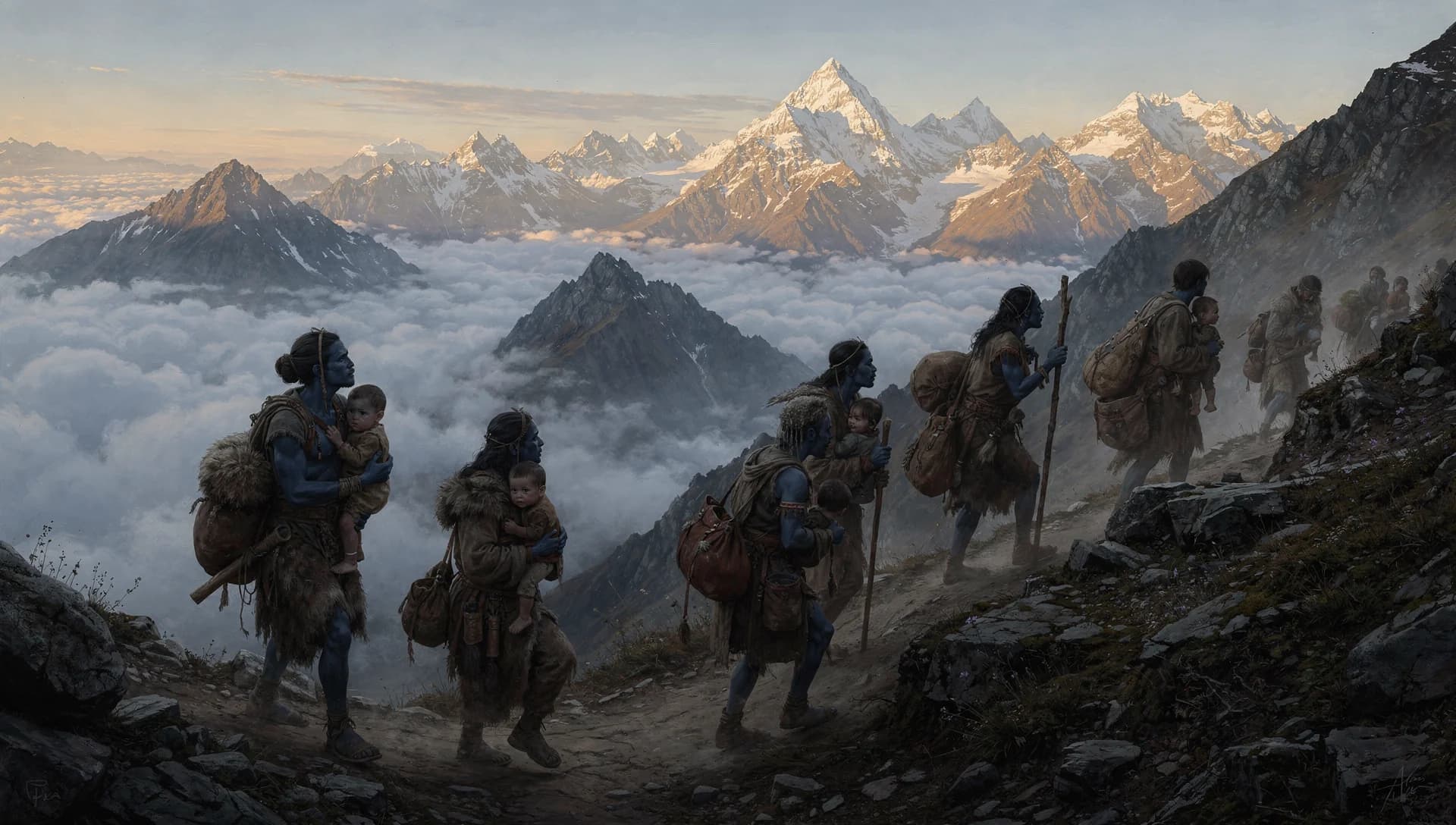
We Came From the North: Pan-African Origin Traditions and the Indigo Migration Path
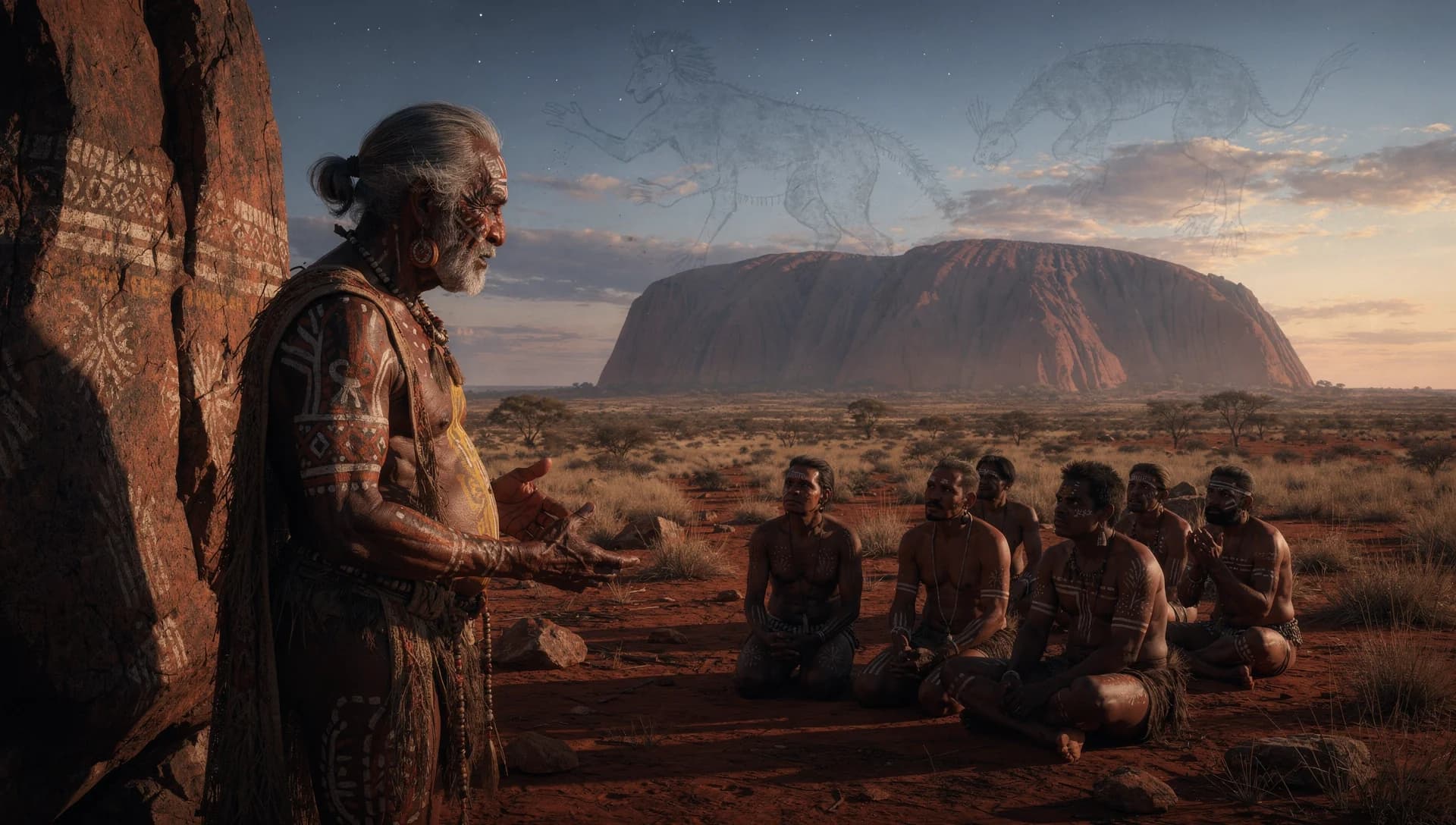
The Longest Memory: Australian Aboriginal Dreamtime and the Primordial Teaching-Ancestors

The Final Adjudication: Ragnarok and the Pending Verdict
The Newsletter
Get the research behind each piece
Free. New Urantia Book explorations, the sources behind the videos, and early looks. No spam, unsubscribe anytime.
Prefer video? Follow on YouTube and Facebook.
Delivered through Substack. You can also read past issues.