
 Mythic
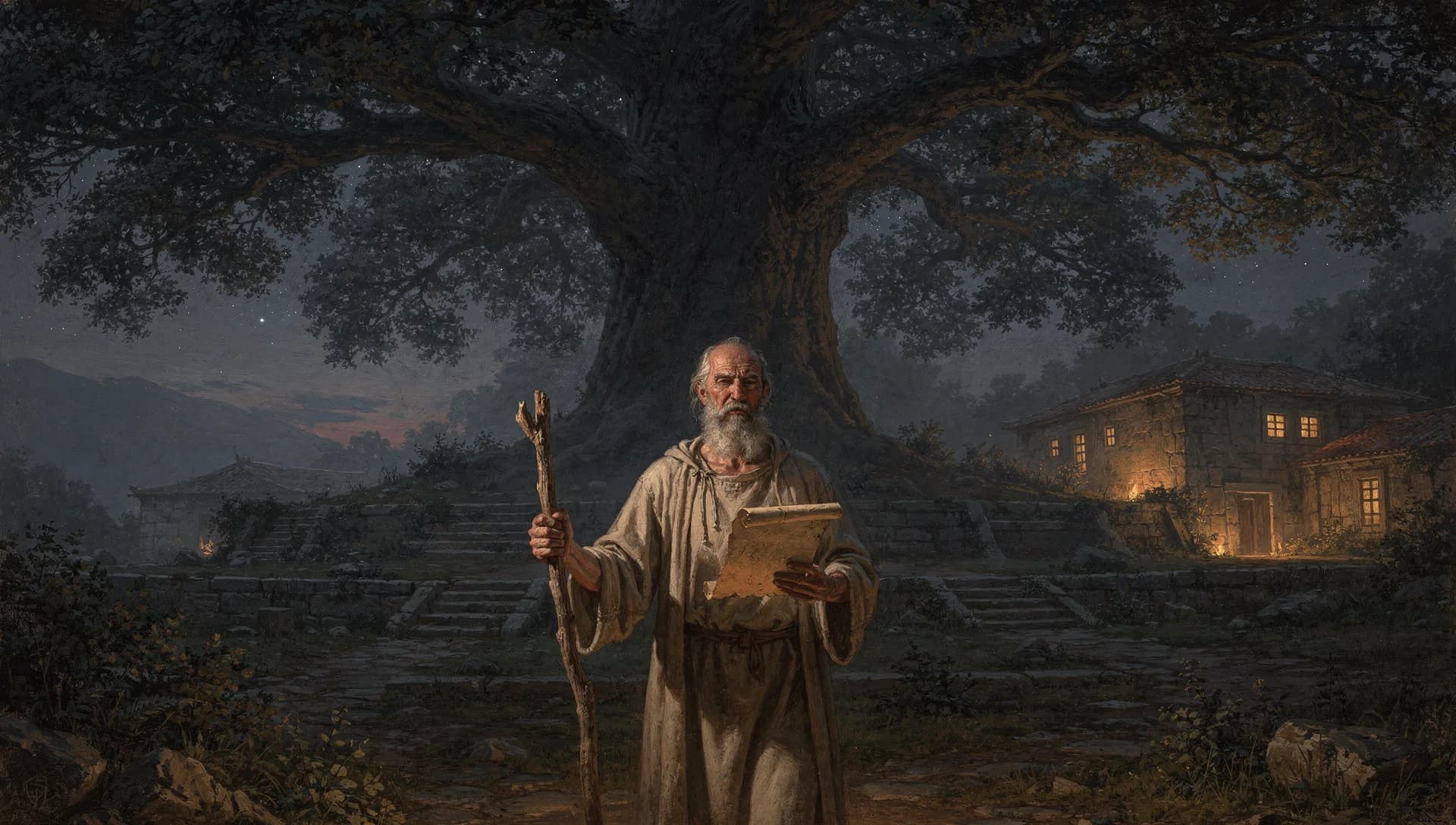
Odin, self-hung on Yggdrasil, the World Tree (Norse)
 UB
UBVan, sustained by the Tree of Life for 150,000 years
Full Article
Read the deep-dive article on this connection
Van, sustained by the Tree of Life for 150,000 years = Odin, self-hung on Yggdrasil, the World Tree (Norse)
The Connection
Odin hangs himself on Yggdrasil for nine nights, wounded, sustaining himself through a prolonged ordeal at the sacred tree to gain transcendent wisdom. Van is sustained by the Tree of Life for over 150,000 years while maintaining cosmic order against the rebel Caligastia. The parallel is precise: a supreme loyalist figure defined by an extended, deliberate relationship with a world tree, emerging as the keeper of cosmic knowledge and civilization.
UB Citation
UB 66:4.13, 67:6.4, 73:6.5
Academic Source
Hávamál 138-139 (Poetic Edda); Lindow, Norse Mythology: A Guide to Gods, Heroes, Rituals, and Beliefs (2001)
Historical Evidence(Moderate evidence)
Hávamál 138-139 records Odin speaking: "I know that I hung on a windy tree nine long nights, wounded with a spear, dedicated to Odin, myself to myself, on that tree of which no man knows from where its roots run." John Lindow (UC Berkeley) identifies this as Odin's definitive act of self-sacrifice for cosmic wisdom, noting Yggdrasil is "the center of the cosmos." UB 67:6.4 states Van and Amadon were "sustained by the technique of the tree of life in conjunction with the specialized life ministry of the Melchizedeks for over one hundred and fifty thousand years." The sustained vigil at a world tree, yielding transcendent knowledge and cosmic guardianship, is structurally identical across both accounts.
Deep Dive
Stanza 138 of the Havamal, in the Poetic Edda, gives Odin's first-person account of his cosmic ordeal. Carolyne Larrington's Oxford translation (1996; revised 2014) renders the passage as a self-hanging on a windy tree for nine nights, wounded with a spear, given to Odin, himself to himself, on the tree whose roots no one knows. The next stanza, 139, has Odin describe his receipt of the runes through this ordeal, the foundational knowledge that gives him his cosmic authority. The myth is foundational to the Odinic tradition: the All-Father obtains his sovereignty not through inherited authority but through prolonged self-sacrifice at the world-tree, an act of will that puts him in possession of the cosmic order's deepest secrets.
The Urantia Book gives us, in the long story of Van and Amadon across Papers 67 and 73, a structurally identical figure. Van was the chairman of the supreme council of co-ordination during the Caligastia administration. When the Lucifer rebellion broke out, Van refused. Paper 67:3.5 records that "upon the outbreak of rebellion, loyal cherubim and seraphim, with the aid of three faithful midwayers, assumed the custody of the tree of life and permitted only the forty loyalists of the staff and their associated modified mortals to partake of the fruit and leaves of this energy plant." Paper 67:6.4 records the duration of Van's subsequent vigil: "Van was left on Urantia until the time of Adam, remaining as titular head of all superhuman personalities functioning on the planet. He and Amadon were sustained by the technique of the tree of life in conjunction with the specialized life ministry of the Melchizedeks for over one hundred and fifty thousand years."
The structural match with the Odinic ordeal is precise on several points. First, both Van and Odin are sustained at a sacred tree for an extended period that defines them. Odin's nine nights are the symbolic duration of the ordeal in mythological time; Van's hundred and fifty thousand years are the literal duration of the loyal remnant's sustained presence at the post-rebellion site. Cultural memory does not preserve numerical specificity across such time-scales; the "nine nights" is the kind of stylized number that mythological tradition uses to encode an extended duration. Second, both are sustained by the tree itself, in a relationship that is more than ordinary nourishment. Odin is wounded and given to the tree; Van and Amadon are sustained by its life-energy in conjunction with specialized ministry. The tree is the source of the sustained life. Third, both emerge from the ordeal as the carriers of cosmic-order knowledge that legitimates their subsequent cosmic position. Odin receives the runes and becomes the All-Father. Van retains the technical and administrative continuity of the Prince's regime through the long dark age and is the figure whom Adam encounters as the surviving repository of Edenic knowledge upon his arrival.
Fourth, both are figures of supreme loyalty. Odin in the Norse tradition is the guarantor of cosmic order against the giants and the chaos-forces. Van in the UB account is the guarantor of universe sovereignty against the Lucifer rebellion. The functional position is identical. Both are the steady center of the cosmic order, the figure who holds the line against dissolution.
Fifth, the geographic detail. Van's highland retreat is described in Paper 67:6.1 as "the highlands west of India," which scholars of Andite migration have generally identified with the Caucasus / Lake Van / Kopet Dagh arc. The Norse tradition's location of Yggdrasil and the realms of the gods does not match this geography directly, but the broader Indo-European tradition's cultural memory of an original highland source has multiple resonances. The migrating Indo-European peoples, including those who eventually became the Germanic stock, carried cultural memory that originated in the Pontic-Caspian region, north of the highland arc where the UB places Van's retreat. The structural transmission from highland origin to northern resettlement is plausible at the level of cultural memory.
What the UB further adds, that the Norse tradition does not preserve, is the explicit linkage between the loyalist remnant and the maintenance of the tree of life. The Norse tradition has the world-tree Yggdrasil as a separate cosmological feature whose roots span the realms; the Odinic ordeal is the All-Father's interaction with this pre-existing cosmic structure. The UB account integrates the elements: the tree of life and the loyalist Van are the same continuous reality, with Van's hundred-and-fifty-thousand-year vigil being literally what sustained the tree as a continuing source of life-energy on the post-rebellion planet. The Odinic mythological elaboration has separated what was originally one continuous biographical reality into two cosmological elements, which is exactly what cultural memory does as it travels through priestly retelling.
E. O. G. Turville-Petre, in Myth and Religion of the North (Holt, Rinehart, and Winston, 1964), and John Lindow, in Norse Mythology: A Guide to Gods, Heroes, Rituals, and Beliefs (Oxford, 2001), have catalogued the cosmological centrality of Yggdrasil and the Odinic ordeal. The tree as the center of the cosmos, with its roots in the realms of the dead, the giants, and the gods; the well of fate at one of its roots; the squirrels and serpents and eagles that populate it; the stags that browse its leaves: this is one of the most fully articulated cosmic-tree complexes in any religious tradition. The Eddic and skaldic literature returns to Yggdrasil repeatedly. The figure of Odin self-hung on the tree is foundational to his Norse mythological position.
The strongest counterargument is the comparative-religion position that world-trees and cosmic-tree ordeals are pan-cultural archetypes (the Hindu ashvattha, the Mesopotamian huluppu, the Mayan ceiba) and the Norse case is one instance of a universal pattern rather than a specific cultural memory of a particular event. The reply is that the universality of the pattern is exactly what we would expect if the underlying historical reality (the tree of life, sustained at Dalamatia and at the post-rebellion sites by the loyalist staff) was a real planetary phenomenon. Multiple regional cultural memories of the same original reality would produce the world-tree distribution we observe. The Norse case is one well-documented instance with unusually rich biographical detail (the Odinic ordeal preserves the figure of the loyalist sustained at the tree across an extended duration), and the UB account fits the rich detail at the level of structural specificity rather than at the level of generic archetype.
What the parallel implies is that one of the most foundational figures in Norse mythology, the All-Father in his cosmic ordeal at the world-tree, preserves cultural memory of Van's sustained vigil at the post-rebellion tree of life across one hundred fifty thousand years. The decoder's job is to recover the structural match and to honor Van's place at the historical core of the Odinic tradition.
Key Quotes
“Van was left on Urantia until the time of Adam, remaining as titular head of all superhuman personalities functioning on the planet. He and Amadon were sustained by the technique of the tree of life in conjunction with the specialized life ministry of the Melchizedeks for over one hundred and fifty thousand years.”
“These antidotal complements of the Satania life currents were derived from the fruit of the tree of life, a shrub of Edentia which was sent to Urantia by the Most Highs of Norlatiadek at the time of Caligastia’s arrival. In the days of Dalamatia this tree grew in the central courtyard of the temple of the unseen Father, and it was the fruit of the tree of life that enabled the material and otherwise mortal beings of the Prince’s staff to live on indefinitely as long as they had access to it.”
“Upon the outbreak of rebellion, loyal cherubim and seraphim, with the aid of three faithful midwayers, assumed the custody of the tree of life and permitted only the forty loyalists of the staff and their associated modified mortals to partake of the fruit and leaves of this energy plant.”
Cultural Impact
Yggdrasil and the Odinic ordeal have been one of the most enduring images in Western religious imagination. Through the Eddic and skaldic literature, through Snorri's Prose Edda, through the long tradition of Scandinavian Christian-pagan synthesis, the world-tree imagery shaped Northern European mythological vocabulary for over a millennium. The Romantic recovery of Norse mythology, especially through Jacob Grimm's Teutonic Mythology (1835), brought the tradition back into European intellectual consciousness. Wagner's Ring cycle (1869-1876) used the tree imagery (the world-ash) and the Odinic figure (Wotan) to shape one of the most influential opera cycles ever composed. Through the long subsequent tradition of fantasy literature, especially Tolkien's Middle-earth (with its Two Trees of Valinor and the broader cosmic-tree architecture), Yggdrasil's descendants populate modern imagination. Marvel Comics' Asgard adaptation, with the World Tree connecting the nine realms, brings the imagery into contemporary popular culture. The cultural inheritance from the Norse cosmic-tree complex is durable and ongoing. The UB account preserves what is real in the tradition (a real tree of life, real loyalist sustained at it for an extended duration) while clarifying what is mythological elaboration.
Modern Resonance
The Yggdrasil image has had a particular resonance in contemporary ecological and spiritual movements. Environmental philosophy has used the world-tree as an emblem of cosmic interconnection. Contemporary neopagan and Norse reconstructionist movements (Asatru, Heathenry) have revived Yggdrasil as a focus of religious practice. The UB framework offers a sober historical referent: a real tree of life, a real loyalist whose vigil at it sustained the planet through the long post-rebellion dark age, a real cultural memory that propagated through the migrating Indo-European populations and crystallized in Norse form by the Viking period. For modern readers attracted to the Norse cosmic-tree imagery and curious about its historical depth, the UB account restores a parsimonious historical core. Van of Urantia stands at the foundation of one of the most enduring religious images in Western culture, and the decoder's job is to make this lineage visible.
Related Mappings
Andite military commander (~5000 BC)
= Thor, Norse god of thunder and warfare
Tree of Life, the Edentia shrub at the center of the Father's temple
= Yggdrasil, the World Tree sustaining all realms (Norse)
The staff split: loyal vs. rebel members of the Prince's corps
= The Aesir-Vanir War, the first conflict among the gods (Norse)
Caligastia, the deposed Planetary Prince whose deception continues on earth
= Loki, the shapeshifting trickster within the Aesir who engineers Ragnarok
Related Articles
Where to next
The free newsletter. The research behind each piece, no spam.