
 Mythic
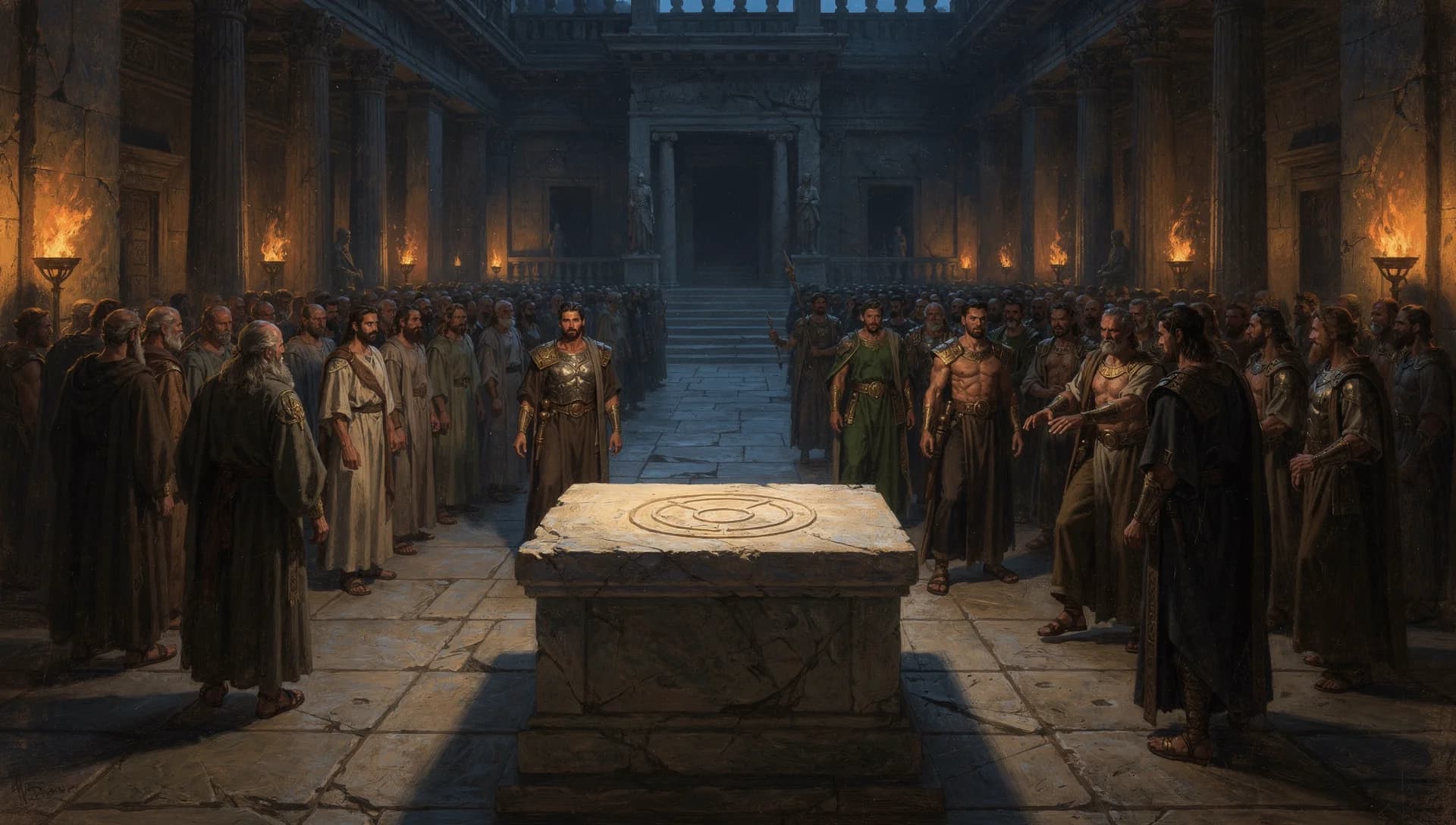
The Aesir-Vanir War, the first conflict among the gods (Norse)
 UB
UBThe staff split: loyal vs. rebel members of the Prince's corps
Full Article
Read the deep-dive article on this connection
The staff split: loyal vs. rebel members of the Prince's corps = The Aesir-Vanir War, the first conflict among the gods (Norse)
The Connection
The first war in Norse mythology is not a battle against monsters but a schism within the divine community itself: Aesir against Vanir, two factions of a once-unified divine order. The Caligastia rebellion split the Prince's staff identically: not a war against outsiders, but a fracture within a single body of superhuman beings assigned to Urantia. The loyal faction of the staff is identified throughout the UB as "Van's people," while the older, wisdom-associated divine family in Norse myth is named the Vanir. The nominal parallel reinforces the structural one.
UB Citation
UB 67:2.2, 67:3.5, 67:6.2-3
Academic Source
Völuspá 24-25 (Poetic Edda); Lindow, Norse Mythology (2001); Prose Edda, Skáldskaparmál (Sturluson)
Historical Evidence(Moderate evidence)
Völuspá 24 records the first war: "She remembers the first war in the world, when the gods with spears struck Gullveig." The Prose Edda Skáldskaparmál identifies this as the beginning of the Aesir-Vanir conflict. John Lindow (UC Berkeley) notes the war represents "a conflict within the divine community rather than between gods and their enemies," a categorization that matches the internal nature of the Caligastia rebellion precisely. UB 67:3.5 records that only 40 of the 100 staff members remained loyal with Van. The structural match is exact: one divine corps, one rebellion, two factions. The Vanir, associated with wisdom and older earth knowledge, parallel Van's loyal civilization-teachers; the Aesir's later dominant warrior culture parallels the rebel faction's declared autonomy.
Deep Dive
Voluspa 24 in the Poetic Edda records the very first war: a conflict not between gods and external enemies but within the divine community itself. The Aesir, the warrior gods of Asgard led by Odin, fought against the Vanir, an older family of fertility and wisdom deities led by Njord, Freyr, and Freyja. The war ended in a truce; the two divine families exchanged hostages (the Aesir sent Honir and Mimir to the Vanir; the Vanir sent Njord, Freyr, and Freyja to the Aesir), and the unified pantheon thereafter included gods of both lineages. The Snorra Edda's Skaldskaparmal preserves the standard medieval Icelandic account, which is consistent with the older Eddic poetry.
This is one of the structural peculiarities of Norse mythology that has long puzzled comparative religion scholars. Why does the Norse tradition begin with an internal war among the gods? Most religious traditions present their pantheons as unified families, with conflict arriving from outside (the giants, the demons, the cosmic chaos-monsters). The Norse alone preserve the memory of a foundational schism within the divine community itself, with the present unity being the post-war integration of two originally distinct factions.
The Urantia Book provides what may be the historical referent. Paper 67:2.2 records the Caligastia rebellion's beginning: "The presentation of this astounding demand was followed by the masterly appeal of Van, chairman of the supreme council of co-ordination. This distinguished administrator and able jurist branded the proposed course of Caligastia as an act bordering on planetary rebellion and appealed to his conferees to abstain from all participation until an appeal could be taken to Lucifer, the System Sovereign of Satania; and he won the support of the entire staff. Accordingly, appeal was taken to Jerusem, and forthwith came back the orders designating Caligastia as supreme sovereign on Urantia and commanding absolute and unquestioning allegiance to his mandates. And it was in reply to this amazing message that the noble Van made his memorable address of seven hours' length in which he formally drew his indictment of Daligastia, Caligastia, and Lucifer as standing in contempt of the sovereignty of the universe of Nebadon."
Paper 67:3.5 records the immediate consequence and the final tally of loyalty: "Upon the outbreak of rebellion, loyal cherubim and seraphim, with the aid of three faithful midwayers, assumed the custody of the tree of life and permitted only the forty loyalists of the staff and their associated modified mortals to partake of the fruit and leaves of this energy plant." Forty out of one hundred staff members remained loyal with Van. Sixty went with Caligastia. The Prince's corps, originally a unified administrative body of one hundred superhuman beings, split into two factions of forty and sixty.
The structural match with the Aesir-Vanir war is precise on three points. First, both traditions preserve memory of a foundational schism within an originally unified divine corps. The Norse Aesir-Vanir war is among gods, not between gods and giants; the Caligastia rebellion is among the Prince's staff, not between the staff and external enemies. The internal-war character is the distinctive feature, shared between the two accounts. Second, the loyal/older-wisdom faction has consistent associations across both. The Vanir are the older earth-and-wisdom deities, associated with fertility, agriculture, and the older religious stratum. The loyal staff under Van were the civilization-teachers, the agricultural and craft-instruction councils, the older Edenic-administrative continuity. The functional match holds. Third, the post-war integration is structurally similar. The Aesir-Vanir war ended with hostage exchange and the integration of both lineages into the unified Norse pantheon. The Caligastia rebellion ended with the loyal staff carrying the Edenic-administrative continuity through the post-rebellion period and eventually integrating with the Adamic mission, with Van eventually returning to Jerusem and the loyal Andonites continuing on earth as the biological leaven of subsequent civilization.
The naming convergence is one further clue. Van the staff member's name and the Vanir family of gods are both pronounceable in Old Norse as Van or Van-ir (the -ir suffix is the standard plural). The leader of the loyal staff was Van; the older wisdom-deities of the Norse pantheon were the Vanir. The phonetic identity is the kind of detail that cultural memory does preserve across millennia, even when the biographical specifics drift into mythological elaboration.
John Lindow, in Norse Mythology (Oxford, 2001), and Georges Dumezil, in Gods of the Ancient Northmen (UCLA, 1973), have catalogued the structural peculiarity of the Aesir-Vanir war in Indo-European comparative mythology. Dumezil's tripartite functionalism (sovereignty, war, fertility) treated the Aesir-Vanir distinction as the Indo-European inheritance of two of the three functions, with the integration representing the synthesis of warrior and fertility religious strata. Dumezil's framework has been variously refined and criticized but remains a major reference point for understanding the structural specificity of the Norse tradition. The UB account adds the historical referent: the war is not just a structural inheritance but the cultural memory of a real foundational schism in the original divine corps assigned to Urantia.
What strengthens the parallel is the geographic and chronological pattern. The Indo-European populations whose religious tradition crystallized in the Norse form had their cultural origins in the Pontic-Caspian and broader highland Eurasian region, north and west of where the UB places Van's highland retreat after the rebellion. The Andite migrations carried cultural memory from the highland source northward and westward over thousands of years, with the Northern European populations being among the destinations. The Norse tradition, recorded in textual form by the medieval Icelandic synthesis but resting on much older oral tradition, would naturally have preserved the cultural memory of the original schism with unusual fidelity, since the loyal Van faction was the source of much of the cultural inheritance the Indo-European populations carried with them.
The strongest counterargument is the comparative-religion position that internal-divine wars are a known mythological pattern, with the Mesopotamian Atrahasis (the Igigi gods rebelling against the Anunnaki) and other Near Eastern traditions providing parallels. The reply is that the Mesopotamian parallels themselves point to the same underlying historical reality (the Caligastia rebellion as cultural memory) and that the broader pattern of internal-divine conflict in early religious traditions is exactly what we would expect from cultural memory of a real foundational schism propagating through multiple regional traditions. The Norse case is one well-documented instance with unusually clear structural specificity (the Vanir name, the older-wisdom function, the integration through hostage-exchange) and the UB account fits these specifics at the level of detail rather than at the level of generic archetype.
What the parallel implies is that the Aesir-Vanir war preserves cultural memory of the Caligastia rebellion's foundational schism in the Prince's staff, with the Vanir being the cultural memory of Van's loyal faction (the older wisdom-and-civilization teachers) and the Aesir being the dominant warrior-culture inheritance that the post-rebellion populations developed in the long subsequent millennia. The decoder's job is to make the structural match visible and to honor Van's place at the historical core of Norse divine genealogy.
Key Quotes
“The presentation of this astounding demand was followed by the masterly appeal of Van, chairman of the supreme council of co-ordination. This distinguished administrator and able jurist branded the proposed course of Caligastia as an act bordering on planetary rebellion and appealed to his conferees to abstain from all participation until an appeal could be taken to Lucifer, the System Sovereign of Satania; and he won the support of the entire staff.”
“Upon the outbreak of rebellion, loyal cherubim and seraphim, with the aid of three faithful midwayers, assumed the custody of the tree of life and permitted only the forty loyalists of the staff and their associated modified mortals to partake of the fruit and leaves of this energy plant.”
Cultural Impact
The Aesir-Vanir distinction shaped Norse religious imagination decisively. The integration of warrior and fertility deity functions into a unified pantheon, with the Vanir contributing fertility, prosperity, and older wisdom while the Aesir provided the warrior-sovereign functions, became one of the structural foundations of Scandinavian pre-Christian religion. Through medieval Icelandic literature, especially the Eddas, the distinction was preserved and elaborated. The nineteenth-century recovery of Norse mythology, especially through Jacob Grimm and Wilhelm Grimm, the Romantic poets, and Wagner's Ring, kept the Vanir distinct from the Aesir in modern reception, with characters like Freyja and Freyr being recognizable as Vanir even in adapted modern forms. Contemporary Heathen and Asatru religious movements often emphasize the distinction, with some modern practitioners particularly drawn to the Vanir as representing an older, earthier, more nature-oriented religious stratum. The cultural inheritance is durable and ongoing. The UB account, by identifying the historical referent in the loyalist Van and his faction, restores the original distinction without diminishing the mythological richness of the Norse elaboration.
Modern Resonance
Contemporary readers attracted to Norse mythology, especially through the various neopagan and Heathen revival movements, often find themselves drawn to the Vanir as the older, more earth-rooted, more wisdom-oriented divine family. The modern reception preserves an intuition that the Vanir are somehow more original than the Aesir, more deeply connected to the planet itself, more associated with the older religious stratum. The UB account confirms this intuition: the Vanir really do preserve cultural memory of an older religious-administrative reality, the Edenic continuity carried by Van's loyal staff across the long post-rebellion period. For modern Heathen practitioners and for readers of Norse-influenced fiction and games, the UB framework offers a parsimonious historical referent for the structural feature they have already perceived. The decoder's job is to make the connection explicit.
Related Mappings
Andite military commander (~5000 BC)
= Thor, Norse god of thunder and warfare
Van, sustained by the Tree of Life for 150,000 years
= Odin, self-hung on Yggdrasil, the World Tree (Norse)
Tree of Life, the Edentia shrub at the center of the Father's temple
= Yggdrasil, the World Tree sustaining all realms (Norse)
Caligastia, the deposed Planetary Prince whose deception continues on earth
= Loki, the shapeshifting trickster within the Aesir who engineers Ragnarok
Related Articles
Where to next
The free newsletter. The research behind each piece, no spam.