
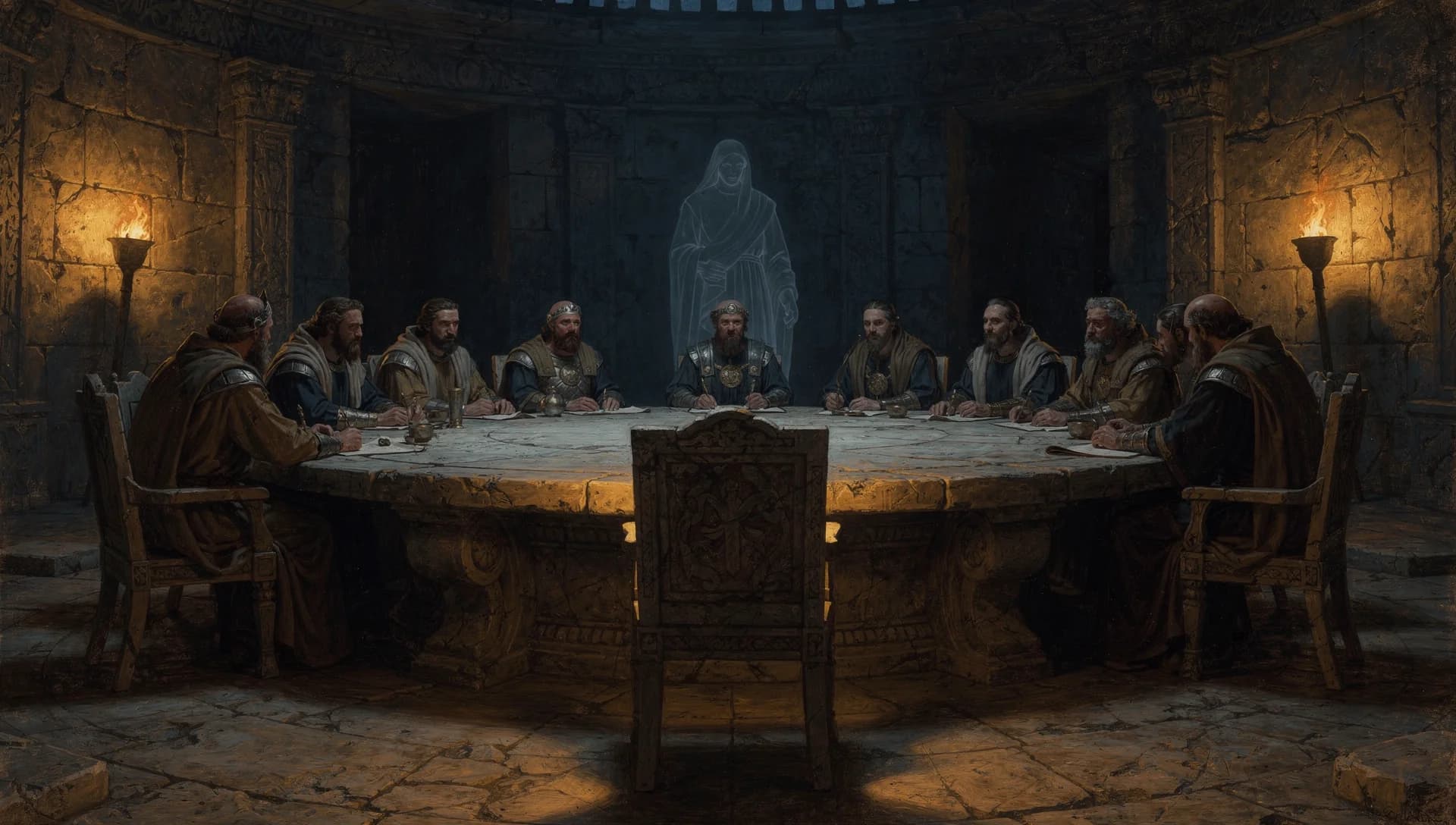
 Mythic
Loki, the shapeshifting trickster within the Aesir who engineers Ragnarok
 UB
UBCaligastia, the deposed Planetary Prince whose deception continues on earth
Full Article
Read the deep-dive article on this connection
Caligastia, the deposed Planetary Prince whose deception continues on earth = Loki, the shapeshifting trickster within the Aesir who engineers Ragnarok
The Connection
Loki sits inside the council of the Aesir but works against it, fathering monstrous offspring, engineering the death of Baldr, and ultimately leading the army that destroys the old order at Ragnarok. Caligastia sits inside the universe government as Planetary Prince, then turns against it, engineers the Lucifer rebellion on Urantia, and still actively opposes the spiritual order from within rather than from outside. Both are insider-betrayers rather than outside enemies, which is the distinguishing feature of the rebellion the UB describes.
UB Citation
UB 53, 67:1-4, 53:9
Academic Source
Lokasenna and Baldrs draumar (Poetic Edda); Gylfaginning 33-35 (Sturluson); Lindow, Norse Mythology (2001)
Historical Evidence(Moderate evidence)
John Lindow identifies Loki as "a member of the Aesir who is simultaneously their enemy," a category that has puzzled Norse scholars because he fits neither the "god" nor the "giant" template cleanly. Gylfaginning 33-35 records Loki's engineering of Baldr's death and his binding beneath the earth until Ragnarok. The insider-betrayer category is precisely what the UB describes for Caligastia: not an external adversary but a member of the ruling council who turned, and who continues to act from within the system rather than from outside it.
Deep Dive
Loki has long been the most theologically peculiar figure in the Norse pantheon. He is not a giant by birth (his father is Farbauti, a giant, but he is fully integrated into the Aesir as Odin's blood-brother). He is not exactly an Aesir either. He is a shapeshifter, a trickster, a problem-solver who repeatedly bails out the gods from difficulties he sometimes himself caused. He fathers monsters: Hel the goddess of the dead, Jormungand the world-serpent, Fenrir the wolf who will swallow Odin at Ragnarok. He arranges the death of Baldr, the most beloved of the gods, through deception. He is bound beneath the earth as punishment, with a serpent dripping venom onto his face, awaiting release at Ragnarok when he will lead the army of chaos against the gods. He is, in John Lindow's phrasing in Norse Mythology (Oxford, 2001), a member of the Aesir who is simultaneously their enemy.
This category has puzzled Norse scholars because it does not fit the standard mythological templates. Lokasenna, the Eddic poem in which Loki crashes a banquet of the gods and insults each of them in turn, presents him as fundamentally part of the divine community even as he undermines it. Baldrs draumar (Baldr's Dreams) records the prophetic warning of Baldr's death that Loki will engineer. Gylfaginning 33-35 in the Prose Edda gives Snorri's standard medieval narrative of Loki's role in Baldr's death and the subsequent binding. The cumulative picture is of an insider-betrayer, a member of the ruling community who acts from within against the community itself, and who is contained but not yet finally judged.
The Urantia Book describes a figure who fits this category with extraordinary precision. Caligastia, the deposed Planetary Prince of Urantia, was originally the highest spiritual authority on the planet, installed at the planetary administrative organization roughly five hundred thousand years ago. He was Lanonandek Son number 9,344 of the secondary order, experienced in local universe administration. He chaired the council that ran the planet. Then he turned. Paper 67 narrates the entire rebellion in detail. Caligastia became the insider-betrayer, the figure inside the ruling council who works against the council itself. He did not become an external enemy; he remained, at least nominally, within the structure. Paper 53:8.6 records his current status: "Caligastia, your apostate Planetary Prince, is still free on Urantia to prosecute his nefarious designs, but he has absolutely no power to enter the minds of men, neither can he draw near to their souls to tempt or corrupt them unless they really desire to be cursed with his wicked presence."
The structural match with Loki is dense at multiple points. First, the insider-betrayer category. Loki is in the Aesir but against the Aesir; Caligastia is in the planetary administration but against the planetary administration. Both are insiders working from within. Second, the production of monstrous offspring. Loki fathers Hel, Jormungand, and Fenrir, the three eschatological adversaries. Caligastia, in the UB account, was the architect of the rebellion that produced the planetary disorder, with Daligastia his immediate assistant, Abaddon his chief of staff among the rebel angels, Beelzebub the leader of the disloyal midwayers, and the broader rebel apparatus that continues to disrupt human spiritual development. The "monstrous offspring" of the Loki tradition is the cultural memory of the rebel staff and its continuing influence.
Third, the arranger of the noble death. Loki engineers Baldr's death, the most morally consequential event in the Norse mythological narrative, through deceptive intermediation (he persuades Hodr the blind god to throw the mistletoe at Baldr, who is otherwise invulnerable). Caligastia engineered the multiple disruptions of the planetary mission, from the original rebellion through the sabotage of subsequent missions including, the UB account suggests, contributing to the conditions that led to the difficulties of Adam and Eve and ultimately to the crucifixion of Christ Michael. The "arranger of the noble death" function fits both figures.
Fourth, the binding-pending-final-judgment status. Loki is bound beneath the earth with the serpent dripping venom, awaiting release at Ragnarok. Caligastia, while not strictly bound (he is "still free on Urantia"), has been deprived of his administrative authority and his power to influence human minds without consent, and the rebellion is awaiting final adjudication that the UB describes as still pending. The held-pending-judgment status fits the structural category, even if the mode of detention differs in detail.
Fifth, the shapeshifting character. Loki is famously a shapeshifter, taking the form of a salmon, a mare, a fly, an old woman. Caligastia, as a Lanonandek Son, is not described as a shapeshifter in any literal sense, but the UB account describes him as the master deceiver who works through subtle influence rather than direct manifestation. The functional category of "deceptive shape-changer" fits, even if the precise mechanism differs.
Stefan Brink's edited volume The Viking World (Routledge, 2008), and Margaret Clunies Ross's various works on Eddic mythology, have catalogued the long scholarly puzzlement over Loki's structural position. The figure resists tidy mythological categorization. Various theories have been proposed: Loki as a hypostasized fire-deity, as an Indo-European trickster type, as a Christianized devil-figure retrojected into the Norse tradition. The UB account offers a different solution: Loki is the cultural memory of Caligastia, the original deposed Planetary Prince, refracted through tens of thousands of years of cultural transmission and elaborated into mythological form. The puzzling structural features (insider-betrayer, deceptive intermediator, monstrous-offspring producer, bound-pending-judgment) are the residue of the actual administrative reality the UB describes.
The strongest counterargument is that Loki's biographical details (the marriage to Sigyn, the children with Angrboda, the various trickster narratives) are too specific to map onto Caligastia, who the UB describes in essentially administrative-doctrinal terms without the mythological color. The reply is that cultural memory inflates and elaborates over millennia, and the biographical color of the Loki tradition is exactly what would be expected from a real administrative reality remembered through scores of generations of priestly retelling. The UB gives us the doctrinal reality; the Norse tradition gives us the cultural memory of that reality after fifty thousand years of human imaginative work. The structural skeleton matches; the biographical color is the work of cultural transmission.
What the parallel implies is that one of the most theologically peculiar figures in any major mythological tradition preserves cultural memory of a real cosmic-administrative event: the rebellion of the Planetary Prince and his continuing influence on Urantia. The decoder's job is to recover the historical referent and to honor Loki's place as the Norse cultural memory of Caligastia.
Key Quotes
“Very little was heard of Lucifer on Urantia owing to the fact that he assigned his first lieutenant, Satan, to advocate his cause on your planet. Satan was a member of the same primary group of Lanonandeks but had never functioned as a System Sovereign; he entered fully into the Lucifer insurrection. The “devil” is none other than Caligastia, the deposed Planetary Prince of Urantia and a Son of the secondary order of Lanonandeks.”
“The last act of Michael before leaving Urantia was to offer mercy to Caligastia and Daligastia, but they spurned his tender proffer. Caligastia, your apostate Planetary Prince, is still free on Urantia to prosecute his nefarious designs, but he has absolutely no power to enter the minds of men, neither can he draw near to their souls to tempt or corrupt them unless they really desire to be cursed with his wicked presence.”
Cultural Impact
Loki has been one of the most generative figures in the modern reception of Norse mythology. Through the Romantic recovery of the Eddas, through Wagner's Ring (where Loge corresponds to Loki), through twentieth-century literature (Karl Edward Wagner's stories, Joanne Harris's Loki novels, Neil Gaiman's American Gods and Norse Mythology), and through contemporary popular culture (Marvel Comics' Loki, the Tom Hiddleston portrayal in the Marvel Cinematic Universe and the Disney+ Loki series), the figure has become one of the most globally recognized mythological characters of the early twenty-first century. The Marvel Loki is a deliberately fanciful adaptation, but it preserves several of the structural features (insider-outsider, shape-shifter, morally ambiguous, ultimately seeking redemption) that the Norse tradition developed across many centuries. The figure's cultural reach is enormous and ongoing. The UB account, by identifying the historical referent in Caligastia, restores a parsimonious source for what would otherwise be a peculiarly persistent and structurally complex mythological pattern.
Modern Resonance
Contemporary popular culture's enthusiasm for Loki has reopened broader questions about insider-betrayal as a religious-spiritual category. The figure of the morally ambiguous insider, the trickster-betrayer who acts from within the ruling community against it, resonates with modern political and institutional anxieties about corruption from within. The UB account offers a sober historical referent: the original insider-betrayer was Caligastia, and the cultural memory of his rebellion has propagated through human religious imagination for hundreds of thousands of years. For contemporary readers fascinated by Loki and curious about the figure's deeper significance, the UB framework restores a parsimonious historical core. The shape-shifter who undermines from within is not arbitrary mythological invention; it is the cultural memory of a real administrative rebellion whose perpetrator is, on the UB account, still active on this planet though deprived of the power to influence human minds without explicit invitation. The decoder's job is to make the connection visible.
Related Mappings
Andite military commander (~5000 BC)
= Thor, Norse god of thunder and warfare
Van, sustained by the Tree of Life for 150,000 years
= Odin, self-hung on Yggdrasil, the World Tree (Norse)
Tree of Life, the Edentia shrub at the center of the Father's temple
= Yggdrasil, the World Tree sustaining all realms (Norse)
The staff split: loyal vs. rebel members of the Prince's corps
= The Aesir-Vanir War, the first conflict among the gods (Norse)
Related Articles
Where to next
The free newsletter. The research behind each piece, no spam.