
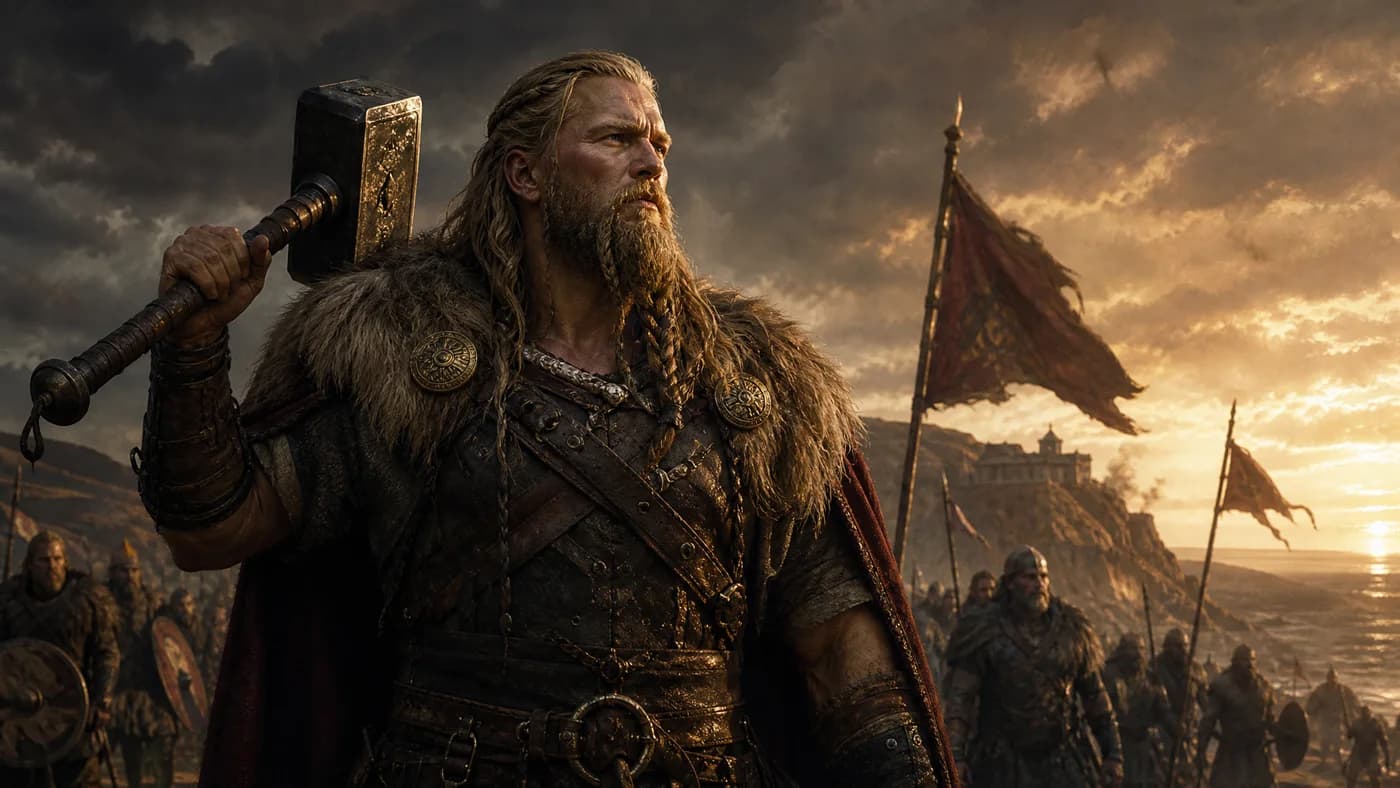
 Mythic
Thor, Norse god of thunder and warfare
 UB
UBAndite military commander (~5000 BC)
Full Article
Read the deep-dive article on this connection
Andite military commander (~5000 BC) = Thor, Norse god of thunder and warfare
The Connection
The UB explicitly states Thor was based on a real Andite commander who led military campaigns in northern Europe and was "later revered as a god, master of the lightning." The Andite military expansion into Europe (~5000-3000 BC) produced culture heroes who were mythologized into the Norse pantheon.
UB Citation
UB 80:5.4, 85:6.4
Academic Source
Sturluson, Prose Edda; Davidson, Gods and Myths of Northern Europe (1964)
Historical Evidence(Strong evidence)
Snorri Sturluson's Prose Edda (c. 1220 CE) Prologue explicitly presents Norse gods as "human Trojan warriors who left Troy after the fall of that city." Thor is described as a historical warrior who "travelled throughout the world, fighting monsters; he eventually came far north where he married Sif." Anthony Faulkes argues Snorri used euhemerism as "a sophisticated tool to preserve pre-Christian material." The euhemeristic tradition in Norse studies continues to generate academic research.
Deep Dive
In the late Bronze Age and early Iron Age, the major flow of cultural influence into northern Europe came from the south and east. The Andite expansion out of Mesopotamia, beginning around 5000 BCE and continuing in waves for the next two millennia, brought military and cultural innovation into Europe along multiple paths: up the Danube, around the Black Sea, across the steppes, and into the Atlantic and North Sea coastlands. The Andite blend (Adamic violet stock plus the loyal Nodite line plus the secondary Sangik races, especially red and Andonite) carried agriculture, metallurgy, organized warfare, and religious innovation into the populations they encountered. Where the Andite military expansion succeeded, the existing populations were either displaced, absorbed, or organized under Andite leadership, and the resulting stock became the foundation for the Indo-European cultural-linguistic family.
The Urantia Book records, in Paper 80:5.4, one specific incident from this expansion: "The decisive struggles between the white man and the blue man were fought out in the valley of the Somme. Here, the flower of the blue race bitterly contested the southward-moving Andites, and for over five hundred years these Cro-Magnoids successfully defended their territories before succumbing to the superior military strategy of the white invaders. Thor, the victorious commander of the armies of the north in the final battle of the Somme, became the hero of the northern white tribes and later on was revered as a god by some of them."
The phrasing is striking: "Thor, the victorious commander of the armies of the north in the final battle of the Somme." This is not Thor as mythological invention; this is Thor as the historical name of a specific Andite commander whose successful campaign against the blue-race Cro-Magnoid populations of northwestern Europe became, over subsequent millennia, the substance of the Norse god of war and thunder.
Paper 85:6.4 confirms the euhemerist reading: "The ghost gods, who are of supposed human origin, should be distinguished from the nature gods, for nature worship did evolve a pantheon, nature spirits elevated to the position of gods. The nature cults continued to develop along with the later appearing ghost cults, and each exerted an influence upon the other. Many religious systems embraced a dual concept of deity, nature gods and ghost gods; in some theologies these concepts are confusingly intertwined, as is illustrated by Thor, a ghost hero who was also master of the lightning."
The UB is naming Thor as a deified human ancestor whose memory was subsequently fused with nature-deity functions (master of the lightning, controller of the storm). The figure became the storm-god by accumulating onto his original biographical core the nature-deity functions that an originally separate sky-storm tradition contributed. This is exactly the pattern that comparative religion has documented for many other syncretic deity-figures, and it fits the Snorri tradition's explicit euhemerism in the Prose Edda.
Snorri Sturluson, writing his Prose Edda around 1220 CE in Iceland, was a Christian writing for Christians, and he framed his treatment of the pagan gods in a euhemerist mode that the medieval Christian tradition found acceptable. The Prologue to the Prose Edda explicitly traces the Aesir back to human ancestors who migrated from Troy after the Trojan War, with Thor as one of these human warriors who traveled the world fighting monsters and eventually settled in the north where he married Sif. The euhemerism is, on the standard Christian-medieval reading, Snorri's apologetic move: he is rationalizing the pagan tradition for a Christian audience by reducing the gods to deified humans. Anthony Faulkes, in his Oxford editions of the Prose Edda and his various scholarly articles, has argued that Snorri's euhemerism was a sophisticated tool for preserving pre-Christian material rather than a simple debunking move; Snorri was using a respectable scholarly framework to record traditions that might otherwise have been suppressed.
What the UB account adds is that Snorri's euhemerism was substantively right, even if his specific historical attributions (Troy, the post-Iliadic dispersal) were wrong. Thor really was a deified human ancestor. The deification mechanism worked as Snorri described, even if the geographic and chronological details that Snorri reconstructed from twelfth-century sources were inaccurate.
H. R. Ellis Davidson, in Gods and Myths of Northern Europe (Penguin, 1964), and John Lindow in Norse Mythology (Oxford, 2001) have catalogued the evidence for Thor's pre-Christian status. Thor was, by the Viking period (roughly 800-1100 CE), the most popular of the Aesir among the common Scandinavian populations. Place-names compounded with Thor (Thorshavn, Thorsgade, dozens of others across Scandinavia and the Norse diaspora) are extraordinarily common, suggesting widespread popular cult. Iconic representations show Thor with his hammer Mjolnir, the iron gauntlets, the belt of strength, the chariot pulled by goats, the red beard. The thunder-god functions are dense: he controls the storms, hurls lightning, defends Midgard against the giants, and provides agricultural fertility through his rain. The cult of Thor was particularly strong among farmers and warriors of the common classes, in distinction from Odin, whose cult was associated with the warrior aristocracy.
The Andite military commander on the Somme around 5000 BCE would have been one of the named heroes whose memory the migrating Andite populations carried with them as they spread across Europe over the subsequent two thousand years. The cultural memory, propagating through Iron Age and Bronze Age generations, would have absorbed nature-deity functions (the storm-god of the older Indo-European inheritance) onto the original biographical core. By the time we have textual evidence in the Roman period (Tacitus's Germania mentions a Donar-Hercules figure that scholars identify with the Germanic Thunor / Norse Thor), the figure has acquired most of his classical attributes. By the Viking period, the integration is complete.
The strongest counterargument is the reductionist position that all gods are nature-deities or psychological archetypes, and the euhemerist reading is mistaken in principle. The reply is that the textual evidence in this case is unusually clear. Snorri's explicit euhemerism, the place-name density associated with Thor in particular, the iconic specificity (the hammer, the goats, the gauntlets), and the popular-warrior cult character all fit better with a deified human ancestor than with a pure nature-deity abstraction. The UB account converges with Snorri's framework and adds the specific historical referent: a real Andite military commander whose victorious Somme campaign became the substance of the later Thor figure.
What the parallel implies is that the most popular of the Norse gods preserves the cultural memory of a real Andite military commander whose successful expansion into northwestern Europe around 5000 BCE shaped the genetic and cultural foundations of the populations who later named him their thunder-god. The decoder's job is to recover the historical referent and to honor Thor as both a historical commander and a subsequently deified hero.
Key Quotes
“Thor, the victorious commander of the armies of the north in the final battle of the Somme, became the hero of the northern white tribes and later on was revered as a god by some of them.”
“Many religious systems embraced a dual concept of deity, nature gods and ghost gods; in some theologies these concepts are confusingly intertwined, as is illustrated by Thor, a ghost hero who was also master of the lightning.”
Cultural Impact
Thor's cultural reach is enormous. Through the Viking period, his cult shaped the religious life of the Scandinavian common classes for several centuries. The conversion of Scandinavia to Christianity (roughly 950-1100 CE) suppressed the cult but did not erase the cultural memory; Thor's name survives in dozens of common Scandinavian and English place-names and personal names, and the day Thursday (Thor's day) carries his name into the contemporary English week. Snorri's Prose Edda preserved the literary tradition through the medieval Christian period. The Romantic recovery of Norse mythology in the nineteenth century, especially through Wagner's Ring cycle (which uses Donner, the German cognate of Thor, as one of its gods) and the broader nineteenth-century Germanic-nationalist revival, brought Thor back into European cultural consciousness. Marvel Comics' Thor, created by Stan Lee, Larry Lieber, and Jack Kirby in 1962, became one of the most successful superhero characters of the modern era; the Marvel Cinematic Universe Thor films (2011, 2013, 2017, 2022) made the figure one of the most globally recognized mythological characters of the twenty-first century. The Marvel Thor is a deliberately fanciful adaptation, but it preserves the iconic core (hammer, lightning, warrior identity, alien-but-divine status) that the Norse tradition developed across three thousand years. The cultural inheritance from one Andite commander on the Somme around 5000 BCE has been remarkably durable.
Modern Resonance
Contemporary popular culture's enthusiasm for Thor has reopened broader questions about the historical core of mythological figures. Most modern readers encountering Thor do so through Marvel rather than through Snorri or the Eddic poems, but the wider cultural curiosity about Norse mythology has produced a substantial popular reception (television series like Vikings, novels like Neil Gaiman's American Gods and Norse Mythology, video games like the God of War Ragnarok title). The UB account offers a sober historical referent for the figure: a real Andite military commander, named Thor, whose Somme victory around 5000 BCE made him the founding hero of the northern white populations. This historical core does not diminish the mythological elaboration; it grounds it. For modern readers fascinated by Thor and curious about the origin of his cult, the UB framework restores a parsimonious historical explanation that converges with Snorri's medieval euhemerism and with the broader scholarly tradition of treating the Norse gods as having human historical cores. The decoder's job is to make the historical referent visible and to honor the long cultural inheritance from a real military victory five thousand years before Snorri wrote.
Related Mappings
Van, sustained by the Tree of Life for 150,000 years
= Odin, self-hung on Yggdrasil, the World Tree (Norse)
Tree of Life, the Edentia shrub at the center of the Father's temple
= Yggdrasil, the World Tree sustaining all realms (Norse)
The staff split: loyal vs. rebel members of the Prince's corps
= The Aesir-Vanir War, the first conflict among the gods (Norse)
Caligastia, the deposed Planetary Prince whose deception continues on earth
= Loki, the shapeshifting trickster within the Aesir who engineers Ragnarok
Related Articles
Where to next
The free newsletter. The research behind each piece, no spam.