
 Mythic
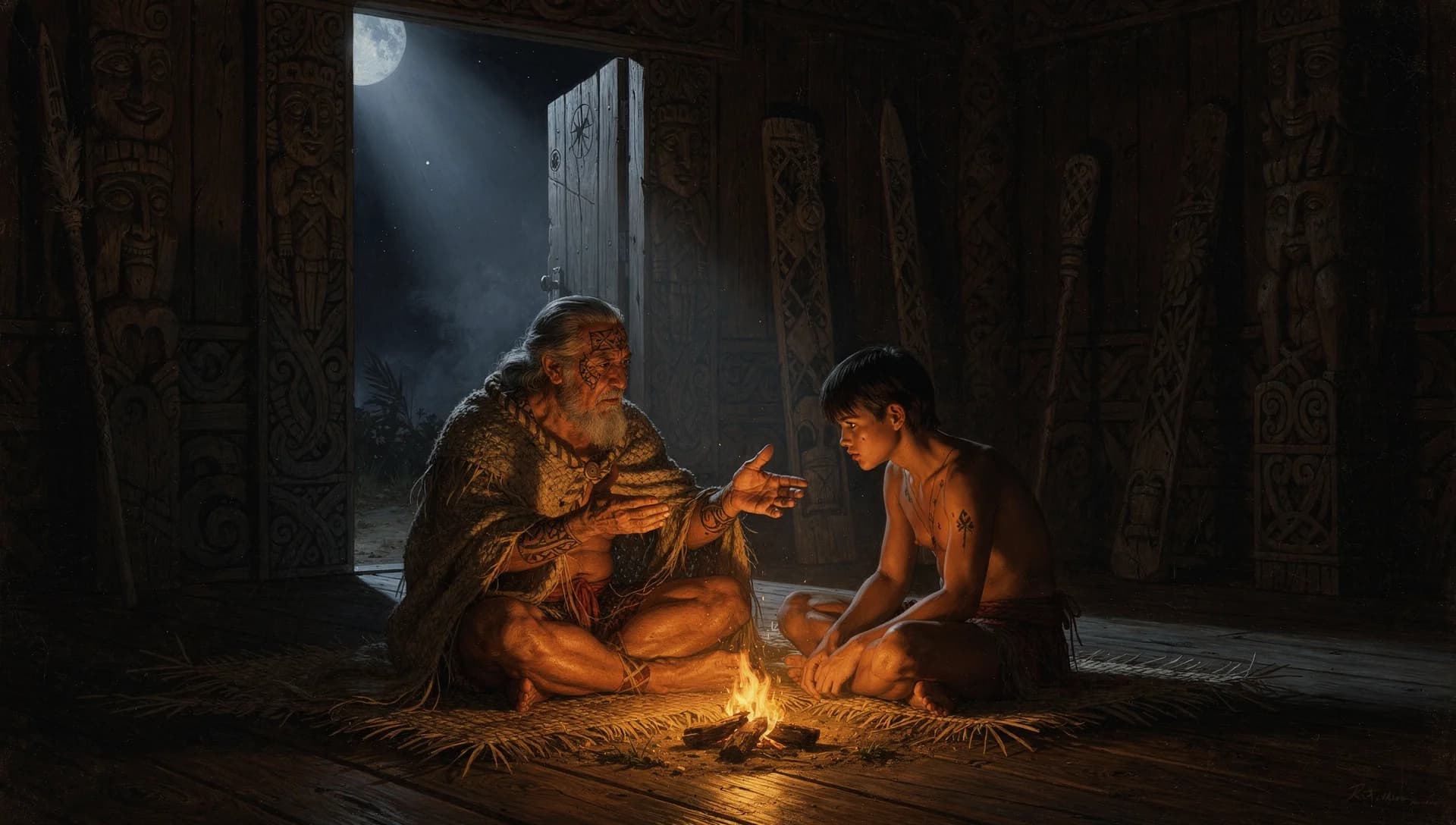
Io, the Maori supreme being known only to the highest priestly caste
 UB
UBUniversal Father, supreme creator
Full Article
Read the deep-dive article on this connection
Universal Father, supreme creator = Io, the Maori supreme being known only to the highest priestly caste
The Connection
Maori religious tradition preserves, alongside the well-known gods (Tane, Rongo, Tu, and others), a hidden teaching of Io, "Io the parent, Io the eternal, Io without limit," a supreme creator known only to the most senior priests and taught in secret. The concept does not fit the surrounding Polynesian polytheism; it has all the marks of an older, imported monotheistic layer being preserved by a specialist tradition. The UB pattern of Salem missionary teaching remembered as an esoteric upper-layer beneath surface polytheism matches the Io tradition exactly.
UB Citation
UB 93:7.1, 94:0.1
Academic Source
Best, Maori Religion and Mythology (1924); Buck, The Coming of the Maori (1949)
Historical Evidence(Moderate evidence)
Elsdon Best's ethnographic recording of Io-matua-kore ("Io the parentless") preserved a genuine but restricted Maori tradition of a supreme high-god distinct from the working pantheon. Te Rangi Hīroa (Sir Peter Buck) treated the Io teaching as authentic pre-Christian Maori theology, not post-missionary invention, while acknowledging its restricted transmission. The pattern (a monotheistic high-god preserved in a restricted tradition beneath surface polytheism) matches what the UB identifies elsewhere in India (Brahman priestly caste), China (proto-Taoist transmission), and Celtic religion.
Deep Dive
In the early twentieth century, the New Zealand ethnographer Elsdon Best worked extensively with Maori tribal elders to record traditional religious knowledge that was on the verge of being lost. The most controversial element of what he recorded was the Io tradition: a body of teaching about a supreme high-god named Io, transmitted only to the highest-ranking priests within the whare wananga (houses of learning), kept secret from the general population, and treated as the most sacred knowledge of the entire Maori religious system.
Io was described as Io-matua-kore (Io the parentless), Io-mata-aho (Io of the radiant face), Io-taketake (Io the fundamental). He was not part of the working pantheon of Tane, Tu, Rongo, Tangaroa, and the other commonly-known gods. He stood above them as their ultimate source and ruler. He was approached only in the most restricted ritual contexts, by the most senior priests, with the most elaborate observances. He was, in essence, a hidden monotheistic high-god preserved within a surface polytheistic system.
The academic reception of the Io tradition has been contested. Best's recording, in his Maori Religion and Mythology (1924) and in a series of articles, presented Io as an authentic pre-Christian Maori tradition. Some later scholars, notably Jonathan Smith, argued that the tradition might have been a post-Christian elite-Maori response to Christian missionary teaching about a supreme creator-God. The tradition's restricted transmission and its theological similarity to Christian monotheism made the post-Christian-influence hypothesis plausible.
Te Rangi Hiroa (Sir Peter Buck), the prominent Maori anthropologist and politician, addressed this question directly in The Coming of the Maori (1949). Buck, who was himself of Maori descent and worked extensively with traditional elders, treated the Io teaching as authentic pre-Christian Maori theology. He acknowledged the restricted transmission but argued that the underlying theological structure (a supreme creator distinct from the working pantheon) was consistent with broader Polynesian religious patterns and could not reasonably be reduced to post-missionary influence.
The broader Polynesian comparative evidence supports Buck's position. The Hawaiian Akea, the Tahitian Ta'aroa, the Tongan and Samoan supreme-creator concepts all show similar structural features: a supreme being who exists prior to and beyond the working pantheon, often associated with originary creation, treated with restricted reverence in elite religious contexts. These are not isolated Maori phenomena; they are the Maori variant of a broader Polynesian pattern that the missionary-influence hypothesis cannot adequately explain.
The UB framework places this Polynesian high-god pattern within the global pattern of Salem-monotheistic teaching reception. UB 93:7.2 specifically mentions Salem-missionary reach into the Pacific: "another traversed China and reached the Japanese of the eastern islands." UB 78:5.7 describes the Andite sailors crossing the Pacific. The Salem-monotheistic teaching reached the Pacific through these multiple routes, and its reception followed the same pattern observed elsewhere: an original supreme-creator teaching was received, partially preserved in elite tradition, while the surface religious life was dominated by intermediate spirits and ancestor-figures.
The Maori Io tradition is one of the cleanest available examples of this pattern. The high-god is genuinely there. The teaching about him is genuinely transmitted. The restriction of transmission to elite priestly contexts is genuine. The integration of the high-god teaching with surface polytheism through hierarchical theological structure is genuine. All of these features fit the Salem-teaching-reception pattern that the UB identifies across many world traditions.
The strongest counterargument is that mainstream Polynesian religious studies has not consistently accepted the Io tradition as authentic pre-Christian Maori theology. The post-Christian-influence hypothesis, while not dominant, has continued to be entertained by some scholars. The picture is genuinely contested, and any honest engagement with the tradition has to acknowledge this scholarly disagreement.
The defense of the authentic-pre-Christian reading is that the broader Polynesian comparative evidence supports it, that the structural integration of the Io teaching with the rest of Maori religious cosmology is too elaborate to be reduced to post-missionary patchwork, and that the testimony of figures like Te Rangi Hiroa, who had genuine indigenous-knowledge access, deserves serious weight against the skeptical hypothesis. The UB framework sides with the authentic-pre-Christian reading and offers a specific historical mechanism (Salem-missionary transmission combined with Andite-sailor cultural influence) for how the underlying teaching reached the Pacific.
Key Quotes
“Salem missionaries penetrated all Europe, even to the British Isles. One group went by way of the Faroes to the Andonites of Iceland, while another traversed China and reached the Japanese of the eastern islands.”
“THE early teachers of the Salem religion penetrated to the remotest tribes of Africa and Eurasia, ever preaching Machiventa's gospel of man's faith and trust in the one universal God as the only price of obtaining divine favor.”
Cultural Impact
The recovery of the Io tradition has been important for Maori cultural identity in the postcolonial era. The recognition that pre-Christian Maori religion included a sophisticated supreme-creator teaching, comparable in theological depth to Christian monotheism, has supported indigenous Maori Christianity's engagement with traditional heritage rather than wholesale rejection. For Maori-heritage readers, the UB framework offers a way to engage with the Io tradition that takes its sophistication seriously while connecting it to global comparative patterns. The Io teaching is genuinely Maori. It also connects to the broader Salem-monotheistic teaching tradition that informs all the major world religions. Both connections are real and both deserve recognition. For comparative religious studies, the Io tradition offers one of the most thoroughly documented examples of the "elite-preserved monotheism beneath surface polytheism" pattern that the UB identifies in many traditions. The Maori case is particularly clean because it was documented at the moment of cultural transition, when the elite-priestly tradition was still alive but at risk of being lost. Best's and Buck's recordings preserve detail that has not been preserved as fully in other traditions where the elite-priestly transmission was disrupted earlier.
Modern Resonance
Contemporary Maori cultural and religious life navigates complex relationships among traditional religion, mainstream Christianity, indigenous Christianity, and various forms of secular New Zealand identity. The Io tradition remains a touchstone in these navigations, often invoked as an authentically Maori spiritual resource that does not require choosing between Christian commitment and indigenous heritage. The UB framework supports this approach. The Io tradition preserves real teaching of a supreme creator who is genuinely Maori in cultural form and genuinely connected to the broader global Salem-monotheistic tradition. Engaging with Io is not a substitute for engaging with the Christian God; it is an engagement with the same underlying reality through a different cultural form. For non-Maori readers, the Io tradition offers one of the most accessible examples of how indigenous traditions can preserve sophisticated theological content that genuinely complements rather than competes with the Christian theological inheritance. The pattern is replicable across many indigenous traditions, but the Maori case is particularly well-documented and theologically articulate.
Related Mappings
Andite sailors crossing "the Pacific by easy stages, tarrying on the many islands"
= The Polynesian voyaging ancestor-heroes
Fandors and the Adamson-era memory of giant birds
= The Maori Pouakai / Te Hokioi, giant divine birds
Sangik dispersion and long oral memory of pre-rebellion teachings
= Australian Aboriginal Dreamtime and the creator ancestors
Andite-reinforced culture-heroes remembered as the first Polynesian navigators
= Maui, Pan-Polynesian demigod who fishes up islands and establishes human arts
Related Articles
Where to next
The free newsletter. The research behind each piece, no spam.