
 Mythic
Australian Aboriginal Dreamtime and the creator ancestors
 UB
UBSangik dispersion and long oral memory of pre-rebellion teachings
Full Article
Read the deep-dive article on this connection
Sangik dispersion and long oral memory of pre-rebellion teachings = Australian Aboriginal Dreamtime and the creator ancestors
The Connection
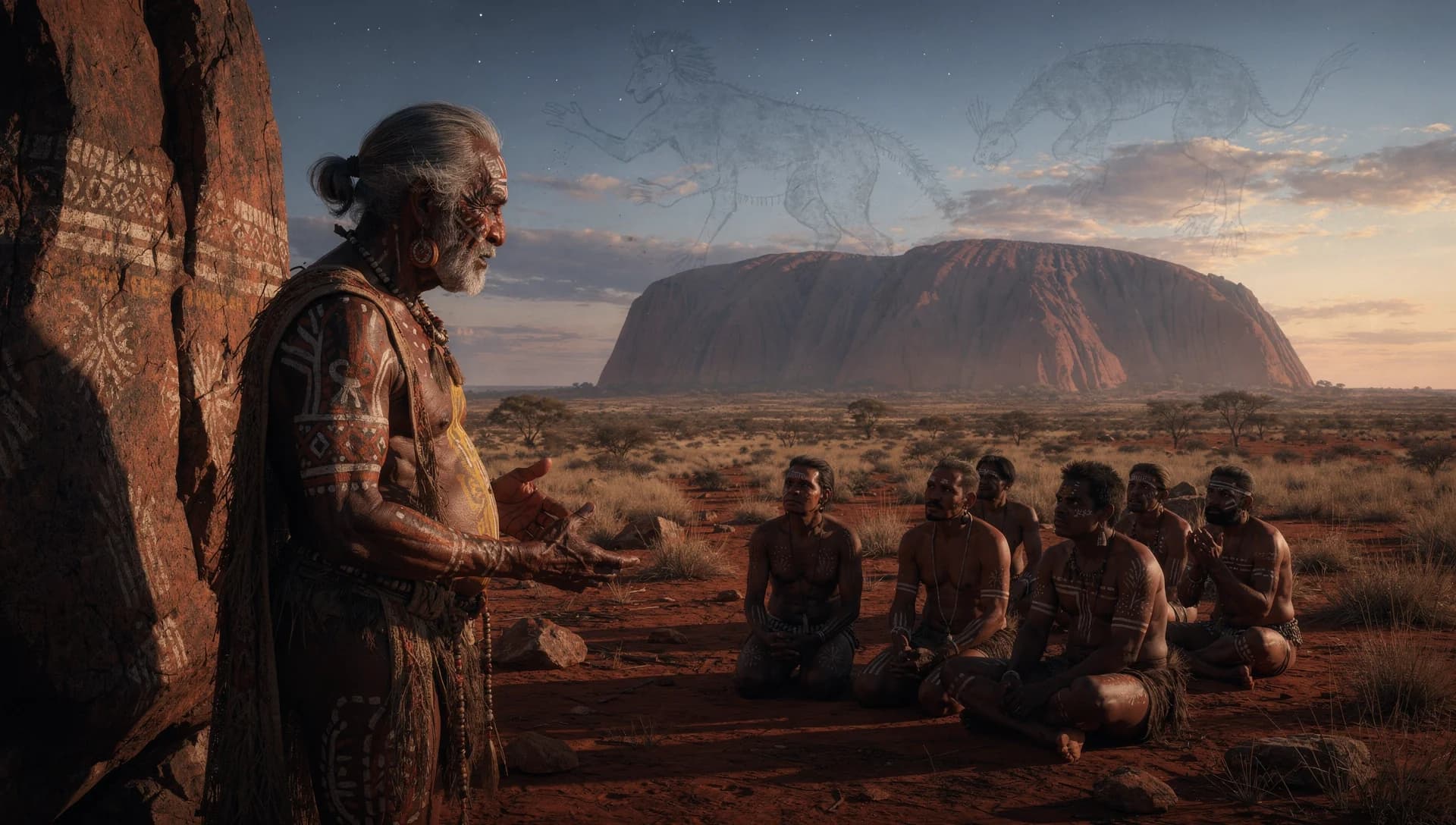
Australian Aboriginal cosmology preserves the "Dreamtime" or "Dreaming," the primordial era when ancestor-beings shaped the land, taught humans language and ceremony, and established moral and social law. The cosmological structure (distant creator, ancestor-beings who descend to establish civilization, sacred sites memorializing their acts) matches the UB pattern of the Prince's staff establishing Dalamatia and its ten councils. The extraordinary persistence of Australian Aboriginal oral tradition, with demonstrably accurate memories of coastlines lost 10,000 years ago, provides a mechanism for how such ancient teaching patterns could survive into the present.
UB Citation
UB 64:7 (racial dispersions); UB 66:5.1-14 (ten councils)
Academic Source
Stanner, The Dreaming and Other Essays (1953); Nunn & Reid, "Aboriginal Memories of Inundation" (2016)
Historical Evidence(Suggestive evidence)
Patrick Nunn and Nicholas Reid's 2016 study in Australian Geographer demonstrated that 21 distinct Aboriginal oral traditions preserve accurate geographic memories of coastline inundation from the Last Glacial Maximum, roughly 10,000 years ago, representing perhaps the longest verifiable oral tradition in the world. W.E.H. Stanner's The Dreaming established the Aboriginal cosmological framework as a sophisticated system of ancestor-teaching and sacred-site memorialization. Both elements (persistence of memory and cosmological structure) fit the UB's account of how ancient pre-rebellion teachings might survive in peripheral populations.
Deep Dive
In 2016, the Australian geographer Patrick Nunn and the linguist Nicholas Reid published a paper in the journal Australian Geographer that quietly upended received wisdom about how long oral traditions can preserve accurate information. They had collected 21 distinct Aboriginal Australian oral traditions about specific coastal inundations: traditions about how a particular bay had once been dry land, about how a specific island had once been connected to the mainland, about how a particular river mouth had once been further offshore. They cross-referenced these traditions with geological reconstructions of post-Pleistocene sea-level rise. The match was extraordinary: the Aboriginal traditions accurately described coastline configurations as they had existed roughly 10,000 years ago, before the post-glacial sea-level rise drowned the earlier coastlines.
This was the strongest empirical demonstration ever made that pre-literate cultural memory can preserve accurate information across timescales of ten thousand years or more. The Aboriginal Australian populations, isolated from external cultural influence for most of this period, had transmitted specific geographic knowledge across roughly 400 generations of oral tradition without losing the underlying accuracy.
Nunn and Reid's findings have profound implications for how scholars approach pre-literate cultural memory generally. The standard scholarly assumption was that oral traditions, while culturally significant, became unreliable as historical sources beyond a few generations. The Aboriginal data shows this assumption was wrong by orders of magnitude. Cultural memory can preserve real information across timescales previously thought impossible.
The Aboriginal Dreamtime cosmology, the broader cultural framework within which these specific oral traditions are embedded, is one of the most sophisticated indigenous cosmologies documented anywhere in the world. W.E.H. Stanner's The Dreaming and Other Essays (1953) established the Dreamtime as the foundational framework: the primordial era when ancestor-beings shaped the land, taught humans language, ceremony, and law, and established the sacred sites that memorialize their actions. Aboriginal religious life consists largely of maintaining the connection to the Dreamtime through ritual practice, song, ceremony, and pilgrimage to sacred sites.
The structural features of Dreamtime cosmology are striking from a comparative perspective. The framework includes a distant supreme creator (variously named depending on language group). It includes ancestor-beings who descend to earth to organize human life and teach civilization. It includes sacred sites that memorialize the ancestor-beings' acts. It includes ritual practices that maintain the connection between humans and the ancestral teaching tradition. It includes a sophisticated system of moral and social law derived from the ancestor-beings' instruction.
The pattern fits the UB framework with surprising precision. UB 64:7 describes the Sangik dispersions, with various racial streams migrating to different regions of the world. UB 66:5.1-14 describes the ten councils of the Prince's staff and their teaching functions. UB 67:4.3 explicitly identifies the cultural memory of post-rebellion superhuman teachers as the source of "the thousand and one legends of a mythical nature, but founded on the facts of the postrebellion days, which later found a place in the folk tales and traditions of the various peoples whose ancestors had participated in these contacts."
The Aboriginal Dreamtime, on this reading, preserves cultural memory of post-rebellion era contact between superhuman teachers and the ancestral Aboriginal populations. The descendants of the original Sangik migrations to Australia carried this memory with them. The extraordinary persistence of Aboriginal oral tradition (now empirically demonstrated by Nunn and Reid for at least one specific element of geographic knowledge) provides the mechanism by which such ancient memory could survive into the present.
The strongest counterargument is that the Dreamtime framework is so distinctively Aboriginal Australian, so embedded in the specific geographic and ecological features of the Australian continent, that it cannot be reasonably read as preserving memory of events that occurred elsewhere. The ancestor-beings of the Dreamtime walked specific Australian landscapes; they shaped specific Australian features; they belong to the Australian land in a way that does not transfer to extra-Australian historical events.
The UB defense is that the Dreamtime framework, while specifically Australian in its surface elaboration, preserves underlying structural elements that are universal across world traditions. The supreme distant creator, the ancestor-teaching figures, the sacred-site memorialization, the ritual maintenance of connection to ancestral teaching: these elements appear across world traditions because they preserve memory of the universal pattern of how organized civilizational teaching was originally delivered. The Aboriginal Australians integrated this universal pattern with their specific Australian landscape and history, producing the distinctively Aboriginal Dreamtime cosmology, but the underlying structural features connect to the universal pattern.
What the Nunn-and-Reid demonstration adds is empirical confirmation that Aboriginal oral tradition really does preserve accurate information across the timescales necessary for the UB framework to be plausible. If the Aboriginal traditions can preserve specific geographic information across 10,000 years, they can in principle preserve other kinds of information across similar or longer timescales. The persistence-of-memory mechanism is not just hypothetical; it is empirically documented.
Key Quotes
“The presence of these extraordinary supermen and superwomen, stranded by rebellion and presently mating with the sons and daughters of earth, easily gave origin to those traditional stories of the gods coming down to mate with mortals. And thus originated the thousand and one legends of a mythical nature, but founded on the facts of the postrebellion days, which later found a place in the folk tales and traditions of the various peoples whose ancestors had participated in these contacts with the Nodites and their descendants.”
“The one hundred were organized for service in ten autonomous councils of ten members each. When two or more of these ten councils met in joint session, such liaison gatherings were presided over by Daligastia.”
Cultural Impact
The recognition that Aboriginal oral tradition preserves accurate ancient information has been transformative for Australian academic and cultural discourse. The Nunn-and-Reid findings have been incorporated into Australian school curricula, university teaching, and policy discussions about indigenous knowledge. Aboriginal cultural authorities increasingly engage with researchers as legitimate knowledge-holders rather than as ethnographic subjects. For the UB framework, the Aboriginal case offers one of the most important empirical anchors available. The UB makes specific historical claims about events tens of thousands of years ago, and one major question for any such framework is how cultural memory could plausibly preserve information across such timescales. The Nunn-and-Reid demonstration provides empirical evidence that the necessary mechanism (very-long-duration accurate oral tradition) is real. This does not prove the UB framework correct; it removes one significant objection to it. For comparative religious studies, the Aboriginal Dreamtime offers a particularly clean example of the universal "ancestor-beings teach civilization" structural pattern. The Australian isolation from external cultural influence for most of human history makes the Aboriginal case useful for testing whether the pattern is genuinely universal or merely diffused through cultural contact. The fact that the pattern appears in Australia, despite the long Australian isolation, supports the universal-pattern reading over the diffused-contact reading.
Modern Resonance
Contemporary Aboriginal Australian communities are engaged in extensive cultural recovery and revitalization work, often in partnership with universities, government agencies, and conservation organizations. The recognition that traditional knowledge preserves real information about historical environmental conditions has supported the integration of traditional ecological knowledge with mainstream scientific environmental management. The UB framework offers theological-historical depth to these contemporary engagements. Aboriginal traditions are not just useful repositories of practical environmental information; they are sophisticated cosmological systems that preserve memory of the original superhuman teaching tradition that shaped early human civilization. Engaging with them as such, rather than as mere ethnographic subjects, restores their proper dignity within the global heritage of human spiritual development. For contemporary readers worldwide, the Aboriginal case offers a powerful example of how cultural memory can preserve information across timescales that the linear-progress narrative tends to dismiss as too long for reliable preservation. The Nunn-and-Reid findings suggest that we should take indigenous traditions seriously as historical sources, not just as cultural artifacts. The UB framework, which depends on the existence of such very-long-duration cultural memory, gains significant credibility from the Aboriginal evidence.
Related Mappings
Andite sailors crossing "the Pacific by easy stages, tarrying on the many islands"
= The Polynesian voyaging ancestor-heroes
Universal Father, supreme creator
= Io, the Maori supreme being known only to the highest priestly caste
Fandors and the Adamson-era memory of giant birds
= The Maori Pouakai / Te Hokioi, giant divine birds
Andite-reinforced culture-heroes remembered as the first Polynesian navigators
= Maui, Pan-Polynesian demigod who fishes up islands and establishes human arts
Related Articles
Where to next
The free newsletter. The research behind each piece, no spam.