
 Mythic
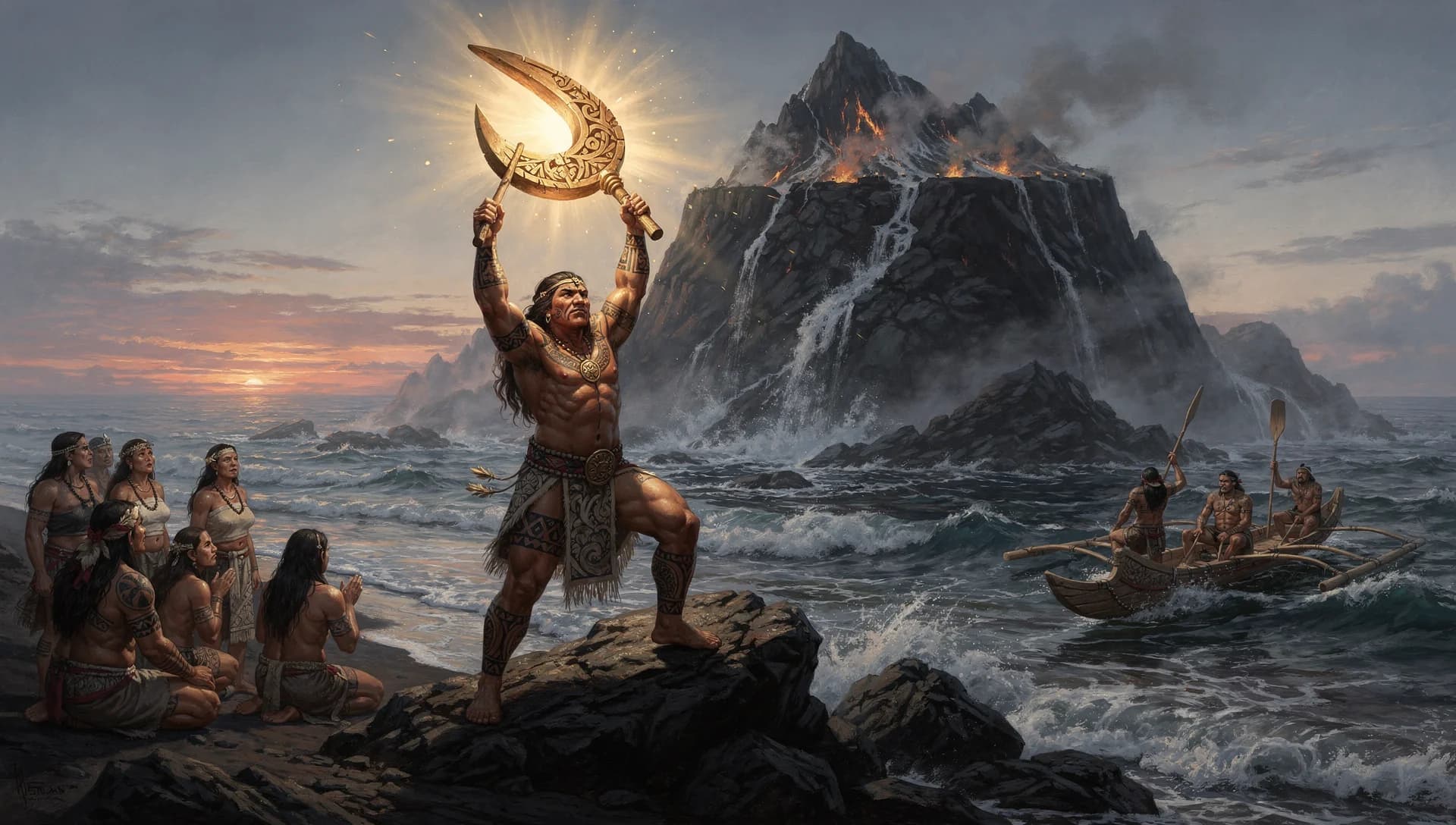
Maui, Pan-Polynesian demigod who fishes up islands and establishes human arts
 UB
UBAndite-reinforced culture-heroes remembered as the first Polynesian navigators
Full Article
Read the deep-dive article on this connection
Andite-reinforced culture-heroes remembered as the first Polynesian navigators = Maui, Pan-Polynesian demigod who fishes up islands and establishes human arts
The Connection
Maui appears across nearly every Polynesian tradition (Hawaiian, Maori, Tahitian, Tongan, Samoan) as a demigod hero who lifts up islands from the sea, lassoes the sun to slow its passage, steals fire for humanity, and establishes the arts of fishing, sailing, and agriculture. Structurally, Maui is the Polynesian version of the culture-bringer superhuman who organizes the natural and civilizational order on behalf of ordinary humans. The UB's 132 Andite sailors, carrying advanced navigational, agricultural, and metallurgical knowledge across the Pacific (78:5.7), provide a specific historical candidate for the underlying memory.
UB Citation
Academic Source
Beckwith, Hawaiian Mythology (1940); Craig, Handbook of Polynesian Mythology (2004)
Historical Evidence(Moderate evidence)
Martha Beckwith's Hawaiian Mythology and Robert Craig's Handbook of Polynesian Mythology both document the Maui cycle as the most widely shared narrative across Polynesia, with sufficient consistency across widely separated archipelagos to indicate a common pre-dispersal origin in the Polynesian homeland. The Maui cycle emphasizes technological and navigational knowledge, the exact domain the UB's Andite sailors would have represented: practical superhuman know-how rather than abstract theology.
Deep Dive
In Hawaiian tradition, Maui is the demigod who fishes up the Hawaiian Islands from the sea floor with his magic fishhook. He lassoes the sun to slow its passage and give humans more daylight for work. He steals fire from the alae bird (the Hawaiian gallinule) for human use. He establishes the technologies of fishing and agriculture. He performs feats of strength and cunning that organize the natural and social order on behalf of ordinary humans.
In Maori tradition, Maui-Tikitiki performs nearly identical feats. He fishes up the North Island of New Zealand. He slows the sun. He brings fire from the underworld. He attempts to defeat death itself by entering Hine-nui-te-Po, the goddess of death, but is killed in the attempt. The Maori Maui is a more tragic figure than the Hawaiian, but the structural narrative is the same.
In Tahitian tradition, the figure is again Maui, with regional variations on the same basic narrative. In Tongan and Samoan traditions, similar Maui-figures perform similar feats. Across the entire Polynesian region, from Hawaii in the north to New Zealand in the south to Easter Island in the east, the Maui cycle is the most widely shared body of narrative material. Martha Beckwith's Hawaiian Mythology (1940) and Robert Craig's Handbook of Polynesian Mythology (2004) document this consistency with extensive comparative material.
The structural consistency across widely separated Polynesian populations indicates that the Maui cycle predates the dispersal of Polynesian peoples across the Pacific. The cycle was carried with the migrating populations from the original Polynesian homeland, and it has been preserved with remarkable fidelity across thousands of kilometers of ocean and many centuries of separate cultural development. This is the diagnostic feature of a pre-dispersal cultural inheritance: consistency across post-dispersal populations that had limited contact with each other.
The cycle's thematic emphasis is on practical, technological, and navigational achievement. Maui fishes up islands (a maritime-survival metaphor for the navigation and settlement of new lands). He slows the sun (an agricultural-temporal achievement, allowing more daylight for cultivation). He brings fire (a basic technology). He establishes the arts of fishing, sailing, and agriculture. He performs feats of strength and cunning that benefit ordinary humans. The cycle is thoroughly oriented toward practical human welfare rather than toward abstract cosmological speculation.
This thematic emphasis is significant for the UB framework. The 132 Andite sailors of UB 78:5.7 carried specifically practical-technological knowledge across the Pacific: advanced navigation, agricultural techniques, metallurgical skills, calendrical understanding, organizational structures. They were not theologians making speculative claims about cosmic structure; they were practical superhuman teachers transmitting concrete civilizational know-how. The Maui cycle's thematic emphasis on practical-technological achievement matches the UB description of what the Andite sailors brought.
The Maui cycle, on the UB account, is the cultural memory of the Andite sailor-teachers preserved in narrative form. The specific feats attributed to Maui (fishing up islands, organizing the calendar, bringing technological knowledge) are mythologized versions of what the Andite teachers actually did: helping populations settle new islands, transmitting calendrical knowledge, introducing technologies. Over centuries, the historical figures became apotheosized into a single demigod figure who carries the cumulative memory of the entire Andite-era teaching mission.
The strongest counterargument is that the Maui cycle can be read entirely as the product of indigenous Polynesian cultural creativity, with no need to invoke external Andite-sailor influence. Polynesian cultures had their own internal dynamics of myth-making, and the Maui cycle could have arisen and spread through entirely indigenous processes. This is a coherent reading.
The UB defense is that the specific structural features of the Maui cycle (a single demigod figure who concentrates the cultural memory of practical-technological achievement) match the pattern that would be expected if the underlying historical reality was a small group of practical-superhuman teachers whose memory was concentrated into a single composite figure over time. The cycle's consistency across non-contacted Polynesian populations argues for a common pre-dispersal source. The thematic match with the UB description of Andite-sailor activities is precise. None of these features prove the UB account, but together they fit the framework better than the purely-indigenous-invention alternative does.
What the Maui cycle offers, regardless of one's position on the UB framework, is one of the cleanest available examples of a culture-hero-demigod whose specific feats are concrete and practical rather than abstract and cosmological. Engaging with the cycle as preserving genuine cultural memory of practical superhuman teaching, rather than as primitive creation-mythology, opens it to a different kind of comparative analysis. The Maui cycle becomes a comparative test case for how practical civilizational knowledge gets remembered across cultures, and the UB framework offers one specific hypothesis about what that remembered reality was.
Key Quotes
“One hundred and thirty-two of this race, embarking in a fleet of small boats from Japan, eventually reached South America and by intermarriage with the natives of the Andes established the ancestry of the later rulers of the Incas. They crossed the Pacific by easy stages, tarrying on the many islands they found along the way.”
“The presence of these extraordinary supermen and superwomen, stranded by rebellion and presently mating with the sons and daughters of earth, easily gave origin to those traditional stories of the gods coming down to mate with mortals.”
Cultural Impact
The Maui cycle has become one of the most globally recognized elements of Polynesian cultural heritage, particularly through its prominence in popular culture. Disney's 2016 animated film Moana made Maui a major character, drawing on his pan-Polynesian cultural status. The cycle has been the subject of extensive scholarly comparative analysis and has been integrated into the cultural curricula of Pacific-region educational systems. The UB framework offers a way to engage with the cycle that takes its cross-cultural consistency seriously while honoring its specifically Polynesian character. Maui is genuinely Polynesian. He is also the cultural memory of practical superhuman teaching that connects to the broader global Andite-era civilizational tradition. Both connections are real and both deserve recognition. For Polynesian-heritage readers, the framework dignifies the Maui cycle as preserving real cultural memory rather than as primitive mythology. The cycle's emphasis on practical achievement is not just simple narrative; it is the diagnostic feature of a tradition that genuinely preserves memory of real practical-technological teaching. Engaging with Maui as such a memory-bearing figure restores his proper dignity within the global heritage of human civilizational development.
Modern Resonance
Contemporary Polynesian voyaging revival movements have made Maui-figures central to their cultural and navigational practice. The Hokulea voyaging tradition, the Te Aurere voyages, and the broader Pacific Voyaging Society network all engage with Maui as a model of practical-navigational achievement that contemporary Pacific peoples can recover and develop. The UB framework supports these revival movements by providing historical depth to the Maui cycle. The cycle is not just a charming traditional story; it preserves real memory of practical superhuman teaching that ultimately traces to the Adamic-Andite civilizational inheritance. Contemporary Polynesians recovering traditional voyaging practices are not just performing cultural revival; they are reconnecting with a tradition that genuinely preserves practical wisdom going back to the very beginning of organized human navigational achievement. For non-Polynesian readers, the Maui cycle offers a particularly clear example of how cultural memory can preserve practical-technological wisdom across millennia. The cycle's thematic emphasis on concrete achievement (fishing, navigation, fire-making, agriculture) makes it useful as a comparative case for understanding how human cultures preserve practical knowledge in narrative form. The framework treats narrative tradition as a real form of cultural data preservation, not just as imaginative storytelling.
Related Mappings
Andite sailors crossing "the Pacific by easy stages, tarrying on the many islands"
= The Polynesian voyaging ancestor-heroes
Universal Father, supreme creator
= Io, the Maori supreme being known only to the highest priestly caste
Fandors and the Adamson-era memory of giant birds
= The Maori Pouakai / Te Hokioi, giant divine birds
Sangik dispersion and long oral memory of pre-rebellion teachings
= Australian Aboriginal Dreamtime and the creator ancestors
Related Articles
Where to next
The free newsletter. The research behind each piece, no spam.