
 Mythic
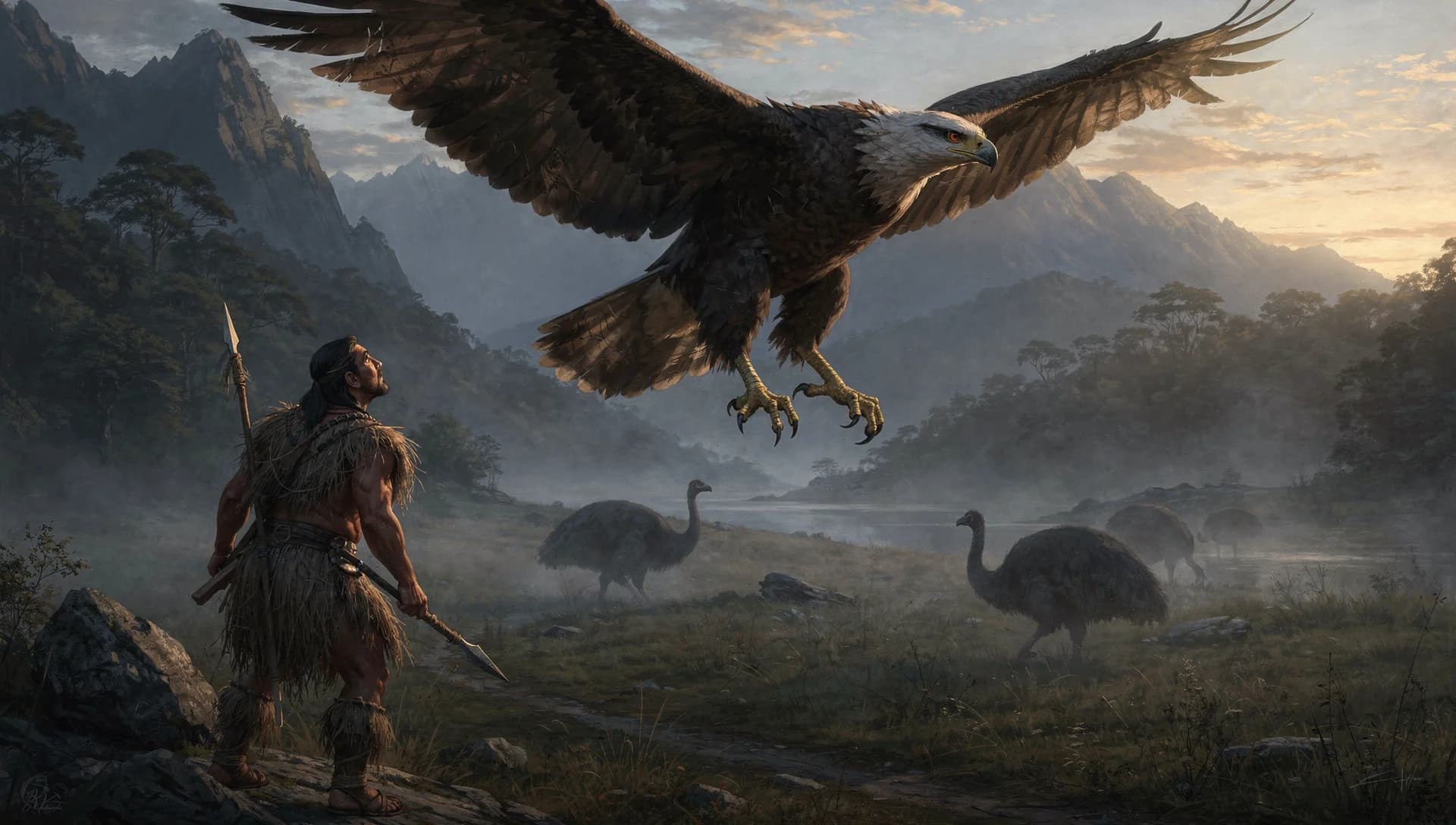
The Maori Pouakai / Te Hokioi, giant divine birds
 UB
UBFandors and the Adamson-era memory of giant birds
Full Article
Read the deep-dive article on this connection
Fandors and the Adamson-era memory of giant birds = The Maori Pouakai / Te Hokioi, giant divine birds
The Connection
Maori tradition preserves memory of the Pouakai or Te Hokioi, a giant bird capable of carrying off a man. Paleontology confirms the Haast's eagle, an eagle with a 3-meter wingspan that preyed on moa, persisted in New Zealand until roughly 1400 CE, recent enough for the incoming Maori to have encountered it directly. In the broader Pacific, memories of giant birds are general. The UB's fandors became extinct roughly 30,000 years ago, but the image of a rideable giant bird carried by Andite teachers into Polynesia would reinforce and be reinforced by the Haast's eagle encounter on arrival in New Zealand.
UB Citation
UB 66:5.6, 74:3.4, 77:5
Academic Source
Worthy & Holdaway, The Lost World of the Moa (2002); Tennyson & Martinson, Extinct Birds of New Zealand (2007)
Historical Evidence(Moderate evidence)
Trevor Worthy and Richard Holdaway documented the Haast's eagle (Hieraaetus moorei) as the largest eagle known in the geological record, with wingspan to 3 meters, extinct approximately 1400 CE. Maori oral tradition of the Pouakai preserves a clearly remembered experience of this animal. The fandor motif in the UB, already connected to Anzu (Sumerian), Garuda (Hindu), and Thunderbird (Indigenous American), finds a natural extension in Polynesian tradition: real giant birds existed, humans remembered them, and Andite-carried memories of fandors blended with direct local encounters.
Deep Dive
Sometime around 1400 CE, the largest eagle ever known to have existed went extinct in New Zealand. The Haast's eagle, Hieraaetus moorei, had a wingspan reaching three meters and a body weight of up to 18 kilograms. It was the apex predator of pre-human New Zealand, hunting moa (the giant flightless birds that filled the herbivore niche on islands without native land mammals) and probably any large prey it could find. When the first Maori settlers arrived in New Zealand around 1300 CE, they encountered this eagle directly. Within roughly a century, both the moa and the Haast's eagle were extinct, the moa hunted by humans and the eagle starved when its primary prey disappeared.
Maori oral tradition preserves clear memory of this giant bird. It is called Pouakai or Te Hokioi, and described in stories as a bird so large it could carry off a man, terrifying enough to require special precautions when traveling, and connected to specific places (particular cliffs and mountains where its nests were said to have been). Trevor Worthy and Richard Holdaway, in The Lost World of the Moa (2002), documented both the paleontological evidence for the Haast's eagle and the Maori oral tradition that preserves direct memory of encounters with it.
The Haast's eagle case is one of the cleanest documented examples of pre-literate cultural memory preserving accurate information about a real animal that subsequently went extinct. The Maori arrived around 1300, encountered the eagle, observed its behavior, told stories about it, and preserved those stories in oral tradition for centuries after the eagle's extinction around 1400. Western paleontology recovered the eagle's existence from its bones starting in the 1870s. The match between the recovered paleontological reality and the preserved oral tradition is precise enough to verify the accuracy of the oral memory.
The UB framework places this Pouakai memory in a broader context. UB 66:5.6 mentions the fandors, the giant passenger birds that the Prince's staff (specifically Bon's group, in the council on tribal government) trained for long-distance travel: "Bon's group were successful in training the great fandors as passenger birds, but they became extinct more than thirty thousand years ago." UB 74:3.4 describes Adam and Eve being shown the Garden of Eden from the air, "carried through the air over this, the most beautiful spot on earth," presumably on fandors during the third day of their tour.
The fandor motif appears widely in world mythology. The Sumerian Anzu (the giant lion-headed bird depicted in the Imdugud Relief at the British Museum). The Hindu Garuda (the divine bird who serves as Vishnu's mount). The Indigenous American Thunderbird (the giant raptor of Pacific Northwest and Plains traditions). The Persian Simurgh (the giant bird who dwells on the cosmic tree). These mythological birds, on the UB account, preserve the cultural memory of the actual fandors that flew over inhabited areas during the long pre-extinction era.
The Maori Pouakai is something different. It is not just preserved memory of mythological-fandor stories; it is direct memory of an actual giant bird (the Haast's eagle) that the Maori encountered in their early settlement of New Zealand. The Pouakai tradition is the ground-floor case of how giant-bird memory works: there were real giant birds, humans encountered them, and humans preserved the memory.
The interesting question is whether the Pouakai tradition is purely local memory of the Haast's eagle, or whether the Maori arrived in New Zealand already carrying mythological-fandor traditions from their broader Polynesian heritage and then attached those traditions to the actual local giant bird they encountered. The UB framework would suggest the latter: the Polynesians arrived with the broader cultural memory of giant birds (carried from Andite-era teaching that ultimately traced to fandor encounters in the Old World), and the Haast's eagle encounter reinforced and localized this memory.
The strongest counterargument is that the Pouakai tradition can be fully explained as local memory of the actual Haast's eagle, with no need to invoke broader cultural transmission of giant-bird mythology. This is a coherent reading. The memory is well-preserved, structurally simple, and adequately accounts for what we know about the Maori-Haast's eagle encounter.
The UB defense is that the broader pattern of giant-bird mythology across world cultures is too consistent to be reduced to independent invention or independent local-memory in each case. The Sumerian Anzu, the Hindu Garuda, the Indigenous American Thunderbird, and the various Polynesian giant-bird traditions share specific structural features (massive wingspan, predatory toward humans, association with sacred mountains or trees) that suggest common cultural memory of an underlying reality. The fandor framework provides a candidate for what that underlying reality was, with the local Pouakai memory of the Haast's eagle being the New Zealand variant of a much broader cross-cultural tradition.
Key Quotes
“It was in these days that carrier pigeons were first used, being taken on long journeys for the purpose of sending messages or calls for help. Bon's group were successful in training the great fandors as passenger birds, but they became extinct more than thirty thousand years ago.”
“The third day was devoted to an inspection of the Garden. From the large passenger birds, the fandors, Adam and Eve looked down upon the vast stretches of the Garden while being carried through the air over this, the most beautiful spot on earth.”
Cultural Impact
The Pouakai tradition has been an important touchstone in New Zealand's cultural conversation about the relationship between Maori traditional knowledge and Western scientific knowledge. The recovery of the Haast's eagle from paleontological evidence in the late nineteenth century, combined with the preserved Maori oral tradition, demonstrated that pre-literate cultural memory could preserve accurate information that Western science only later confirmed. This demonstration has had practical implications for how indigenous knowledge is treated in contemporary New Zealand environmental and cultural policy. The Maori traditional knowledge system (matauranga Maori) is now recognized as a legitimate source of information about historical environmental conditions, rather than being dismissed as primitive folklore. The UB framework adds a global comparative dimension to this New Zealand case. The Pouakai memory is not just an isolated example of accurate indigenous knowledge; it is part of a worldwide pattern of giant-bird memory that connects Maori tradition to Sumerian, Hindu, Indigenous American, and other cultural heritages. The framework dignifies the Maori tradition by placing it in this global comparative context while honoring its specifically New Zealand character.
Modern Resonance
Contemporary climate-change and biodiversity-loss concerns have made the question of recently-extinct large animals newly urgent. The Haast's eagle case is one of many examples of human-driven extinction of large fauna that has accompanied the spread of Homo sapiens across the globe. The Maori played a role in causing the Haast's eagle's extinction (by hunting the moa to extinction and depriving the eagle of its primary prey), and the cultural memory they preserved is therefore also a memory of their own role in environmental change. The UB framework offers a long-historical perspective on this pattern. Humans have been driving large-animal extinctions for tens of thousands of years, with the fandors having gone extinct "more than thirty thousand years ago" and many other large species following similar trajectories. The contemporary biodiversity crisis is the latest expression of a much older pattern, not a uniquely modern aberration. For contemporary readers, the Pouakai case offers a powerful example of how cultural memory can preserve accurate information about lost species. As the current extinction event accelerates, the memories preserved by indigenous and traditional cultures may become increasingly important as records of what has been lost. The UB framework supports treating these memories as serious historical-environmental data rather than as primitive folklore.
Related Mappings
Andite sailors crossing "the Pacific by easy stages, tarrying on the many islands"
= The Polynesian voyaging ancestor-heroes
Universal Father, supreme creator
= Io, the Maori supreme being known only to the highest priestly caste
Sangik dispersion and long oral memory of pre-rebellion teachings
= Australian Aboriginal Dreamtime and the creator ancestors
Andite-reinforced culture-heroes remembered as the first Polynesian navigators
= Maui, Pan-Polynesian demigod who fishes up islands and establishes human arts
Related Articles
Where to next
The free newsletter. The research behind each piece, no spam.