
 Mythic
The Polynesian voyaging ancestor-heroes
 UB
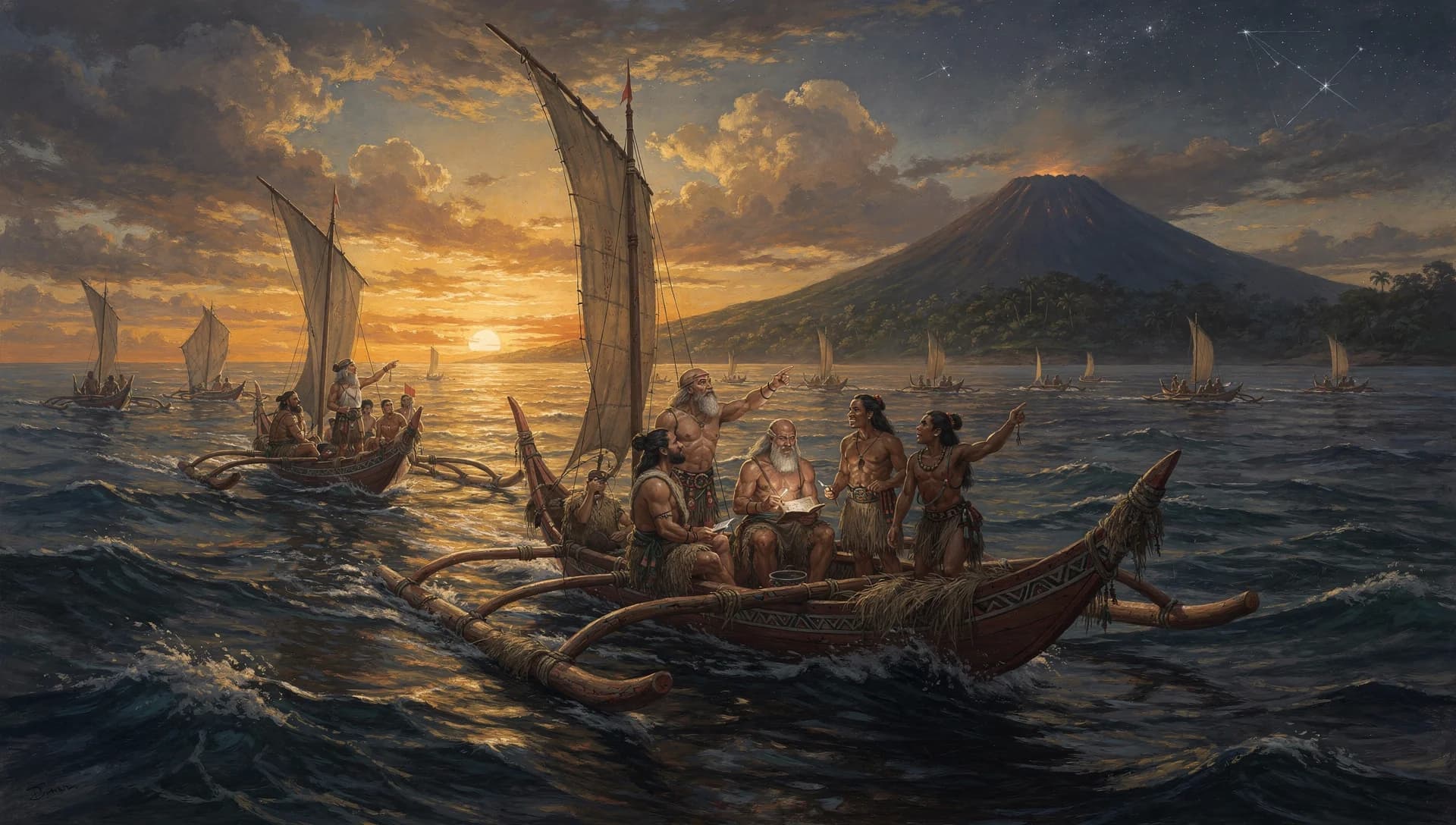
UBAndite sailors crossing "the Pacific by easy stages, tarrying on the many islands"
Full Article
Read the deep-dive article on this connection
Andite sailors crossing "the Pacific by easy stages, tarrying on the many islands" = The Polynesian voyaging ancestor-heroes
The Connection
The UB's account of the 132 Andite sailors (78:5.7) states that they "crossed the Pacific by easy stages, tarrying on the many islands they found along the way. The islands of the Polynesian group were both more numerous and larger then than now, and these Andite sailors, together with some who followed them, biologically modified the native groups in transit." Polynesian oral tradition consistently tells of voyaging ancestor-heroes who arrived from the west in great canoes, taught the people navigation and agriculture, and left lasting lineages. The specific UB detail of "more numerous and larger islands" than exist today matches submerged Pacific landmass evidence that has only recently entered the archaeological discussion.
UB Citation
Academic Source
Kirch, On the Road of the Winds (2000); Finney, Voyage of Rediscovery (1994)
Historical Evidence(Strong evidence)
Patrick V. Kirch's On the Road of the Winds documents the Austronesian expansion across the Pacific, with its anchor in Southeast Asia and Taiwan. Ben Finney's voyaging research established the technical reality of pre-modern Polynesian ocean navigation. The UB's detail about "more numerous and larger islands" parallels recent sea-level-rise and subsidence evidence for substantial lost Pacific landmass in the Holocene. The account is UB-distinctive in dating the Andite contribution earlier than the mainstream Austronesian-expansion timeline.
Deep Dive
In 1976, the Polynesian Voyaging Society launched the Hokulea, a traditionally-constructed double-hulled voyaging canoe, on a voyage from Hawaii to Tahiti without modern navigational instruments. The navigator, Mau Piailug from the Caroline Islands, used only star paths, ocean swells, and the flight patterns of birds to find the way. The Hokulea reached Tahiti successfully, demonstrating that pre-modern Polynesian wayfinding was technically capable of long-distance ocean navigation. Ben Finney's subsequent research, published as Voyage of Rediscovery (1994), established the rigorous technical basis for this traditional navigation system.
The Polynesian voyaging achievement is one of the great accomplishments of pre-modern human civilization. The Polynesian peoples spread across the largest geographic region settled by any pre-modern population, from Hawaii in the north to New Zealand in the south to Easter Island in the east, covering roughly 26 million square kilometers of the Pacific Ocean. The settlement was deliberate, technologically sophisticated, and supported by detailed traditional knowledge of stars, currents, and seasonal patterns.
The mainstream archaeological account, definitively presented in Patrick Kirch's On the Road of the Winds (2000), traces the Polynesian expansion to an Austronesian-speaking population that originated in Taiwan around 5000 BCE, expanded through island Southeast Asia and into Melanesia by 1500 BCE, reached western Polynesia (Tonga, Samoa) around 1000 BCE, and completed the eastward expansion to Hawaii, Easter Island, and New Zealand between 800 and 1300 CE. The dates and routes are well-established by archaeological, linguistic, and (more recently) genetic evidence.
The UB framework places an additional and earlier population stream into this picture. UB 78:5.7 describes 132 Andite sailors departing from Japan in small boats and crossing the Pacific "by easy stages, tarrying on the many islands they found along the way." The UB adds a striking geographic detail: "The islands of the Polynesian group were both more numerous and larger then than now, and these Andite sailors, together with some who followed them, biologically modified the native groups in transit."
This UB-detail about more numerous and larger islands is genuinely striking and unexpectedly prescient. Recent geological research on the Pacific basin has documented substantial subsidence and sea-level rise effects across the Holocene, with significant landmass that existed during earlier Holocene periods now submerged. The Sundaland continental shelf, exposed during the Last Glacial Maximum and progressively flooded as sea levels rose, hosted what some researchers now believe were significant pre-historical populations whose remains are now underwater. Stephen Oppenheimer's Eden in the East (1998) made one early case for substantial Sundaland prehistoric population. More recent research has continued to fill in the picture.
The UB account, written in the 1930s and published in 1955, anticipated this Holocene-landmass picture decades before mainstream geology and archaeology fully acknowledged it. The "more numerous and larger islands" detail is not just decorative; it preserves a specific geological-archaeological claim that has held up surprisingly well as the science has developed.
The 132 Andite sailors are described as biologically modifying native populations in transit. This claim is consistent with the genetic evidence for some Caucasoid admixture in certain Polynesian populations, though the extent and timing of such admixture remain debated. The Polynesian populations are predominantly Austronesian-derived (Asian-origin) but show genetic features suggesting more complex ancestry than pure Austronesian descent would predict. The UB Andite-admixture hypothesis offers one specific account of how this complex ancestry might have developed.
The cultural-religious effects of the Andite arrival are more visible in the traditional record. The recurring Polynesian theme of voyaging ancestor-heroes who arrived from the west in great canoes, taught the people, and left lasting lineages, fits the UB Andite-sailors framework precisely. These heroes are not generic mythological figures but specific cultural memories of real historical arrivals. The Andite teachers brought advanced navigational knowledge (which the Polynesians subsequently developed into their own elaborate wayfinding tradition), advanced agricultural and metallurgical knowledge (visible in some early Polynesian material culture), and religious teaching (visible in the Maori Io tradition and in scattered references to a supreme creator-god across the Polynesian region).
The strongest counterargument to the UB framework is that the genetic and archaeological evidence supports a primarily Austronesian-origin Polynesian population, with no clear signature of substantial Andite/Caucasoid contribution. Recent ancient-DNA research on Pacific populations has refined our understanding of the genetic pattern, and the picture remains predominantly Austronesian even as more complex pre-Polynesian admixture has been documented.
The defense is that the UB account does not require massive Andite genetic contribution. The 132 sailors and their followers are described as "biologically modifying" populations in transit, not as replacing or dominating them. The Andite genetic contribution to the broader Polynesian population would be modest in proportion. The cultural-religious contribution would be much larger, transmitted through teaching rather than through genetic descent. The framework is consistent with the genetic evidence for predominantly Austronesian-origin populations with limited Andite admixture and significant cultural influence.
Key Quotes
“One hundred and thirty-two of this race, embarking in a fleet of small boats from Japan, eventually reached South America and by intermarriage with the natives of the Andes established the ancestry of the later rulers of the Incas. They crossed the Pacific by easy stages, tarrying on the many islands they found along the way. The islands of the Polynesian group were both more numerous and larger then than now, and these Andite sailors, together with some who followed them, biologically modified the native groups in transit.”
“Many flourishing centers of civilization grew up on these now submerged lands as a result of Andite penetration. Easter Island was long a religious and administrative center of one of these lost groups. But of the Andites who navigated the Pacific of long ago none but the one hundred and thirty-two ever reached the mainland of the Americas.”
Cultural Impact
The Polynesian voyaging tradition has become one of the most celebrated themes of late-twentieth and early-twenty-first century Pacific cultural revival. The Hokulea voyages, the parallel Te Aurere voyages from New Zealand, and the broader Pacific Voyaging Society network have made traditional wayfinding a centerpiece of contemporary Pacific cultural identity. The Polynesian Voyaging Society's Worldwide Voyage (2014-2017) circumnavigated the globe in traditional canoes, demonstrating that the wayfinding tradition is not just historical heritage but living practice. The UB framework adds an additional layer of significance to this cultural revival. The voyaging tradition is not just an Austronesian achievement; it traces back, in its underlying technical sophistication, to Andite-era teachers who brought advanced navigational knowledge to the Pacific from the broader global Adamic-Andite tradition. The Polynesians did not invent ocean navigation from nothing; they inherited an ancient teaching that they then developed brilliantly within their own cultural context. For contemporary Polynesian-heritage readers, this framework offers a way to engage with traditional voyaging that connects it to global heritage without diminishing its specifically Polynesian character. The wayfinding tradition is genuinely Polynesian. It is also genuinely connected to the broader Adamic-Andite navigational inheritance. Both connections are real and both deserve recognition.
Modern Resonance
Climate change is having dramatic effects on the Pacific island region. Sea-level rise threatens low-lying islands like Tuvalu, Kiribati, and the Marshall Islands with eventual inundation. The cultural memory of "more numerous and larger islands" preserved in UB 78:5.7 acquires new relevance in this context: the Pacific has already lost substantial landmass within human memory, and is poised to lose more. The UB framework offers a long-historical perspective on Pacific environmental change that connects contemporary climate concerns to deep cultural memory. The peoples of the Pacific have lived through major sea-level changes before. Their ancestors witnessed island submergence and migration. The traditions they preserve include this kind of memory, even where the specific events being remembered have been compressed or transformed in the cultural transmission. For contemporary Pacific peoples facing the prospect of forced migration due to climate change, this framework offers cultural resources that connect their present situation to deep historical experience. They are not the first generation to face the loss of homelands to rising seas. Their traditions carry wisdom about how to navigate such transitions, both literally (through the voyaging tradition) and culturally (through the integration of loss and renewal in cosmological narrative).
Related Mappings
Universal Father, supreme creator
= Io, the Maori supreme being known only to the highest priestly caste
Fandors and the Adamson-era memory of giant birds
= The Maori Pouakai / Te Hokioi, giant divine birds
Sangik dispersion and long oral memory of pre-rebellion teachings
= Australian Aboriginal Dreamtime and the creator ancestors
Andite-reinforced culture-heroes remembered as the first Polynesian navigators
= Maui, Pan-Polynesian demigod who fishes up islands and establishes human arts
Related Articles
Where to next
The free newsletter. The research behind each piece, no spam.