
Io the Parentless: The Maori Supreme Being and the Hidden Salem Layer in Polynesian Religion
Maori tradition preserves, alongside the familiar pantheon of Tane, Rongo, Tu, and Tangaroa, a restricted teaching of Io, the supreme creator known only to the most senior priests. The Urantia Book documents Salem missionary teaching reaching the remotest tribes of Africa and Eurasia. The Io tradition preserves that monotheistic seed in restricted priestly transmission, in line with how the Brahmanic, Celtic, and Chinese esoteric lineages carried the same substrate.
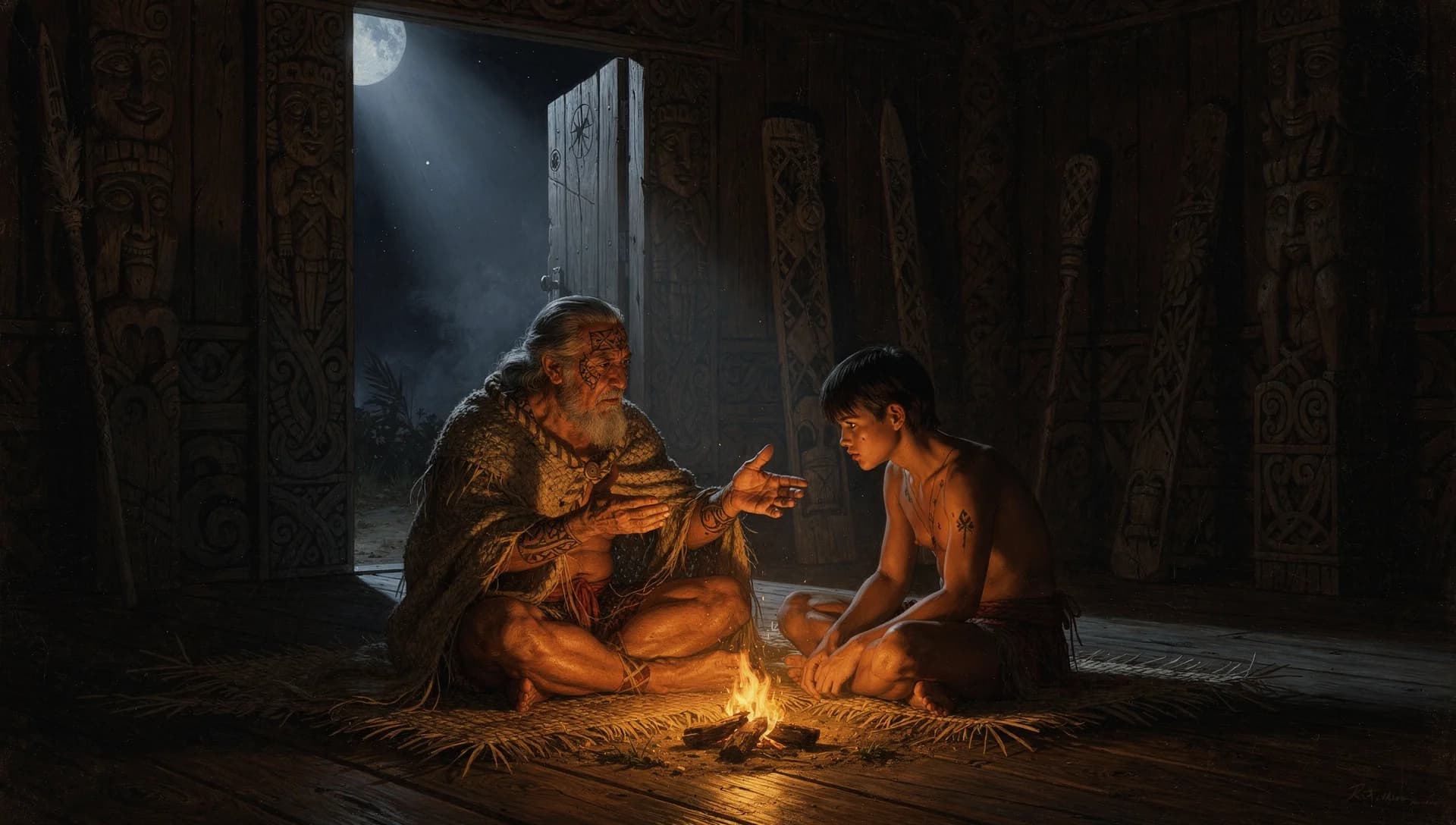
Salem high-god preserved in esoteric priestly transmission = Io, the Maori supreme being known only to the highest priestly caste
This article expands on the decoder mapping. For the side-by-side card and quick reference, see the mapping page.
The Hidden Supreme Being
Maori religious tradition, as recorded by ethnographers working with senior tohunga in the nineteenth and twentieth centuries, preserves a restricted teaching about a supreme being who stands apart from the familiar public pantheon. The pantheon everyone knew included Tane (forest), Rongo (cultivation and peace), Tu (warfare), and Tangaroa (sea). Above them, in the inner teaching, was Io.
The titles attached to Io carry the weight of a fully developed monotheism. He is Io-matua-kore, "Io the parentless." He is Io-nui, "Io the great." He is Io-te-waiora, "Io the living water." He is Io-te-mounga-tapu, "Io the sacred mountain." He is Io-te-matua, "Io the parent." He is Io-kore-te-ahi, "Io without fire." Each title sharpens the same picture: a self-existent creator from whom everything else proceeds.
The Io teaching was not part of the open religion. It belonged to the most senior tohunga of the whare wananga, the house of learning, and was passed on through a formal initiatory pedagogy. The content was held as sacred knowledge and kept separate from what the wider community knew.
The Urantia Book identifies the historical mechanism behind that pattern.
What the Urantia Book Says
The Urantia Book describes the global reach of the Salem missionary enterprise:
"THE early teachers of the Salem religion penetrated to the remotest tribes of Africa and Eurasia, ever preaching Machiventa's gospel of man's faith and trust in the one universal God as the only price of obtaining divine favor." (UB 94:0.1)
It also notes how hard it was to keep the monotheistic content intact in primitive tribal settings:
"But the task was so great and the tribes were so backward that the results were vague and indefinite. From one generation to another the Salem gospel found lodgment here and there, but except in Palestine, never was the idea of one God able to claim the continued allegiance of a whole tribe or race." (UB 93:7.3)
"There was always a tendency for the new doctrine to become absorbed into the older body of religious teaching and magical practice. A new revelation is always contaminated by the older evolutionary beliefs." (UB 93:7.4)
The Urantia Book traces the survival of Salem content across several traditions, though not always through a priesthood that welcomed it. In India the Brahman priests rejected the Salem gospel outright and worked to combat the Salem teachers (UB 94:1.5, 94:1.7), and yet the Melchizedek contribution still carried forward: the populace later returned to the ancient rituals of the Vedas "as they had been modified by the teachings of the Melchizedek missionaries and crystallized by the later Brahman priesthood" (UB 94:4.1). The monotheistic reach in India came from philosophy rather than from the priesthood, and it stopped short of a personal God (UB 94:3.1, 94:3.4). China is the more direct line: Lao-tse "built directly upon the concepts of the Salem traditions when he declared Tao to be the One First Cause of all creation" (UB 94:6.3). So the shape that repeats is not a guarded priestly secret. It is Salem content surviving inside whatever older system absorbed it, which is the tendency the revelators name outright (UB 93:7.4).
In our reading the Polynesian preservation of Io fits that shape. The book's own route for the Salem teachers ends at Japan: "Salem missionaries penetrated all Europe, even to the British Isles. One group went by way of the Faroes to the Andonites of Iceland, while another traversed China and reached the Japanese of the eastern islands" (UB 93:7.2). It names no Salem teacher in the Pacific. The pathway into the Pacific that we propose runs through the 132 Andites of 78:5.7, treated in the companion article on Polynesian Andite sailors. The link between them and Io is ours, not the book's.
What the Ancient Sources Say
The Io tradition reaches us mainly through the work of Elsdon Best, Te Rangi Hīroa (Sir Peter Buck), and later Maori scholars. Best's Maori Religion and Mythology (Dominion Museum Bulletin, 1924, two volumes) is the foundational treatment. Best worked with senior tohunga over decades and recorded the Io teaching with the permission of the elders who carried it.
Best's account fills in the theological detail. Io is the self-existent supreme being from whom every other deity and every created thing proceeds. The creation begins with Io alone in the pre-cosmic void, Te Kore. From there it moves through Te Po, the night, into Te Ao, the light. Cosmic order is established by Io's word and thought. The idea of creation by divine word and thought runs parallel to the Genesis account and to the Christian Logos theology.
Te Rangi Hīroa, of Maori ancestry and trained in both traditional knowledge and Western anthropology, addressed the Io teaching in The Coming of the Maori (Whitcombe and Tombs, 1949). Buck accepted the Io content as authentic pre-European Maori theology while raising fair methodological questions about restricted transmission and theological elaboration.
Scholarly debate has settled into three positions. The first holds that the Io teaching is genuinely pre-European Maori theology preserved in restricted priestly transmission. Best, Buck, Ranginui Walker, and Hirini Melbourne work in this lineage. The second is skeptical. Jonathan Smith and Rawiri Taonui, among others, see post-Christian influence and argue the Io content may be a nineteenth-century elaboration shaped by missionary contact. The third is intermediate. Margaret Orbell and Buck in his more cautious moments treat the Io teaching as authentic pre-European content that has been elaborated and systematized under later influences.
The authenticity question is hard to settle for a clear methodological reason. The Io teaching was restricted to priestly transmission and was not generally known across the broader Maori population. Missionaries working with the wider community usually never encountered it and reported the absence of monotheistic content in open Maori religion. The recovered material we now have came through the cooperation of senior tohunga in the late nineteenth and early twentieth centuries, and that is the body of testimony scholarship has worked from since.
Parallel Polynesian traditions point in the same direction. The Tahitian Ta'aroa tradition carries a primordial creator distinct from the pantheon. Hawaiian Kane includes monotheistic-leaning content in restricted priestly transmission. Samoan Tagaloa preserves creator content beneath the broader pantheon. The same restricted priestly pattern surfaces across Polynesia, which suggests a shared substrate from before the dispersal rather than independent invention in each archipelago.
Why This Mapping Matters
In our reading the Io tradition, and the parallel Polynesian high-god traditions, fit a pattern the Urantia Book's account suggests across several world religions: Salem monotheistic content is preserved in restricted esoteric priestly transmission while the broader population absorbs the religion into a polytheistic framework. The seed is planted, and an inner institution carries it forward through formal initiation while everyday religion continues alongside.
In our reading the Polynesian witness is significant because it would extend Salem reach into the Pacific. The Urantia Book does not name Polynesia in the missionary itinerary. The named routes pass through Africa, Eurasia and the British Isles and end with "the Japanese of the eastern islands" (UB 94:0.1, 93:7.2). The Pacific link through the 132 Andite sailors is our reading. Even so, the Io content carries structural features, a self-existent supreme being, creation by word and thought, a multi-stage cosmogony, that in our reading align closely with the Salem material the Urantia Book attributes to Machiventa's teaching.
The book tells of the Andites who crossed the Pacific in one paragraph:
"They crossed the Pacific by easy stages, tarrying on the many islands they found along the way. The islands of the Polynesian group were both more numerous and larger then than now, and these Andite sailors, together with some who followed them, biologically modified the native groups in transit." (UB 78:5.7)
The passage says the sailors changed the island peoples biologically. It gives them no date (UB 78:5.7, 79:5.9), and it says nothing of what they taught or of Salem. Of the Andites in general the book says: "For the time being, at least, their presence usually improved the religious beliefs and moral practices of the older races" (UB 78:5.8), and that the culture of Mesopotamia spread "over Europe, India, China, northern Africa, and the Pacific Islands" (UB 78:5.8). That the 132 carried the religious content Io preserves is our reading.
The timing counts against a Salem source. If the voyage belongs to the Andite migrations, which the book dates "from about 15,000 to 6000 B.C." (UB 78:3.9), as we read it, it came thousands of years before Machiventa: "It was 1,973 years before the birth of Jesus that Machiventa was bestowed upon the human races of Urantia" (UB 93:2.1). On that reading the 132 could have carried older Adamic and Andite teaching into the Pacific, but not the Salem gospel itself.
The Polynesian record does not yet show the voyage either. The settlement of Rapa Nui is estimated at AD 1150 to 1280 (as cited by Moreno-Mayar et al. 2024, Nature). The contact between Polynesia and the Americas that genetics has dated falls at about AD 1200 and runs the other way, from the Americas into Polynesia (Ioannidis et al. 2020, Nature; Moreno-Mayar et al. 2024). These findings do not show a voyage from Japan across the whole Pacific, which is the voyage the book describes, and we have found no archaeological report of the submerged centers of civilization that 78:5.7 speaks of.
The survival pattern carries weight inside the Urantia framework, though it is not a story of priesthoods guarding a secret. In India the Melchizedek teachings survived inside Vedic ritual that the later Brahman priesthood crystallized, after the priests themselves had rejected the Salem gospel (94:4.1, 94:1.5). In China the line is direct: Lao-tse "built directly upon the concepts of the Salem traditions" (94:6.3). The Io tohunga tradition in Polynesia is the case this article makes. The Celtic and druidic parallel is ours to draw rather than the book's, since the Urantia Book never mentions druids or Celts. What repeats across these traditions is Salem content surviving inside whatever older system absorbed it (93:7.4), sometimes carried by a priesthood and sometimes in spite of one.
The Polynesian extension adds geographic range the Old World cases alone cannot supply. A monotheistic seed traceable to Salem, preserved through restricted priestly institutions across multiple distinct cultural zones, looks like exactly the kind of comprehensive missionary and cultural enterprise the Urantia Book describes.
For Polynesian religious studies, our reading is this. The Io tradition is best read neither as post-European Christian influence nor as a purely indigenous theological development arising in isolation. It is a continuation of pre-dispersal Polynesian religious content that already incorporated elevated monotheistic substrate from the Andite Pacific input, with the possibility of later reinforcement through the trans-Pacific cultural contact that the archaeological record continues to document.
Sources
- The Urantia Book, Paper 93 (Machiventa Melchizedek), Paper 94 (The Melchizedek Teachings in the Orient). Urantia Foundation, first printing 1955. Cited passages: 78:3.9, 78:5.7, 78:5.8, 79:5.9, 93:2.1, 93:7.1-4, 94:0.1, 94:1.5, 94:1.7, 94:3.1, 94:3.4, 94:4.1, 94:6.3.
- Ioannidis, A. G. et al. 2020. Native American gene flow into Polynesia predating Easter Island settlement. Nature 583:572.
- Moreno-Mayar, J. V. et al. 2024. Ancient Rapanui genomes reveal resilience and pre-European contact with the Americas. Nature 633:389.
- Best, Elsdon. Maori Religion and Mythology. Dominion Museum Bulletin, 1924 (two volumes); reprinted Wellington, 1982.
- Buck, Peter (Te Rangi Hīroa). The Coming of the Maori. Whitcombe and Tombs, 1949.
- Walker, Ranginui. Ka Whawhai Tonu Matou: Struggle Without End. Penguin, 1990.
- Orbell, Margaret. The Natural World of the Maori. Collins, 1985.
- Taonui, Rawiri. "Ranginui, Papatūānuku, and the Atua: Creation Beliefs and the Atua." In Te Ara: The Encyclopedia of New Zealand, Ministry for Culture and Heritage, 2005.
- Craig, Robert D. Handbook of Polynesian Mythology. ABC-CLIO, 2004.
- Beckwith, Martha. Hawaiian Mythology. Yale University Press, 1940; reprinted University of Hawai'i Press, 1970.
Confidence and Evidence
- Confidence: INFORMED SPECULATION
- Evidence rating: MODERATE
- Basis: The Urantia Book documents Salem content surviving inside older religious systems across several traditions (93:7.4, 94:4.1, 94:6.3). In our reading the Maori Io tradition preserves structural features (self-existent supreme being, creation by word and thought, generative cosmology) consistent with the Salem substrate; the druidic parallel is ours, since the book never mentions druids. The Pacific link runs through the 132 Andites of 78:5.7, which is also our reading: the book gives them no date and says nothing of what they taught, its Salem route ends at Japan (93:7.2), and no archaeological or genetic trace of their voyage has yet been found.
Related Decoder Articles
- Polynesian Voyaging Ancestors = Andite Sailors
- Brahmanic Monotheism = Salem Priestly Preservation
- African High-God = Salem Monotheism Layer
Byline: Derek Samaras | Urantia Book Network | April 2026
Connecting Articles
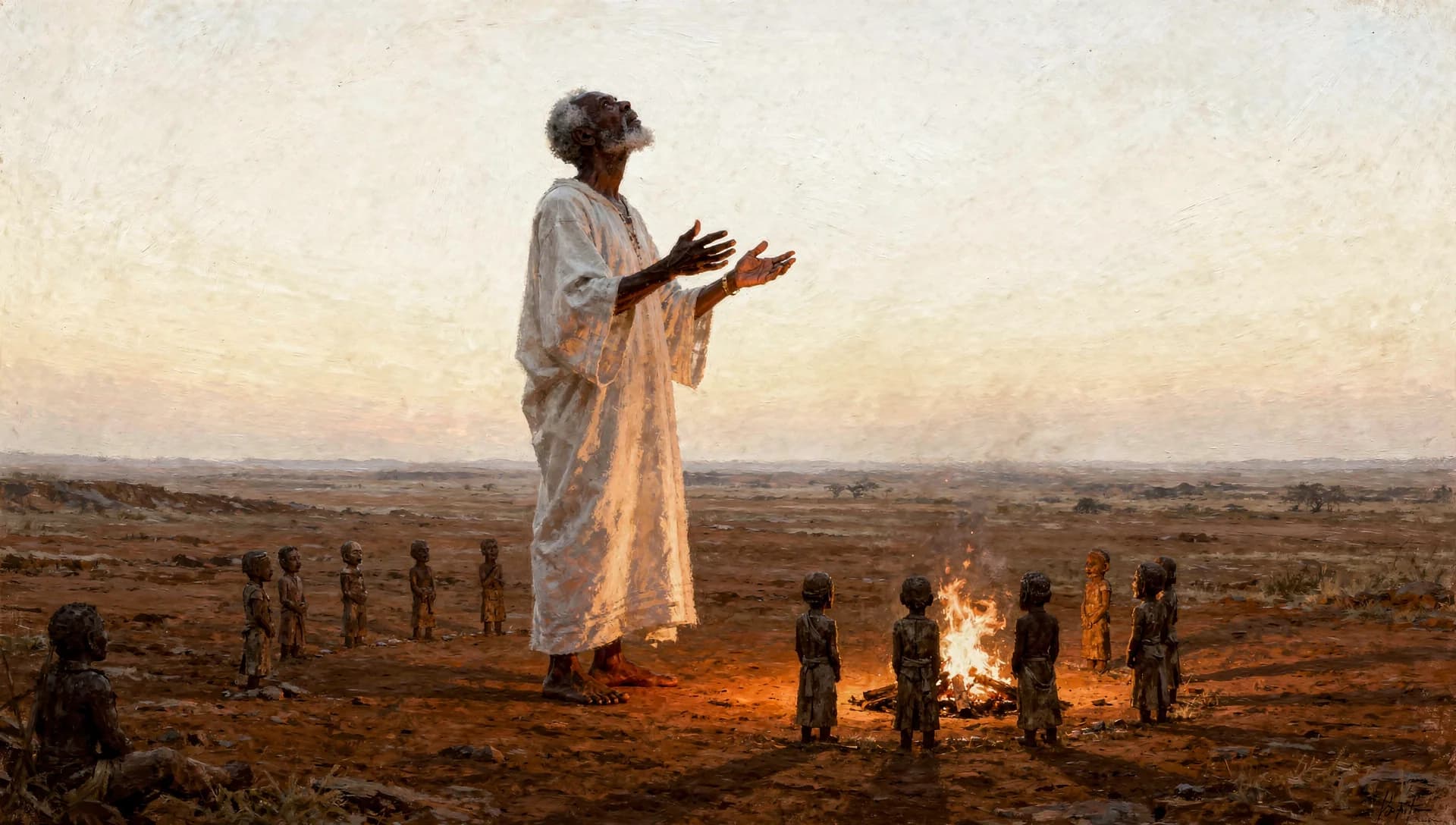
The Sky God Who Withdrew: African High-God Traditions and the Salem Teaching Layer
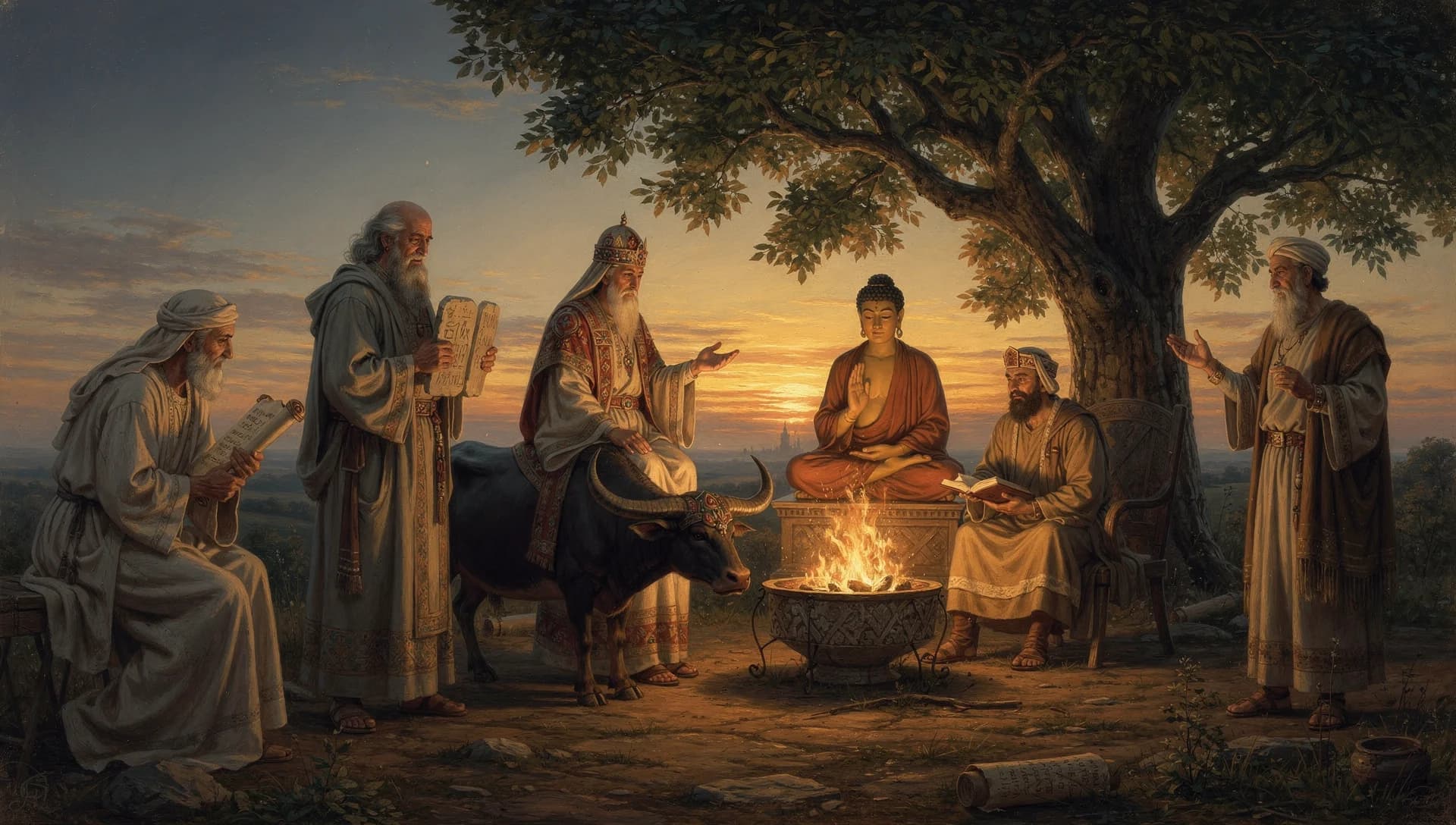
Seven Teachers, One Preparation: The Axial Age and the Salem Continuity
The Vow to Stay: Bodhisattva Ideal and the Salem Missionary Commission
The Primordial Teacher Before Buddha: Tonpa Shenrab, Yungdrung Bön, and the Salem Layer in Tibetan Religion
The Newsletter
Get the research behind each piece
Free. New Urantia Book explorations, the sources behind the videos, and early looks. No spam, unsubscribe anytime.
Prefer video? Follow on YouTube and Facebook.
Delivered through Substack. You can also read past issues.