
 Mythic
Biblical Noah, composite figure
 UB
UBThree Noahs: Historical, Regional, and Literary
Full Article
Read the deep-dive article on this connection
Three Noahs: Historical, Regional, and Literary = Biblical Noah, composite figure
The Connection
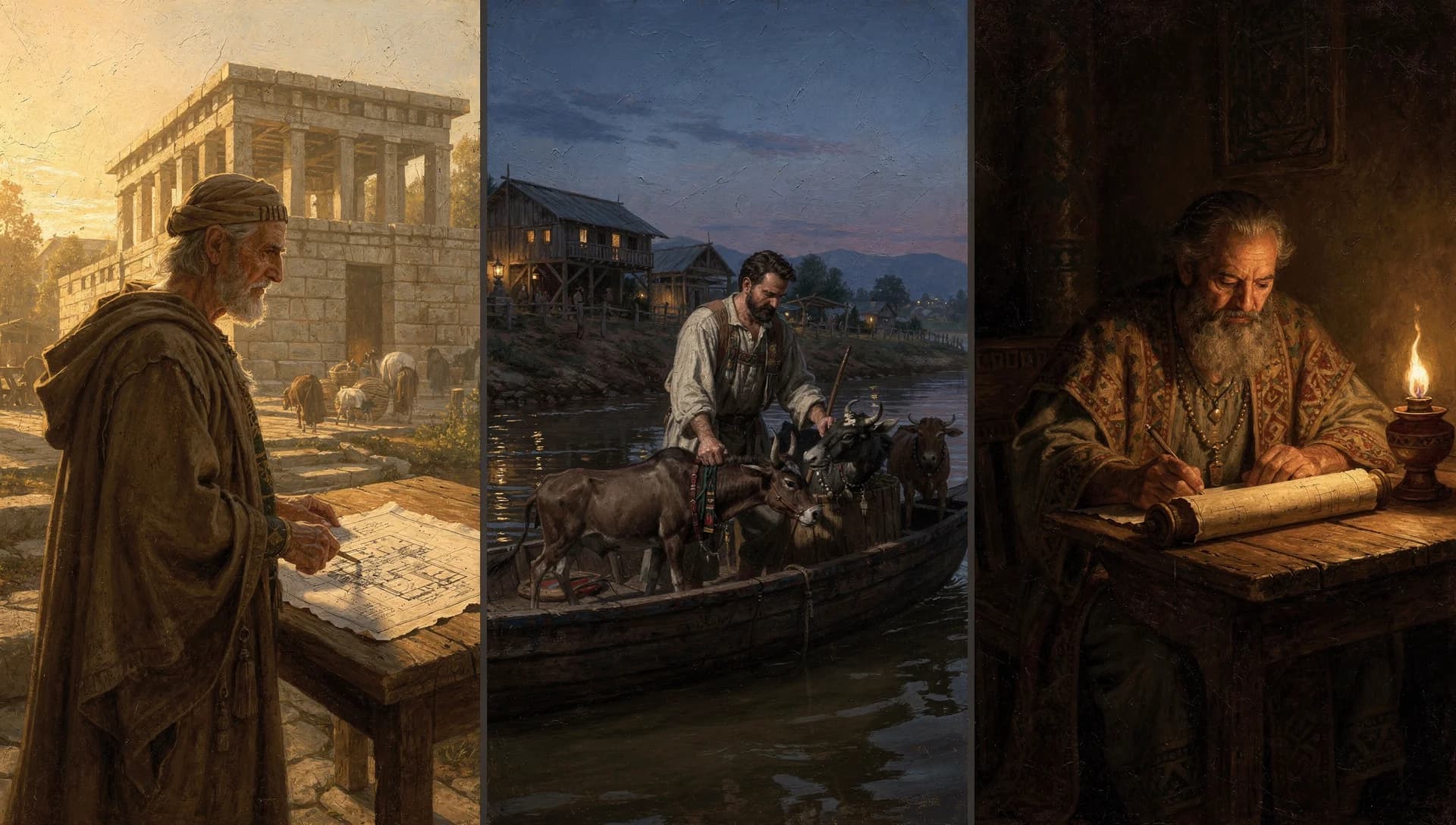
The UB names three distinct "Noahs" collapsed into one Genesis character: (1) Noah, son of the architect and builder of the Garden of Eden, present at Adam and Eve's arrival (74:2.5), (2) Noah of Aram, a real wine maker near Erech who kept flood records and warned his neighbors to build boat-shaped houses (78:7.5), (3) the literary Noah of Genesis, invented by Hebrew priests during the Babylonian captivity to simplify the genealogy back to Adam (78:7.3-4). The biblical flood narrative is a priestly construction; there was never a universal flood.
UB Citation
UB 74:2.5, 78:7.2-5
Academic Source
Genesis 6-9; Atrahasis Epic; Gilgamesh XI; Ryan & Pitman, Noah's Flood (1998)
Historical Evidence(Strong evidence)
A clear chain of literary inheritance is documented: Ziusudra (Sumerian, c. 2100-2000 BCE) to Atrahasis (Old Babylonian, c. 1800 BCE) to Utnapishtim (Standard Babylonian Gilgamesh XI) to Noah (Hebrew, finalized 7th-5th century BCE). TheTorah.com (academic): "These are not parallel inventions; they are successive reworkings. The overlaps are structural and, in some cases, verbal." Three distinct Mesopotamian flood heroes predate Genesis by 1,000+ years.
Deep Dive
In 1872 George Smith of the British Museum was working through fragments of cuneiform tablets recovered from the library of Ashurbanipal at Nineveh when he stumbled on the Babylonian flood account in tablet XI of the Gilgamesh Epic. Smith was so excited that he reportedly stripped to his shirt and ran around the room. The Babylonian story preserves all the major narrative beats of the Genesis flood, in some places using nearly identical phrasing: a pious hero is warned of an impending flood, builds a great boat, takes his family and pairs of animals aboard, rides out the deluge, sends out birds (a dove, a swallow, a raven) to test the waters, lands on a mountain, and offers sacrifice. The Babylonian flood text predates the Hebrew text by over a thousand years.
The chain of literary descent is well documented. Ziusudra of the Sumerian flood story (c. 2100-2000 BCE) becomes Atrahasis in the Old Babylonian account (c. 1800 BCE) becomes Utnapishtim in the Standard Babylonian Gilgamesh Epic XI becomes Noah in Genesis (canonical form 7th-5th century BCE). The Hebrew version is the latest and the most theologically reframed but the substantive narrative beats are continuous. Mainstream biblical scholarship treats the flood narrative as a Hebrew priestly reception of the older Mesopotamian tradition, with the theological reframing distinctive (one God, a moral cause for the flood, a covenant promise after) but the narrative architecture inherited.
The Urantia Book provides the actual historical sequence behind both the Mesopotamian and the Hebrew traditions. There were not one Noah but three, and the conflations are the work of priestly editors over centuries.
First, Paper 74:2.5 records the original Noah, present at the very founding of the second garden: "Soon after their awakening, Adam and Eve were escorted to the formal reception on the great mound to the north of the temple. This natural hill had been enlarged and made ready for the installation of the world's new rulers. Here, at noon, the Urantia reception committee welcomed this Son and Daughter of the system of Satania. Amadon was chairman of this committee, which consisted of twelve members embracing a representative of each of the six Sangik races; the acting chief of the midwayers; Annan, a loyal daughter and spokesman for the Nodites; Noah, the son of the architect and builder of the Garden and executive of his deceased father's plans; and the two resident Life Carriers." This Noah is a thirty-eight-thousand-year-old figure, a Nodite of the loyal lineage, an architect's son carrying out his deceased father's plans for the second garden. He is the prestigious original whose name eventually got attached to the later flood story.
Second, Paper 78:7.5 records the actual flood-Noah: "But Noah really lived; he was a wine maker of Aram, a river settlement near Erech. He kept a written record of the days of the river's rise from year to year. He brought much ridicule upon himself by going up and down the river valley advocating that all houses be built of wood, boat fashion, and that the family animals be put on board each night as the flood season approached. He would go to the neighboring river settlements every year and warn them that in so many days the floods would come. Finally a year came in which the annual floods were greatly augmented by unusually heavy rainfall so that the sudden rise of the waters wiped out the entire village; only Noah and his immediate family were saved in their houseboat." This is a real historical figure, a regional flood survivor, around 5000 BCE in Mesopotamia, whose biography became the substrate of the Atrahasis-Ziusudra-Utnapishtim narrative tradition. He is the source of the Mesopotamian flood literature.
Third, Paper 78:7.3 records the literary Noah, the priestly invention: "Almost five thousand years later, as the Hebrew priests in Babylonian captivity sought to trace the Jewish people back to Adam, they found great difficulty in piecing the story together; and it occurred to one of them to abandon the effort, to let the whole world drown in its wickedness at the time of Noah's flood, and thus to be in a better position to trace Abraham right back to one of the three surviving sons of Noah." Paper 78:7.4 explicitly states: "The Biblical story of Noah, the ark, and the flood is an invention of the Hebrew priesthood during the Babylonian captivity. There has never been a universal flood since life was established on Urantia."
So the canonical Genesis Noah is a literary composite. The name comes from the Nodite original at the founding of the second garden. The flood biography comes from the regional Mesopotamian flood-survivor at Erech. The universal-flood frame comes from the Hebrew priests at Babylon, who needed a literary device to bridge the genealogical gap from Adam to Abraham. The priestly editors did not invent the flood material; they inherited it from the Mesopotamian tradition (the Atrahasis and Gilgamesh narratives were available in Babylon during the captivity, in libraries the exiles had access to). They synthesized the older Hebrew tradition of the architect's son with the Mesopotamian flood-survivor tradition and grafted the resulting composite onto the genealogy.
Paper 78:7.6 records that "these floods completed the disruption of Andite civilization. With the ending of this period of deluge, the second garden was no more. Only in the south and among the Sumerians did any trace of the former glory remain." The regional flooding around Erech in the early-to-middle fifth millennium BCE was a real catastrophic event for the Andite civilization of Mesopotamia. It was not a worldwide deluge, but it was civilization-disrupting for a significant region, and the cultural memory was preserved and elaborated through Sumerian, Akkadian, and eventually Hebrew priestly hands.
Robert Ballard's underwater archaeology in the Black Sea, beginning in 1999, has documented at least one major regional flooding event in the broader region around 5600 BCE that submerged significant inhabited coastlines. The Ryan and Pitman 1998 hypothesis of a Black Sea flood from the Mediterranean has been refined by subsequent research. Whether or not the specific Black Sea event is the one preserved in cultural memory, the basic UB claim that the flood narrative descends from a real regional catastrophe rather than from cosmogonic myth is consistent with the developing geological and archaeological picture. The Hebrew priests' universalizing of a regional event is exactly what comparative scholarship has documented across many ancient Near Eastern flood traditions.
The strongest counterargument is the doctrinal investment in a literal worldwide flood. Young-earth creationism, in particular, has insisted on a global flood as the explanation for the geological column. The reply is that the Hebrew text itself does not require a strictly worldwide reading; "all the earth" (kol ha-aretz) in Hebrew can mean "all the land" in the regional sense, as it does in many other biblical contexts. The mainstream scholarly consensus, including evangelical Old Testament scholarship outside the strict young-earth tradition, has long accepted that the Genesis flood account is best read as a theologically reframed regional event rather than as a literal global catastrophe. The UB reading converges with the mainstream position and adds biographical specificity.
What the parallel implies is that the Genesis flood narrative is real history, refracted through millennia of priestly transmission and editorial synthesis. The decoder's job is to disambiguate the three Noahs and let each of them stand in his own historical place.
Key Quotes
“Almost five thousand years later, as the Hebrew priests in Babylonian captivity sought to trace the Jewish people back to Adam, they found great difficulty in piecing the story together; and it occurred to one of them to abandon the effort, to let the whole world drown in its wickedness at the time of Noah’s flood, and thus to be in a better position to trace Abraham right back to one of the three surviving sons of Noah.”
“The traditions of a time when water covered the whole of the earth’s surface are universal. Many races harbor the story of a world-wide flood some time during past ages. The Biblical story of Noah, the ark, and the flood is an invention of the Hebrew priesthood during the Babylonian captivity. There has never been a universal flood since life was established on Urantia.”
“But Noah really lived; he was a wine maker of Aram, a river settlement near Erech. He kept a written record of the days of the river’s rise from year to year. He brought much ridicule upon himself by going up and down the river valley advocating that all houses be built of wood, boat fashion, and that the family animals be put on board each night as the flood season approached.”
Cultural Impact
The Genesis flood narrative is one of the most consequential stories in religious imagination. Through the Hebrew Bible into the Christian and Muslim traditions, the Noah story shaped how three of the world's major religions understood divine judgment, covenantal mercy, and the moral relationship between God and humanity. Through medieval Christian iconography (the long tradition of ark paintings, mosaics, and sculpture), through the Renaissance recovery (Michelangelo's Sistine ceiling), through Romantic literature and the explosion of modern flood-myth comparativism, the story has been central to Western culture. The wider scholarly tradition of comparative flood mythology, beginning with George Smith's discovery in 1872, has documented hundreds of flood-survival narratives across world cultures, suggesting some genuine catastrophic memory underlying the universal pattern. The UB account preserves what is real in this universal memory (regional catastrophic floods, surviving heroes, preserved animals) while clarifying what is literary editorial invention (the universal-flood frame, the conflation of three Noahs into one). The cultural inheritance is durable and ongoing; the UB account makes it more accurate without diminishing its substance.
Modern Resonance
Contemporary biblical scholarship and contemporary geology have together made the literal worldwide flood reading scientifically untenable. Young-earth creationism continues to defend the literal reading, but mainstream evangelical Old Testament scholarship and Catholic biblical exegesis have largely accepted that the Genesis flood is best read as a theologically reframed regional event. The UB framework offers a coherent middle position: the flood was real, the survivor (the Erech wine maker) was real, the narrative tradition descending through Sumerian, Akkadian, and Hebrew hands is real, and the universal-flood frame is a priestly editorial decision made for specific genealogical reasons during the Babylonian captivity. Modern readers wrestling with the Genesis flood can accept the historical core (real regional flood, real survivor, real tradition) without committing to the literal universal-flood reading that the geological evidence rules out. The decoder's job is to disambiguate the layers and let each layer carry its own historical weight. Three Noahs, three different historical realities, conflated into one canonical figure by editors who had reasons we can now reconstruct.
Related Mappings
Serapatatia, well-meaning Nodite leader
= The Serpent in the Garden of Eden
Eve's mating with Cano the Nodite
= "Eating the Forbidden Fruit" / Original Sin
Cain receiving a Thought Adjuster
= The "Mark of Cain," divine protection
Machiventa Melchizedek, incarnated teacher
= Melchizedek, mysterious priest-king deleted from Genesis
Related Articles
Where to next
The free newsletter. The research behind each piece, no spam.