
 Mythic
"Eating the Forbidden Fruit" / Original Sin
 UB
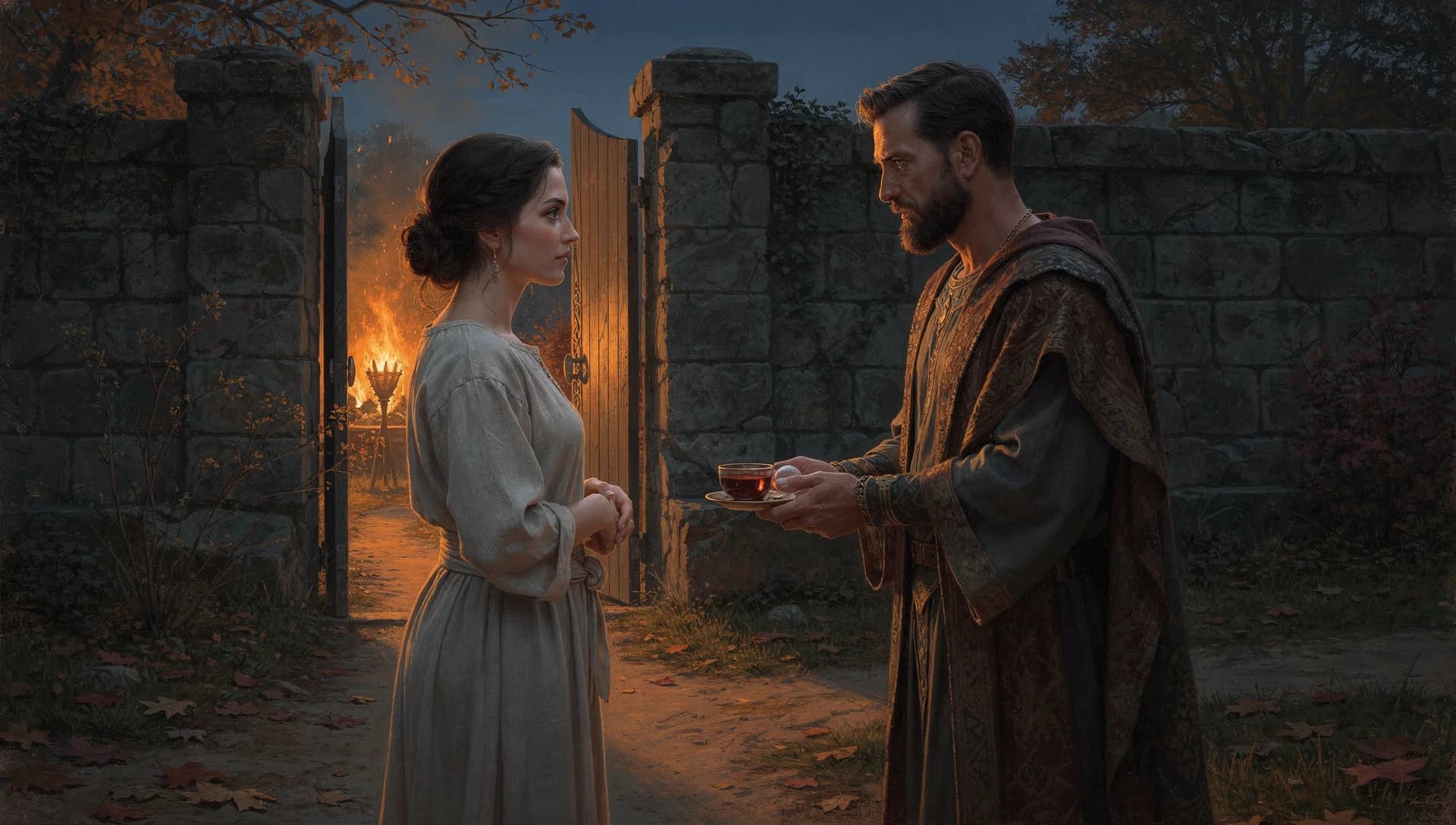
UBEve's mating with Cano the Nodite
Full Article
Read the deep-dive article on this connection
Eve's mating with Cano the Nodite = "Eating the Forbidden Fruit" / Original Sin
The Connection
The UB explains that Genesis is a euphemism for a sexual union: "eating fruit" equals mating with Cano. The "forbidden" act was the compromise of the Adamic biologic mission. "Original sin" is a theological abstraction built on a garbled memory of a real default by a real Material Daughter.
UB Citation
UB 75:3-5, 76:4
Academic Source
Genesis 3; Augustine, De Civitate Dei
Historical Evidence(Moderate evidence)
Bernhard Lang (Society for OT Study, Ashgate, 2008) reconstructs the forbidden tree as originally a mandrake promoting fertility, with a pre-canonical narrative involving gods prohibiting the fruit so only they would possess the secret of fertility/sexuality. The Adapa Myth (Mesopotamian): both Adapa and Adam "underwent a test before the deity based upon something they were to consume, both failed and forfeited immortality."
Deep Dive
The reading of Genesis 3 that has dominated Western Christian theology for sixteen centuries treats the forbidden fruit as literal botany: a real fruit, on a real tree, eaten in real disobedience to a real divine command. Augustine, in De Civitate Dei and the anti-Pelagian writings, built the doctrine of original sin on this literal-fruit reading. Aquinas systematized it. Calvin defended it. Milton dramatized it. Modern Christian theology has spent two centuries trying to extract the doctrinal lessons from a story whose literal reading produces increasingly difficult theological consequences.
The Hebrew text itself does not require the literal-fruit reading. The verb "to eat" (akal) carries metaphorical extensions throughout the Hebrew Bible, including sexual ones. "Knowing" (yada) is the standard Hebrew euphemism for sexual relations: Adam knew Eve his wife, and she conceived. The "tree" (etz) is a polyvalent symbol in the broader ancient Near Eastern imagination, often associated with fertility cults, with the goddess Asherah, with sacred groves where ritual sexual practices occurred. Bernhard Lang's reconstruction in the Society for OT Study volume of the Eden narrative shows that the pre-canonical layer of Genesis 3 was structured around a mandrake (a fertility-promoting plant) rather than around an apple, with the gods' prohibition being on the secret of fertility itself. The Mesopotamian Adapa myth, often paired with Genesis 3 by comparativists, has Adapa offered the food of immortality and refusing it on the warning of his patron god Ea, with the result that Adapa and his descendants forfeit eternal life. The structural unit (a primordial figure, a test involving a substance to be consumed, a failure, the forfeit of immortality) is shared between Adapa and Adam, with the substance varying.
The Urantia Book provides the sober biographical version. Paper 75:3.5 records Serapatatia's proposal: "Serapatatia contended that, if the Nodites, as the most progressive and co-operative race, could have a leader born to them of part origin in the violet stock, it would constitute a powerful tie binding these peoples more closely to the Garden." Paper 75:3.7 records Eve's consent to a secret conference with Cano. Paper 75:3.8 records the meeting: "The fateful meeting occurred during the twilight hours of the autumn evening, not far from the home of Adam. Eve had never before met the beautiful and enthusiastic Cano, and he was a magnificent specimen of the survival of the superior physique and outstanding intellect of his remote progenitors of the Prince's staff." The parenthetical at the end of 75:3.8 is significant: "Outside of the Garden, multiple mating was a common practice." Paper 75:3.9 records the consent: "Influenced by flattery, enthusiasm, and great personal persuasion, Eve then and there consented to embark upon the much-discussed enterprise, to add her own little scheme of world saving to the larger and more far-reaching divine plan. Before she quite realized what was transpiring, the fatal step had been taken. It was done."
The "fatal step" was a sexual union with Cano of the Nodites, ahead of the Edenic schedule and outside the strict requirement of biological purity that the Adamic mission required. The "fruit" of Genesis 3 is the cultural memory of this event, mediated through five thousand years of priestly retelling. The euphemistic transfer from sexual act to consumed food is exactly the kind of thing the Hebrew text accommodates, and the kind of thing the priestly editors at Babylon would have done to render an embarrassing and theologically delicate event in canonical form.
Paper 75:5.2 records Adam's parallel default: "It was in the despair of the realization of failure that Adam, the day after Eve's misstep, sought out Laotta, the brilliant Nodite woman who was head of the western schools of the Garden, and with premeditation committed the folly of Eve. But do not misunderstand; Adam was not beguiled; he knew exactly what he was about; he deliberately chose to share the fate of Eve. He loved his mate with a supermortal affection, and the thought of the possibility of a lonely vigil on Urantia without her was more than he could endure." This is the moral high point of the narrative. Adam was not deceived; he chose to share Eve's fate out of love. The Genesis 3 sequence preserves this in its own way: the woman gave him the fruit and he ate. The man's act is not depicted as a separate seduction but as a deliberate choice to follow his wife.
Paper 75:4.4 preserves the substance of the warning: "Every time the Garden pair had partaken of the fruit of the tree of life, they had been warned by the archangel custodian to refrain from yielding to the suggestions of Caligastia to combine good and evil. They had been thus admonished: In the day that you commingle good and evil, you shall surely become as the mortals of the realm; you shall surely die." The structural match with Genesis 2:17 is exact: "in the day that you eat of it you shall surely die." The Hebrew text has preserved the warning verbatim across five thousand years of priestly transmission. What it has lost is the specifics of what "commingling good and evil" meant in the original biographical context. The UB recovers the specifics: a premature mating that compromised the violet race purity that the planetary mission required.
Paper 76:4.1 records the result: "Adam and his offspring had blue eyes, and the violet peoples were characterized by fair complexions and light hair color, yellow, red, and brown." Paper 76:4.2 adds: "Eve did not suffer pain in childbirth; neither did the early evolutionary races. Only the mixed races produced by the union of evolutionary man with the Nodites and later with the Adamites suffered the severe pangs of childbirth." The Genesis 3 curse on Eve, "I will greatly multiply your pain in childbearing," is the cultural memory of this real biological consequence. The mixed populations resulting from the post-default mingling did suffer increased childbirth pain compared to the pure violet line that would have existed had the mission gone according to schedule.
The strongest counterargument is that the UB account is a euphemistic rationalization of a mythic narrative, and the Genesis text is what it appears to be: a story about disobedience-by-eating, with the moral lesson about following God's commands. The reply is that the Hebrew text itself supports the sexual reading at multiple levels, the Mesopotamian comparative material supports it, modern critical scholarship has been moving toward it for over a century, and the UB account fits the text more precisely than the literal-fruit reading does. The doctrinal architecture built on the literal reading (universal inherited guilt, total depravity, the necessity of substitutionary atonement) was always a reach from the actual textual base. The UB's biographical reading recovers the actual event and lets the doctrinal architecture rest on more sustainable foundations.
What the parallel implies is that the Eden story is real history, not religious fiction or psychological allegory. A real default occurred. Real biological consequences followed. The Hebrew priests at Babylon preserved the substance in canonical form, with euphemism and theological elaboration, but the underlying event was a particular biographical fact with particular consequences. The decoder's job is to make the actual event visible.
Key Quotes
“The fateful meeting occurred during the twilight hours of the autumn evening, not far from the home of Adam. Eve had never before met the beautiful and enthusiastic Cano, and he was a magnificent specimen of the survival of the superior physique and outstanding intellect of his remote progenitors of the Prince’s staff.”
“Every time the Garden pair had partaken of the fruit of the tree of life, they had been warned by the archangel custodian to refrain from yielding to the suggestions of Caligastia to combine good and evil. They had been thus admonished: “In the day that you commingle good and evil, you shall surely become as the mortals of the realm; you shall surely die.””
“It was in the despair of the realization of failure that Adam, the day after Eve’s misstep, sought out Laotta, the brilliant Nodite woman who was head of the western schools of the Garden, and with premeditation committed the folly of Eve. But do not misunderstand; Adam was not beguiled; he knew exactly what he was about; he deliberately chose to share the fate of Eve.”
Cultural Impact
The doctrine of original sin shaped Western Christian theology for sixteen centuries. Through Augustine's anti-Pelagian writings, the Council of Carthage in 418, and the long Catholic and Protestant theological traditions, the doctrine became the foundation of Western soteriology. Calvin's doctrine of total depravity, Luther's doctrine of inherited guilt, the Tridentine Catholic position, and the Wesleyan and Arminian alternatives all worked within the inherited framework. The doctrine shaped marriage, sexuality, and family life in Western Christendom: sexual desire was suspect because it was the channel through which original sin was transmitted to each new generation. Augustine's specific identification of concupiscence as the residue of the Fall colored Western sexual ethics down to the present. Outside theology, the doctrine shaped Western literature (Milton, Hawthorne, Faulkner), psychology (Freud's reception of Christian sexual guilt), and political philosophy (Hobbes's pessimism about human nature, the Calvinist theological substrate of New England Puritanism and its long American afterlife). The cultural inheritance of the literal-fruit reading is one of the most consequential bodies of doctrine in human history. The UB account preserves what was real in the original event while clearing the doctrinal overhead built on a misreading.
Modern Resonance
Contemporary Christians often experience the doctrine of original sin as theologically alienating and psychologically harmful. The notion that an infant is born guilty, that all humanity bears the imputation of an ancient act of disobedience, that sexual desire is itself the residue of the Fall, has become difficult to defend in a moral environment shaped by post-Enlightenment ideas about individual responsibility and human dignity. The UB framework offers a coherent alternative. The Edenic default was a specific biographical event with specific biological consequences, fixable through subsequent divine action (the bestowal of Christ Michael, the bestowal of the Spirit of Truth, the continuing work of the Adjusters). It was not a cosmic Fall imputing universal guilt. Modern readers attempting to recover a usable Christianity often find this framing helpful: the gospel is restored as good news rather than as the solution to a manufactured problem. Eve's default was real and consequential, but it was not the metaphysical catastrophe that medieval theology made of it. The decoder's job is to point at what really happened and let the theology recover its proportion.
Related Mappings
Serapatatia, well-meaning Nodite leader
= The Serpent in the Garden of Eden
Cain receiving a Thought Adjuster
= The "Mark of Cain," divine protection
Three Noahs: Historical, Regional, and Literary
= Biblical Noah, composite figure
Machiventa Melchizedek, incarnated teacher
= Melchizedek, mysterious priest-king deleted from Genesis
Related Articles
Where to next
The free newsletter. The research behind each piece, no spam.