
Who Was Melchizedek: The Emergency Son History Forgot
He appears in two verses of Genesis, one psalm, and a single chapter of Hebrews, with no birth, no death, no genealogy, no explanation. The Dead Sea Scrolls call him a divine being. Paul calls him eternal. The Urantia Book says he was real, his mission was real, and the reason his record is so thin is that Hebrew scribes spent centuries trying to remove him.

The Most Mysterious Figure in the Bible
He appears in exactly two verses of Genesis:
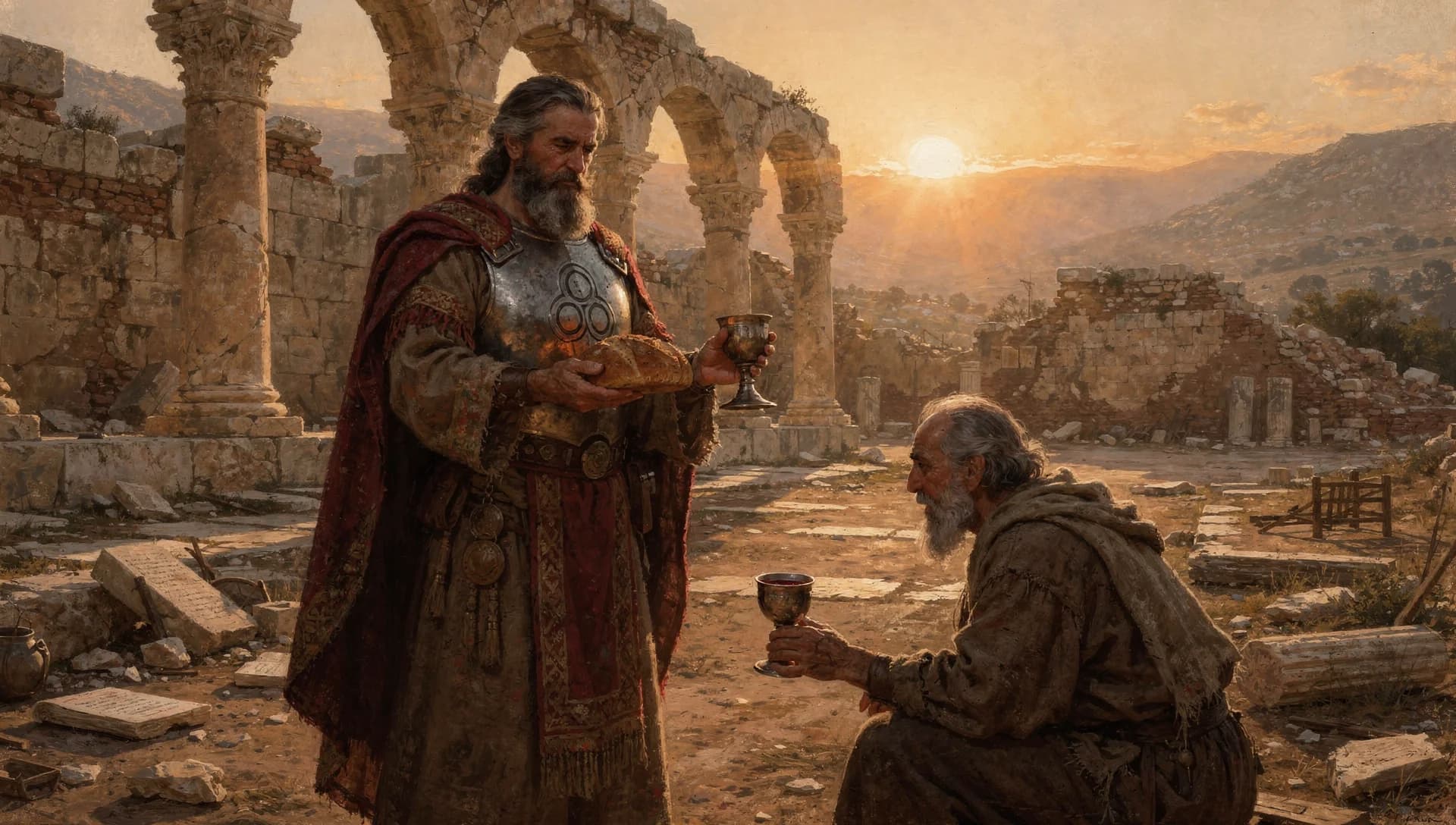
"And Melchizedek king of Salem brought out bread and wine. He was priest of God Most High. And he blessed him and said, 'Blessed be Abram by God Most High, Possessor of heaven and earth; and blessed be God Most High, who has delivered your enemies into your hand!' And Abram gave him a tenth of everything." (Genesis 14:18-20)
That's it. No introduction. No genealogy. No exit. A king-priest named Melchizedek appears out of nowhere, blesses Abraham, receives a tithe, and vanishes from the narrative as abruptly as he arrived.
Psalm 110:4 quotes God telling the Davidic king: "You are a priest forever, after the order of Melchizedek." Still no explanation.
The book of Hebrews, written roughly a thousand years after Genesis and treating Melchizedek as its central theological illustration, makes the most stunning claim: "He is without father or mother or genealogy, having neither beginning of days nor end of life, but resembling the Son of God he continues a priest forever." (Hebrews 7:3)
Without father. Without mother. Without genealogy. No birth. No death.
This is not how the Bible describes human beings. This is not even how it describes angels. Something unusual is being described here, and both the canonical text and its interpreters have struggled for two millennia to explain it.
The Dead Sea Scrolls, discovered at Qumran in 1947, contain a text called 11QMelchizedek that presents Melchizedek as a heavenly being who will execute God's judgment at the end of days, standing in the council of God, identified with the "God" (Elohim) of Psalm 82. This is a near-divine figure, far beyond a local king-priest.
The Urantia Book provides a complete, specific, historically situated account of who this person was, what he came to do, and why his record is so thin in the canonical text.
The Salem Mission
It was 1,973 years before the birth of Jesus that Machiventa was bestowed upon the human races of Urantia (UB 93:2.1). He appeared under extraordinary circumstances: a Melchizedek Son incarnating in mortal flesh, an emergency measure triggered by a spiritual crisis.
His name was Machiventa Melchizedek. He was a Melchizedek Son, one of a class of universe administrators, teachers, and emergency ministers who ordinarily operate at the superphysical level. Melchizedeks are not Material Sons (Adam and Eve are Material Sons). They are a distinct and higher order of being. Machiventa's appearance in a physical, human-compatible body was an emergency measure, an authorization from the universe government that was virtually unprecedented (UB 93:1.3).
The emergency was this: the monotheism that Amenemope's Egyptian influence, the lingering Nodite traditions, and the memory of Adam's teachings had preserved was collapsing. The concept of one God, the God that Abraham's ancestors had barely maintained, was being overwhelmed by the polytheistic traditions of the surrounding cultures. Another few generations and the thread would break entirely (UB 93:1.1).
Machiventa Melchizedek appeared physically, materializing into a body, and established himself at Salem Salem (the site of what would later become Jerusalem). He had one message, and it was simple enough to memorize and transmit across generations:
There is one God. Trust God. Live righteously. That is enough.
He called his God "El Elyon," God Most High. The same title used in Genesis 14.
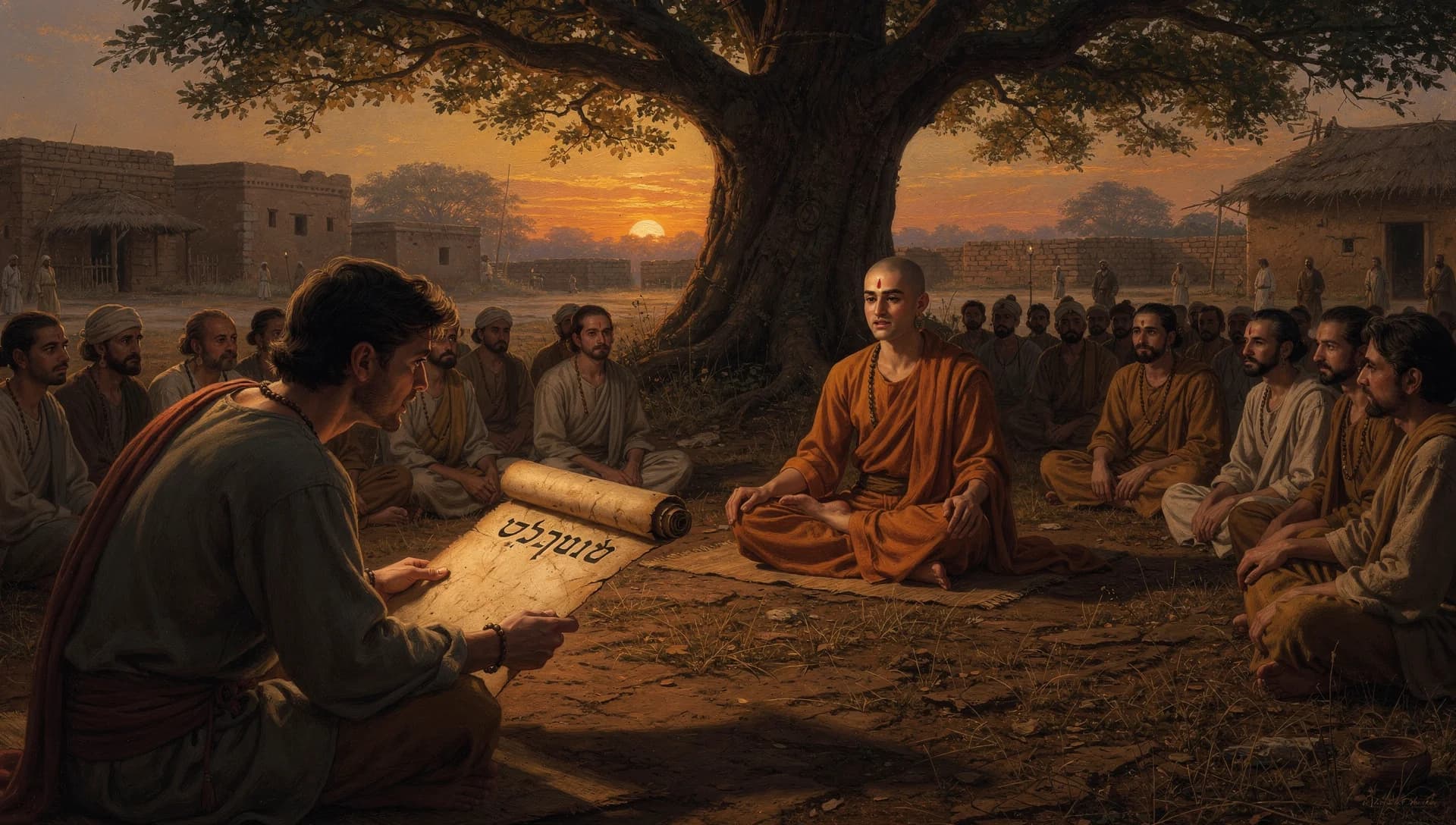
He trained teachers, established a school at Salem, and sent missionaries outward across the ancient world. The reach of the Salem mission was extraordinary: Urantia Book records indicate that Salem missionaries reached Egypt, Mesopotamia, the eastern Mediterranean, Iran, India, and China, and that the monotheistic impulses in Greek philosophy, early Buddhism, Zoroastrianism, and Confucianism all contain traces of the Salem teaching (UB 131:0.1).
The Man Abraham Met
When Abram returned from the battle of the kings (Genesis 14), he stopped at Salem. The meeting that followed was consequential. While there were many families in the region as well qualified as Abraham's for receiving the Salem teachings, Abraham stood out for his faith, sincerity, and willingness to act on what he believed (UB 93:5.2).
The bread and wine were a deliberate sacramental choice. Machiventa had wisely offered his followers a sacrament of bread and wine as a substitute for the older sacrifice of flesh and blood (UB 93:4.14). This simple covenant became the foundation of Abraham's religious life and the precedent for what would later re-emerge in the Lord's Supper.
Abram's tithe of a tenth of his spoils was not a tax. It was a gesture of religious allegiance, the same gesture that followers of the Salem teaching made throughout the ancient world.
This single encounter placed Abraham in the Melchizedek line. That is why Psalm 110 could say the Davidic king was a priest "after the order of Melchizedek," because the entire Hebrew tradition traced itself through Abraham's encounter at Salem.
Why He Had No Genealogy
Hebrews 7:3, "without father or mother or genealogy, having neither beginning of days nor end of life," is often interpreted as theological poetry. Some scholars treat it as rhetorical exaggeration. Some early church fathers treated it as evidence that Melchizedek was the pre-incarnate Christ.
The Urantia Book's explanation is literal: Machiventa Melchizedek was not born of human parents. He materialized. A being who materializes into a physical body from a higher order of existence has no human genealogy because he has no human parents. He did not have a human birth. He did not have a human death. He eventually dematerialized when his mission was complete (UB 93:10.1).
"Without father or mother or genealogy, having neither beginning of days nor end of life" is not poetry. It is an accurate description, preserved by a tradition that no longer understood what it was describing.
The Erasure
Here is where the history becomes genuinely important.
The Urantia Book's account of planetary history explains that during the Babylonian captivity (597-538 BCE), the Hebrew priests who compiled and edited the Torah made a systematic effort to reorganize the religious tradition around a single, coherent, Yahwistic narrative. This was not necessarily dishonest; they believed they were preserving what mattered. But it had consequences (UB 97:7.1).
Melchizedek was a problem.
He was not a Hebrew. He was a Canaanite king-priest who predated Moses, predated the Torah, predated the covenant at Sinai, and yet had been acknowledged as a legitimate priest of God Most High by the patriarch Abraham himself. He occupied a position of religious authority that was entirely outside the Levitical system the priests were trying to establish as the only valid channel of access to God.
The Urantia Book records that the Hebrew scribes systematically reduced the Melchizedek materials, a body of tradition that was much larger than what survived into the canonical text (UB 93:9.7). The original Salem teaching documents, the fuller account of Abraham's relationship with Machiventa, the records of the Salem missionaries and their reach: most of this was either suppressed or lost in the redaction process.
What survived is Genesis 14:18-20, two verses that couldn't be removed without tearing the Abraham narrative apart, and Psalm 110:4, which was too embedded in the royal theology to eliminate.
The Dead Sea Scrolls community at Qumran, writing between roughly 200 BCE and 70 CE, still knew something bigger was there. 11QMelchizedek describes him as a heavenly being who would appear at the end of days. They didn't have the full account, but they remembered that he was more than a local priest.
Paul's letter to the Hebrews, working with the same two Genesis verses and the Psalm, builds an entire theological argument ("Jesus is a priest like Melchizedek, not like the Levites, which means the whole Levitical system has been superseded") from materials that were already fragmentary by the time Paul had access to them.
What Machiventa Is Doing Now
Here is the part the canonical tradition has no framework for at all.
The Urantia Book records that Machiventa Melchizedek's mission at Salem lasted approximately 94 years. At the conclusion of his material life on earth, he did not die. He dematerialized and returned to his normal sphere of existence as a Melchizedek Son (UB 93:10.1).
But his connection to Urantia did not end. The book records that as a result of his emergency bestowal and his unique service on a world that has been doubly defaulted (by the Lucifer Rebellion and the Adamic default), Machiventa holds an extraordinary position in the continuing administration of Urantia.
He is currently, as the book states, "the vicegerent Planetary Prince of Urantia," serving in the position that Caligastia vacated through rebellion (UB 55:7.3). He is part of the active celestial administration of this world, in a role that is more than honorary.
The New Jerusalem that Christian tradition associates with the end of the age includes, in the Urantia Book's telling, the actual, ongoing governance of Machiventa Melchizedek, the same person who brought bread and wine to Abraham on the road from the battle of the kings.
Why This Matters
The Melchizedek material is important not because of its historical curiosity, but because of what it demonstrates about the nature of revelation.
The UB describes a universe in which specific interventions occur at specific historical moments in response to specific crises. The appearance of Machiventa at Salem was not a myth or a legend. It was a real administrative decision, made by real universe authorities, executed by a real being, who taught real monotheism to real people at a real place, and whose influence reached from the Nile to the Indus, from the Mediterranean to China, seeding the world's major spiritual traditions with the core concept that has driven every genuine religious advance in human history: there is one God, and that God is your Father.
The fragments that survived the scribal redaction (two verses in Genesis, one line in a Psalm, one argumentative chapter in Hebrews, one scroll from Qumran) are enough to show that the tradition knew something was there. Something big. Something that didn't fit the normal categories.
The Urantia Book gives you the full picture. It starts where the fragments point.
Salem, the site of Machiventa's emergency mission, is mapped at the Interactive Planetary Map alongside the full Salem missionary network across 10 civilizations.
For the mythology connections, Melchizedek and the Salem missionaries across world traditions: The Mythology Decoder
For how Melchizedek's teaching reached different cultures: The Convergence
For the full context of what he was responding to, the Lucifer Rebellion: What They Changed
Byline: Derek Samaras | Urantia Book Network | April 2026
Connecting Articles

The Real History of God: From Onagar to the Universal Father
The Priest Who Had No Father: Machiventa Melchizedek and the Genesis Fragment

The 24 Counselors: Who They Are and What They Do
The Prophet Who Almost Got There: Gautama Siddhartha and the Salem Gospel
The Newsletter
Get the research behind each piece
Free. New Urantia Book explorations, the sources behind the videos, and early looks. No spam, unsubscribe anytime.
Prefer video? Follow on YouTube and Facebook.
Delivered through Substack. You can also read past issues.