
 Mythic
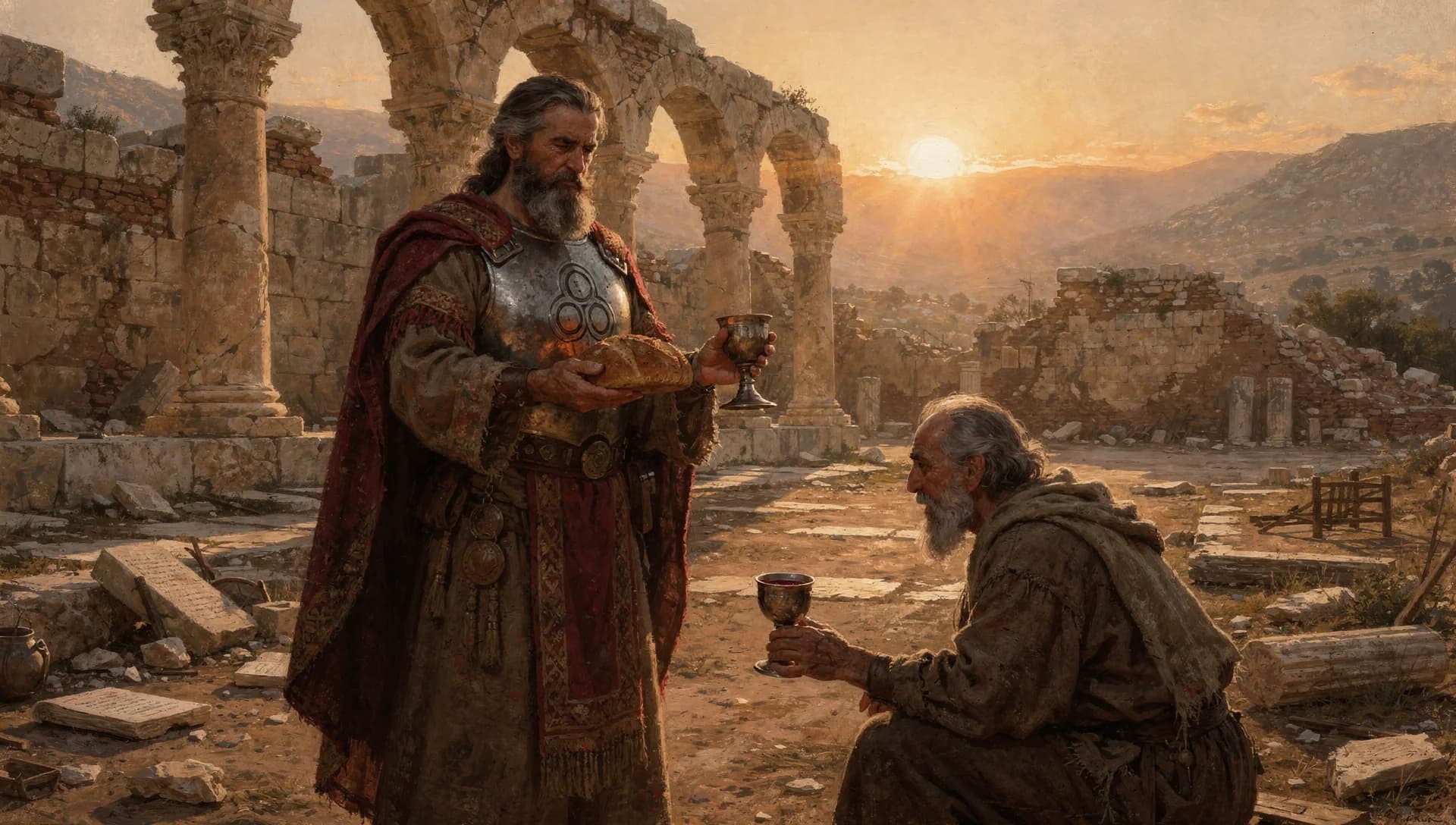
Melchizedek, mysterious priest-king deleted from Genesis
 UB
UBMachiventa Melchizedek, incarnated teacher
Full Article
Read the deep-dive article on this connection
Machiventa Melchizedek, incarnated teacher = Melchizedek, mysterious priest-king deleted from Genesis
The Connection
Machiventa incarnated at Salem (~1973 BC) and taught for 94 years. Later Hebrew scribes deliberately minimized Melchizedek to elevate Abraham. "The Hebrew scribes systematically destroyed every record they could find of Machiventa Melchizedek."
UB Citation
Academic Source
Genesis 14:18-20; Hebrews 7; Dead Sea Scrolls 11Q13
Historical Evidence(Strong evidence)
11Q13 (Dead Sea Scrolls, Cave 11, c. 100 BCE) portrays Melchizedek as "an enormously exalted divine being, to whom are applied names generally reserved for God alone." Hebrews 7: "without father or mother, without genealogy, without beginning of days or end of life." Frank Moore Cross (1973): "El Elyon" (God Most High) predates Yahwism. Margaret Barker (1992): the Melchizedek tradition represents an older, suppressed strand of Israelite religion.
Deep Dive
Genesis 14 is one of the strangest chapters in the Hebrew Bible. After a long account of a war among Mesopotamian kings, the narrative pauses for a brief encounter that has puzzled scholars for two millennia. Abraham, returning from rescuing Lot, meets a figure named Melchizedek, king of Salem, priest of God Most High. Melchizedek brings out bread and wine, blesses Abraham, and Abraham gives him a tenth of the spoils. Five verses, no genealogy, no backstory, no follow-up. The figure appears, blesses, receives the tithe, and disappears. Genesis never mentions him again.
The Hebrew text is striking for what it does not say. Melchizedek has no father named, no mother named, no tribe attached, no death recorded. He is called "priest of God Most High" (kohen le-El Elyon), using a divine title that predates the standard Yahwist vocabulary and that scholars have traced to the older Canaanite religious stratum. He blesses Abraham in the name of El Elyon, "creator of heaven and earth," a phrase that occurs nowhere else in the patriarchal narratives. Abraham, the founding father of monotheism in the canonical tradition, accepts the blessing and pays the tithe, recognizing this priest's authority as superior to his own. The encounter is cosmically charged but textually brief.
The Hebrew Bible never returns to Melchizedek with the same status. Psalm 110:4 alludes to him as the type of an eternal priesthood: "You are a priest forever after the order of Melchizedek." The Letter to the Hebrews in the New Testament builds an extensive theological argument on the figure, in chapter 7: "He is without father or mother, without genealogy, having neither beginning of days nor end of life, but resembling the Son of God he continues a priest forever." The Hebrews author sees in Melchizedek a type of Christ's eternal priesthood, but he is working from very thin canonical material. Almost everything he says about Melchizedek is read out of the silences of Genesis 14, which is exactly what the UB account predicts.
Paper 93:9.9 records: "The national ego of the Jews was tremendously depressed by the Babylonian captivity. In their reaction against national inferiority they swung to the other extreme of national and racial egotism, in which they distorted and perverted their traditions with the view of exalting themselves above all races as the chosen people of God; and hence they carefully edited all their records for the purpose of raising Abraham and their other national leaders high up above all other persons, not excepting Melchizedek himself. The Hebrew scribes therefore destroyed every record of these momentous times which they could find, preserving only the narrative of the meeting of Abraham and Melchizedek after the battle of Siddim, which they deemed reflected great honor upon Abraham."
Paper 93:9.10 adds the doctrinal consequence: "And thus, in losing sight of Melchizedek, they also lost sight of the teaching of this emergency Son regarding the spiritual mission of the promised bestowal Son; lost sight of the nature of this mission so fully and completely that very few of their progeny were able or willing to recognize and receive Michael when he appeared on earth and in the flesh as Machiventa had foretold."
The UB's account of Machiventa Melchizedek runs across Papers 93 and 94. Around 1973 BCE, in response to the failure of the Adamic mission and the imminent loss of monotheistic teaching from the planet, a Melchizedek of the order of Salvington volunteered to incarnate as an emergency Son and reestablish the worship of the One God. He appeared at Salem, set up his teaching, conducted a 94-year ministry, and at its conclusion vanished from human view. He did not die in the ordinary sense; he was withdrawn back to his order. The Salem teaching he inaugurated reached Egypt, India, Mesopotamia, Crete, Greece, and northern Europe through his missionaries. Abraham was his most prominent personal contact; the covenant Genesis attributes to Yahweh's call of Abraham was originally Machiventa's covenant with Abraham, with subsequent priestly editing transferring the action from the human-form Melchizedek to the deity directly.
The Dead Sea Scrolls fragment 11Q13 (11QMelchizedek), discovered in 1956, preserves a Qumran community text from around 100 BCE that treats Melchizedek as "an enormously exalted divine being," to whom are applied names and roles that elsewhere are reserved for God himself. The Qumran text reads Melchizedek as the heavenly judge who will deliver the righteous and execute judgment on Belial at the end of days. This is a much higher status than anything Genesis 14 by itself implies, and it suggests that an older tradition about Melchizedek as a more-than-human figure was preserved in some Jewish circles even after the priestly editorial program had reduced his canonical presence to the five verses of Genesis 14. The Qumran text is exactly the kind of evidence the UB account predicts: residual material of an older Melchizedek tradition that the priestly editors did not entirely succeed in suppressing.
Margaret Barker, in The Great Angel: A Study of Israel's Second God (Westminster John Knox, 1992) and her broader Temple Theology series, has argued for an older suppressed strand of Israelite religion in which a second divine figure (variously identified as the angel of YHWH, Wisdom, the Son of Man) operated alongside the high God. Frank Moore Cross, in Canaanite Myth and Hebrew Epic (Harvard, 1973), traced the El Elyon (God Most High) terminology to a pre-Yahwist Canaanite stratum, with the Melchizedek narrative as one of the clearest preserved instances. The mainstream scholarly recognition that Melchizedek represents an older religious layer that the canonical tradition could not entirely erase is well established. The UB account adds the historical referent: the Melchizedek of Genesis 14 was Machiventa, the incarnated emergency Son, whose 94-year ministry the Hebrew priests at Babylon systematically minimized to one chapter.
The Hebrews 7 description of Melchizedek as "without father or mother, without genealogy, without beginning of days or end of life" is striking. The Hebrews author is reasoning from textual silences (Genesis 14 does not give Melchizedek a genealogy), but the description is exactly what would be true of an incarnated Son of the order of Salvington whose human form was taken on directly without ordinary birth and laid down without ordinary death. The Hebrews author was reading the text more accurately than he knew. The figure Genesis 14 describes really did appear without parents, really did teach without genealogical lineage, really did continue without recorded death in the human sense.
The strongest counterargument is that the Genesis 14 figure is a priestly invention to legitimate later Jerusalem priestly claims, and no historical referent should be sought. The reply is the cumulative weight of the evidence. The Qumran 11QMelchizedek text shows an older tradition of Melchizedek as an exalted divine figure. The Hebrews 7 description preserves details that fit the UB account precisely. The El Elyon vocabulary points to a pre-Yahwist religious stratum. The structural anomalies of Genesis 14 (a priest of higher status than Abraham, blessing the patriarch, receiving the tithe, with no follow-up) are exactly what we would expect for a deliberately minimized memory of a more substantial historical event. The literary fingerprint of priestly suppression is dense; the UB account names the suppressed reality.
What the parallel implies is that the Hebrew Bible's most enigmatic priestly figure is the cultural memory of a real being, named Machiventa, whose 94-year ministry around 1900 BCE was systematically minimized by the priestly editors at Babylon for nationalistic reasons. The decoder's job is to recover the historical referent and let the canonical text be read as the heavily edited remnant it actually is.
Key Quotes
“The Hebrew scribes therefore destroyed every record of these momentous times which they could find, preserving only the narrative of the meeting of Abraham and Melchizedek after the battle of Siddim, which they deemed reflected great honor upon Abraham.”
“And thus, in losing sight of Melchizedek, they also lost sight of the teaching of this emergency Son regarding the spiritual mission of the promised bestowal Son; lost sight of the nature of this mission so fully and completely that very few of their progeny were able or willing to recognize and receive Michael when he appeared on earth and in the flesh as Machiventa had foretold.”
Cultural Impact
The Melchizedek tradition shaped Christian theology decisively through Hebrews 7 and the long patristic and medieval tradition of typological reading. Christ as eternal high priest "after the order of Melchizedek" became one of the foundational typologies of Christology. Through medieval Catholic theology, the Melchizedek figure shaped the doctrine of the Eucharistic priesthood; the offering of bread and wine at Genesis 14 became the type of the Catholic Mass. Through Reformed and Anglican traditions, the Melchizedek typology continued to inform debates about the nature of priesthood and ministry. Mormon theology, reading Genesis 14 in the Latter-day Saint tradition, established a distinct "Melchizedek priesthood" as the higher of two priestly orders within the LDS church. The Eastern Orthodox tradition has preserved Melchizedek in iconography and liturgy. The Dead Sea Scrolls discovery of 11QMelchizedek in 1956 reopened scholarly debate about the older Jewish traditions of Melchizedek as an exalted divine figure. The cultural inheritance is dense and continues to shape contemporary religious imagination. The UB account, by identifying the historical referent as Machiventa the incarnated Son, lets the various strands of the tradition be read as descendants of a single real event rather than as competing religious inventions.
Modern Resonance
Contemporary biblical scholarship has been moving toward recognition of the Melchizedek tradition as preserving an older, partly suppressed Israelite religious layer. Margaret Barker's Temple Theology project, the Society of Biblical Literature work on the angel of YHWH and the Wisdom traditions, and the broader scholarly attention to the Qumran Melchizedek text have together restored Melchizedek to a more prominent place in the academic discussion of Second Temple Judaism. The UB account aligns with this scholarly trajectory and supplies the missing historical referent: a real incarnated emergency Son whose 94-year ministry inaugurated a tradition that the canonical Hebrew text carefully reduced. For contemporary readers wrestling with the Hebrew Bible's strange suppression of one of its most theologically suggestive figures, the UB framework offers a coherent explanation. The decoder's job is to make the suppression visible and to recover what was suppressed. Machiventa Melchizedek deserves to stand as one of the most important religious figures in the chain of revelation that culminated in Christ Michael, and the UB lets him stand there.
Related Mappings
Serapatatia, well-meaning Nodite leader
= The Serpent in the Garden of Eden
Eve's mating with Cano the Nodite
= "Eating the Forbidden Fruit" / Original Sin
Cain receiving a Thought Adjuster
= The "Mark of Cain," divine protection
Three Noahs: Historical, Regional, and Literary
= Biblical Noah, composite figure
Related Articles
Where to next
The free newsletter. The research behind each piece, no spam.