
 Mythic
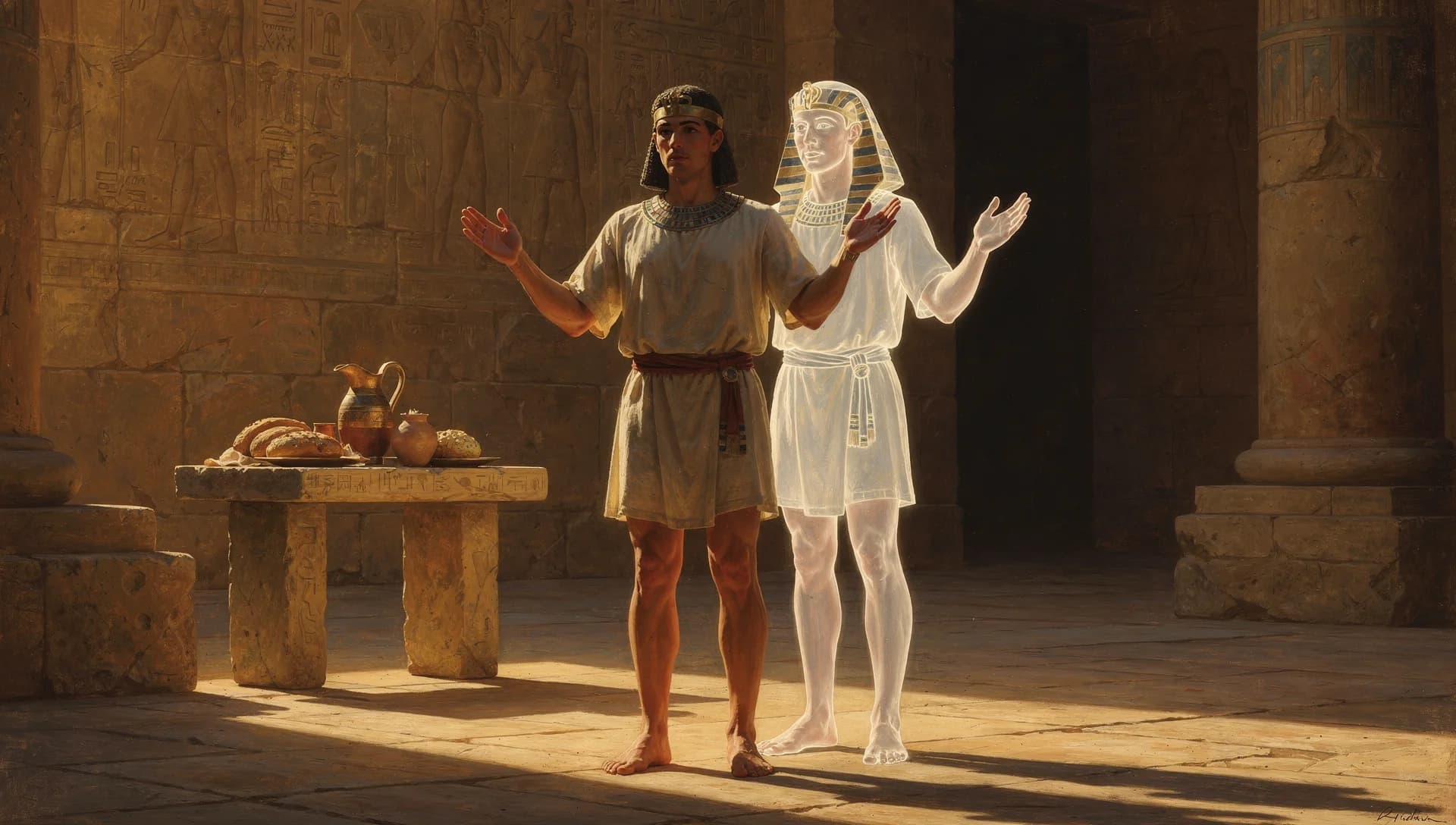
Egyptian Ka, the divine spirit-double
 UB
UBThought Adjuster, indwelling divine fragment
Full Article
Read the deep-dive article on this connection
Thought Adjuster, indwelling divine fragment = Egyptian Ka, the divine spirit-double
The Connection
The UB explicitly compares the Egyptian Ka to the Thought Adjuster concept. The Ka was understood as a divine essence bestowed at birth, an invisible spiritual counterpart that accompanied the individual through life and survived death. This is one of the closest pre-modern approximations to the Adjuster concept found in any ancient religion.
UB Citation
Academic Source
Allen, Middle Egyptian (2000); Assmann, Death and Salvation in Ancient Egypt (2005)
Historical Evidence(Strong evidence)
The UB directly references the Egyptian Ka as an ancient precursor to the Thought Adjuster concept: "Among the Egyptians, in the ka we find a concept which is analogous to spirit." James P. Allen describes the Ka as "the essential life-force" and "spiritual duplicate" of a person, bestowed by the creator god. Jan Assmann notes the Ka was "a divine force within each individual." The structural parallel is explicit: an invisible divine presence, individually bestowed, that guides moral development and survives death.
Deep Dive
On the wall of a temple at Luxor, in a relief carved in the fifteenth century BCE, the birth of the future Pharaoh Amenhotep III is depicted in a sequence of panels. The newborn prince is held in the arms of the Nile god, Hapy, who attends the divine birth. Beside the prince, identical in form, is a second infant, slightly smaller but in every visual detail an image of the first. This second figure is the Ka of the prince, his spiritual double, bestowed at birth, intended to accompany him through life and to greet him in the afterlife on the far bank of the Great River. The relief is one of the clearest visual articulations of one of the most sophisticated theological concepts in ancient Egyptian religion.
The Ka was not simply the soul, in the sense that later Greek psyche or Hebrew nephesh denote the soul. It was a specific spiritual entity bestowed at the moment of birth or shortly thereafter, conceived as a divine spirit-double or guardian presence, originating in the divine realm and returning to the divine realm at death. James P. Allen, in Middle Egyptian, defines the Ka as "the essential life-force" and "spiritual duplicate" of a person, bestowed by the creator. Jan Assmann describes the Ka as "a divine force within each individual." The Ka was thought to be the source of moral guidance during life. An Egyptian inscription cited in the UB itself reads: "I did not disregard its speech; I feared to transgress its guidance. I prospered thereby greatly; I was thus successful by reason of that which it caused me to do; I was distinguished by its guidance." The Ka was, the Egyptians said, "an oracle from God in everybody."
The Urantia Book draws a direct line from the Egyptian Ka concept to the Thought Adjuster doctrine. UB 111:0.4 states: "In the conception of the atman the Hindu teachers really approximated an appreciation of the nature and presence of the Adjuster, but they failed to distinguish the copresence of the evolving and potentially immortal soul. The Chinese, however, recognized two aspects of a human being, the yang and the yin, the soul and the spirit. The Egyptians and many African tribes also believed in two factors, the ka and the ba; the soul was not usually believed to be pre-existent, only the spirit." UB 111:0.5 elaborates with specific reference to the Luxor relief: "On the walls of a temple at Luxor, where is depicted the birth of Amenhotep III, the little prince is pictured on the arm of the Nile god, and near him is another child, in appearance identical with the prince, which is a symbol of that entity which the Egyptians called the ka."
UB 111:0.6 makes the doctrinal parallel explicit: "The ka was thought to be a superior spirit genius which desired to guide the associated mortal soul into the better paths of temporal living but more especially to influence the fortunes of the human subject in the hereafter. When an Egyptian of this period died, it was expected that his ka would be waiting for him on the other side of the Great River. At first, only kings were supposed to have kas, but presently all righteous men were believed to possess them." That last detail is theologically significant. The democratization of the Ka, from royal prerogative to general human endowment, parallels the UB account of Thought Adjuster bestowal. UB tradition records that prior to the bestowal of Michael as Jesus on Urantia, Adjusters were bestowed selectively rather than universally. After the bestowal, the Spirit of Truth was poured out on all flesh, and Adjuster bestowal became universal upon the first moral choice of the developing child. The Egyptian tradition's gradual democratization of the Ka, from Old Kingdom royal exclusivity to Middle and New Kingdom general application, parallels this trajectory in stylized form.
The structural parallel between Ka and Adjuster is dense. Both are bestowed at or near birth (the Adjuster typically arrives at the first moral decision of the child, around age six). Both are divine in origin, fragments or representatives of the supreme God. Both function as inner moral guidance during life. Both are expected to play a role in the afterlife trajectory of the individual. Both are conceived as not identical with the personal self but as a copresent divine companion to the self. The match is not approximate; it is detailed. The UB explicitly identifies the Egyptian Ka as one of the closest pre-Christian articulations of the Adjuster doctrine, alongside the Hindu Atman and the Chinese yang.
What is striking is how this doctrine entered Egyptian theology in the first place. Egyptian religion is notable for its complex dual or quadruple anthropology: the body, the Ba, the Ka, the akh, the name, the shadow, each conceived as a distinct aspect of the person. No other ancient Mediterranean religion has quite this specificity. Greek psychology has psyche, nous, thumos, but these are functional faculties of a single soul rather than separately existent entities. Hebrew anthropology has nephesh, ruach, and neshamah, but these are also functional aspects rather than independently existing copresences. The Egyptian Ka stands out as a separately existent divine presence, a specific theological entity rather than a functional aspect of mind. The UB account suggests this distinctiveness derives from Salem missionary influence: the Egyptians were recipients of the Salem teaching of indwelling divine presence, and they integrated it into their existing complex anthropology as the Ka concept. Other Near Eastern cultures received the same teaching but assimilated it differently, producing the Hindu Atman, the Chinese yang, and the Hebrew tradition's eventual conception of the divine spirit indwelling the prophets.
The strongest counterargument is that the Ka concept appears in Egyptian texts long before the conventionally dated Melchizedek incarnation around 2000 BCE. The Pyramid Texts of the Old Kingdom, dating to the late third millennium, already feature the Ka. If Salem missionary influence is the source, the chronology does not work directly. The reply is that the UB account does not attribute the Ka concept exclusively to Salem missionary influence; it identifies the Ka as a pre-existing Egyptian concept that approximated the Adjuster doctrine. UB 111:0.4 simply states that the Egyptians "believed in two factors, the ka and the ba." The Salem teaching, when it arrived through the Salemite physician's influence on Akhenaten's mother, did not introduce the Ka but reinforced and clarified the existing tradition. The Pyramid Texts' Ka is a pre-Salem refraction of an even older theological intuition; the Salem-influenced Ka of the New Kingdom is a fuller articulation of the same underlying truth.
Key Quotes
“The Egyptians and many African tribes also believed in two factors, the ka and the ba; the soul was not usually believed to be pre-existent, only the spirit.”
“On the walls of a temple at Luxor, where is depicted the birth of Amenhotep III, the little prince is pictured on the arm of the Nile god, and near him is another child, in appearance identical with the prince, which is a symbol of that entity which the Egyptians called the ka. This sculpture was completed in the fifteenth century before Christ.”
“The ka was thought to be a superior spirit genius which desired to guide the associated mortal soul into the better paths of temporal living but more especially to influence the fortunes of the human subject in the hereafter.”
Cultural Impact
The Ka concept's most direct cultural inheritance was through the elaborate Egyptian funerary tradition: the mummification practices, the tomb provisioning, the Ka chapels in pyramid complexes, and the entire ritual apparatus that ensured the deceased's Ka was sustained and reunited with its earthly counterpart. Through Hellenistic syncretism, the Ka concept influenced Greco-Roman ideas about guardian daimones (the daimon of Socrates being a famous example) and the Roman genius (the indwelling divine spirit of each individual, familial in origin). The early Christian doctrine of the guardian angel inherits the structural pattern: an individually assigned spiritual companion, bestowed by God, charged with the guidance and protection of a particular human being. Through medieval Christian devotional literature and into modern popular religion (the guardian angel of folk Catholicism, the New Age "spirit guide"), this lineage continues. Modern psychological language preserves a secularized version: the "inner voice" of conscience, the "higher self" of humanistic psychology, the unconscious moral guidance system that contemporary readers experience as their own deepest self. The cultural inheritance is one of the most durable in religious history: a tradition of an indwelling divine companion that traces from the Egyptian Ka through Salem missionary refinement, into the Christian guardian angel, and finally into modern psychological self-understanding.
Modern Resonance
Contemporary spiritual seekers, particularly those drawn to the New Age tradition or to the more metaphysical strands of contemporary Christianity, frequently report a sense of indwelling divine presence that does not fit easily into the standard categories of either secular psychology or institutional theology. The Egyptian Ka, the Hindu Atman, the Quaker "inner light," the Pentecostal "Holy Spirit witness," and the modern "higher self" are all attempts to name what the UB calls the Thought Adjuster. The UB framing offers something the other traditions do not: a precise theological account of what this presence is (a fragment of the Universal Father), how it arrives (universal bestowal upon first moral choice), what it does (guides the development of the soul), and where it ultimately leads (the eternal Paradise career of the ascending mortal). For contemporary readers who recognize the inner-divine-presence experience but find the available theological vocabularies inadequate, the UB account provides clear and integrated language. The Egyptian Ka, beautifully depicted on the Luxor wall and persistently testified to in Egyptian tomb inscriptions, was an early and partial articulation of the same reality that the UB articulates fully.
Related Mappings
Machiventa Melchizedek's Salem missionaries
= Ikhnaton / Akhenaten, pharaoh who proclaimed one God
Amenemope, Egyptian conscience teacher
= "Son of Man," source for Proverbs and Psalm 1
Evolving mortal soul
= Egyptian Ba, the soul-bird
Okhban, murdered Egyptian prophet
= One of only four great prophets of Egypt
Related Articles
Where to next
The free newsletter. The research behind each piece, no spam.