
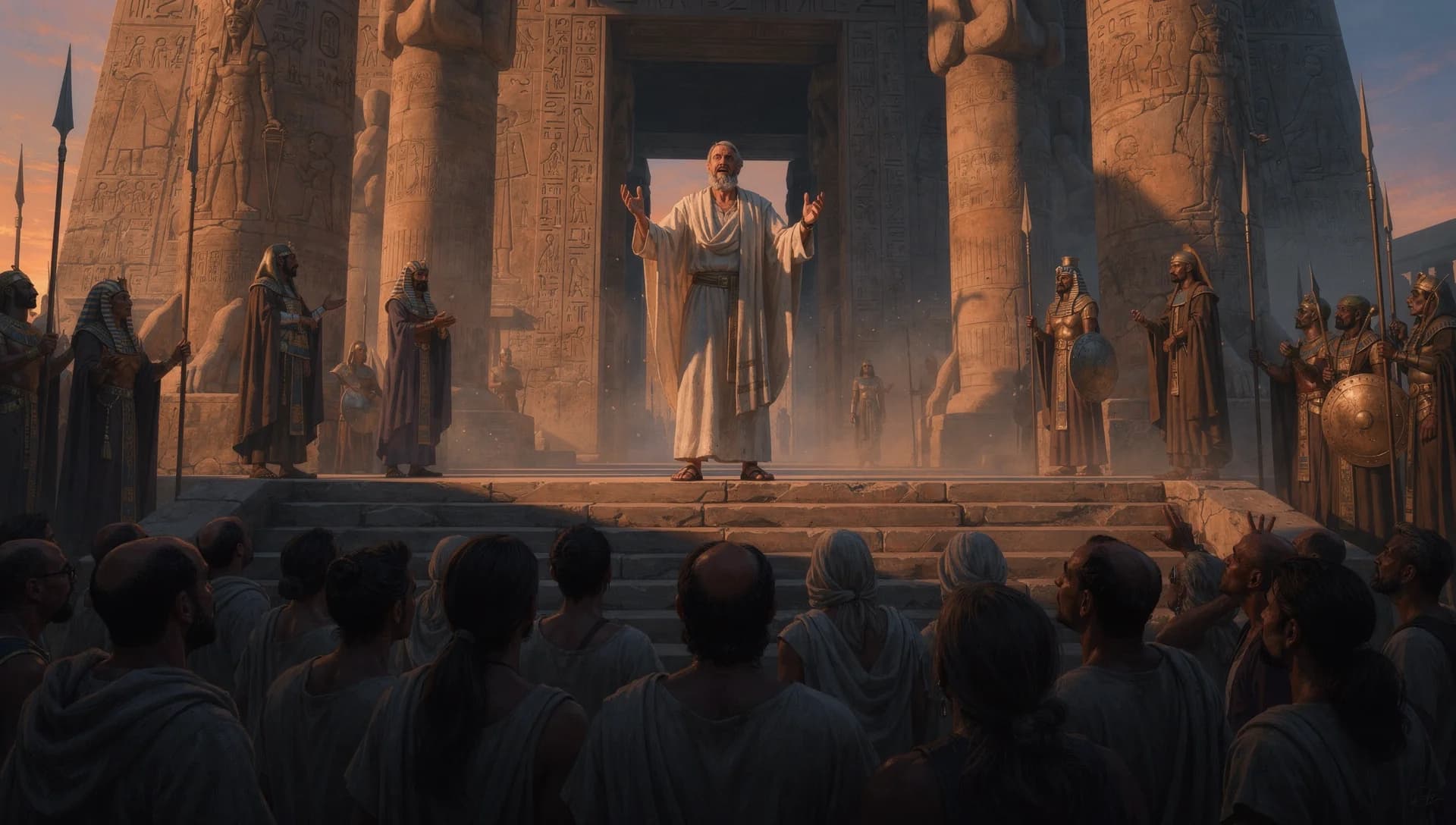
 Mythic
One of only four great prophets of Egypt
 UB
UBOkhban, murdered Egyptian prophet
Full Article
Read the deep-dive article on this connection
Okhban, murdered Egyptian prophet = One of only four great prophets of Egypt
The Connection
The UB names Okhban as one of only four great human prophets who maintained the Salem teaching in Egypt. He was murdered for his monotheistic preaching, illustrating the dangerous resistance that pure monotheism faced in polytheistic Egypt. His martyrdom predated and foreshadowed the resistance Ikhnaton would face centuries later.
UB Citation
Academic Source
Breasted, Development of Religion and Thought in Ancient Egypt (1912)
Historical Evidence(Moderate evidence)
The UB specifically names four outstanding Salem teachers in Egypt, with Okhban being one who was killed for his teachings. While Okhban does not appear in surviving Egyptian records (most prophetic figures outside the royal court left no archaeological trace), the pattern of murdered monotheistic teachers is well-documented in ancient Near Eastern history. James Henry Breasted documented recurring tensions between Egyptian priestly establishments and reformers who challenged polytheistic orthodoxy.
Deep Dive
In a single dense sentence, UB 95:3.5 names four great prophets of Egypt across six thousand years and gives the fate of each: "In six thousand years only four great prophets arose among the Egyptians. Amenemope they followed for a season; Okhban they murdered; Ikhnaton they accepted but halfheartedly for one short generation; Moses they rejected." Three of these names are familiar from independent sources. Amenemope is documented in Papyrus BM 10474 and identified by mainstream scholarship as the source of Proverbs 22:17 through 24:22. Akhenaten is one of the most thoroughly studied figures in Egyptology. Moses, on the UB account, was raised in the Egyptian royal court and represents in some sense an Egyptian as well as a Hebrew tradition. The fourth name, Okhban, has no independent attestation. The UB simply records that the Egyptians murdered him for his teaching.
The absence of independent confirmation does not by itself argue against the UB's claim. Most prophetic figures outside the royal court in ancient Egypt left no archaeological or textual trace. The Egyptian record is dominated by royal monuments and elite funerary inscriptions. A non-royal religious teacher, particularly one whose teaching ran counter to the priestly establishment and whose career ended in murder rather than monumental commemoration, would be precisely the kind of figure most likely to be erased from the surviving record. The pattern is well-attested in ancient Near Eastern religious history. The Hebrew Bible itself testifies to recurring murders of prophets by the religious establishment of their own people. Jeremiah was thrown into a cistern. Uriah son of Shemaiah, mentioned in Jeremiah 26:20-23, was killed by Jehoiakim for prophesying against Jerusalem. Zechariah son of Jehoiada, in 2 Chronicles 24:20-22, was stoned to death in the Temple courtyard. The murder of monotheistic prophets by polytheistic establishments was so common a pattern in the ancient Near East that it became proverbial.
The UB account places Okhban in the same prophetic lineage as Amenemope and Ikhnaton, namely the lineage descending from Melchizedek's Salem mission. UB 95:3.5 identifies the early Salem teachers in Egypt as "the first to proclaim conscience as the mandate of God, the voice of Deity." This is the doctrinal core of the Salem teaching as it reached Egypt: monotheism with an emphasis on indwelling moral guidance. Amenemope articulated this doctrine in his wisdom corpus and was followed for a season. Akhenaten attempted to institutionalize it under the guise of solar worship and was accepted for one short generation. Okhban, presumably attempting to articulate it in a different period or context, was killed.
The chronology of the four prophets is not specified by the UB, but the structure suggests a sequence. Amenemope is conventionally dated to the New Kingdom, perhaps the twelfth or eleventh century BCE. Akhenaten reigned in the fourteenth century BCE. Moses is conventionally dated to the thirteenth or twelfth century BCE. Okhban must therefore fall somewhere in this same general window, with the Egyptian Salem mission active across roughly six hundred to a thousand years from the time of Melchizedek's incarnation around 2000 BCE. The Salemite physician who influenced Akhenaten's mother is described by the UB as part of an ongoing missionary network in Egypt. Okhban was likely a participant in this same network, working in a different period or region than Amenemope and Akhenaten.
The strongest counterargument is that the UB names a specific historical figure who has no independent attestation, which is the kind of claim that could be either confirmed or falsified by archaeological discovery. The reply is that the absence of independent attestation is exactly what we would expect for a non-royal prophetic figure whose career ended in murder. If a tomb inscription, papyrus fragment, or temple wall inscription bearing the name Okhban were ever to surface, it would be a striking confirmation of the UB account. The current absence is not evidence against the claim; it is the expected condition for this category of historical figure.
The Okhban entry is also significant for what it tells us about the UB's approach to historical reporting. The UB does not claim Okhban as a major figure of comparable stature to Amenemope or Moses. It simply lists him as one of four great prophets of Egypt, gives his fate in a single word ("murdered"), and moves on. This kind of brief, unembellished historical reporting, naming figures who do not appear in the surviving record but whose existence is consistent with the broader pattern, is one of the markers of the UB's narrative style. It does not embellish; it does not invent dramatic stories around obscure figures; it reports them as part of the larger sweep of planetary history.
Key Quotes
“In six thousand years only four great prophets arose among the Egyptians. Amenemope they followed for a season; Okhban they murdered; Ikhnaton they accepted but halfheartedly for one short generation; Moses they rejected.”
“These early Nile valley teachers were the first to proclaim conscience as the mandate of God, the voice of Deity.”
“There was another man prophesying in the name of the Lord, Uriah son of Shemaiah from Kiriath-jearim. He prophesied against this city and against this land in words exactly like those of Jeremiah. King Jehoiakim with all his warriors and all the officials heard his words; and the king sought to put him to death.”
Cultural Impact
The pattern of the murdered prophet, articulating monotheism against an established polytheistic priesthood and paying with his life, is one of the foundational tropes of the Hebrew prophetic tradition. Jesus' lament over Jerusalem, "Jerusalem, Jerusalem, the city that kills the prophets and stones those who are sent to it!" (Matthew 23:37, Luke 13:34), explicitly invokes this pattern. The Christian martyrology that developed in the early centuries of the church drew heavily on this prophetic-martyr template, and through Christianity the pattern entered Western cultural inheritance as one of the central images of the truth-teller killed by his own people. Through Hebrew prophetic literature and Christian martyrology, the pattern shaped the Western moral imagination's understanding of religious witness, conscience against authority, and the cost of speaking truth. Okhban, named in the UB but otherwise unattested, is one of the unrecorded predecessors of this long lineage. His murder by the Egyptian establishment, if the UB account is accurate, is one of the early instances of a pattern that would recur for the next three thousand years across multiple civilizations.
Modern Resonance
The figure of the unrecorded martyr, named only in fragmentary or apocryphal sources, has a particular resonance in contemporary historical consciousness. Modern historiography has worked extensively to recover the histories of the marginalized, the silenced, and the erased: the women, slaves, dissenters, and minor religious figures whose lives shaped major movements but whose individual stories were lost from the official record. Okhban belongs to this category. He is named in the UB precisely because the official Egyptian record erased him. Whether or not archaeology ever confirms his existence, his presence in the UB's account testifies to a historical method that includes the silenced as well as the celebrated. For contemporary readers concerned with historical justice and the recovery of suppressed voices, the UB's brief mention of Okhban is a small but characteristic instance of its broader commitment to including the figures whom official history has erased.
Related Mappings
Machiventa Melchizedek's Salem missionaries
= Ikhnaton / Akhenaten, pharaoh who proclaimed one God
Amenemope, Egyptian conscience teacher
= "Son of Man," source for Proverbs and Psalm 1
Thought Adjuster, indwelling divine fragment
= Egyptian Ka, the divine spirit-double
Evolving mortal soul
= Egyptian Ba, the soul-bird
Related Articles
Where to next
The free newsletter. The research behind each piece, no spam.