
 Mythic
"Son of Man," source for Proverbs and Psalm 1
 UB
UBAmenemope, Egyptian conscience teacher
Full Article
Read the deep-dive article on this connection
Amenemope, Egyptian conscience teacher = "Son of Man," source for Proverbs and Psalm 1
The Connection
The UB identifies Amenemope as the greatest human teacher of his era, whose writings became the foundation for Hebrew wisdom literature. His "Wisdom of Amenemope" is the direct source for Proverbs 22:17 through 24:22, as well as Proverbs 15, 17, and 20. He also composed what later became Psalm 1. His concept of conscience as an inner moral voice anticipated the Thought Adjuster teaching.
UB Citation
Academic Source
Budge, The Teaching of Amen-em-apt (1924); Lichtheim, Ancient Egyptian Literature Vol. II
Historical Evidence(Strong evidence)
Adolf Erman first demonstrated the literary dependence of Proverbs 22:17-24:22 on the Wisdom of Amenemope in 1924. This finding is now mainstream biblical scholarship. The British Museum Papyrus 10474 preserves the complete text. Miriam Lichtheim confirms that "the dependence of the biblical text on the Egyptian is generally accepted." The UB goes further by identifying Amenemope as using the title "son of man" and teaching that conscience was the voice of God, a concept directly relevant to Thought Adjuster ministry.
Deep Dive
In 1888 the British Museum acquired a long papyrus from a dealer in Egypt. It was filed in the collection as Papyrus BM 10474 and largely ignored for several decades. In 1923 the Egyptologist E. A. Wallis Budge published a transcription and translation, and the following year Adolf Erman published a careful comparison with the Hebrew Book of Proverbs. The result was one of the most consequential discoveries in the history of biblical studies. Papyrus 10474 contained the complete Wisdom of Amenemope, a thirty-chapter Egyptian instruction text dating to roughly the twelfth or eleventh century BCE. Erman demonstrated that Proverbs 22:17 through 24:22, the so-called "Words of the Wise" section, was almost a direct translation of the central chapters of the Amenemope text, with the same maxims in nearly the same order, the same imagery, and in some cases the same phrases. The conclusion was inescapable: a portion of the Hebrew Book of Proverbs was directly dependent on an Egyptian source. The finding has been repeatedly confirmed and refined since 1924. Miriam Lichtheim's standard edition in Ancient Egyptian Literature notes that "the dependence of the biblical text on the Egyptian is generally accepted." Modern scholarship debates the exact mechanism of transmission but not the fact of dependence.
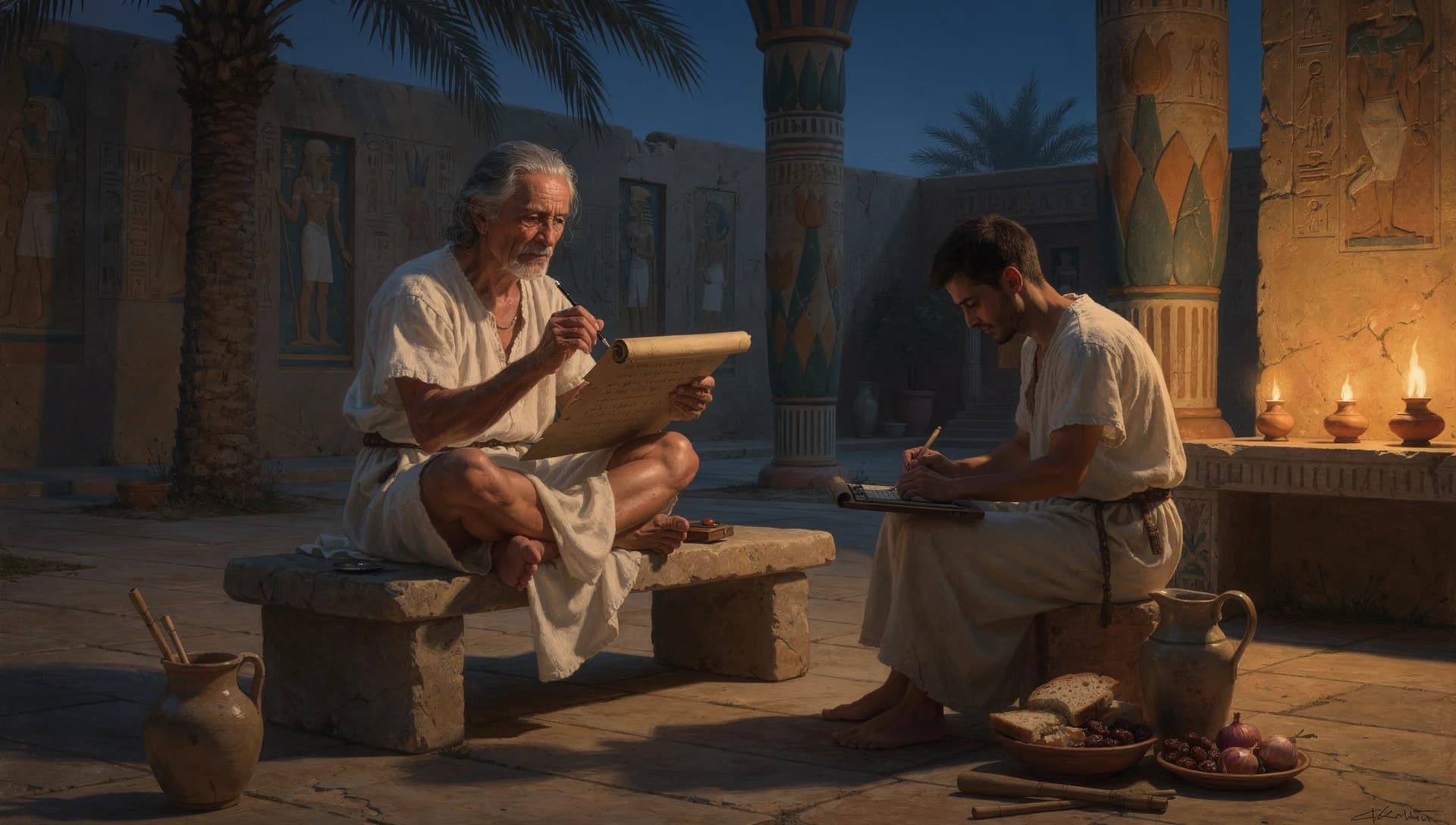
The Urantia Book gives a detailed account of who Amenemope was, what he taught, and why his work entered the Hebrew tradition. UB 95:4.1 records: "In due time there grew up in Egypt a teacher called by many the 'son of man' and by others Amenemope. This seer exalted conscience to its highest pinnacle of arbitrament between right and wrong, taught punishment for sin, and proclaimed salvation through calling upon the solar deity." The "son of man" identification is striking. The phrase, ben adam in Hebrew or bar enasha in Aramaic, becomes one of the most loaded titles in later Jewish and Christian theology, used by the prophet Ezekiel of himself and adopted by Jesus as his characteristic self-designation. The UB places its origin not in the Hebrew tradition but in the Egyptian wisdom tradition through Amenemope.
UB 95:4.2 elaborates on the teaching: "Amenemope taught that riches and fortune were the gift of God, and this concept thoroughly colored the later appearing Hebrew philosophy. This noble teacher believed that God-consciousness was the determining factor in all conduct; that every moment should be lived in the realization of the presence of, and responsibility to, God. The teachings of this sage were subsequently translated into Hebrew and became the sacred book of that people long before the Old Testament was reduced to writing." The mechanism of transmission is therefore a Hebrew translation of the Wisdom of Amenemope, circulating as scripture in Hebrew communities long before the canonical Tanakh was finalized. When the Book of Proverbs was assembled, the Amenemope-derived material was incorporated as the "Words of the Wise" section.
UB 95:4.5 makes a further specific claim that goes beyond what mainstream scholarship has confirmed: "In the Book of Hebrew Proverbs, chapters fifteen, seventeen, twenty, and chapter twenty-two, verse seventeen, to chapter twenty-four, verse twenty-two, are taken almost verbatim from Amenemope's Book of Wisdom. The first psalm of the Hebrew Book of Psalms was written by Amenemope and is the heart of the teachings of Ikhnaton." Mainstream scholarship has confirmed the 22:17 through 24:22 dependence; the broader claim about chapters 15, 17, and 20 is consistent with the general character of those chapters but harder to test directly. The Psalm 1 attribution to Amenemope is intriguing and not currently part of the academic consensus, but Psalm 1's structural similarity to the Amenemope corpus (the contrast between the way of the righteous and the way of the wicked, the imagery of the tree planted by water, the meditation on the law) makes the attribution plausible.
The Thought Adjuster connection in the UB account is particularly important. UB 95:3.5 states that the early Salem teachers in Egypt "were the first to proclaim conscience as the mandate of God, the voice of Deity." Amenemope's teaching that "God-consciousness was the determining factor in all conduct" and that "every moment should be lived in the realization of the presence of, and responsibility to, God" is, on the UB reading, an early articulation of the Thought Adjuster doctrine. The Adjuster, the indwelling fragment of the Universal Father in each mortal mind, is the actual mechanism of the conscience that Amenemope describes. The Egyptian tradition's parallel concept, the Ka, will be discussed in the next mapping; Amenemope is working with both the broader Egyptian Ka tradition and the specifically Salem-derived doctrine of indwelling divine presence.
The strongest counterargument to the UB account is the "son of man" attribution. The phrase has a complex history in Hebrew and Aramaic literature, and tracing it to an Egyptian sage is not standard. The reply is that the Hebrew phrase ben adam (literally "son of Adam" or "son of man") is generic enough in Hebrew that it could plausibly have been a calque on an Egyptian honorific applied to Amenemope. The UB account is reporting a specific historical claim that Amenemope was called "son of man," not that the later Hebrew use of ben adam was directly borrowed from him. Whether the title traveled from Amenemope into Hebrew and then via Ezekiel into Jesus is a further question the UB does not directly address.
Key Quotes
“In due time there grew up in Egypt a teacher called by many the "son of man" and by others Amenemope. This seer exalted conscience to its highest pinnacle of arbitrament between right and wrong, taught punishment for sin, and proclaimed salvation through calling upon the solar deity.”
“In the Book of Hebrew Proverbs, chapters fifteen, seventeen, twenty, and chapter twenty-two, verse seventeen, to chapter twenty-four, verse twenty-two, are taken almost verbatim from Amenemope's Book of Wisdom. The first psalm of the Hebrew Book of Psalms was written by Amenemope and is the heart of the teachings of Ikhnaton.”
“These early Nile valley teachers were the first to proclaim conscience as the mandate of God, the voice of Deity.”
Cultural Impact
The Wisdom of Amenemope, through its incorporation into the Book of Proverbs, has shaped Western moral consciousness more than almost any other ancient Egyptian text. The maxims about humility, honesty in commerce, kindness to the poor, restraint of speech, and the limits of riches that fill the central section of Proverbs come substantially from Amenemope. Through Proverbs, these maxims entered Christian moral instruction, medieval homiletics, the Renaissance moral essay tradition, and the broader cultural inheritance of Western moral common sense. When Benjamin Franklin in Poor Richard's Almanack quotes wisdom about saving and honesty, he is operating within a tradition that flows ultimately from a thirteenth-century BCE Egyptian sage. The Hebrew tradition's distinctive contribution was to integrate this wisdom material with the prophetic tradition of social justice, the priestly tradition of cultic purity, and the legal tradition of Sinai; but the wisdom material itself, including its central image of the inner moral voice and its theological framework of divine providence governing human affairs, is substantially Amenemope's contribution. The Book of Proverbs as a Hebrew composition is, in a real sense, a translation and integration of an older Egyptian wisdom corpus. That fact, established by Erman's 1924 demonstration, has reshaped modern understanding of biblical literary history.
Modern Resonance
Mainstream biblical scholarship treats the Amenemope dependence as a finding about literary borrowing in the ancient Near East, with the implication that the Hebrew Bible is more entangled with surrounding cultures than the older devotional reading allowed. The UB account adds a layer that the academic discussion does not have access to: Amenemope was not just a brilliant Egyptian wisdom teacher but a participant in a specific religious movement (the Salem teaching network) that was attempting to transmit a doctrine of one God and indwelling divine presence across the literate cultures of the ancient Near East. The Hebrew Bible's borrowings from Amenemope are therefore not borrowings from a foreign tradition but borrowings from an upstream node in the same Salem-derived stream that produced the Hebrew tradition itself. This reframing is significant for contemporary religious dialogue: the Hebrew, Christian, and Islamic traditions that descend from the Hebrew Bible can recognize Amenemope as part of their own theological lineage rather than as a foreign source they have appropriated. The figure of the "son of man," conscience as voice of God, and the universalist moral framework of the wisdom literature are all part of a single transmission stream that the UB calls the Salem teaching.
Related Mappings
Machiventa Melchizedek's Salem missionaries
= Ikhnaton / Akhenaten, pharaoh who proclaimed one God
Thought Adjuster, indwelling divine fragment
= Egyptian Ka, the divine spirit-double
Evolving mortal soul
= Egyptian Ba, the soul-bird
Okhban, murdered Egyptian prophet
= One of only four great prophets of Egypt
Related Articles
Where to next
The free newsletter. The research behind each piece, no spam.