
 Mythic
Egyptian Ba, the soul-bird
 UB
UBEvolving mortal soul
Full Article
Read the deep-dive article on this connection
Evolving mortal soul = Egyptian Ba, the soul-bird
The Connection
The UB draws an explicit parallel between the Ba and the evolving mortal soul. The Ba was depicted as a bird with a human head, representing the personality aspect that could travel between worlds. Unlike the Ka (divine gift), the Ba was understood as something that developed through the quality of one's life, paralleling the UB teaching that the soul is co-created by the mortal mind and the Thought Adjuster.
UB Citation
Academic Source
Zabkar, A Study of the Ba Concept (1968); Assmann, Death and Salvation in Ancient Egypt (2005)
Historical Evidence(Strong evidence)
The UB states: "Among the Egyptians, in the ka we find a concept which is analogous to spirit, and in the ba a concept resembling soul." Louis Zabkar demonstrated that the Ba represented the "manifestation of the individual after death" and was distinctly experiential rather than innate. The Ka/Ba distinction in Egyptian theology closely mirrors the Adjuster/soul distinction in UB theology: one is a divine gift (Ka/Adjuster), the other is the evolving product of lived experience (Ba/soul).
Deep Dive
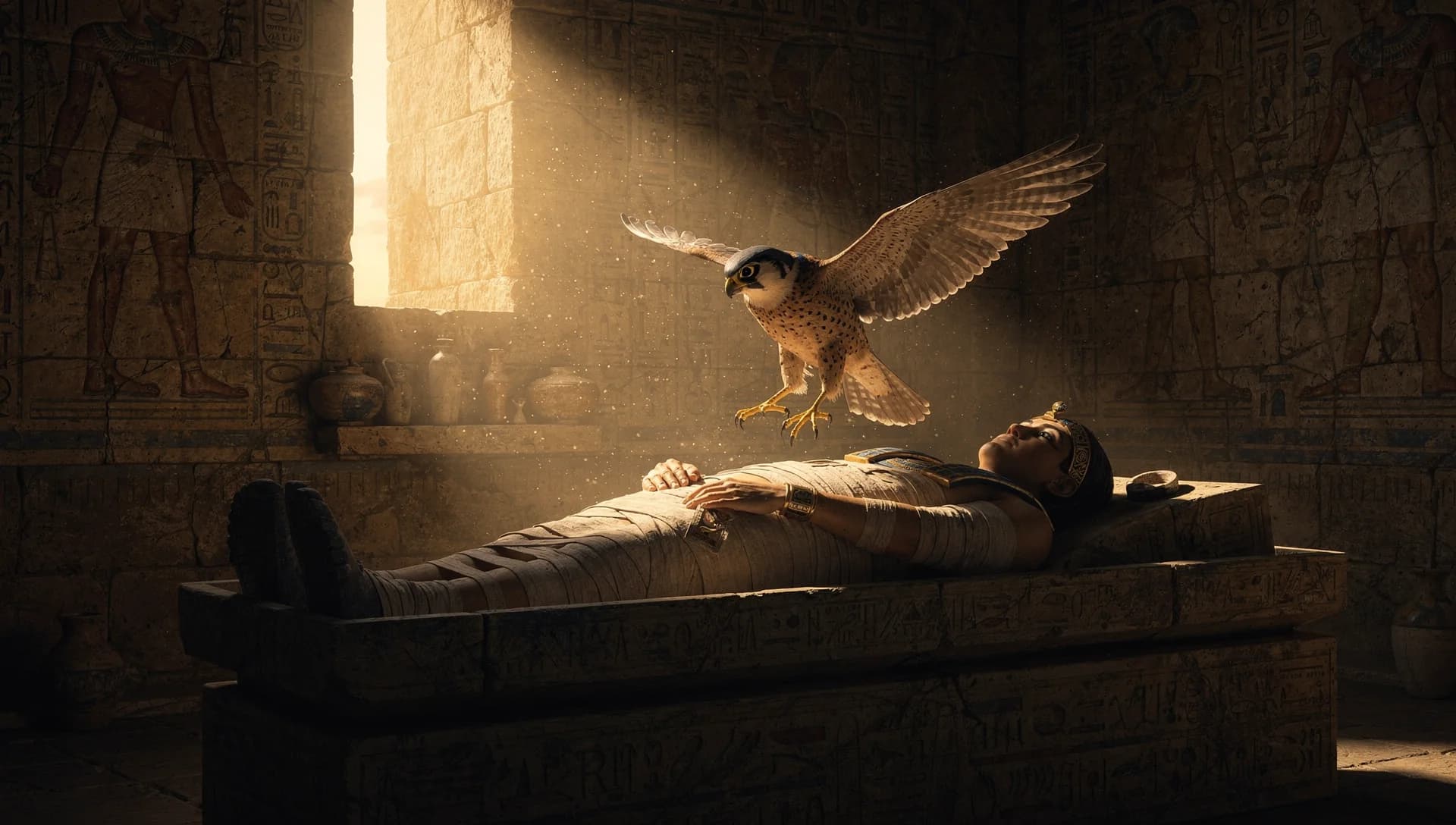
The Ba is depicted in Egyptian funerary art as a small bird with a human head, rendered with the head of the deceased so that it carries the unmistakable identity of the person it represents. In Book of the Dead vignettes, the Ba is shown leaving the tomb at dawn to fly out into the world of the living, then returning at dusk to rest with the body in the tomb. In other scenes the Ba hovers above the mummy, gazing down at it. In still others the Ba descends into the underworld with the deceased to participate in the trial of the heart against the feather of Maat. The image of the human-headed bird, capable of flight, anchored to the body but not identical with it, is one of the most evocative theological images from any ancient civilization.
The Ba was distinguished from the Ka in Egyptian theology by its temporal character. The Ka was bestowed at birth and conceived as a stable spiritual companion. The Ba developed through the life of the individual; it was, as Louis Zabkar demonstrated in his 1968 study A Study of the Ba Concept, "the manifestation of the individual after death," carrying forward what was uniquely the person's own. Egyptian texts speak of the Ba being released from the body at death, traveling between the worlds, eventually being reunited with the body in some form of resurrection or eternal continuity. The Ba was experiential, biographical, and personal in a way that the Ka was not.
The Urantia Book draws an explicit parallel between this Egyptian Ka/Ba distinction and the UB doctrinal pair of Thought Adjuster and evolving mortal soul. UB 111:0.4 records: "The Egyptians and many African tribes also believed in two factors, the ka and the ba; the soul was not usually believed to be pre-existent, only the spirit." The clause "the soul was not usually believed to be pre-existent, only the spirit" is the structural key. The Ka is pre-existent: it comes from the divine realm at birth, it does not develop, it is not created by the individual's experience. The Ba is not pre-existent: it is the manifestation of the individual after life has been lived, the expression of what the person has become. This is precisely the UB doctrine. The Thought Adjuster is pre-existent (a fragment of the Universal Father, eternal in nature, sent from Paradise to indwell the mortal mind). The soul is not pre-existent (it is co-created by the joint action of the mortal mind and the indwelling Adjuster, evolving through lived experience).
The structural distinction matters because most religious traditions have collapsed the two concepts into a single "soul" that combines both functions. Christian theology, particularly in its Augustinian mainstream, speaks of "the soul" as both the divinely bestowed essence and the evolving moral subject. Greek philosophy similarly used psyche to mean both the immortal divine principle and the experiential personality. The Egyptian distinction between Ka and Ba is one of the rare ancient theological systems to keep the two functions analytically separate, with separate vocabulary and separate iconographic representation. The UB doctrine of Thought Adjuster and soul, often confusing to readers from Christian or Hindu backgrounds because they are accustomed to a single "soul" concept, maps cleanly onto the Egyptian pair.
The Ba's bird form also has theological resonance with the UB account. The Ba is depicted as a bird because it is mobile, it travels, it leaves the body and returns. The UB describes the soul as the morontia (intermediate, between material and spirit) reality that survives the death of the material body and continues the ascendant career on the mansion worlds. The soul is the transferable, journeying aspect of the personality. The Egyptian image of the Ba as a flying bird is a stylized memory of the soul's nature as a journeying entity. After mortal death, in the UB account, the soul is repersonalized on the mansion worlds, reunited with the Adjuster, and begins the long ascent through the local universe and the superuniverse and finally to Paradise. The Egyptian Ba's nightly travel into the underworld and daily return to the body is a more limited version of the same idea: the soul travels, the soul returns, the soul ultimately is destined for a permanent fate in the divine realm.
The early Egyptian view that only kings had Bas, gradually democratized to include all righteous persons, parallels the UB account of soul development. UB tradition holds that survival of mortal death depends on the development of a survivable soul, which in turn depends on moral choices made during life. Not every mortal achieves this; some refuse moral cooperation with the Adjuster sufficiently that no soul develops. The Egyptian theological development from royal-only Ba to general Ba follows the same logic: not every person has a Ba, but every person who has lived rightly does. The structural match with the UB doctrine of conditional immortality (survival depends on moral choice) is exact.
The strongest counterargument is that Egyptian theology was not as systematic as the UB account makes it sound. There were variations across periods, regions, and even within single texts. The Coffin Texts present a different theology than the Pyramid Texts; the Book of the Dead shows further evolution. But the Ka/Ba distinction is one of the most stable elements across this evolution, attested in nearly every period of Egyptian theological development. It is the structural skeleton on which the variations hang. The UB account is identifying this stable structural feature, not claiming uniformity in every detail.
Key Quotes
“The Egyptians and many African tribes also believed in two factors, the ka and the ba; the soul was not usually believed to be pre-existent, only the spirit.”
“In the conception of the atman the Hindu teachers really approximated an appreciation of the nature and presence of the Adjuster, but they failed to distinguish the copresence of the evolving and potentially immortal soul.”
“The Ba represents the manifestation of the individual after death, the personality made fully effective in the divine realm.”
Cultural Impact
The Egyptian Ka/Ba distinction had limited direct cultural transmission to later Mediterranean traditions, in part because Egyptian theology was largely opaque to Greek and Roman readers and in part because the Hebrew and Christian traditions developed their own anthropological vocabulary. But the indirect inheritance is substantial. The Christian doctrine of the resurrection of the body owes some of its imagery to Egyptian funerary tradition: the body preserved, the spirit returning, the unified person restored in the eschatological future. The medieval theological distinction between the spiritus (the divinely indwelling principle, often associated with the Holy Spirit's witness) and the anima (the experiential soul, the seat of personality) is structurally similar to the Ka/Ba distinction, though arrived at independently through Greek philosophical sources. The Renaissance hermetic tradition, which had access to a romanticized version of Egyptian wisdom through the Corpus Hermeticum, partially recovered the Ka/Ba structure under the names of "spiritus" and "anima" or "soul" and "spirit." Modern theologians from Karl Rahner to Hans Urs von Balthasar have worked to recover a similar two-aspect anthropology within Christianity, reading "soul" and "spirit" as distinct levels in the human person. Each of these modern recoveries is, in its own way, a partial rediscovery of what the Egyptian theologians articulated three thousand five hundred years ago and what the UB articulates in the language of Adjuster and soul.
Modern Resonance
Contemporary readers, often raised in a vague mind-body dualism that treats "the soul" as a single undifferentiated entity, frequently struggle to make sense of the UB's distinction between Thought Adjuster and evolving soul. The Egyptian Ba/Ka pair, accessible through any introduction to Egyptian religion, provides a useful pedagogical bridge. Once the Ka and Ba are understood as distinct concepts (one bestowed and stable, the other developed and biographical), the UB anthropology becomes immediately intelligible. The Adjuster is the bestowed divine companion (the Ka in Egyptian language), and the soul is the developed personality that survives death (the Ba in Egyptian language). Modern depth psychology, particularly the Jungian tradition's distinction between Self (the divine center) and ego (the developed personality), preserves a faded version of the same structure. For contemporary readers integrating UB anthropology, the Egyptian theological vocabulary provides one of the cleanest ancient parallels available.
Related Mappings
Machiventa Melchizedek's Salem missionaries
= Ikhnaton / Akhenaten, pharaoh who proclaimed one God
Amenemope, Egyptian conscience teacher
= "Son of Man," source for Proverbs and Psalm 1
Thought Adjuster, indwelling divine fragment
= Egyptian Ka, the divine spirit-double
Okhban, murdered Egyptian prophet
= One of only four great prophets of Egypt
Related Articles
Where to next
The free newsletter. The research behind each piece, no spam.