
The Spirit-Double: The Egyptian Ka and the Thought Adjuster
Egyptian theology held that every person was accompanied by an invisible spiritual counterpart bestowed at birth by the creator god: the Ka. The Urantia Book identifies this concept as one of the clearest ancient approximations of the Thought Adjuster, the actual indwelling fragment of the Universal Father that accompanies every normal human mind.
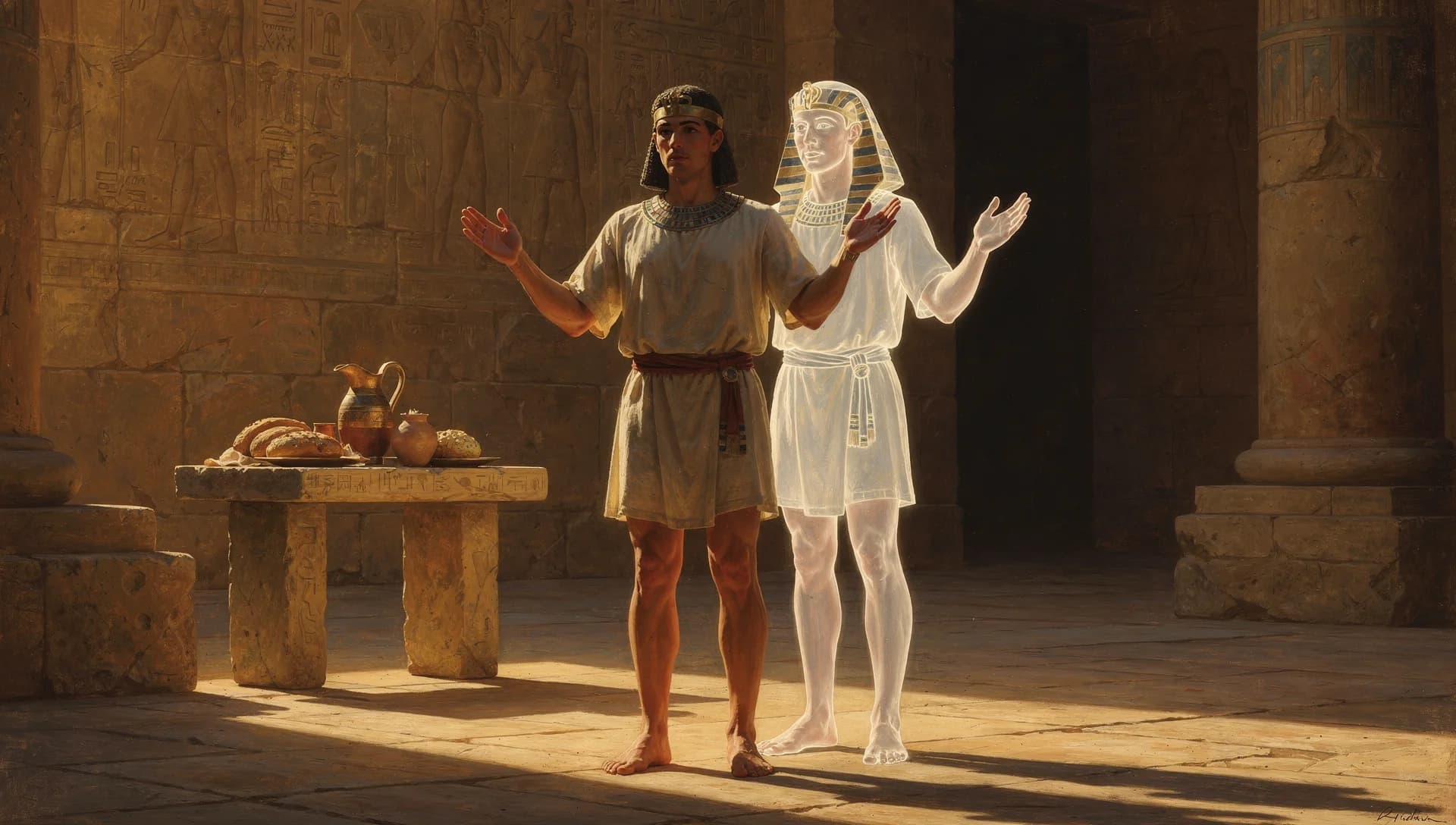
Thought Adjuster, indwelling divine fragment = Egyptian Ka, the divine spirit-double
This article expands on the decoder mapping. For the side-by-side card and quick reference, see the mapping page.
A Concept the Egyptians Had and the Greeks Did Not
The Ka is one of the most distinctive concepts in Egyptian religious thought and one of the more difficult to translate into modern theological categories. The standard modern renderings include "spirit-double," "life-force," "vital essence," "spiritual counterpart," and "creative power." James P. Allen's Middle Egyptian: An Introduction to the Language and Culture of Hieroglyphs (Cambridge University Press, 2000) treats the Ka as a hieroglyphic term best understood by accumulation rather than by definition.
What is common to all the attested uses is the claim that every human being has an invisible spiritual counterpart, distinct from the body, distinct from the personality, bestowed at the moment of creation by the creator god Khnum. This counterpart is not the person's soul in the modern sense; the Egyptians had a separate word, Ba, for that. The Ka is something more specific: a divine gift, present from birth, accompanying the person through life, continuing after death, and ultimately determining whether the person achieves immortal survival.
The structural claim is unusual among ancient religions. Most traditions that have a notion of inner divine presence treat it as something the person attains through practice, or something bestowed upon the exceptional (prophets, kings, saints). The Egyptian Ka is bestowed on everyone. It is the universal condition of being human.
The Urantia Book identifies the Ka directly as one of the closest ancient approximations of the Thought Adjuster.
What the Urantia Book Says
The comparative treatment in Paper 111 sets the Egyptian Ka in series with the Hindu atman and the Chinese yang-yin as ancient attempts to articulate the indwelling divine reality:
"In the conception of the atman the Hindu teachers really approximated an appreciation of the nature and presence of the Adjuster, but they failed to distinguish the copresence of the evolving and potentially immortal soul. The Chinese, however, recognized two aspects of a human being, the yang and the yin, the soul and the spirit. The Egyptians and many African tribes also believed in two factors, the ka and the ba; the soul was not usually believed to be pre-existent, only the spirit." (UB 111:0.4)
The Egyptian Ka-Ba distinction receives specific comparative weight. The Urantia Book's judgment is that the Egyptians, unlike the Hindus, preserved the critical structural feature of distinguishing two inner realities rather than conflating them into one. The Ka corresponds to the Adjuster; the Ba corresponds to the evolving mortal soul. The structural correctness is remarkable for an ancient tradition operating without the later theological vocabulary.
The Adjuster itself is treated throughout Paper 111 as the core of the mortal religious experience:
"Material evolution has provided you a life machine, your body; the Father himself has endowed you with the purest spirit reality known in the universe, your Thought Adjuster. But into your hands, subject to your own decisions, has been given mind, and it is by mind that you live or die. It is within this mind and with this mind that you make those moral decisions which enable you to achieve Adjusterlikeness, and that is Godlikeness." (UB 111:1.4)
The distinction between the Adjuster (divine gift) and the soul (evolving result of co-operation with the gift) is the feature the Urantia Book credits the Egyptian tradition with partially preserving through the Ka-Ba distinction:
"Mind is your ship, the Adjuster is your pilot, the human will is captain. The master of the mortal vessel should have the wisdom to trust the divine pilot to guide the ascending soul into the morontia harbors of eternal survival." (UB 111:1.9)
The Egyptian theological vocabulary, in the Urantia Book's account, was doing exactly this work. The Ka was the pilot; the Ba was the evolving soul; the mortal person in between was the captain whose moral decisions determined which of the two would prevail in the survival calculation.
What the Ancient Source Says
The Ka concept is attested from the Old Kingdom (third millennium BCE) onward. The Pyramid Texts (Unas Pyramid, c. 2350 BCE) already refer to the Ka as the royal spiritual counterpart bestowed by the creator god. The Coffin Texts (Middle Kingdom, c. 2000 BCE) extend the concept to non-royal individuals. By the New Kingdom, the Ka is a universal feature of Egyptian theological anthropology.
Louis V. Žabkar's A Study of the Ba Concept in Ancient Egyptian Texts (University of Chicago Press, 1968) and Andrey Bolshakov's Man and His Double in Egyptian Ideology of the Old Kingdom (Harrassowitz, 1997) provide the principal modern scholarly treatments. The Ka's specific features, as reconstructed from the primary sources, include:
First, bestowal at birth by the creator god. The Ka is given, not earned. Khnum, the ram-headed creator, is depicted on temple reliefs fashioning the Ka at the same potter's wheel as he fashions the body. The reliefs at Luxor Temple and Deir el-Bahari show the process explicitly.
Second, distinctness from the body. The Ka is not the body's soul in the vitalist sense. It is an accompanying presence, depicted iconographically as a second figure standing beside or behind the person, with upraised arms (the ka-sign hieroglyph, two arms raised). Jan Assmann's Death and Salvation in Ancient Egypt (Cornell University Press, 2005) documents the iconographic tradition across three thousand years.
Third, universality. Every person has a Ka. The Ka is not the privilege of the king or the priest; it is the general human condition. The distinction between the king's Ka and the commoner's Ka is not of kind but of quality and degree.
Fourth, post-mortem persistence. The Ka continues after the body's death, and one of the functions of mummification, funerary offerings, and the tomb cult is to sustain the relationship between the deceased and his Ka. John Taylor's Death and the Afterlife in Ancient Egypt (British Museum Press, 2001) treats the funerary practice in detail.
Fifth, relationship to survival. The Ka's condition determines the deceased's survival. A person who has lived well has a healthy Ka that continues. A person who has lived badly has a Ka that fails and the person is obliterated. The judgment scene in the Book of the Dead (Chapter 125) depicts the weighing of the heart against the feather of Maat (truth): the Ka's accumulated integrity is what is being weighed.
Why This Mapping Matters
The Egyptian Ka is the clearest ancient anticipation of the Thought Adjuster concept available in the world's religious literature. Every feature the Urantia Book attributes to the Adjuster (divine gift, bestowed on every normal human, distinct from the soul proper, determining ultimate survival, accompanying the person through life and beyond) is present in the Egyptian Ka tradition. The only feature the Egyptian tradition got substantially wrong is the mechanism of sustenance: the Egyptians thought the Ka was sustained by funerary offerings and physical body preservation, while the Urantia Book treats the Adjuster as sustained directly by the Universal Father and the ascending soul as sustained by the co-operative moral development of the mortal personality.
This is a remarkable convergence. The Egyptian tradition had no contact with the Urantia revelation, no written philosophical tradition of the Upanishadic type, no systematic theological development. It had a ritual and funerary tradition that developed a precise anthropological vocabulary over three millennia. And the vocabulary that emerged, the Ka-Ba distinction, the universality of the Ka, the role of the Ka in survival, matches the Urantia Book's account of the Adjuster-soul complex with precision.
The mapping's significance is threefold. First, it confirms that the ancient Egyptian religious tradition was not working without contact with something real. A tradition producing the Ka concept and the Ka-Ba distinction was touching actual features of the human religious situation. Second, it establishes that the Egyptian tradition, despite its elaborate polytheism and its eventual corruption into mystery-cult forms, preserved a structurally accurate anthropology at the personal level. Third, it provides a vocabulary for Egyptian-speaking peoples (and, through them, for the Hellenistic and eventually the Coptic Christian communities) to receive the later Christian indwelling-spirit teaching without having to invent the conceptual category from scratch.
Sources
- The Urantia Book, Paper 111 (The Adjuster and the Soul). Urantia Foundation, first printing 1955. Cited passages: 111:0.4, 111:1.4, 111:1.9.
- Allen, James P. Middle Egyptian: An Introduction to the Language and Culture of Hieroglyphs. Cambridge University Press, 2000.
- Žabkar, Louis V. A Study of the Ba Concept in Ancient Egyptian Texts. Studies in Ancient Oriental Civilization 34, University of Chicago Press, 1968.
- Bolshakov, Andrey O. Man and His Double in Egyptian Ideology of the Old Kingdom. Harrassowitz, 1997.
- Assmann, Jan. Death and Salvation in Ancient Egypt. Translated by David Lorton. Cornell University Press, 2005.
- Taylor, John H. Death and the Afterlife in Ancient Egypt. British Museum Press, 2001.
- Allen, James P., translator. The Egyptian Book of the Dead. Metropolitan Museum of Art / Chronicle Books, 2015.
Confidence and Evidence
- Confidence: UB CONFIRMED
- Evidence rating: STRONG
- Basis: The Urantia Book names the Ka directly in Paper 111 as one of the ancient approximations of the Adjuster concept. The Egyptian theological anthropology (bestowed at birth, universal, distinct from soul, determining survival, post-mortem persistent) matches the Adjuster description feature for feature. The Ka-Ba distinction preserves the two-reality structure that the Upanishadic tradition later conflated.
Related Decoder Articles
- Evolving Mortal Soul = Egyptian Ba, the Soul-Bird
- Thought Adjuster = Atman, the Inner Self
- Salem Missionaries = Ikhnaton / Akhenaten
By Derek Samaras
Connecting Articles
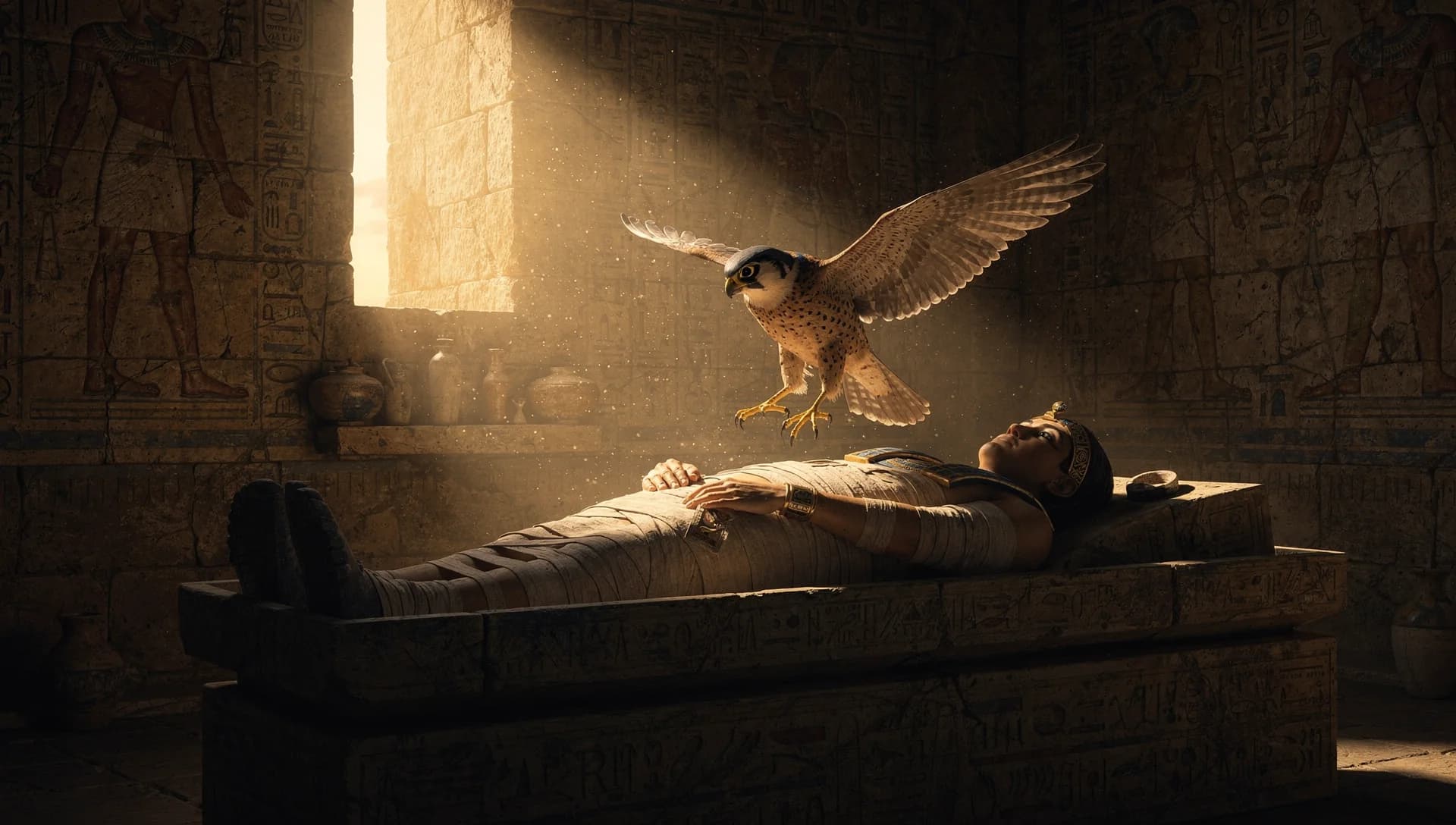
The Soul-Bird: The Egyptian Ba and the Evolving Mortal Soul

Two Realities, Two Names: Yang and Yin as Soul and Spirit

The Mark of Mercy: Cain's Thought Adjuster and the Genesis Mark

The Spark Within the Body: Orphic Brotherhood and the Thought Adjuster in Greek Dress
The Newsletter
Get the research behind each piece
Free. New Urantia Book explorations, the sources behind the videos, and early looks. No spam, unsubscribe anytime.
Prefer video? Follow on YouTube and Facebook.
Delivered through Substack. You can also read past issues.