
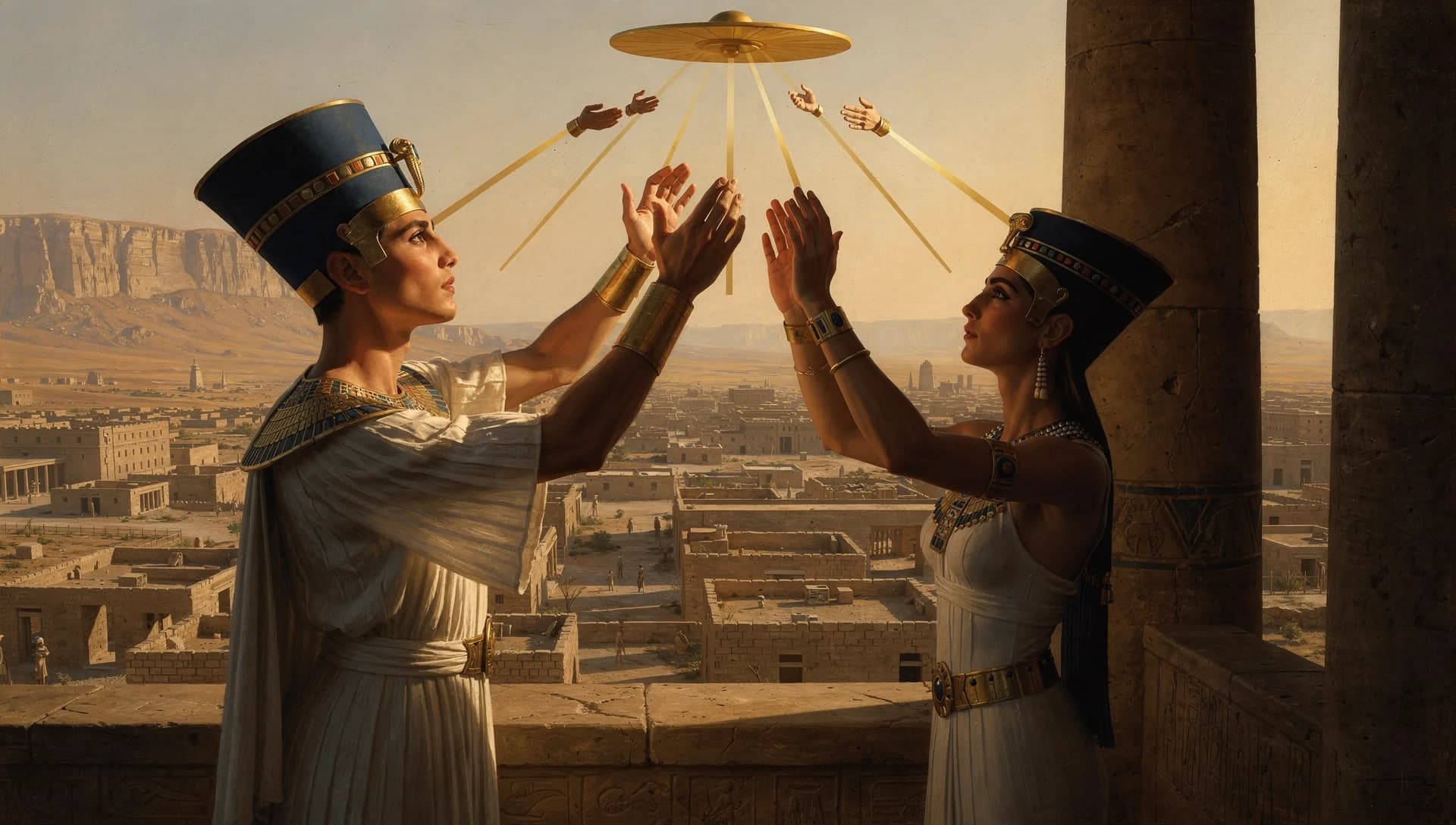
 Mythic
Ikhnaton / Akhenaten, pharaoh who proclaimed one God
 UB
UBMachiventa Melchizedek's Salem missionaries
Full Article
Read the deep-dive article on this connection
Machiventa Melchizedek's Salem missionaries = Ikhnaton / Akhenaten, pharaoh who proclaimed one God
The Connection
The UB states that Ikhnaton's monotheism came directly from the Salem missionary tradition. A Salemite physician influenced a woman of the royal family, who "prevailed upon her son, Ikhnaton, Pharaoh of Egypt, to accept these doctrines of One God." His worship of Aten was a deliberate strategy: approaching the Universal Father "under the guise of the sun-god" to make monotheism palatable to Egyptians.
UB Citation
Academic Source
Hornung, Akhenaten and the Religion of Light (1999); Assmann, Moses the Egyptian (1997)
Historical Evidence(Strong evidence)
Ikhnaton's "Great Hymn to the Aten" (c. 1350 BCE) is widely recognized as a precursor to Psalm 104. Jan Assmann documents the transmission: "The similarities between the Great Hymn and Psalm 104 are too striking to be coincidental." The UB explains the mechanism: Salem missionaries carried Melchizedek's monotheism into Egypt, where it influenced the royal court. Ikhnaton's Amarna revolution (c. 1353-1336 BCE) was the most dramatic attempt at monotheism before Moses, and the UB places it in a direct lineage from Melchizedek's Salem.
Deep Dive
Akhenaten ascended the throne of Egypt as Amenhotep IV in roughly 1353 BCE and within a few years had done what no Egyptian pharaoh before him had even contemplated. He changed his name to Akhenaten ("effective for the Aten"). He abandoned Thebes, the ancient capital and the center of the Amun priesthood, and built a brand new city in the desert at Tell el-Amarna. He proclaimed the worship of one god, the Aten, the visible solar disc, and progressively suppressed the worship of the older Egyptian pantheon, including the closure of temples and the chiseling out of the names of other gods from public inscriptions. He composed hymns, the Great Hymn to the Aten foremost among them, that articulate a startlingly modern monotheism: a single creator god who made all peoples and languages, who sustains all life through the daily passage of the sun, who is universal rather than national. He fathered Tutankhamun. He died after a reign of seventeen years, and within a generation the priests of Amun had reversed his reforms, demolished his city, and erased his name from the king lists. The episode was so thoroughly buried that European scholarship did not rediscover it until the late nineteenth century, when Flinders Petrie and Howard Carter excavated Amarna.
The Great Hymn to the Aten, found inscribed on the walls of the tomb of Ay at Amarna, is one of the most striking religious texts of the ancient world. Jan Assmann, in his work on Egyptian religion, has argued that the structural and verbal similarities between the Great Hymn and Hebrew Psalm 104 are so close that direct dependence is the most economical explanation. Both hymns describe the creator's daily provision through the sun, both list the categories of life sustained by divine action, both move from cosmic scale to particular ecological detail in the same sequence. Adolf Erman first noted the parallel a century ago. The mainstream consensus is that the Hebrew psalmist either knew the Akhenaten hymn directly or knew a tradition descended from it.
The Urantia Book provides the upstream source for both. UB 95:5.1 records: "The teachings of Amenemope were slowly losing their hold on the Egyptian mind when, through the influence of an Egyptian Salemite physician, a woman of the royal family espoused the Melchizedek teachings. This woman prevailed upon her son, Ikhnaton, Pharaoh of Egypt, to accept these doctrines of One God." The Salemite physician is the agent of transmission. Melchizedek, who incarnated at Salem in roughly 2000 BCE and taught the doctrine of one God to Abraham and to a wider circle of disciples, sent missionaries throughout the ancient Near East. One of those missionaries (or a descendant of the original missionary tradition) reached the Egyptian royal court and influenced the king's mother. She in turn influenced Akhenaten. UB 95:5.6 specifies the strategic decision: "Very wisely Ikhnaton sought to establish monotheism under the guise of the sun-god. This decision to approach the worship of the Universal Father by absorbing all gods into the worship of the sun was due to the counsel of the Salemite physician."
Two features of this account are especially striking. First, it explains why Akhenaten's monotheism was so close to the Hebrew tradition that descended from Melchizedek through Abraham, Moses, and the prophetic tradition. Both are downstream from the same Salem source, with one branch reaching Egypt through the Salemite physician and the other branch reaching the Hebrews through Abraham's lineage. The Hebrew Psalm 104 and Akhenaten's Great Hymn are not borrowed one from the other; they are cousins, both descended from a common ancestor in the Melchizedek tradition. Second, it explains why Akhenaten was the only pharaoh to attempt monotheism. The standard academic view treats his reform as either an idiosyncratic personal vision or a political maneuver against the Amun priesthood. The UB account adds the missing causal element: he was directly influenced by a missionary tradition that had been transmitting the doctrine of one God through the ancient Near East for several centuries.
UB 95:5.2 makes a further claim that ties the Akhenaten episode into the larger Christological narrative: "Since the disappearance of Melchizedek in the flesh, no human being up to that time had possessed such an amazingly clear concept of the revealed religion of Salem as Ikhnaton. In some respects this young Egyptian king is one of the most remarkable persons in human history. During this time of increasing spiritual depression in Mesopotamia, he kept alive the doctrine of El Elyon, the One God, in Egypt, thus maintaining the philosophic monotheistic channel which was vital to the religious background of the then future bestowal of Michael." On this reading, Akhenaten's reform was not just a local Egyptian phenomenon but a critical link in the planetary preparation for the Michael bestowal. Without the maintenance of monotheism in some quarter of the literate world, the cultural and theological substrate for the gospel that Jesus would later proclaim would have been weakened. Akhenaten's seventeen-year reign, despite being reversed politically, kept that substrate alive long enough for the tradition to feed into the Hebrew prophetic line and through it into the Christian era.
UB 95:5.3 even suggests a counterfactual that has implications for the Christological geography: "Moses, the greatest character between Melchizedek and Jesus, was the joint gift to the world of the Hebrew race and the Egyptian royal family; and had Ikhnaton possessed the versatility and ability of Moses, had he manifested a political genius to match his surprising religious leadership, then would Egypt have become the great monotheistic nation of that age; and if this had happened, it is barely possible that Jesus might have lived the greater portion of his mortal life in Egypt."
The strongest counterargument to the UB account is that it inserts a non-attested missionary network into a period and region where independent textual evidence is sparse. The reply is that the textual evidence is sparse precisely because the Salem missionaries operated as a non-institutional teaching tradition, working through influence rather than centralized organization. The Akhenaten episode itself, on the conventional academic reading, is a puzzle: where did this monotheistic vision come from in a fundamentally polytheistic culture, with no prior textual lineage? The UB account names the source.
Key Quotes
“The teachings of Amenemope were slowly losing their hold on the Egyptian mind when, through the influence of an Egyptian Salemite physician, a woman of the royal family espoused the Melchizedek teachings. This woman prevailed upon her son, Ikhnaton, Pharaoh of Egypt, to accept these doctrines of One God.”
“Since the disappearance of Melchizedek in the flesh, no human being up to that time had possessed such an amazingly clear concept of the revealed religion of Salem as Ikhnaton. In some respects this young Egyptian king is one of the most remarkable persons in human history.”
“Very wisely Ikhnaton sought to establish monotheism under the guise of the sun-god. This decision to approach the worship of the Universal Father by absorbing all gods into the worship of the sun was due to the counsel of the Salemite physician.”
Cultural Impact
Akhenaten's monotheistic reform was forgotten by ancient memory, erased by the priests of Amun, and absent from classical and medieval understanding of Egypt. Its rediscovery in the late nineteenth and early twentieth century, through the excavation of Amarna and the decipherment of the Great Hymn, transformed the modern understanding of Egyptian religion and of the ancient Near Eastern background of the Hebrew Bible. Sigmund Freud's late book Moses and Monotheism (1939) argued that Moses was an Egyptian priest of the Atenist tradition who carried Akhenaten's monotheism to the Hebrews, an inversion of the Hebrew self-understanding that has had enduring scholarly interest even where Freud's specific reconstruction is rejected. Jan Assmann's Moses the Egyptian (1997) revived the question with sophisticated philological analysis. Through these mediating works, Akhenaten has become a figure of contemporary cultural fascination, appearing in novels (Naguib Mahfouz's Akhenaten), film (the 1954 Howard Hawks Land of the Pharaohs), and an entire popular history literature. The seventeen-year reign of a single Egyptian king continues to ripple through religious and cultural debate three thousand five hundred years later.
Modern Resonance
Modern Egyptology is divided on Akhenaten. Some treat him as a brilliant religious visionary, others as a tyrannical fanatic who damaged Egypt's institutional fabric, others still as a cynical political operator using monotheism to break the power of the Amun priesthood. The UB account integrates these positions: Akhenaten was a sincere religious convert who received the doctrine through the Salemite physician's influence on his mother, but he lacked the political genius to consolidate the reform, and his rapid imposition of monotheism antagonized the priesthood and destabilized the kingdom. UB 95:5.4 puts it plainly: "But he went too fast; he built too much, more than could stand when he had gone." The honest assessment of his limitations does not diminish his significance. He was, on the UB reading, the most clear-eyed monotheist of the post-Melchizedek era and a critical link in the chain of preparation for the Michael bestowal. Contemporary readers, who often encounter Akhenaten as either a hero of religious freedom or a cautionary figure of fanaticism, are reading a partial picture; the UB synthesis is more nuanced and historically credible than either popular extreme.
Related Mappings
Related Articles
Where to next
The free newsletter. The research behind each piece, no spam.