
 Mythic
African "first family" creation narratives (Zulu Unkulunkulu, Shilluk Juok)
 UB
UBSangik racial origins: all six colored races arose in a single Himalayan family
Full Article
Read the deep-dive article on this connection
Sangik racial origins: all six colored races arose in a single Himalayan family = African "first family" creation narratives (Zulu Unkulunkulu, Shilluk Juok)
The Connection
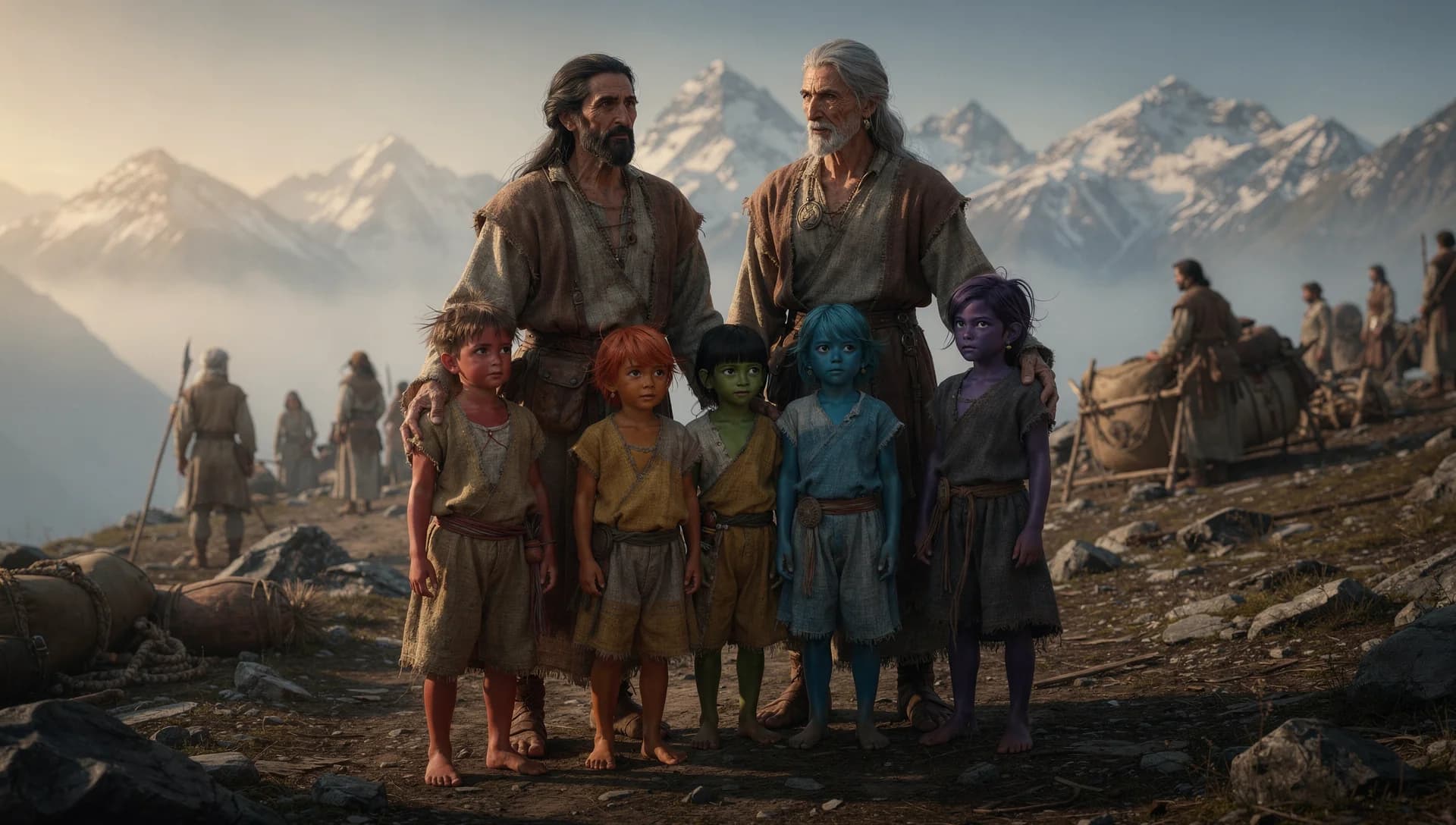
The UB records that "the six colored races of Urantia" all arose as mutations within a single Badonan tribal family in the Himalayan foothills around 500,000 years ago, later dispersing across the world. African traditional cosmologies frequently describe humanity emerging from a single "first couple" or "first ancestor" produced directly by the creator, and the indigo race specifically is remembered in its own traditions as descending from such a progenitor. These narratives preserve the Sangik-origin pattern: a common human source, with the racial streams diverging outward from one point.
UB Citation
UB 64:6.1-3, 64:6.25
Academic Source
Mbiti, African Religions and Philosophy (1969); Callaway, Religious System of the Amazulu (1870)
Historical Evidence(Suggestive evidence)
The Zulu high-god Unkulunkulu is remembered as both creator and first ancestor, with humanity descending directly from him through reed-born progenitors. Henry Callaway's 19th-century ethnography preserved Zulu first-family narratives consistent with the broader Bantu "Mvidi / Mulungu made the first man" pattern. Modern population genetics confirms sub-Saharan Africa as the geographic origin of Homo sapiens, matching the broad outlines of the UB's "humanity originated from one family, later dispersed" account even while differing on timeline and mechanism.
Deep Dive
In Zulu cosmology, all humanity descends from Unkulunkulu, the great-great-ancestor, who emerged from a bed of reeds at the beginning of time. Unkulunkulu is both the supreme creator and the literal progenitor of the Zulu people. Other African traditional religions preserve similar first-family narratives. The Shilluk of South Sudan trace humanity to Juok, who created the first man from clay and breathed life into him. The Akan of Ghana trace ancestry to Onyame, who created the first humans and sent them to populate the earth. The Fon of Benin trace humanity to Mawu and Lisa, the dual creators who established the first human family.
The pattern across many sub-Saharan African traditions is consistent: humanity originated from a single first family or first ancestor produced directly by the supreme creator-God, with subsequent dispersion explaining the diversity of contemporary human populations. The pattern is so widespread that John Mbiti, in African Religions and Philosophy, treats it as one of the foundational structures of African cosmological imagination.
The UB framework places this pattern in specific historical context. UB 64:6.1 states that "the simultaneous emergence of all six races on Urantia, and in one family, was most unusual." The six colored Sangik races did not arise as separate evolutionary branches; they all emerged as mutations within a single Badonan tribal family in the Himalayan foothills approximately 500,000 years ago. The mutations were extraordinary: red, orange, yellow, green, blue, and indigo human children appearing in successive births within one family lineage.
The dispersal followed naturally. UB 64:7.13 describes the geographic dispersion of the racial streams: "The superior races sought the northern or temperate climes, while the orange, green, and indigo races successively gravitated to Africa over the newly elevated land bridge which separated the westward retreating Mediterranean from the Indian Ocean." The indigo race specifically migrated to Africa, where they eventually took possession of the continent.
The African first-family narratives, on the UB account, preserve the cultural memory of this single-family origin. The descendants of the indigo race remembered, in distorted but recognizable form, that they descended from a single supreme-creator-produced ancestral family. Other races independently developed their own first-family narratives because they inherited the same memory.
The structural correspondence is exact. The Zulu Unkulunkulu narrative produces all humanity from a single creator-derived ancestral source. The UB Sangik narrative produces all racial diversity from a single creator-derived ancestral family. The traditions agree on the underlying point: humanity is one family, originated from a divine source, with subsequent diversification explaining the varieties we observe.
Modern population genetics confirms certain elements of this picture while differing on others. The "Out of Africa" hypothesis, now strongly supported by mitochondrial DNA, Y-chromosome, and autosomal genetic evidence, identifies sub-Saharan Africa as the geographic origin of all anatomically modern humans. The most recent common ancestor of all currently living humans (Mitochondrial Eve, on the matrilineal line) lived approximately 150,000-200,000 years ago in sub-Saharan Africa. The most recent common male ancestor (Y-chromosomal Adam) lived in a similar but slightly different timeframe.
The UB framework agrees with the genetic evidence that all humanity descends from a small African ancestral population, but the UB places this origin much earlier (approximately 500,000 years ago) and locates it in the Himalayan foothills rather than in the African Rift Valley. This is a significant difference. The UB account requires that the original Badonan family migrated from the Himalayan area to Africa during the post-emergence dispersion period, with the resulting African population preserving the deepest genetic continuity with the original family.
The strongest counterargument is that the genetic evidence places human origin firmly in Africa, and there is no genetic signature of an ancestral non-African population that subsequently migrated to Africa and replaced or absorbed the indigenous population. This is a real difficulty for the UB framework.
The defense, drawn from a careful reading of the UB chronology, is that the genetic Most Recent Common Ancestor (MRCA) calculations are consistent with substantial African ancestral residence over hundreds of thousands of years, but cannot reach back to the 500,000-year point of the UB-described Sangik emergence with current methods. The UB framework requires the indigo race to have had the longest African residence (since they migrated there earliest after the initial Sangik emergence), which would produce the deepest genetic continuity in African populations, exactly what current genetic evidence shows. The framework is consistent with the genetic data even though the dating differs significantly from mainstream estimates.
What the African first-family narratives offer, regardless of one's position on the UB chronology, is widespread cultural memory of single-family human origin. This memory is real, deeply preserved, and consistent across many independent traditions. The UB framework is one candidate explanation for why the memory is so consistent.
Key Quotes
“On an average evolutionary planet the six evolutionary races of color appear one by one; the red man is the first to evolve, and for ages he roams the world before the succeeding colored races make their appearance. The simultaneous emergence of all six races on Urantia, and in one family, was most unusual.”
“The indigo race. As the red men were the most advanced of all the Sangik peoples, so the black men were the least progressive. They were the last to migrate from their highland homes. They journeyed to Africa, taking possession of the continent, and have ever since remained there except when they have been forcibly taken away, from age to age, as slaves.”
Cultural Impact
The recognition of widespread first-family narratives across African traditional religion has been one of the foundational observations of postcolonial African theology. Mbiti, Idowu, and others have used these narratives to argue that African traditional religion is fundamentally compatible with the Christian Genesis narrative of single human origin from a divine source. The compatibility has supported indigenous African Christianity's engagement with traditional heritage rather than wholesale rejection. The UB framework offers a more specific historical anchor for this theological compatibility. The first-family narratives are not just structurally similar to Genesis; they preserve, in their own cultural idiom, the cultural memory of the actual single-family origin that the UB describes in detail. This framing supports African Christian theology in its engagement with traditional religious heritage while providing a specific historical claim about why the traditions are genuinely compatible. For broader comparative religious studies, the African first-family pattern offers one of the cleanest illustrations of cross-cultural memory of unified human origin. The pattern is not unique to Africa; it appears in multiple traditions worldwide. But the African expression is particularly well-documented and structurally consistent across diverse traditions, making it useful as a baseline for comparative analysis.
Modern Resonance
In the contemporary American conversation about race, the recognition of single-family human origin has political-cultural significance that extends beyond academic theology. The genetic evidence that all humans share recent common ancestors makes biological-racial categories ultimately untenable as fundamental divisions; the visible variations are surface features overlaid on a fundamentally common humanity. The UB framework adds theological depth to this scientific recognition. We are not just biologically a single family; we are spiritually and historically a single family, with origins that can be traced to a specific ancestral lineage that produced all the racial diversity we observe today. This recognition has practical implications for how we think about racial difference, racial conflict, and racial justice. The traditional African first-family narratives preserve this recognition in their own cultural idiom. Recovering them, taking them seriously as genuine cultural memory rather than as primitive cosmology, contributes to the broader project of recognizing the fundamental unity of humanity across the surface diversity of cultures and racial features. The UB framework offers a specific historical anchor for this recognition that connects the African traditional resources with the global Salem-monotheistic teaching tradition.
Related Mappings
Salem missionary teaching of one God, reaching Africa through Egypt
= Olodumare (Yoruba) / Nyame (Akan) / Mulungu (Bantu): remote high-god
Sahara civilization of the superior indigo race (UB 78:1.10)
= Dogon cosmology: Amma the creator and the Nommo who taught civilization
Ongoing Adamic and Salem cultural contribution to Nile civilization
= Egyptian influence carried southward into Kush, Nubia, and the Horn of Africa
Indigo race as distinct Sangik lineage, the last to migrate from the Badonan highlands
= Pan-African origin traditions of humanity's first ancestors coming from the north and east
Related Articles
Where to next
The free newsletter. The research behind each piece, no spam.