
 Mythic
Dogon cosmology: Amma the creator and the Nommo who taught civilization
 UB
UBSahara civilization of the superior indigo race (UB 78:1.10)
Full Article
Read the deep-dive article on this connection
Sahara civilization of the superior indigo race (UB 78:1.10) = Dogon cosmology: Amma the creator and the Nommo who taught civilization
The Connection
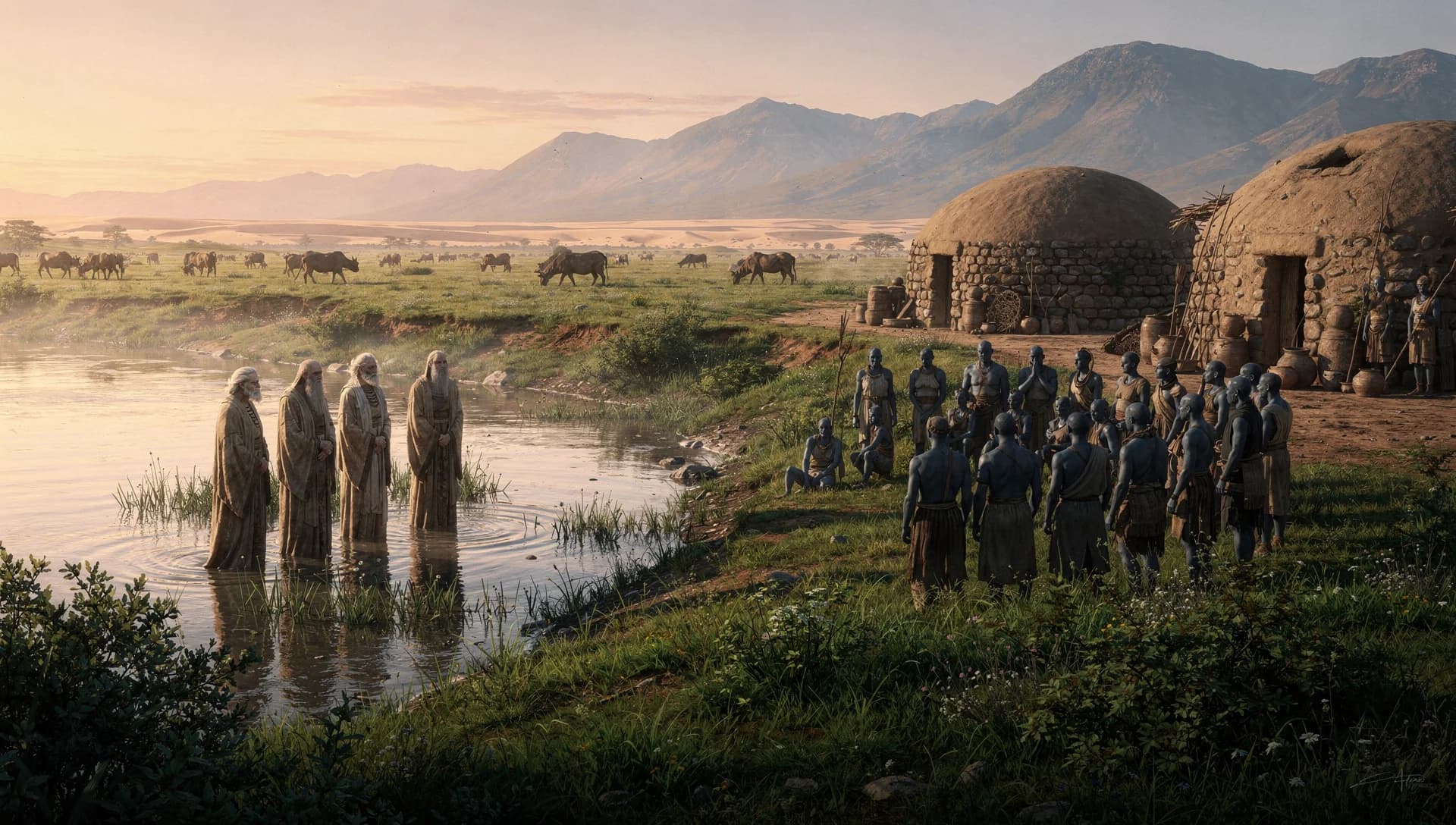
The UB describes the pre-desertification Sahara as the home of "the superior elements of the indigo race" who built "the most progressive settlements" of their race and carried strains of the extinct orange and green races. The Dogon of present-day Mali and Burkina Faso, who migrated south from the Sahara as it dried, preserve one of the most elaborate creation cosmologies in Africa: the supreme Amma creates the Nommo, amphibious ancestor-teachers who descend to earth and give humans language, agriculture, and ritual. The Nommo are not Amma, they serve Amma. The structural match to the Prince's corporeal staff serving the Universal Father is exact, and the Dogon migration route traces back to the very region the UB identifies.
UB Citation
UB 78:1.10, 80:1.4, 80:2.1
Academic Source
Griaule, Conversations with Ogotemmêli (1948); Dieterlen, The Pale Fox (1965)
Historical Evidence(Moderate evidence)
Marcel Griaule's decades of fieldwork with the Dogon elder Ogotemmêli recorded a cosmology in which Amma, the single supreme creator, sends the Nommo (twin or octuple ancestor-teachers) to earth to teach humanity the arts of civilization. Germaine Dieterlen's The Pale Fox documents the Dogon granary of knowledge, an organized body of cosmological teachings strikingly similar to the Sumerian ME and the UB's ten councils of the Prince's staff. The Sahara drought the UB dates at roughly 10,000 BCE matches the archaeological end of the "Green Sahara," and the southward migration of its peoples carried their cosmology with them.
Deep Dive
In 1946, the French anthropologist Marcel Griaule sat for thirty-three days with the Dogon elder Ogotemmêli in the village of Lower Ogol on the Bandiagara escarpment in central Mali. Ogotemmêli, blind and elderly, walked Griaule through the Dogon cosmological system in extraordinary detail. The resulting book, Conversations with Ogotemmêli (Dieu d'Eau, 1948), is one of the most extensively documented ethnographic accounts of any African cosmology. Griaule's student Germaine Dieterlen continued the work in The Pale Fox (Le Renard Pâle, 1965), recording further levels of the Dogon teaching that Ogotemmêli had only hinted at.
The Dogon cosmological system is genuinely extraordinary. At its center stands Amma, the single supreme creator who exists before the universe and produces it from a primordial seed of cosmic vibration. Amma creates the Nommo, ancestor-teachers who descend to earth to organize human life and teach civilization. The Nommo are described variously as twin beings, as octuple beings, as amphibious figures associated with water, and as bringers of language, agriculture, metallurgy, and ritual. They establish the granary of knowledge, an elaborate system of cosmological-architectural teachings that organize Dogon religious and social life.
The Dogon system has features that have proven controversial within the academic literature. Griaule and Dieterlen recorded specific astronomical knowledge in Dogon tradition, including knowledge of the binary nature of Sirius (the star's invisible companion Sirius B was not photographed by Western astronomers until 1862, but Dogon tradition allegedly knew of it). Subsequent scholarship has divided over whether Griaule recorded genuine ancient Dogon knowledge or whether he was inadvertently feeding Western astronomical concepts back to his Dogon informants and then collecting them as confirmation. Walter van Beek's 1991 article in Current Anthropology took the skeptical view; James Clifford and others have defended Griaule's methodology.
Whatever one concludes about the specific Sirius B controversy, the underlying Dogon cosmological system is genuinely sophisticated and deeply documented. The Amma / Nommo structure is not in dispute. The granary of knowledge with its elaborate cosmological architecture is not in dispute. The Dogon migration history from the pre-desertification Sahara is not in dispute.
The UB framework places this Dogon cosmology in specific historical context. UB 78:1.10 describes "the superior elements of the indigo race" as having "their most progressive settlements in what is now the great Sahara desert. This indigo-black group carried extensive strains of the submerged orange and green races." Before the Sahara desertified, it hosted what the UB calls the most advanced settlements of the indigo population, who carried genetic and cultural inheritances from earlier (now extinct) racial streams.
When the Sahara dried (the UB dates the major drought to roughly 10,000 BCE, matching the archaeological end of the Green Sahara phase), the populations migrated southward, carrying their cosmological teachings with them. The Dogon are widely understood by Africanist anthropologists to be descended from populations that migrated south as the Sahara dried. The Dogon cosmology, in the UB framing, preserves the religious teaching of the pre-desertification Sahara civilization.
The structural specifics match the UB framework with surprising precision. The Amma / Nommo structure (single supreme creator dispatching ancestor-teachers to earth) matches the UB's account of the Universal Father dispatching the Planetary Prince and his corporeal staff. The Nommo as twin or octuple beings matches the structured-staff organization the UB describes. The granary of knowledge as organized cosmological teaching matches the UB's ten councils of the Prince's staff teaching specific subject matter. The amphibious / water-associated character of the Nommo matches the standard ancient Near Eastern motif of teaching figures associated with water (Sumerian Enki, Indian Matsya, Akkadian Adapa).
The strongest counterargument is that the Dogon cosmology is mainstream-recognized as exceptionally elaborate but is treated within Africanist anthropology as a sophisticated indigenous development rather than as the residue of any specific external transmission. The UB framework assigns the elaborate cosmology to deep historical inheritance from the pre-desertification Sahara, but this inheritance cannot be directly verified given the absence of pre-Saharan archaeological remains for the indigenous-Africa cosmological tradition. The framework is plausible but not strictly testable.
What the Dogon case offers is one of the cleanest available examples of an African traditional religion that preserves elaborate, structured, theologically sophisticated teaching. Whatever account one takes of its origin, the Dogon system challenges the colonial-era stereotype of African traditional religion as primitive polytheism. It is sophisticated, structured, and clearly preserves a deep tradition that goes back well before contemporary Dogon culture took its present form.
Key Quotes
“The Sahara civilization. The superior elements of the indigo race had their most progressive settlements in what is now the great Sahara desert. This indigo-black group carried extensive strains of the submerged orange and green races.”
“But during earlier times there was little to hinder the westward migration of the Adamites. The Sahara was an open grazing land overspread by herders and agriculturists. These Saharans never engaged in manufacture, nor were they city builders. They were an indigo-black group which carried extensive strains of the extinct green and orange races.”
Cultural Impact
The Dogon cosmology has had outsized cultural impact relative to the small population (approximately 800,000 Dogon people) that maintains it. Griaule's Conversations with Ogotemmêli is one of the most widely read ethnographic works of the twentieth century, and the Dogon system has been featured in popular literature on African traditional religion, comparative cosmology, and (controversially) ancient astronomy. The UB framework offers a way to engage with the Dogon system that takes its sophistication seriously without falling into either of the two common pitfalls. The first pitfall is the romantic reading that treats the Dogon system as preserving secret ancient wisdom from advanced civilizations (the Robert Temple Sirius Mystery approach, which is academically discredited). The second pitfall is the deflationary reading that treats the Dogon system as a sophisticated but ultimately ordinary indigenous African development. The UB framing splits the difference. The Dogon system does preserve genuine memory of an earlier, more elaborate teaching tradition. That tradition is not from extraterrestrials but from the pre-desertification Sahara civilization that preceded the modern Dogon by thousands of years. The system is genuinely sophisticated because it inherits from a sophisticated source, not because it was invented from scratch by the modern Dogon. This framing dignifies both the Dogon as transmitters and the underlying tradition as the source.
Modern Resonance
The Dogon area of Mali has been increasingly difficult to access in recent years due to the security situation in the broader Sahel region. The cultural integrity of the Dogon religious tradition is under significant pressure from displacement, violence, and the broader instability that has affected the region. Documenting and preserving the tradition is increasingly urgent. The UB framework adds gravity to this preservation effort. The Dogon are not just maintaining a local cultural heritage; they are the contemporary custodians of a tradition that descends from the pre-desertification Sahara civilization, the earliest organized religious culture of sub-Saharan Africa. Their tradition is one of the oldest surviving religious teachings in the world, with genuine continuity to civilizational structures that predate ancient Egypt and rival or exceed Sumer in their depth. For contemporary readers interested in indigenous religious traditions, the Dogon offer one of the most thoroughly documented examples of an African tradition that genuinely preserves deep cultural memory. The UB framework provides a context for understanding why the Dogon system is as elaborate as it is: not because the modern Dogon are unusually inventive, but because they inherit from an unusually deep tradition. Engaging with the Dogon as such custodians, rather than as exotic ethnographic specimens, restores their tradition to its proper place in the global religious heritage.
Related Mappings
Salem missionary teaching of one God, reaching Africa through Egypt
= Olodumare (Yoruba) / Nyame (Akan) / Mulungu (Bantu): remote high-god
Sangik racial origins: all six colored races arose in a single Himalayan family
= African "first family" creation narratives (Zulu Unkulunkulu, Shilluk Juok)
Ongoing Adamic and Salem cultural contribution to Nile civilization
= Egyptian influence carried southward into Kush, Nubia, and the Horn of Africa
Indigo race as distinct Sangik lineage, the last to migrate from the Badonan highlands
= Pan-African origin traditions of humanity's first ancestors coming from the north and east
Related Articles
Where to next
The free newsletter. The research behind each piece, no spam.