
 Mythic
Olodumare (Yoruba) / Nyame (Akan) / Mulungu (Bantu): remote high-god
 UB
UBSalem missionary teaching of one God, reaching Africa through Egypt
Full Article
Read the deep-dive article on this connection
Salem missionary teaching of one God, reaching Africa through Egypt = Olodumare (Yoruba) / Nyame (Akan) / Mulungu (Bantu): remote high-god
The Connection
The UB states that Salem missionaries and, later, "mixed Andites and Egyptians followed down both the east and west coasts of Africa well below the equator." The pattern the UB identifies across world religions is that an original teaching of one distant creator-God gets covered over by intermediary gods and ancestral spirits. That is exactly the West African and Bantu high-god pattern: a supreme creator (Olodumare, Nyame, Mulungu) who withdrew from daily affairs but remains the ultimate source, with lesser spirits handling day-to-day concerns. This is the Salem high-god template, stripped down to its remote-creator core.
UB Citation
UB 78:5.5, 93:7.1
Academic Source
Idowu, African Traditional Religion: A Definition (1973); Mbiti, African Religions and Philosophy (1969)
Historical Evidence(Moderate evidence)
John S. Mbiti documented what he termed "diffused monotheism" across sub-Saharan Africa: nearly every traditional African religion affirms a single supreme creator-God whose name varies but whose attributes are consistent (sky-dwelling, aloof, the source of life and moral law). E. Bolaji Idowu argued that Yoruba Olodumare was a genuine monotheistic concept, not a post-Christian import. Wilhelm Schmidt's Urmonotheismus thesis, while controversial, collected extensive ethnographic evidence that traditional African religions preserve a high-god layer older than the surrounding polytheism. The UB provides the mechanism the Urmonotheismus thesis lacked: a historical Salem-missionary transmission reaching the continent.
Deep Dive
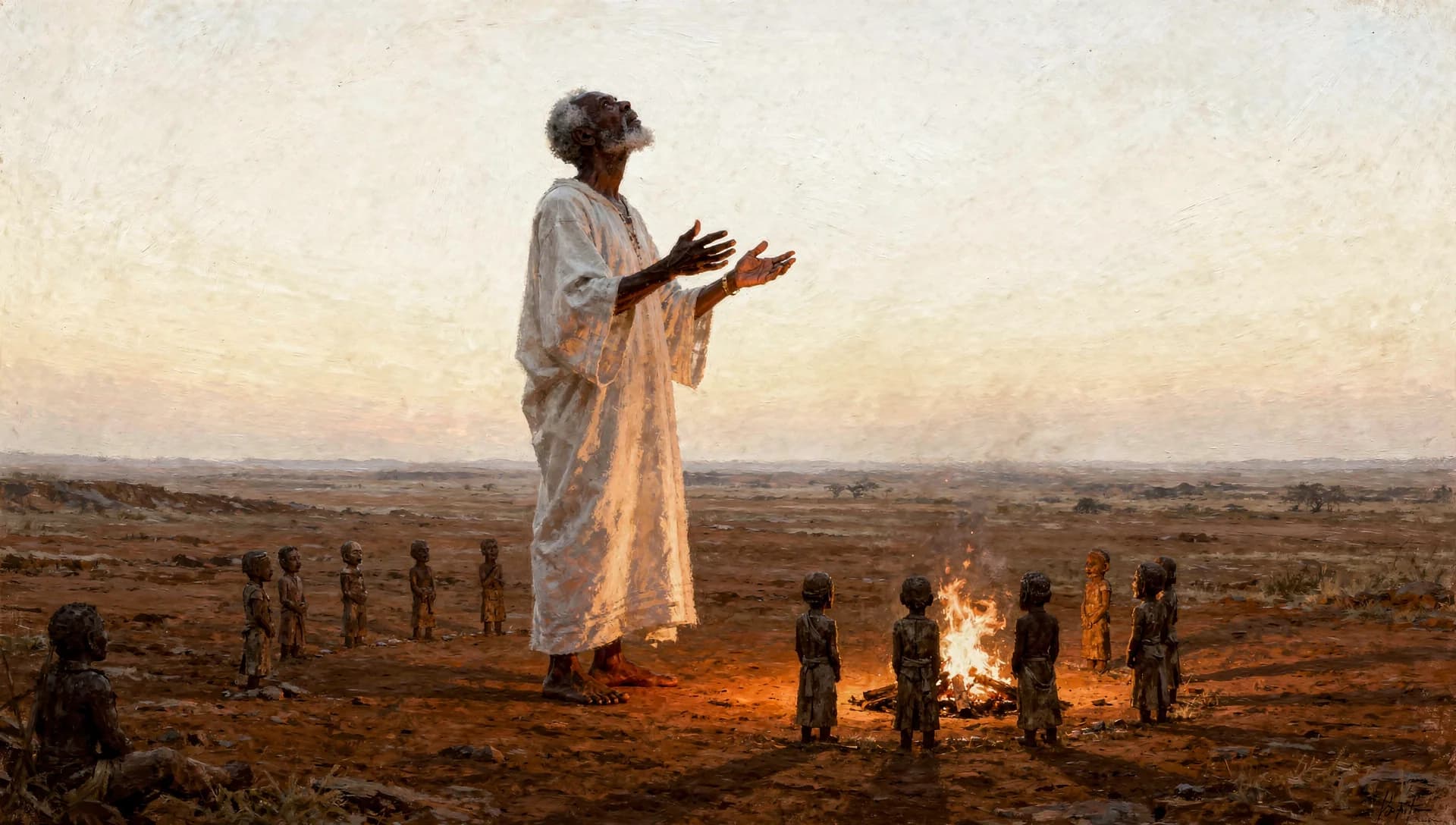
Sit with a Yoruba elder in a village near Ile-Ife, the spiritual capital of the Yoruba people in southwestern Nigeria. Ask about Olodumare. The elder will explain, with characteristic patience, that Olodumare is the supreme creator, the source of all things, the ultimate authority over the orisha (the lesser deities who handle day-to-day affairs). Olodumare does not require sacrifice. Olodumare does not require temples. Olodumare is too distant for direct petitionary prayer; one approaches Olodumare through the orisha. But Olodumare is the foundation of everything else, the ultimate referent of all religious life.
Travel hundreds of miles south, into Igbo country in southeastern Nigeria. The supreme being there is called Chukwu or Chineke. The descriptions are remarkably similar: distant, supreme, creator of all, the ultimate authority behind the lesser spirits who handle direct human affairs. Travel further south into the Akan territories of Ghana, and the supreme being is Nyame. Travel into Bantu-speaking East Africa, and the supreme being is Mulungu, Ngai, or Mungu. The names vary. The structure is consistent.
John S. Mbiti, in his 1969 African Religions and Philosophy, called this pattern "diffused monotheism." Mbiti, a Kenyan Anglican priest and one of the foremost African theologians of the twentieth century, surveyed the continent's traditional religions and concluded that nearly all of them affirm a single supreme creator-God whose attributes are remarkably consistent: sky-dwelling, ultimately aloof from daily affairs, the source of life and moral law, approachable through intermediaries but recognized as the foundation of all religious life.
E. Bolaji Idowu, in African Traditional Religion: A Definition (1973), argued specifically against the colonial-missionary assumption that African traditional religion was primitive polytheism. Idowu insisted that Yoruba Olodumare was a genuine pre-Christian monotheistic concept, not a post-missionary import. The orisha were not gods alongside Olodumare but ministerial figures within a fundamentally monotheistic framework.
The pattern of "diffused monotheism" was independently observed by Wilhelm Schmidt in the early twentieth century. Schmidt's Der Ursprung der Gottesidee (The Origin of the Idea of God), published in twelve volumes between 1912 and 1955, collected ethnographic evidence from indigenous traditions worldwide and argued for what he called Urmonotheismus, primitive monotheism. Schmidt held that the earliest religious form was monotheism, with polytheism developing later as a secondary phenomenon. The thesis was controversial in its time and is largely rejected today, but the underlying ethnographic data Schmidt collected is real.
The UB framework provides the historical mechanism that Schmidt's thesis lacked. UB 78:5.5 states that "mixed Andites and Egyptians followed down both the east and west coasts of Africa well below the equator." UB 93:7.1 states that Salem missionaries "penetrated to all the surrounding tribes." UB 94:0.1 states that "THE early teachers of the Salem religion penetrated to the remotest tribes of Africa and Eurasia." The Salem-missionary teaching of one universal Creator-God reached sub-Saharan Africa through these multiple pathways.
The pattern of reception the UB describes elsewhere is precisely what we see in African traditional religion. The original monotheistic teaching is received. It is partially absorbed into the existing religious framework. Over centuries, the surface religious life shifts toward intermediary figures (orisha, ancestors, nature spirits) while the supreme creator-God recedes into the upper-layer status that "diffused monotheism" describes. The high-god remains, but his immediate cultic functions are taken over by more accessible figures.
This pattern is so consistent across sub-Saharan Africa, and so distinctive in its specific structural features, that it requires explanation beyond the standard "every culture has gods of various ranks" generalization. The specific feature of "remote universal creator who recedes behind active intermediaries" is the diagnostic of Salem-teaching reception, and it appears across African traditions with structural consistency.
The strongest counterargument is that mainstream comparative religion does not accept Schmidt's Urmonotheismus thesis, and the African data is interpreted within mainstream frameworks as evidence of evolved monotheism rather than primal monotheism preserved. This is a real scholarly disagreement. The UB framework sides with Schmidt's underlying observation while providing the historical mechanism (Salem missionary transmission) that mainstream scholarship dismissed when it dismissed Schmidt's broader thesis. The underlying ethnographic data is solid; the question is what historical narrative best explains it.
The cumulative effect is to dignify African traditional religion in a way that Western academic frameworks have often failed to do. African traditional religions are not primitive polytheism. They are sophisticated theological systems that preserve, in their own cultural idiom, the universal Creator-God teaching that Salem missionaries brought to the continent during the second millennium BCE.
Key Quotes
“The Andites not only migrated to Europe but to northern China and India, while many groups penetrated to the ends of the earth as missionaries, teachers, and traders. They contributed considerably to the northern groups of the Saharan Sangik peoples. But only a few teachers and traders ever penetrated farther south in Africa than the headwaters of the Nile. Later on, mixed Andites and Egyptians followed down both the east and west coasts of Africa well below the equator, but they did not reach Madagascar.”
“Melchizedek continued for some years to instruct his students and to train the Salem missionaries, who penetrated to all the surrounding tribes, especially to Egypt, Mesopotamia, and Asia Minor.”
Cultural Impact
The recognition of African "diffused monotheism" has been one of the most significant developments in twentieth-century African theology. Mbiti's African Religions and Philosophy is a foundational document of postcolonial African religious thought, and Idowu's work on Yoruba religion has shaped a generation of African theologians. The political-cultural significance of this recognition has been considerable. Colonial-era European missionaries often dismissed African traditional religion as primitive polytheism that needed to be entirely replaced by Christianity. Postcolonial African theology has progressively recovered the monotheistic dimension of traditional religion and used it as a resource for indigenous Christianity that engages constructively with pre-Christian heritage rather than rejecting it wholesale. The UB framework supports this postcolonial theological project. African traditional religion preserves real Salem-monotheistic teaching that reached the continent thousands of years before European missionary contact. Engaging with traditional religion is not engaging with primitive paganism but with the African receptions of the same universal monotheistic teaching that informed all the world's major religions. This framing dignifies the tradition and supports its serious theological engagement.
Modern Resonance
Contemporary African Christianity is one of the fastest-growing religious movements in the world, with the largest national populations of Catholics now in countries like the Democratic Republic of the Congo, Nigeria, and Uganda. The forms African Christianity is taking are increasingly distinctive, drawing on traditional religious resources rather than simply replicating Western Christian forms. The UB framework offers theological grounding for this distinctive African Christianity. The traditional African recognition of a supreme creator-God is not foreign to Christian monotheism; it is the African reception of the same Salem teaching that ultimately informed Christianity itself. African Christianity can therefore engage with traditional religious heritage as continuous with rather than antithetical to Christian theological commitment. For non-African readers, the African pattern offers one of the most thoroughly documented illustrations of the worldwide Salem-teaching reception that the UB describes. Mbiti's ethnographic survey of "diffused monotheism" across hundreds of African traditional religions provides a uniquely rich dataset for understanding what happens when a universal monotheistic teaching enters and is partially absorbed by a polytheistic religious environment. The pattern is consistent enough to be diagnostic of the underlying historical process.
Related Mappings
Sahara civilization of the superior indigo race (UB 78:1.10)
= Dogon cosmology: Amma the creator and the Nommo who taught civilization
Sangik racial origins: all six colored races arose in a single Himalayan family
= African "first family" creation narratives (Zulu Unkulunkulu, Shilluk Juok)
Ongoing Adamic and Salem cultural contribution to Nile civilization
= Egyptian influence carried southward into Kush, Nubia, and the Horn of Africa
Indigo race as distinct Sangik lineage, the last to migrate from the Badonan highlands
= Pan-African origin traditions of humanity's first ancestors coming from the north and east
Related Articles
Where to next
The free newsletter. The research behind each piece, no spam.