
 Mythic
Egyptian influence carried southward into Kush, Nubia, and the Horn of Africa
 UB
UBOngoing Adamic and Salem cultural contribution to Nile civilization
Full Article
Read the deep-dive article on this connection
Ongoing Adamic and Salem cultural contribution to Nile civilization = Egyptian influence carried southward into Kush, Nubia, and the Horn of Africa
The Connection
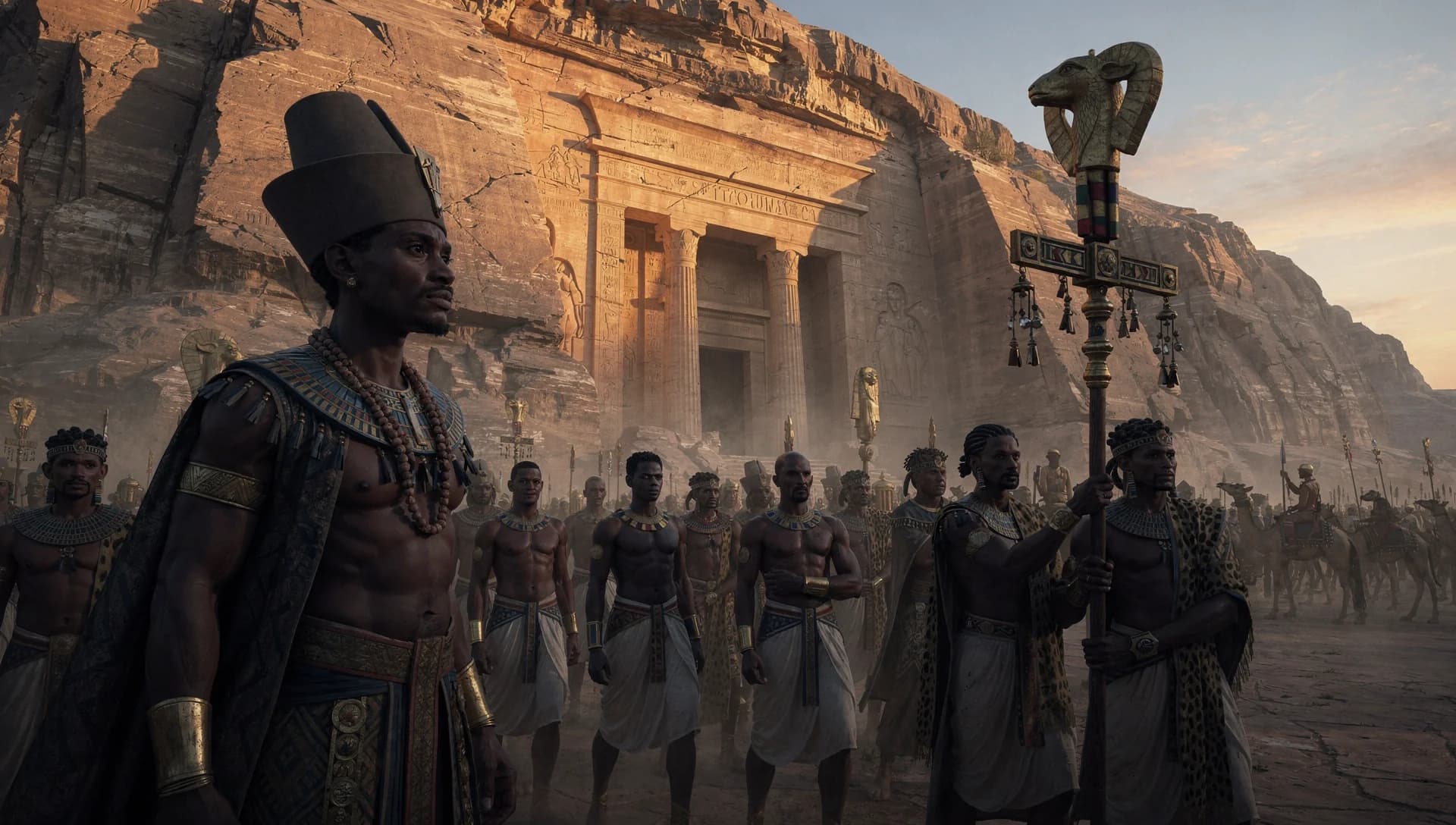
The UB states that "for more than thirty thousand years Egypt received a steady stream of Mesopotamians, who brought along their art and culture to enrich that of the Nile valley," and that Andite-Egyptian expeditions reached "below the equator." Nubian, Kushite, and early Ethiopian civilizations all show dependent cultural influence from Egyptian religion and iconography: the ram-headed Amun, the solar disk, the sacred tree, and the concept of divine kingship all travel south. These are not independent developments but downstream continuation of the same Salem-Egyptian transmission the UB locates at Ikhnaton's court.
UB Citation
UB 80:1.3, 78:5.5, 95:5.1-6
Academic Source
Wilkinson, The Complete Gods and Goddesses of Ancient Egypt (2003); O'Connor, Ancient Nubia (1993)
Historical Evidence(Moderate evidence)
Richard H. Wilkinson documents extensive Egyptian religious influence on Kushite and Nubian royal theology, with the Kushite kings of Egypt's 25th Dynasty (c. 750-650 BCE) adopting Amun-worship as state religion. David O'Connor's archaeological work at Kerma and Napata traces a continuous cultural corridor between Egypt and sub-Saharan Africa that carried religious concepts southward. The UB places the original Salem seed at Ikhnaton's court, and the Nubian Amun is a direct descendant of the Egyptian solar-Aten theology with its monotheistic leanings.
Deep Dive
In 728 BCE, the Kushite king Piye marched north out of Napata in modern Sudan, conquered Egypt, and established what became the 25th Dynasty of Egyptian pharaohs. For roughly a century, sub-Saharan African kings ruled the entire Nile valley from the Mediterranean to the Fourth Cataract. The Kushite pharaohs adopted the full apparatus of Egyptian royal religion, with particular devotion to Amun, the supreme god of Thebes, whose cult had become identified with universal sovereignty.
The Kushite adoption of Amun-worship was not external imitation. It reflected a much older religious continuity. Amun-veneration had existed at Napata since at least the Middle Kingdom, and the Kushite religious establishment maintained a major Amun temple at Gebel Barkal that they considered the "southern Iput" or southern counterpart of Karnak. The Kushites understood themselves not as adopting a foreign religion but as participating in a religious tradition that already extended the full length of the Nile.
The Egyptian-Nubian-Kushite religious corridor functioned as a cultural pipeline carrying religious concepts southward into sub-Saharan Africa across more than a millennium. Richard Wilkinson's The Complete Gods and Goddesses of Ancient Egypt (2003) documents the persistence of Egyptian religious iconography in Nubian and post-Nubian African contexts. David O'Connor's archaeological work at Kerma (the early Nubian capital) and Napata established the deep continuity of this cultural-religious corridor.
The UB places the historically pivotal moment of this corridor at the court of Ikhnaton. UB 95:5.1 states: "The teachings of Amenemope were slowly losing their hold on the Egyptian mind when, through the influence of an Egyptian Salemite physician, a woman of the royal family espoused the Melchizedek teachings. This woman prevailed upon her son, Ikhnaton, Pharaoh of Egypt, to accept these doctrines of One God." Ikhnaton's religious revolution at Amarna (c. 1353-1336 BCE) is, on the UB account, the high point of Salem-missionary penetration into Egyptian state religion.
Ikhnaton's revolution failed in its immediate political form. After his death, the priesthood of Amun reasserted control, the Amarna capital was abandoned, and the official religion returned to traditional polytheistic forms. But the Amarna theology did not entirely disappear. Significant elements of monotheistic-leaning solar theology persisted in the cult of Amun-Re, particularly in the Theban priestly tradition that the Kushites later inherited. The Hymn to Amun in Papyrus Leiden I 350 (a Ramesside-era text) presents Amun in nearly monotheistic terms: "all gods are three: Amun, Re, and Ptah," with Amun as the hidden ultimate reality of which the others are aspects.
This residual Amarna-derived theology was carried south into Nubia and Kush. The Kushite Amun is more thoroughly identified with universal sovereignty and supreme divinity than the standard pre-Amarna Theban Amun. The Kushite priesthood developed an elaborate theological structure in which Amun functioned as the ultimate reality behind all other divine manifestations.
UB 78:5.5 states that "mixed Andites and Egyptians followed down both the east and west coasts of Africa well below the equator." UB 80:1.3 adds: "For more than thirty thousand years Egypt received a steady stream of Mesopotamians, who brought along their art and culture to enrich that of the Nile valley." The cultural corridor between Egypt and sub-Saharan Africa was active for tens of thousands of years before the Kushite period, with religious teachings flowing southward continuously.
The downstream effect on sub-Saharan African religious development was significant. The widespread sub-Saharan African pattern of "diffused monotheism" (a remote supreme creator-God who recedes behind active intermediary spirits) is consistent with the Egyptian-Amarna-Kushite theological inheritance, though it cannot be reduced to that inheritance alone. The high-god patterns of West African religions (Yoruba Olodumare, Akan Nyame), East African religions (Bantu Mulungu, Kikuyu Ngai), and Central African religions (Bantu Mvidi) all show structural features consistent with the kind of remote-supreme-creator theology that the Egyptian-Amarna tradition exemplified.
The strongest counterargument is that mainstream Africanist scholarship resists the proposition that sub-Saharan African religious development was significantly shaped by Egyptian influence. The "Afrocentric" tradition of Cheikh Anta Diop and Molefi Asante has championed Egyptian influence; the mainstream Africanist tradition has been skeptical, treating sub-Saharan African religious development as largely indigenous. The actual scholarly evidence supports a middle position: there was significant cultural exchange across the Nubian corridor, but sub-Saharan African religions are not simply derivatives of Egyptian religion.
The UB framework supports this middle position. The Salem-Egyptian-Amarna teaching influenced sub-Saharan Africa through the cultural corridor, but the broader Salem-missionary teaching also reached Africa through other routes (UB 78:5.5 explicitly mentions both the east and west African coasts as receiving teaching). The result was a pattern of multiple-stream Salem teaching reaching the continent, with the resulting religious developments being genuinely indigenous adaptations of received teaching rather than mere derivatives of any single external source.
Key Quotes
“For more than thirty thousand years Egypt received a steady stream of Mesopotamians, who brought along their art and culture to enrich that of the Nile valley. But the ingress of large numbers of the Sahara peoples greatly deteriorated the early civilization along the Nile so that Egypt reached its lowest cultural level some fifteen thousand years ago.”
“The teachings of Amenemope were slowly losing their hold on the Egyptian mind when, through the influence of an Egyptian Salemite physician, a woman of the royal family espoused the Melchizedek teachings. This woman prevailed upon her son, Ikhnaton, Pharaoh of Egypt, to accept these doctrines of One God.”
Cultural Impact
The recognition of the Egyptian-Nubian-Kushite religious corridor as a major channel for cultural-religious transmission has been one of the significant developments of late-twentieth-century Africanist scholarship. The earlier scholarly tradition often treated sub-Saharan Africa as religiously isolated from Mediterranean and Near Eastern developments, treating any apparent influence as evidence of recent missionary contact rather than ancient cultural exchange. The UB framework supports the more recent recognition that sub-Saharan African religious development was genuinely shaped by Mediterranean and Near Eastern teaching streams reaching the continent through the Nile corridor and through the West and East African coasts. This is not a derogation of African religious tradition; it is a recognition that African religion participates in the same global pattern of Salem-missionary reception that the UB documents across all the major religious traditions of the world. For African Christian theology, this framing has practical importance. African Christianity is not foreign to African religious heritage; it engages with a continent whose pre-Christian traditions had already received significant Salem-monotheistic influence through the Egyptian-Nubian corridor. The traditional religious vocabulary of African Christianity therefore connects to genuine pre-Christian theological resources rather than substituting Christian concepts for incompatible African ones.
Modern Resonance
In contemporary debates about Afrocentrism, African heritage, and the relationship between African and Mediterranean civilizational development, the Egyptian-Nubian-Kushite corridor has become a contested site. Afrocentric scholarship emphasizes the African character of Egyptian civilization and the indigeneity of religious development across the Nile valley. Mainstream Egyptology has often resisted these emphases, treating Egyptian civilization as a separate development with limited connection to sub-Saharan Africa. The UB framework offers a way to honor both sides of this debate. Egyptian civilization is genuinely African, and its development is genuinely connected to sub-Saharan African religious heritage. The Salem-missionary teaching that influenced Egyptian religious thought, particularly through Ikhnaton's Amarna revolution, was carried southward through the Nubian corridor into the broader sub-Saharan religious environment. African religious heritage is therefore deeply connected to the global Salem-teaching tradition, not as derivative of it but as one of its major streams of historical reception. For contemporary readers, this framing offers a way to engage with African religious heritage that takes its sophistication seriously, recognizes its connections to the broader global tradition, and avoids both the romantic-nationalist excesses of pure Afrocentrism and the dismissive-isolationist tendencies of older Africanist scholarship. The Egyptian-Nubian-Kushite corridor is a historical reality, and the religious traditions that flowed through it deserve serious theological engagement.
Related Mappings
Salem missionary teaching of one God, reaching Africa through Egypt
= Olodumare (Yoruba) / Nyame (Akan) / Mulungu (Bantu): remote high-god
Sahara civilization of the superior indigo race (UB 78:1.10)
= Dogon cosmology: Amma the creator and the Nommo who taught civilization
Sangik racial origins: all six colored races arose in a single Himalayan family
= African "first family" creation narratives (Zulu Unkulunkulu, Shilluk Juok)
Indigo race as distinct Sangik lineage, the last to migrate from the Badonan highlands
= Pan-African origin traditions of humanity's first ancestors coming from the north and east
Related Articles
Where to next
The free newsletter. The research behind each piece, no spam.