
 Mythic
Pan-African origin traditions of humanity's first ancestors coming from the north and east
 UB
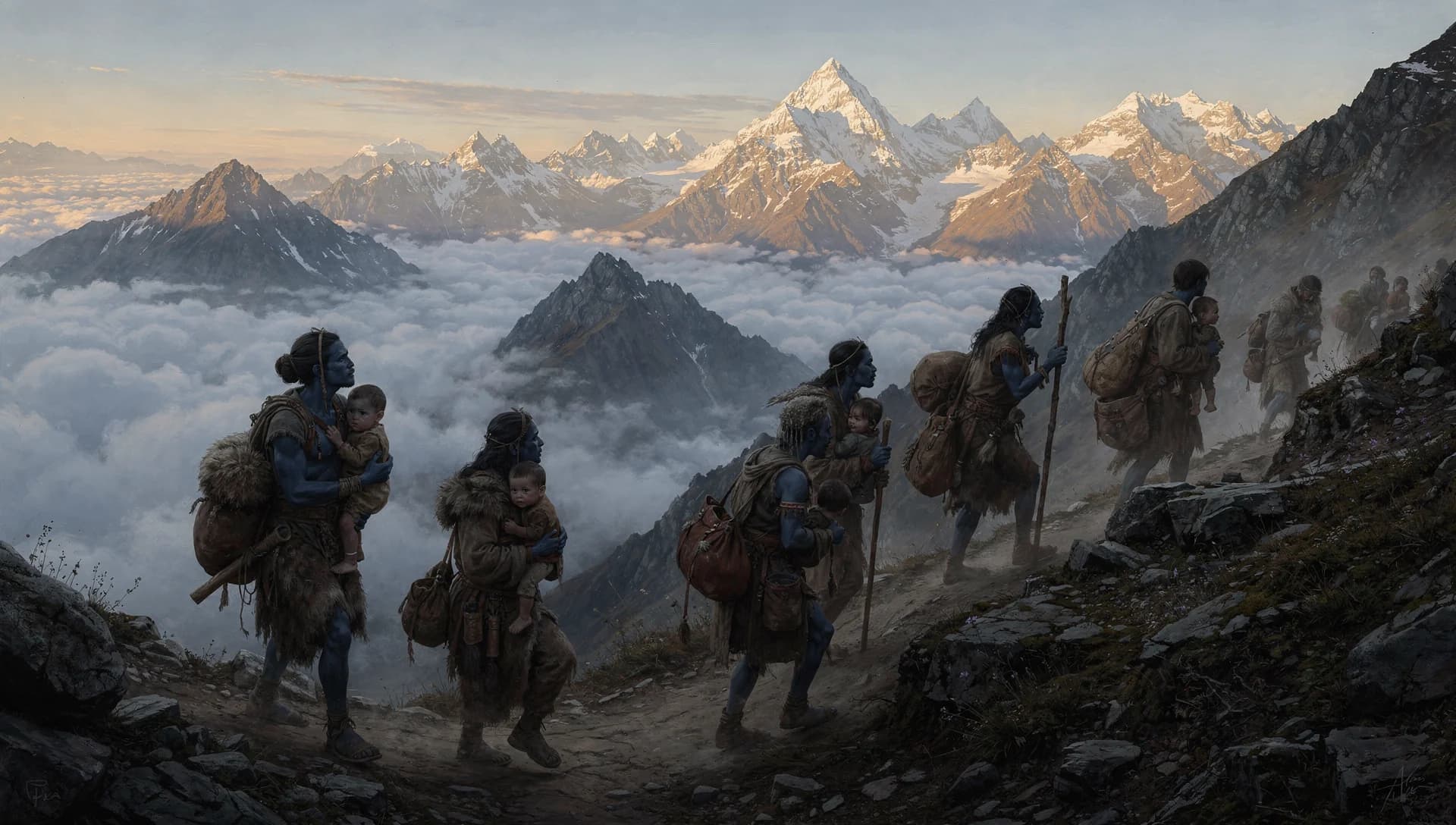
UBIndigo race as distinct Sangik lineage, the last to migrate from the Badonan highlands
Full Article
Read the deep-dive article on this connection
Indigo race as distinct Sangik lineage, the last to migrate from the Badonan highlands = Pan-African origin traditions of humanity's first ancestors coming from the north and east
The Connection
The UB identifies the indigo race as the last of the six colored races to migrate from the ancestral Himalayan-foothills home, journeying to Africa where they "took possession of the continent." Many sub-Saharan African origin traditions independently identify a northern or northeastern ancestral homeland from which the founding ancestors came: the Dogon trace their migration from the Mande region and ultimately from Egypt, Bantu traditions track an origin in the Lake Chad or Great Lakes region, and Igbo tradition preserves an eastern homeland memory. The pattern of "we came from the north or east" maps onto the UB's Badonan-to-Africa indigo migration route.
UB Citation
UB 64:6.25, 64:7.13-14
Academic Source
Ehret, The Civilizations of Africa (2002); Oliver & Fagan, Africa in the Iron Age (1975)
Historical Evidence(Suggestive evidence)
Christopher Ehret's linguistic reconstruction of African population history traces Bantu expansion from a Nigerian-Cameroonian cradle eastward and southward, with the cultural corridor moving out of Lake Chad basin. Roland Oliver's archaeological synthesis documents the iron-age expansions. The UB's specific claim that "they journeyed to Africa, taking possession of the continent" from a northern ancestral homeland maps broadly onto the modern consensus on African population movement, even while the UB's dating places the initial migrations much earlier than conventional chronology.
Deep Dive
Across sub-Saharan African traditional religion runs a recurring narrative element: the founding ancestors came from the north or northeast. The Dogon trace their migration from the Mande region of West Africa, and ultimately, in the deepest layer of their tradition, from Egypt and beyond. The Bantu-speaking populations of central, eastern, and southern Africa preserve traditions of migration from a northern homeland, often associated with the Lake Chad basin or the Great Lakes region. The Igbo of southeastern Nigeria preserve the story of an eastern ancestral homeland from which the founding ancestors emerged. The Yoruba trace their origins to Ile-Ife, but their deeper traditions speak of migration from the north or northeast.
This recurring "we came from the north" element is not a feature of every African traditional religion, but it appears across enough independent traditions to be diagnostic of something real about the deep history of African population movement. The pattern is too widespread to be accidental and too specific to reduce to generic "we came from somewhere" mythology.
The mainstream linguistic and archaeological account of African population history broadly supports this traditional memory. Christopher Ehret's The Civilizations of Africa (2002) reconstructs the Bantu expansion as having moved from a Nigerian-Cameroonian cradle eastward and southward across the continent over the past three thousand years. Earlier population movements are less well-reconstructed but appear to have moved from northeastern centers (the Sahara during its green phase, the Nile valley) southward and westward across sub-Saharan Africa.
The UB framework places this pattern in the context of the original Sangik dispersion. UB 64:6.25 states that the indigo race "were the last to migrate from their highland homes. They journeyed to Africa, taking possession of the continent." UB 64:7.13 adds geographic detail: "The superior races sought the northern or temperate climes, while the orange, green, and indigo races successively gravitated to Africa over the newly elevated land bridge which separated the westward retreating Mediterranean from the Indian Ocean." The land bridge in question is between the eastern Mediterranean and the Indian Ocean, which would have placed the migration corridor through the eastern Mediterranean and into Africa from the northeast.
The "we came from the north" element of African traditional religion thus preserves cultural memory of the original Sangik migration to Africa from the Himalayan-Mediterranean direction. The migration was not a single event but a long process of successive movements over many tens of thousands of years. The traditional memories preserve this directionality: the founders came from the north, the deepest ancestral homeland was in the north or northeast, the original migrants moved southward and westward into the contemporary territories.
This reading is consistent with the genetic evidence in broad outline while differing significantly in detail. Modern population genetics traces all anatomically modern humans to a sub-Saharan African ancestral population (the Out of Africa hypothesis), with subsequent migrations in multiple directions. The UB framework differs from this account on the location of the absolute origin (Himalayan rather than African) and on the timeline (500,000 years ago rather than 200,000 years ago for the most recent common ancestral population). But on the question of subsequent African population movements, the UB framework and the genetic evidence agree: there were significant population movements from northeastern African centers southward and westward across the continent, and the populations that completed these migrations carried cultural memories of their northern origins.
The strongest counterargument to the UB northern-origin reading is that mainstream genetics places the ultimate human origin in Africa, not in the Himalayas. This is correct as far as current genetic methods can reach. The UB account requires an event 500,000 years ago that is well beyond the time-depth current genetic methods can directly resolve. The disagreement between UB chronology and mainstream genetic chronology on the origin of humanity is real and significant.
The defense, drawn from careful reading of both the UB and the genetic literature, is that the UB and mainstream genetics agree about more than they disagree. Both place all currently living humans in a single ancestral lineage. Both identify Africa as the geographic location with the deepest genetic continuity. Both recognize significant population movements out of and within Africa over the past hundred thousand years. The disagreement is primarily about events more than 200,000 years ago, where neither account is directly testable by current methods.
For the African traditional memories specifically, the UB framework offers a way to take them seriously as historical testimony. The recurring "we came from the north" element is not generic mythology but the cultural memory of real population movements that did indeed bring populations southward into the contemporary African territories. The traditions are remembering something that actually happened.
Key Quotes
“The indigo race. As the red men were the most advanced of all the Sangik peoples, so the black men were the least progressive. They were the last to migrate from their highland homes. They journeyed to Africa, taking possession of the continent, and have ever since remained there except when they have been forcibly taken away, from age to age, as slaves.”
“The superior races sought the northern or temperate climes, while the orange, green, and indigo races successively gravitated to Africa over the newly elevated land bridge which separated the westward retreating Mediterranean from the Indian Ocean.”
Cultural Impact
The recognition that African traditional religious memories preserve real historical content about ancestral population movements has been one of the significant developments in postcolonial African historiography. The earlier scholarly tradition often treated traditional origin narratives as ahistorical mythology with no useful information about actual past events. Postcolonial scholarship has progressively recovered the genuine historical content of these narratives, treating them as oral-historical sources alongside archaeological and linguistic evidence. The UB framework supports this recovery. African traditional origin narratives preserve real memory of real population movements. The Bantu memories of northern origins, the Dogon memories of Saharan ancestry, the various traditions of migration from northeastern centers, all preserve genuine historical content about the deep history of African population dispersion. Reading them as historical testimony, rather than as primitive mythology, recovers a layer of African history that the colonial-era scholarly tradition often dismissed. For contemporary African historiography, this framing offers theological grounding for taking traditional sources seriously alongside archaeological and linguistic evidence. The traditional sources are not reliable in the way that documentary sources are reliable, but they preserve real cultural memory that complements and sometimes supplements what other sources can establish.
Modern Resonance
Contemporary African diaspora communities, particularly in the Americas, have engaged extensively with African traditional origin narratives as a resource for identity reconstruction. The Afrocentric movement, the African heritage movement, and various Pan-African intellectual traditions have all drawn on these narratives to articulate a distinctive African identity that connects contemporary diaspora populations with deep African heritage. The UB framework offers a way to engage with these movements that takes the traditional narratives seriously while avoiding the romantic-nationalist excesses that sometimes characterize them. The narratives preserve real historical memory. The memory connects contemporary populations to genuine deep history. But the deep history is the same as the deep history of all humanity: a single Sangik origin from which all racial streams descend, with subsequent dispersions producing the contemporary populations. For diaspora-heritage readers, this framing offers a way to honor the African origins narratives without making them grounds for separation from the broader human family. The "we came from the north" element of African traditional religion connects African diaspora identity not just to African heritage but to the original Sangik dispersion from which all humanity descends. The connection is not racial-exclusive but rather radically inclusive: all humanity shares the same deep ancestry, and the African traditional narratives preserve a particularly clear memory of how that shared ancestry produced the contemporary populations.
Related Mappings
Salem missionary teaching of one God, reaching Africa through Egypt
= Olodumare (Yoruba) / Nyame (Akan) / Mulungu (Bantu): remote high-god
Sahara civilization of the superior indigo race (UB 78:1.10)
= Dogon cosmology: Amma the creator and the Nommo who taught civilization
Sangik racial origins: all six colored races arose in a single Himalayan family
= African "first family" creation narratives (Zulu Unkulunkulu, Shilluk Juok)
Ongoing Adamic and Salem cultural contribution to Nile civilization
= Egyptian influence carried southward into Kush, Nubia, and the Horn of Africa
Related Articles
Where to next
The free newsletter. The research behind each piece, no spam.