
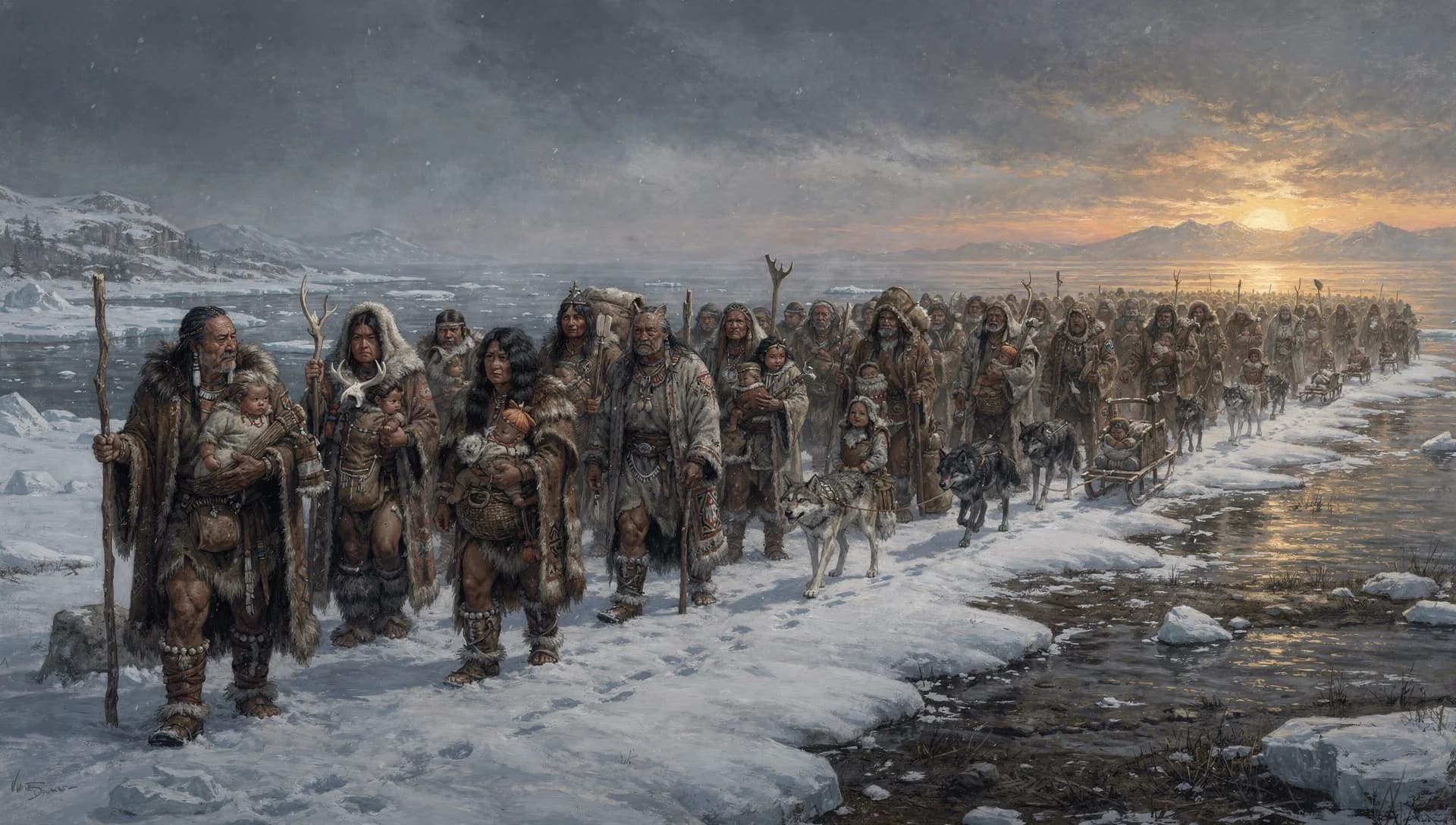
 Mythic
Pan-Indigenous origin traditions: emergence from the north, the sea-crossing ancestors
 UB
UBRed race migration from Asia to the Americas across the Bering land bridge
Full Article
Read the deep-dive article on this connection
Red race migration from Asia to the Americas across the Bering land bridge = Pan-Indigenous origin traditions: emergence from the north, the sea-crossing ancestors
The Connection
The UB records: "About eighty-five thousand years ago the comparatively pure remnants of the red race went en masse across to North America, and shortly thereafter the Bering land isthmus sank, thus isolating them." (64:6.5) Many Indigenous American origin traditions describe the first ancestors emerging from a northern source, following the buffalo or a sacred guide, and crossing a cold or icy threshold into the present lands. We read the shared memory of a northern origin and a threshold-crossing migration as a memory of that crossing. The reading is ours. The genetic and archaeological evidence supports the Asian origin and the Bering route, and it contradicts the date, the Eskimo crossing, the statement that no red man returned to Asia, and the isolation.
UB Citation
UB 64:6.5, 64:7.4, 64:7.5
Academic Source
Moreno-Mayar et al., Nature 553 (2018); Bennett et al., Science 373 (2021); further reading, not checked here: Hultkrantz, The Religions of the American Indians (1979); Reich, Who We Are and How We Got Here (2018)
Historical Evidence(Suggestive evidence)
Genetic modelling has the founding population of the Americas split from East Asians about 36,000 years ago, with gene flow between the two until about 25,000 years ago, and Beringia is the accepted route (Moreno-Mayar et al. 2018, Nature). The northern-origin motif is widely reported in Indigenous American traditions; we have not checked the published surveys (such as Hultkrantz 1979) for the examples. The UB says: "About eighty-five thousand years ago the comparatively pure remnants of the red race went en masse across to North America" (64:6.5). The White Sands footprints are dated to about 23,000 to 21,000 years ago (Bennett et al. 2021, Science), so on the date the evidence does not support the book.
Deep Dive
Ancient DNA research, told for general readers in books by David Reich (2018) and Jennifer Raff (2022), has changed the study of how the Americas were peopled. The figures here come from the papers themselves; we have not checked the books. Genetic modelling puts the split of the founding population from East Asians at about 36,000 years ago, with gene flow between the two lasting until about 25,000 years ago (Moreno-Mayar et al. 2018, Nature). A genome of about 24,000 years ago from Mal'ta in Siberia ties Native Americans to an ancient Siberian population as well (Raghavan et al. 2014, Nature). Human footprints at White Sands, New Mexico, are dated to about 23,000 to 21,000 years ago (Bennett et al. 2021, Science), a date other methods have since supported (Pigati et al. 2023; Holliday et al. 2025), though some still dispute it (Rhode et al. 2024).
The Urantia Book says: "About eighty-five thousand years ago the comparatively pure remnants of the red race went en masse across to North America, and shortly thereafter the Bering land isthmus sank, thus isolating them." (64:6.5) That is more than sixty thousand years earlier than the White Sands footprints, so on the date the evidence does not support the book. Of the time before the crossing the book says: "In later times they had serious and prolonged trouble with their yellow brethren in Asia. They were aided by their early invention of the bow and arrow, but they had unfortunately inherited much of the tendency of their ancestors to fight among themselves, and this so weakened them that the yellow tribes were able to drive them off the Asiatic continent." (64:6.4) And: "They were closely followed by the yellow tribes, who subsequently drove them out of Asia into North America." (64:7.4)
In our reading this part of the account meets the genetic evidence in an interesting way. The founding population came from East Asia, from a group that split from other East Asians and also carried ancestry from an ancient Siberian population. A people pushed north and east into Beringia by neighbours in the East Asian core, then crossing into the Americas when conditions allowed, fits that pattern. The UB's account, that the yellow tribes "subsequently drove them out of Asia into North America" (64:7.4), fits it too, though the dates are far apart.
Many Indigenous American origin traditions are commonly summarized as telling of first ancestors who came from the north or from below, following a sacred guide, and crossed a threshold into the present lands. The Navajo emergence tradition tells of the people coming up through underworlds. The Iroquoian creation tradition tells of a descent from the Sky World. Various Plains traditions tell of arrival from the north or the northwest. The Lenape Walam Olum, whose authenticity is widely doubted, tells of a migration from the northwest. These are summaries of ours; we have not checked each one against its sources.
Åke Hultkrantz's The Religions of the American Indians (1979) is a standard survey of these traditions. We have not checked it for the examples above or for any judgment of their historical basis.
In our reading the structural fit with the UB account is significant. A crossing by way of Beringia is the accepted account, and the genetic evidence supports it. That Indigenous oral tradition keeps a memory of that crossing is our reading, not a finding. The UB gives the crossing a history of its own: "The primary Sangik peoples, the superior races, avoided the tropics, the red man going northeast to Asia, closely followed by the yellow man" (64:7.3); "the yellow tribes were able to drive them off the Asiatic continent" (64:6.4); and "when the land passage to the West, over the Bering isthmus, became passable, these tribes were not slow in forsaking the inhospitable shores of the Asiatic continent" (79:5.6). The UB's date, "About eighty-five thousand years ago" (64:6.5), is contradicted by the evidence we have checked.
The strongest counterargument is the date, and it stands. The earliest well-dated trace of people in North America that we have checked, the White Sands footprints, is about 23,000 to 21,000 years ago, more than sixty thousand years after the book's date. Two replies are sometimes offered, and neither holds on the book's own terms. One is that the dates keep moving earlier: they have moved by thousands of years, not by sixty thousand. The other is that an early red-race entry was followed by later migrations that supplied most of today's ancestry. But the book has the crossing followed by isolation: "this represents the only contact of the North American red man with any other human stock down to about one thousand years ago, when the white man first chanced to land on the Atlantic coast" (64:7.19).
What the parallel would imply, if our reading holds, is that Indigenous American traditions of northern origin and threshold crossing keep a memory of a real event across a very long span. That is what this mapping proposes; it is not an established finding. The evidence supports the Asian origin and the route of the book's account, and contradicts its date, the Eskimo crossing, the statement that no red man returned to Asia and the isolation. The companion article sets out each of these with its sources.
Key Quotes
“In later times they had serious and prolonged trouble with their yellow brethren in Asia. They were aided by their early invention of the bow and arrow, but they had unfortunately inherited much of the tendency of their ancestors to fight among themselves, and this so weakened them that the yellow tribes were able to drive them off the Asiatic continent.”
“When the colored descendants of the Sangik family began to multiply, and as they sought opportunity for expansion into adjacent territory, the fifth glacier, the third of geologic count, was well advanced on its southern drift over Europe and Asia. These early colored races were extraordinarily tested by the rigors and hardships of the glacial age of their origin.”
Cultural Impact
The Indigenous American migration narrative has shaped both Indigenous self-understanding and broader American historical consciousness. Within Indigenous communities, the migration traditions are foundational to tribal identity and to the relationship with specific lands. The Lakota Mato Paha (Bear Butte), the Navajo four sacred mountains, the Hopi mesas, the Apache mountain ranges, and innumerable other sacred sites are anchored to migration narratives that establish the people in their current lands by divine and ancestral sanction. The threshold-crossing motif underlies many ceremonial structures, with renewal ceremonies often re-enacting the original arrival. Beyond Indigenous communities, the migration question has been at the center of American historical and political controversy since the colonial period. The peopling of the Americas, when it happened, who the founding population was, what their relationship to subsequent migrations and to contemporary Indigenous communities is, has been contested in ways that intersect with land claims, treaty rights, and questions of cultural belonging. The Bering land bridge framework, established in nineteenth-century anthropology and confirmed by genetic and archaeological evidence in the twentieth and twenty-first centuries, has become the standard framework for academic and popular understanding. The recent dating revisions and the new evidence from sites like Cooper's Ferry, White Sands, and the Yana RHS site in Siberia are continuously updating the picture.
Modern Resonance
The genetic recovery of how the Americas were peopled has made the old question of Indigenous antiquity newly concrete. The genetic evidence supports an origin in Asia and a crossing by way of Beringia. The oldest well-dated trace of people in North America that we have checked, the White Sands footprints of about 23,000 to 21,000 years ago, is older than the old Clovis-first model allowed. Our reading adds that the traditions of arrival from the north may carry the memory of that crossing. The UB's own account agrees on the origin and the route: "They were closely followed by the yellow tribes, who subsequently drove them out of Asia into North America" (64:7.4). It does not agree on the date: "About eighty-five thousand years ago the comparatively pure remnants of the red race went en masse across to North America" (64:6.5) is more than sixty thousand years earlier than the evidence. Taking traditional knowledge seriously as a possible historical source does not require setting that disagreement aside.
Related Mappings
Onamonalonton, spiritual leader of the red race (~65,000 BC)
= The "Great Spirit" tradition (Gitchi Manitou, Wakan Tanka)
Fandors, giant passenger birds (last died ~30,000 years ago)
= Thunderbird, giant supernatural bird
Midwayers, invisible planetary ministers who interact with the mortal realm
= Hopi Kachinas, ancestor-spirits who mediate between gods and humans
The corporeal staff of one hundred, teachers of civilization
= Navajo Holy People (Dine'é Diyini), the superhuman teachers who established the Diné way
Related Articles
Where to next
The free newsletter. The research behind each piece, no spam.