
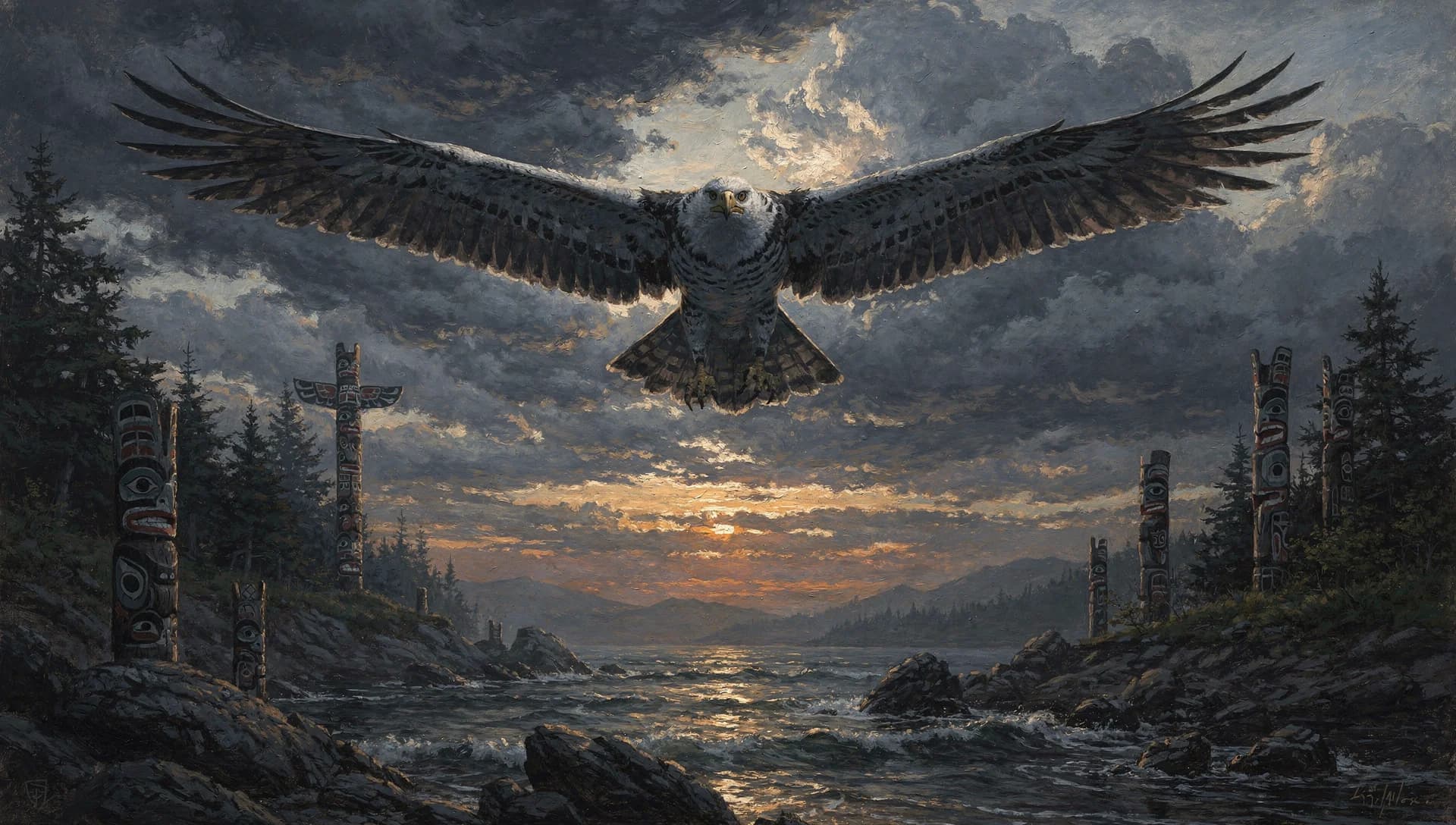
 Mythic
Thunderbird, giant supernatural bird
 UB
UBFandors, giant passenger birds (last died ~30,000 years ago)
Full Article
Read the deep-dive article on this connection
Fandors, giant passenger birds (last died ~30,000 years ago) = Thunderbird, giant supernatural bird
The Connection
The red race migrated from Asia to the Americas via the Bering land bridge. If fandors were still alive during or near this migration period, memories of giant birds could have been carried into the Americas and preserved as Thunderbird traditions over tens of thousands of years of oral retelling.
UB Citation
Academic Source
Leeming, The World of Myth (1990); oral tradition studies
Historical Evidence(Strong evidence)
Argentavis magnificens and the Teratornithidae family: giant birds with 12-18 foot wingspans that existed in the Americas from the Late Oligocene to the Late Pleistocene. U.S. National Park Service confirms their existence. "These northern teratorns encountered humans at the end of the Pleistocene, roughly 11,000 years ago" and "probably influenced the various Thunderbird myths of the Native Americans." Real giant birds existed, humans saw them, and the memory persisted as mythology. Additionally, Pillar 43 at Gobekli Tepe (c. 9600 BCE, southeastern Turkey) prominently features a large bird figure holding a disc, one of humanity's oldest monumental carvings, predating Sumerian civilization by ~5,000 years. The giant bird motif appears across cultures from Mesopotamia to the Americas.
Deep Dive
Stand in the basement of the Natural History Museum of Los Angeles County, in the paleontological storage area, and you can examine the fossilized bones of Argentavis magnificens, the largest flying bird that ever lived. Wingspan estimates run from twenty to twenty-three feet. Body weight perhaps one hundred fifty to one hundred eighty pounds. The Argentavis lived in what is now Argentina from about nine to six million years ago, but its smaller North American cousins, the Teratornithidae, persisted into the late Pleistocene. Teratornis merriami was a fourteen-foot-wingspan condor-like bird whose remains have been recovered from the La Brea tar pits in Los Angeles, dated to as recently as twelve thousand years ago. The U.S. National Park Service confirms that these northern teratorns encountered humans at the end of the Pleistocene, roughly eleven thousand years ago, and the Park Service explicitly notes that teratorns probably influenced the various Thunderbird myths of the Native Americans.
The Urantia Book at 66:5.6 records that during the Dalamatian period, Bon's group (the council on the conquest of predatory animals) successfully trained the great fandors as passenger birds. The fandors were used on long journeys for sending messages and calls for help. The UB notes that the fandors became extinct more than thirty thousand years ago. The dating is significant: the red race entered the Americas across the Bering land bridge well before the fandor extinction, and if fandors were still alive during or near the migration period, memories of them could have been carried into the Americas and preserved in oral tradition for tens of thousands of years.
The Thunderbird tradition is one of the most widespread mythological motifs in Indigenous American religious life. Versions appear from the Pacific Northwest (where the Kwakwaka'wakw and Tlingit traditions feature thunderbirds prominently in totem-pole iconography) through the Plains (where Lakota tradition includes Wakinyan, the thunder beings) and Eastern Woodlands (where Algonquian and Iroquoian traditions include thunderbird figures) to the Southeast (where Cherokee and Creek traditions include similar figures). The thunderbirds are typically described as enormous birds capable of producing thunder by flapping their wings and lightning by flashing their eyes. They are usually associated with storms, with high mountains, and with sacred mediating power between the celestial and terrestrial realms.
The structural fit with the UB account is precise on multiple levels. First, real giant birds existed in the Americas during the period of human habitation. The teratorns are the largest flying birds known to have coexisted with humans anywhere in the world. Second, the temporal overlap is documented. Humans and teratorns were both present in the Americas during the late Pleistocene, with the teratorns persisting until roughly eleven thousand years ago. Third, the U.S. National Park Service explicitly attributes Thunderbird mythology to the human encounter with these real giant birds. The mythological tradition has a real biological referent.
The UB account adds a layer to this picture. The fandors were not just any large birds; they were specifically the trained passenger birds of the Dalamatian civilization, used for transcontinental communication and travel. If the red race carried memories of the fandors westward across Asia and across the Bering land bridge, and if those memories were combined with direct encounters with the surviving teratorns in the Americas, the resulting mythological tradition would be exactly what the Thunderbird actually is: a giant bird with sacred mediating power, associated with high places and storms, remembered as both real biological presence and as supernatural figure.
A striking confirmation appears at Gobekli Tepe in southeastern Turkey. Pillar 43 of the earliest layer (carbon dated to approximately 9600 BCE) prominently features a large bird figure holding a disc, one of humanity's oldest monumental carvings, predating Sumerian civilization by approximately five thousand years. The giant bird with sacred mediating power is one of the deepest motifs in human religious iconography, surfacing across continents in cultures that had no contact with one another. The UB account explains the cross-cultural distribution: humans had really seen giant birds (real teratorns and Argentavis-type birds in the Americas, real fandors used as passenger birds in the Dalamatian period across multiple regions), and the memory persisted as mythology across millennia.
The strongest counterargument is that mythological giant birds are a common cultural pattern that does not require a real biological referent to explain, with similar figures appearing in cultures with no large-bird presence. This is a fair point. The reply is that where giant birds did exist (the Americas with teratorns, parts of Eurasia and Africa potentially with even larger now-extinct birds), the mythological figures are particularly elaborated, and the UB account provides a specific mechanism (the trained Dalamatian fandors) that explains the cross-cultural distribution including in regions where local giant birds may not have been present.
What the parallel implies is that the contemporary scientific recovery of the Pleistocene megafauna, including the teratorns and other giant flying birds, provides empirical confirmation of mythological traditions that materialist scholarship has typically treated as primitive imagination. The traditions are not primitive imagination. They are real memory of real biological presences, sometimes elaborated into supernatural figures over millennia of oral transmission, but anchored in actual encounters with real giant birds. The Thunderbird is not a fantasy. The Thunderbird is the cultural memory of real giant flying creatures that humans really saw, with the additional layer of remembered fandors from the broader Dalamatian inheritance. For contemporary Indigenous American religious practitioners, this offers external scientific validation of the antiquity and reality of the traditional knowledge. For paleontologists and mythologists, it offers a unified framework that takes both the biological evidence and the cultural memory seriously as complementary sources of historical truth.
Key Quotes
“It was in these days that carrier pigeons were first used, being taken on long journeys for the purpose of sending messages or calls for help. Bon’s group were successful in training the great fandors as passenger birds, but they became extinct more than thirty thousand years ago.”
“The Park Service notes that teratorns encountered humans at the end of the Pleistocene roughly eleven thousand years ago, and observes that these giant birds probably influenced the various Thunderbird myths of the Native Americans.”
“Leeming documents the Thunderbird tradition as one of the most widespread mythological motifs across Indigenous American religious traditions, with consistent features (enormous wingspan, control of storms, sacred mediating power) suggesting a shared mythological source.”
Cultural Impact
The Thunderbird tradition has shaped Indigenous American art, ceremony, and identity for thousands of years. The thunderbird figures prominently in Northwest Coast totem-pole iconography, in Plains beadwork and parfleche art, in Eastern Woodlands wampum and quill work, and in contemporary Indigenous design across all regions. The Lakota Wakinyan tradition includes complex ceremonial relationships with the thunder beings, with thunder dreamers (heyoka) playing distinctive roles in tribal life. The Pacific Northwest cosmology features thunderbirds as great hereditary crests of certain noble lineages, with elaborate thunderbird-and-killer-whale iconography. Beyond Indigenous communities, the thunderbird has entered American popular consciousness through the United States military (multiple aircraft and squadrons named Thunderbird, with the U.S. Air Force aerial demonstration team called the Thunderbirds), through American automotive design (the Ford Thunderbird), and through American sports (multiple teams named Thunderbirds). The thunderbird symbol on the New Mexico state flag (Zia sun symbol) and on the Arkansas state quarter both reflect the deep American cultural inheritance of Indigenous spiritual symbolism. In contemporary fantasy literature and gaming, thunderbirds and giant magical birds owe substantial debt to the Indigenous American mythological inheritance.
Modern Resonance
The contemporary scientific recovery of Pleistocene megafauna has produced one of the most striking convergences between paleontology and mythology. The Argentavis, the teratorns, and other giant flying birds really existed. Humans really encountered them. The mythological traditions that developed around these encounters are not primitive imagination but real memory transmitted across millennia. The UB framework adds the fandor lineage to this picture, explaining the cross-cultural presence of giant-bird mythology including in regions where local giant birds may not have been documented. For contemporary readers wrestling with the question of whether ancient mythology contains real historical information, the Thunderbird offers a particularly clean test case: the answer is yes, the underlying biological referent is real, the cultural memory has been remarkably accurate across enormous time-depth. This raises legitimate questions about how much other apparently mythological material may also be carrying real historical content. The UB framework treats this systematically: much mythological material is real memory with metaphysical interpolation, and the task of comparative religion is to recover the real historical referent without dismissing either the memory or the religious meaning that has accreted around it.
Related Mappings
Onamonalonton, spiritual leader of the red race (~65,000 BC)
= The "Great Spirit" tradition (Gitchi Manitou, Wakan Tanka)
Midwayers, invisible planetary ministers who interact with the mortal realm
= Hopi Kachinas, ancestor-spirits who mediate between gods and humans
The corporeal staff of one hundred, teachers of civilization
= Navajo Holy People (Dine'é Diyini), the superhuman teachers who established the Diné way
Red race migration from Asia to the Americas across the Bering land bridge
= Pan-Indigenous origin traditions: emergence from the north, the sea-crossing ancestors
Related Articles
Where to next
The free newsletter. The research behind each piece, no spam.