
 Mythic
The "Great Spirit" tradition (Gitchi Manitou, Wakan Tanka)
 UB
UBOnamonalonton, spiritual leader of the red race (~65,000 BC)
Full Article
Read the deep-dive article on this connection
Onamonalonton, spiritual leader of the red race (~65,000 BC) = The "Great Spirit" tradition (Gitchi Manitou, Wakan Tanka)
The Connection
The UB states Onamonalonton is the origin of the Great Spirit tradition among the red race. This monotheistic thread persisted for tens of thousands of years through oral tradition, predating all Near Eastern monotheism by vast stretches of time.
UB Citation
UB 64:6.7, 92:5.3
Academic Source
Gill, Native American Religions (1982); Hultkrantz, The Religions of the American Indians (1979)
Historical Evidence(Moderate evidence)
Algonquian linguistic tradition: Gitche Manitou ("Great Spirit") translates as "the Creator of all things and the Giver of Life." Christopher Vecsey documents pre-contact concepts of a supreme creative power. Academic nuance: European observers "frequently misinterpreted Gitche Manitou as a singular, monotheistic deity, elevating it above other spiritual forces." Indigenous traditions portray it as "a collective, benevolent essence -- eternal, life-giving, and the ultimate owner of the universe."
Deep Dive
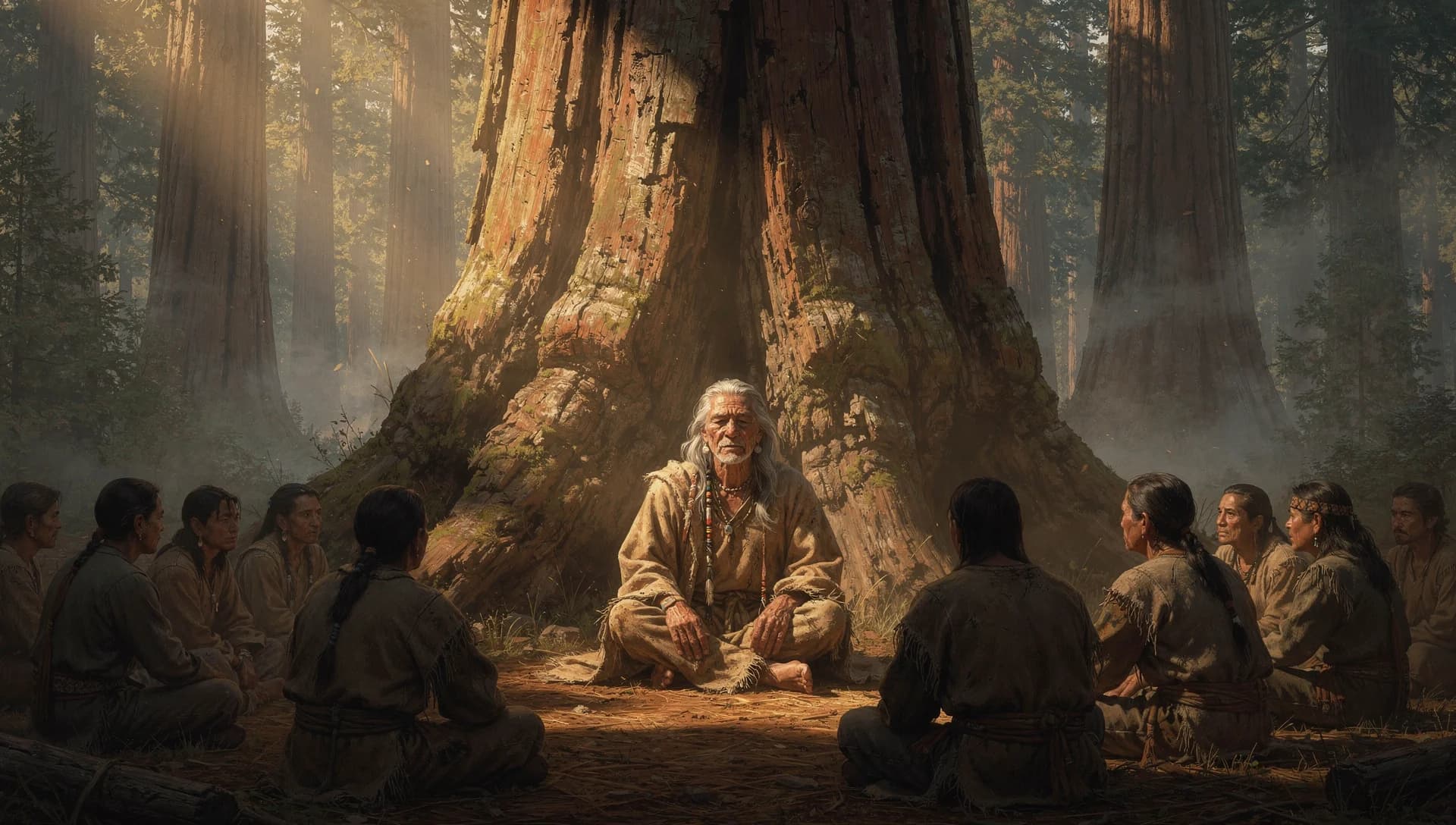
In the redwood forests of what is now northern California, around 65,000 years ago, by the Urantia Book's reckoning, a leader named Onamonalonton emerged among the red race of the Americas. He was a spiritual deliverer at a moment of crisis. The red race had crossed from Asia into the Americas across the Bering land bridge approximately twenty thousand years earlier, and after their migration they had drifted into the spiritual darkness that followed the Caligastia apostasy. Onamonalonton brought temporary peace and revived the worship of the Great Spirit. Paper 64:6.7 records the precise location: he maintained his headquarters among the great redwood trees of California, and many of his later descendants came down to modern times among the Blackfoot Indians.
The Great Spirit tradition that Onamonalonton revived ran in attenuated form across Indigenous American religious life for the next sixty-five thousand years. Paper 92:4.5 records that of all who received the teachings of the one hundred (Caligastia's corporeal staff at Dalamatia), the red men held them longest. The idea of the Great Spirit was preserved more durably among Indigenous Americans than among any other branch of humanity, though by the time European contact established the historical record, the idea was a hazy concept in Amerindian religion when contact with Christianity greatly clarified and strengthened it.
The Algonquian linguistic tradition preserves the Great Spirit concept under the name Gitche Manitou (literally Great Spirit, with manitou often translated as a more general term for spiritual power). Christopher Vecsey's foundational 1983 monograph Traditions of the Earth and her Sister: Native American Religion documents the pre-contact concepts of supreme creative power across multiple Indigenous American traditions. The Lakota Wakan Tanka, the Algonquian Gitche Manitou, the Iroquois Orenda, the Anishinaabe Gizhe Manidoo, and the Cherokee Yowa all participate in a broader pan-Indigenous tradition of supreme creative spiritual power. Sam Gill's 1982 Native American Religions: An Introduction provides the standard contemporary academic survey.
Academic nuance is important here. European observers often misinterpreted Gitche Manitou and similar concepts as a singular monotheistic deity directly equivalent to the Christian God. Indigenous traditions themselves often portray these concepts as more complex: a collective benevolent essence, eternal and life-giving, sometimes manifest in particular sacred presences (the Wakan Tanka of the Lakota is sometimes understood as the unity of multiple sacred presences rather than a singular personal God in the Western sense). The relationship between the Indigenous concepts and Christian-style monotheism is genuinely contested in Native American studies scholarship.
The UB framework navigates this complexity by recognizing both elements. The Great Spirit tradition originated as a real Salem-style monotheistic teaching, transmitted through Onamonalonton from the earlier Dalamatian inheritance. Over sixty-five thousand years of transmission through preliterate oral traditions, the original concept became attenuated, mixed with subsidiary spiritual presences, and partially depersonalized. By the time of European contact, the residual Great Spirit tradition was both genuinely monotheistic in its underlying structure and genuinely contained subsidiary spiritual presences in its elaborated practice. Contact with Christianity, the UB suggests, helped clarify and strengthen the original monotheistic element rather than introducing it from outside.
The structural fit with the UB account is precise. A spiritual tradition transmitted orally through tens of thousands of years would be expected to undergo exactly the kind of attenuation and elaboration the historical record documents. The original Salem-style teaching of one supreme creative spirit would persist in modified form, with the addition of subsidiary spiritual presences, the partial depersonalization of the supreme concept, and the variety of regional articulations. The remarkable thing is not that the tradition became attenuated but that the underlying monotheistic structure persisted at all across such a vast time-depth.
The strongest counterargument is that the academic study of Indigenous American religion has moved away from interpretations that emphasize underlying monotheism, recognizing the genuine plurality and complexity of Indigenous spiritual frameworks. This is a fair point and the UB framework should not be used to flatten that complexity. The reply is that the UB framework does not require Indigenous traditions to be monotheistic in the Christian sense. It requires only that an underlying monotheistic theological inheritance be present in the traditions in modified form, alongside the subsidiary spiritual presences and elaborate ceremonial frameworks that the academic literature accurately documents. Both can be true at once.
What the parallel implies is significant for the contemporary engagement with Indigenous American spirituality. The Great Spirit tradition is not a primitive proto-monotheism that will be perfected by Christianity, nor is it an entirely separate spiritual framework with no relationship to other world religions. It is a fragmentary preservation, across an unusually long time-depth, of the same Salem-derived teaching that surfaces in modified form in many other traditions. The Lakota wicasa wakan, the Anishinaabe pipe-keeper, and the Tlingit shaman are working within a spiritual tradition that has real continuity with the broader human inheritance of revealed religion, while also having its own distinctive character.
Key Quotes
“Because of this great retrogression the red men seemed doomed when, about sixty-five thousand years ago, Onamonalonton appeared as their leader and spiritual deliverer. He brought temporary peace among the American red men and revived their worship of the “Great Spirit.” Onamonalonton lived to be ninety-six years of age and maintained his headquarters among the great redwood trees of California. Many of his later descendants have come down to modern times among the Blackfoot Indians.”
“Of all who received the teachings of the one hundred, the red men held them longest, but the idea of the Great Spirit was but a hazy concept in Amerindian religion when contact with Christianity greatly clarified and strengthened it.”
“Hultkrantz documents the High God and Great Spirit traditions across multiple Indigenous American religious traditions, with the supreme creative power often understood as a more diffuse spiritual presence than the personal monotheistic God of the Christian tradition.”
“Gill provides a contemporary academic survey of Indigenous American religious traditions, with attention to the diversity of spiritual frameworks across regional and tribal traditions and to the difficulty of mapping Indigenous concepts onto Christian-style monotheism.”
Cultural Impact
The Great Spirit tradition is one of the most enduring spiritual inheritances in human history, having been transmitted through oral tradition across more than sixty millennia. Its endurance is remarkable: while many ancient religious traditions have been entirely lost, the basic concept of a supreme creative spiritual power persisted across the long durée of Indigenous American history and remains a living tradition today among many Native American communities. Through the colonial encounter, the tradition entered European-American consciousness and shaped Romantic-era writings about the noble savage and the natural religion (Rousseau, Chateaubriand). Through the nineteenth-century reservation period, the tradition survived suppression and underwent revival movements (the Ghost Dance, the Native American Church, the Indian Shaker Church). Through the twentieth-century Pan-Indian movement and the American Indian Movement, the tradition entered broader American spiritual consciousness as a distinctive Indigenous voice. Black Elk's testimony, transmitted through John Neihardt and Joseph Epes Brown, has shaped contemporary spiritual seekers' encounter with Lakota tradition. The pipe ceremony, the sweat lodge, the vision quest, and the powwow are all contemporary expressions of a tradition that has continuity reaching back tens of thousands of years to Onamonalonton. Beyond Indigenous communities, the tradition has shaped American environmental ethics, the deep ecology movement, and contemporary spiritual ecology in ways that continue to influence broader cultural conversation.
Modern Resonance
The Great Spirit tradition speaks directly to contemporary spiritual seekers who are looking for spiritual depth without the institutional baggage of Western Christianity. The UB framework offers a way to take the tradition seriously while placing it in its proper historical context. The tradition is not exotic or primitive; it is one of the longest-running fragmentary preservations of underlying Salem-derived teaching, with continuity across more than sixty millennia of human spiritual history. The Indigenous American spiritual leaders, both contemporary and historical, are heirs to a tradition that is not less ancient than the major world religions but more ancient than any of them. For contemporary non-Indigenous seekers drawn to Native American spiritual traditions, the UB framework offers a way to engage respectfully without appropriation: the underlying spiritual reality the traditions point to is real, the specific cultural expressions belong to specific peoples, and the broader human inheritance of revealed religion is shared. For Indigenous spiritual leaders working to preserve and transmit their traditions, the framework offers external validation that takes the antiquity and significance of the traditions seriously without flattening their distinctive character into Western theological categories.
Related Mappings
Fandors, giant passenger birds (last died ~30,000 years ago)
= Thunderbird, giant supernatural bird
Midwayers, invisible planetary ministers who interact with the mortal realm
= Hopi Kachinas, ancestor-spirits who mediate between gods and humans
The corporeal staff of one hundred, teachers of civilization
= Navajo Holy People (Dine'é Diyini), the superhuman teachers who established the Diné way
Red race migration from Asia to the Americas across the Bering land bridge
= Pan-Indigenous origin traditions: emergence from the north, the sea-crossing ancestors
Related Articles
Where to next
The free newsletter. The research behind each piece, no spam.