
 Mythic
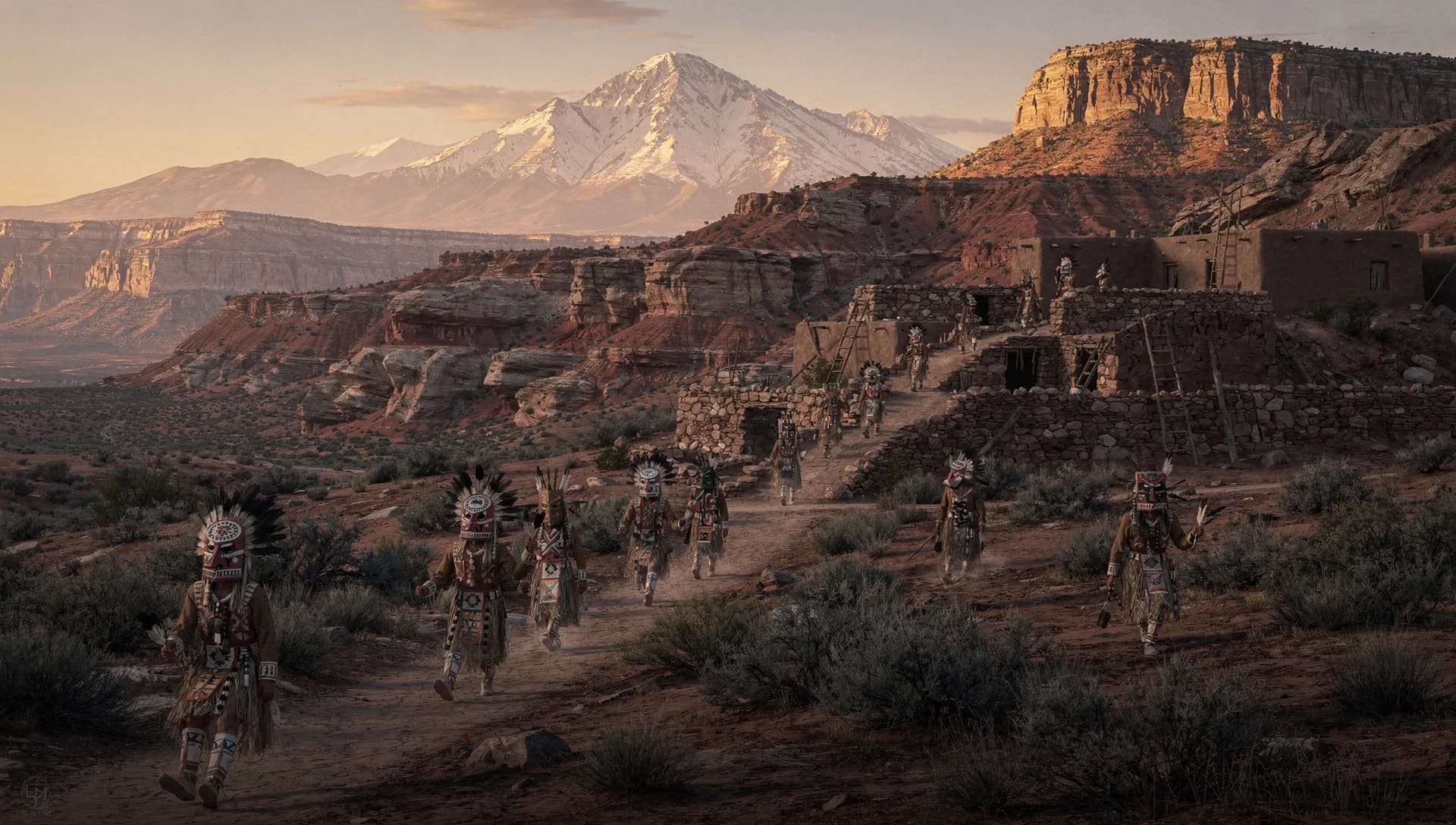
Hopi Kachinas, ancestor-spirits who mediate between gods and humans
 UB
UBMidwayers, invisible planetary ministers who interact with the mortal realm
Full Article
Read the deep-dive article on this connection
Midwayers, invisible planetary ministers who interact with the mortal realm = Hopi Kachinas, ancestor-spirits who mediate between gods and humans
The Connection
The UB describes the midwayers as a permanent order of planetary beings, invisible to mortal sight but present and active in human affairs, serving as the continuity-stewards of Urantia across the generations. Hopi cosmology describes the Kachinas as ancestor-spirits who dwell in the San Francisco Peaks, who descend to the mesas during the ceremonial season to dance among the people, and who carry prayers between human and divine realms. The structural match (invisible but present planetary intermediaries who serve as the continuity thread between generations) is precise, even if the cultural expression differs.
UB Citation
UB 77:7-9
Academic Source
Waters, Book of the Hopi (1963); Wright, Kachinas: A Hopi Artist's Documentary (1973)
Historical Evidence(Moderate evidence)
Frank Waters' Book of the Hopi documented the Kachina cosmology as a sophisticated system of spiritual intermediaries, with the Kachinas described as real beings who once lived openly with humans, then withdrew to the mountain when human conduct no longer warranted their visible presence. Barton Wright catalogued the 300+ named Kachinas, each with distinct personalities and functions. The parallel to the UB midwayers (1,111 loyal beings assigned to planetary ministry, who once operated more openly and now work covertly) is direct.
Deep Dive
On the high mesas of northern Arizona, the Hopi people have for centuries maintained a ceremonial calendar organized around the visits of the Kachinas, ancestor-spirits who descend from the San Francisco Peaks during the winter solstice and remain among the people through the kachina season ending at the summer solstice. During this period, masked dancers in the kivas embody the Kachinas in elaborate ceremonies that are simultaneously religious enactment, theological instruction, and the maintenance of cosmic order. There are over three hundred named Kachinas in the Hopi tradition, each with distinctive personality, function, and iconography, ranging from the most sacred (the Kachina Mother and the Eototo, the chief Kachina) through specific functional figures (rain-bringers, planting kachinas, warrior kachinas) to the comic and disciplinary figures that train children in proper conduct.
The Hopi cosmology, as documented by Frank Waters in his 1963 Book of the Hopi (a controversial but influential source) and elaborated by Barton Wright, Edward Curtis, and others, describes the Kachinas as real beings who once lived openly with humans in the early world, then withdrew to the San Francisco Peaks when human conduct no longer warranted their visible presence. They continue to descend during the ceremonial season, embodied through the masked dancers, to mediate between the human and the divine realms. The withdrawal-and-mediated-return pattern is structurally distinctive in the Indigenous American religious landscape.
The Urantia Book describes a category of created beings called the midwayers in Papers 77 through 78. These are described as a permanent order of planetary beings, neither human nor angelic, who serve as the continuity-stewards of Urantia across the generations. They are invisible to mortal sight but present and active in human affairs. The primary midwayers (Paper 77:7.1) numbered originally 50,000, of whom 40,119 went into the Lucifer rebellion. The secondary midwayers, originating later through the Adamic dispensation, made up the rest of the planetary corps. The total surviving loyal midwayer population on Urantia is given as 10,992 (Paper 77:8.1), unified into the United Midwayers of Urantia after Pentecost.
The structural fit between the midwayers and the Kachinas is precise on multiple points. Both are described as real beings, not allegorical figures. Both are invisible-but-present planetary intermediaries. Both serve as the continuity thread between generations. Both have a withdrawal-and-mediated-return pattern in their relationship to mortals. Both are organized into specific functional categories (the midwayers have primary and secondary orders with distinctive functions; the Kachinas have over three hundred named figures with specific roles). Both are associated with sacred mountains (the midwayers do not have a single mountain association, but the Hopi Kachinas are explicitly tied to the San Francisco Peaks; the parallel is loose but the structural function of a sacred high place as the home of the intermediary beings is real).
The numerical detail is suggestive. The UB gives 1,111 as the number of midwayers loyal to Christ Michael's bestowal regime (Paper 77 establishes the broader population, with various subdivisions). The Hopi tradition does not give a specific number of Kachinas equivalent to 1,111, but the Hopi insistence on a specific catalog of named figures (rather than a generic class) parallels the UB insistence on midwayers as a specific identifiable corps with named individuals.
Frank Waters' Book of the Hopi has been criticized in academic Hopi studies for combining genuine traditional material with Waters' own interpretive framework, and contemporary scholarship is more cautious about his presentation. Barton Wright's 1973 Kachinas: A Hopi Artist's Documentary, which works directly with Hopi cultural authorities, is more reliable on the specific Kachina inventory. Either source establishes the basic structural feature: the Kachinas are real beings, planetary intermediaries, mostly invisible, present-but-withdrawn, mediating between human and divine realms across generations.
The strongest counterargument is that the Hopi tradition is integral to its cultural and ecological context, and external comparative frameworks should not be imposed without invitation from Hopi cultural authorities. This is a fair point and the UB framework should be used carefully here. The reply is that the structural parallel is not a claim about Hopi religion's content; it is a claim that the underlying spiritual reality (planetary intermediary beings) is real, and the Hopi tradition has preserved a remarkably accurate cultural memory of that reality. The Hopi practice and ceremony belong to the Hopi people. The underlying spiritual reality, if the UB account is correct, is shared across humanity.
What the parallel implies is that the Kachina tradition, like the Great Spirit tradition, has preserved real cosmological information across millennia of oral transmission. The midwayers are real. The Kachinas are the Hopi cultural-memory preservation of that reality, with specific local elaboration and ceremonial development. For contemporary readers, this offers a way to take the Hopi spiritual tradition seriously as carrying real cosmological content, while respecting the cultural ownership of the specific ceremonial and theological elaboration.
Key Quotes
“The majority of the primary midwayers went into sin at the time of the Lucifer rebellion. When the devastation of the planetary rebellion was reckoned up, among other losses it was discovered that of the original 50,000, 40,119 had joined the Caligastia secession.”
“At the last adjudication of this world, when Michael removed the slumbering survivors of time, the midway creatures were left behind, left to assist in the spiritual and semispiritual work on the planet. They now function as a single corps, embracing both orders and numbering 10,992. *The United Midwayers of Urantia* are at present governed alternately by the senior member of each order. This regime has obtained since their amalgamation into one group shortly after Pentecost.”
“Waters documents the Kachina cosmology as a sophisticated system of spiritual intermediaries, with the Kachinas described as real beings who once lived openly with humans, then withdrew to the San Francisco Peaks when human conduct no longer warranted their visible presence.”
“Wright catalogs over three hundred named Kachinas with distinctive personalities, functions, and iconographic conventions, drawn from extensive collaboration with Hopi cultural authorities and traditional artists.”
Cultural Impact
The Kachina tradition is one of the most elaborately developed Indigenous American spiritual systems still in active practice. The Hopi mesas of northern Arizona, the Zuni pueblos of New Mexico, and other Pueblo communities continue full ceremonial cycles centered on Kachina ceremonies. The carved Kachina dolls (tihu in Hopi), originally made for children as teaching aids and now also collected as art, have entered American material culture as recognizable Indigenous art form, with Edward Curtis and other early-twentieth-century photographers and collectors having brought the imagery into broader American consciousness. The Kachina ceremonial cycle has shaped Pueblo Revival architecture, Southwestern art deco, and contemporary Indigenous design movements. Beyond Pueblo communities, the broader concept of ancestor-spirits as planetary intermediaries has parallels across Indigenous American traditions, from the Ojibwe Manido figures through the Lakota Tunkasila ancestor-grandfathers to the Northwest Coast spirit beings. The Kachinas have entered contemporary American spiritual seekers' consciousness through the New Age movement, often in problematically appropriated forms, but also through more respectful engagements like the work of Gary Snyder and Peter Matthiessen. In academic religious studies, the Kachina tradition has been a major focus for understanding Indigenous American spirituality on its own terms rather than through Western theological categories.
Modern Resonance
The Kachina tradition raises a significant question for contemporary religious imagination: are there real planetary intermediary beings, neither divine nor merely human, who mediate between heaven and earth? The UB framework offers a precise answer: yes, the midwayers are real, they have been on the planet for hundreds of thousands of years, they continue to be present and active in human affairs, and they are invisible to mortal sight but real in their existence and effect. The Hopi Kachina tradition has preserved a cultural memory of this reality with unusual fidelity. For contemporary readers drawn to ideas of spirit guides, ancestor presence, and planetary intermediaries, the framework offers a way to take the underlying intuition seriously without uncritical acceptance of any particular New Age elaboration. Real intermediary beings exist. The Kachinas are the Hopi cultural-memory preservation of this reality. The midwayers are the broader cosmological framework. For the contemporary spiritual practitioner, this offers a more grounded and historically anchored engagement with the question of planetary intermediaries than either Christian fundamentalism (no intermediaries) or popular New Age (many uncritically accepted intermediaries) typically provides.
Related Mappings
Onamonalonton, spiritual leader of the red race (~65,000 BC)
= The "Great Spirit" tradition (Gitchi Manitou, Wakan Tanka)
Fandors, giant passenger birds (last died ~30,000 years ago)
= Thunderbird, giant supernatural bird
The corporeal staff of one hundred, teachers of civilization
= Navajo Holy People (Dine'é Diyini), the superhuman teachers who established the Diné way
Red race migration from Asia to the Americas across the Bering land bridge
= Pan-Indigenous origin traditions: emergence from the north, the sea-crossing ancestors
Related Articles
Where to next
The free newsletter. The research behind each piece, no spam.