
The Crossing: Red Race Migration and Pan-Indigenous Origin Traditions
Many Indigenous American origin traditions tell of a journey from a distant homeland and of relatives left behind. The Urantia Book says: "About eighty-five thousand years ago the comparatively pure remnants of the red race went en masse across to North America" (UB 64:6.5). We read that crossing as the event behind the traditions. The reading is ours. The evidence supports the Asian origin and the route. It contradicts the date, the Eskimo crossing, the statement "No red man ever returned to Asia" (UB 64:6.5) and the isolation.
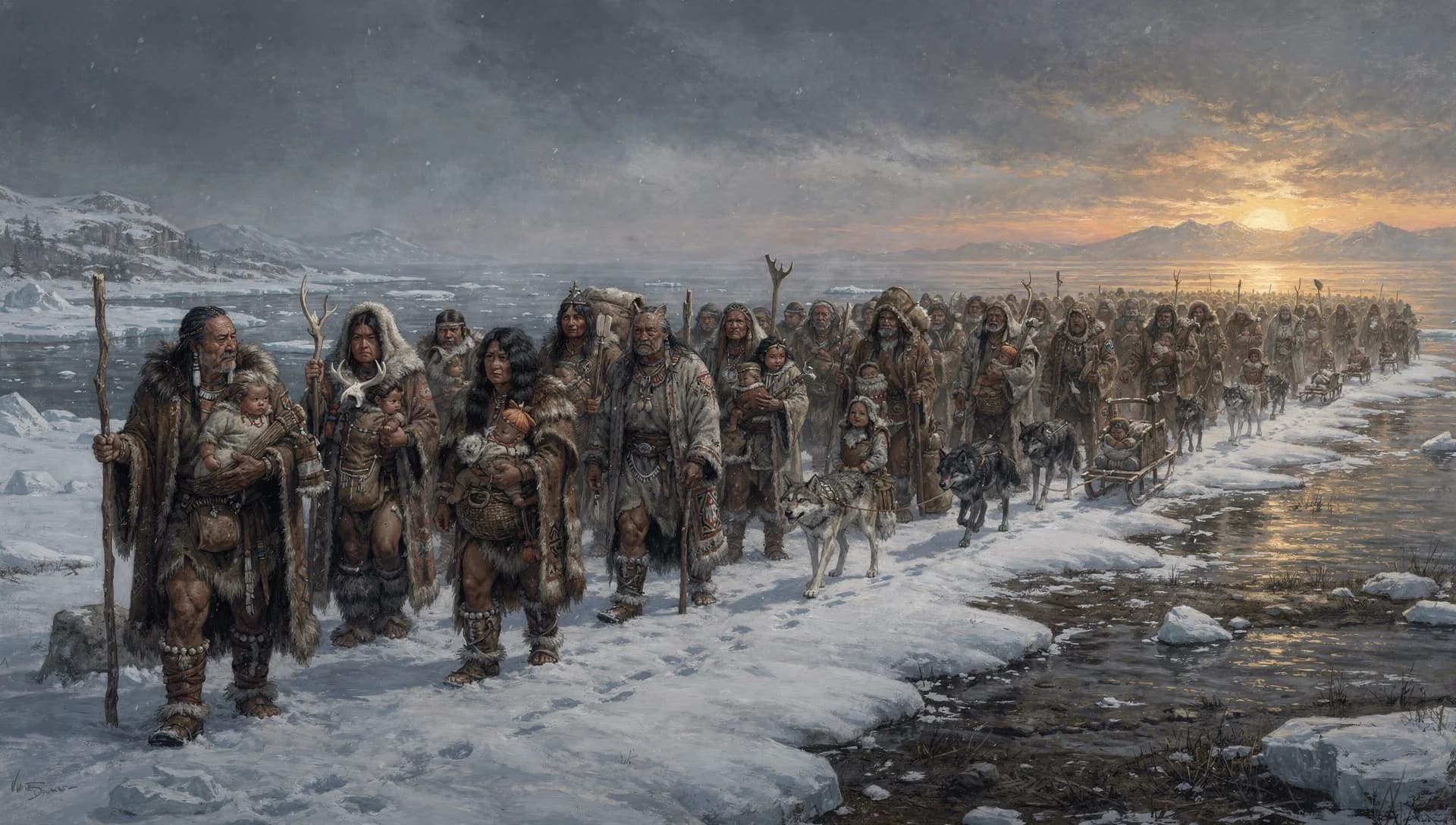
Red race migration from Asia to the Americas across the Bering land bridge = Pan-Indigenous origin traditions: emergence from the north, the sea-crossing ancestors
This article expands on the decoder mapping. For the side-by-side card and quick reference, see the mapping page.
What the Traditions Tell
Many Indigenous American origin traditions are commonly summarized as sharing features in what they tell of ancestral origins. A journey from a distant homeland. A crossing of water or a narrow land passage. Separation from relatives who remained behind. Emergence in a new continental environment. In that summary the features recur across linguistically and culturally distant tribal traditions.
The Pueblo traditions tell of emergence from an underground world through a passage. The Mexica traditions of Mesoamerica tell of Aztlan, the ancestral homeland to the north. Some northern traditions are said to tell of a cold northern homeland, and some Southwestern traditions of a long journey. These are summaries of ours. We have not checked each one against its sources, and a reader should treat them as a starting point, not as findings.
The Urantia Book describes a migration that, in our reading, these traditions may preserve. In its paragraphs on the red man the book does not make that link itself (UB 64:6.3, 64:6.4, 64:6.5, 64:6.6, 64:6.7, 64:6.8, 64:6.9, 64:7.4, 64:7.5, 64:7.18, 64:7.19, 79:5.6, 79:5.7). It is our inference.
What the Urantia Book Says
The red race's distribution and subsequent migration is described:
"The red men early began to migrate to the northeast, on the heels of the retreating ice, passing around the highlands of India and occupying all of northeastern Asia. They were closely followed by the yellow tribes, who subsequently drove them out of Asia into North America." (UB 64:7.4)
The migration event is detailed:
"When the relatively pure-line remnants of the red race forsook Asia, there were eleven tribes, and they numbered a little over seven thousand men, women, and children. These tribes were accompanied by three small groups of mixed ancestry, the largest of these being a combination of the orange and blue races. These three groups never fully fraternized with the red man and early journeyed southward to Mexico and Central America, where they were later joined by a small group of mixed yellows and reds." (UB 64:7.5)
The geographical event is precise:
"About eighty-five thousand years ago the comparatively pure remnants of the red race went en masse across to North America, and shortly thereafter the Bering land isthmus sank, thus isolating them. No red man ever returned to Asia. But throughout Siberia, China, central Asia, India, and Europe they left behind much of their stock blended with the other colored races." (UB 64:6.5)
The book continues:
"When the red man crossed over into America, he brought along much of the teachings and traditions of his early origin. His immediate ancestors had been in touch with the later activities of the world headquarters of the Planetary Prince." (UB 64:6.6)
Of the Eskimos, Paper 64 says:
"A little more than eighty thousand years ago, shortly after the red man entered northwestern North America, the freezing over of the north seas and the advance of local ice fields on Greenland drove these Eskimo descendants of the Urantia aborigines to seek a better land, a new home; and they were successful, safely crossing the narrow straits which then separated Greenland from the northeastern land masses of North America." (UB 64:7.18)
And in the next paragraph:
"About five thousand years ago a chance meeting occurred between an Indian tribe and a lone Eskimo group on the southeastern shores of Hudson Bay. These two tribes found it difficult to communicate with each other, but very soon they intermarried with the result that these Eskimos were eventually absorbed by the more numerous red men. And this represents the only contact of the North American red man with any other human stock down to about one thousand years ago, when the white man first chanced to land on the Atlantic coast." (UB 64:7.19)
Between "About eighty-five thousand years ago" (UB 64:6.5) and "About five thousand years ago" (UB 64:7.19) lie about eighty thousand years. The figure is our arithmetic from the book's two dates. Of the crossing the book says "shortly thereafter the Bering land isthmus sank, thus isolating them" (UB 64:6.5); of the Eskimos at Hudson Bay, "these Eskimos were eventually absorbed by the more numerous red men" (UB 64:7.19); and of the three groups of mixed ancestry, that they "early journeyed southward to Mexico and Central America" (UB 64:7.5).
What the Ancient Sources Say
The archaeological and genetic evidence for Indigenous American origins has been progressively refined over the past century. For decades the Clovis complex was considered the earliest archaeological horizon in North America, the view known as the Clovis-first model, and Clovis is dated to about 13,050 to 12,750 years ago (Waters et al. 2020, Science Advances). Monte Verde in Chile has been dated to about 14,500 years ago, about 12,500 BCE, which is older than Clovis. A panel of specialists who visited the site in 1997 accepted it as an archaeological site of the age that T. Dillehay had argued (Meltzer et al. 1997, American Antiquity), and new radiocarbon dates put the sediments that seal the occupation layer at about 14,550 years ago (Pino and Dillehay 2023, Antiquity). A 2026 study disputes the date and argues that the site cannot be older than the middle Holocene, 8,200 to 4,200 years ago (Surovell et al. 2026, Science).
David Reich's Who We Are and How We Got Here (Pantheon, 2018) is a book-length account of the genetic research for general readers; we have not checked it, and the figures below come from the papers cited. Genetic modelling puts the split of the founding population from East Asians at about 36,000 years ago, with gene flow between the two lasting until about 25,000 years ago (Moreno-Mayar et al. 2018, Nature). Those are dates for the founders separating from their Asian relatives, not for an arrival in the Americas. Human footprints at White Sands National Park in New Mexico are dated to about 23,000 to 21,000 years ago (Bennett et al. 2021, Science). Pollen and luminescence dating published in 2023 supported those ages (Pigati et al. 2023, Science). A 2024 critique holds that the dating is still unresolved (Rhode et al. 2024, PaleoAmerica). Five authors of the 2023 study answered it in the same volume (Pigati et al. 2024, PaleoAmerica), and radiocarbon dates on wetland mud, measured by two laboratories independent of the first work, again supported an age in the Last Glacial Maximum (Holliday et al. 2025, Science Advances). Jennifer Raff's Origin: A Genetic History of the Americas (Twelve, 2022) is a more recent account for general readers, also not checked here.
The Urantia Book says: "About eighty-five thousand years ago the comparatively pure remnants of the red race went en masse across to North America" (UB 64:6.5). That date is more than sixty thousand years earlier than the White Sands footprints (Bennett et al. 2021, Science). On the date, the evidence does not support the book.
The book's next date meets the same difficulty. Of the red men it says that "about sixty-five thousand years ago, Onamonalonton appeared as their leader and spiritual deliverer" (UB 64:6.7). That is more than forty thousand years before the White Sands footprints (Bennett et al. 2021, Science).
Two parts of the account find support in the evidence. The first is the Asian origin and the route. The book says the red men were "occupying all of northeastern Asia" and that the yellow tribes "subsequently drove them out of Asia into North America" (UB 64:7.4), and it names the way they went: "the land passage to the West, over the Bering isthmus" (UB 79:5.6). There is broad agreement that the Americas were first peopled by way of Beringia, the land bridge between far northeast Asia and northwestern North America, and genetic modelling has the founding population split from East Asians (Moreno-Mayar et al. 2018, Nature). The match covers the origin and the route only, not the isolation the book describes: "shortly thereafter the Bering land isthmus sank, thus isolating them" (UB 64:6.5). The second is the stock left behind, and here the support rests on our inference. The book says that "throughout Siberia, China, central Asia, India, and Europe they left behind much of their stock blended with the other colored races" (UB 64:6.5). It adds: "The northern Chinese peoples, together with the Andonite Siberians, assimilated much of the red stock and were in considerable measure benefited thereby." (UB 79:5.6) The genome of a person who lived about 24,000 years ago at Mal'ta in south-central Siberia is closely related to modern Native Americans and basal to modern western Eurasians, and the study estimates that 14 to 38 percent of Native American ancestry may come from that ancient population (Raghavan et al. 2013, Nature). That ties Native Americans to an ancient Siberian population that the study places at the base of the western Eurasian line. The gene flow the study reports runs from that population into the ancestors of Native Americans, not from a departing people into the peoples of Eurasia. Siberia and Europe are two of the five regions the book names. Reading the shared ancestry as the book's red stock is our inference, not a finding of the study, and the genome is about 24,000 years old, not 85,000.
Four parts of the account are contradicted by the evidence, and they carry the same weight. The first is the date, set out above. The second is the Eskimo crossing. The book dates it "A little more than eighty thousand years ago" and has the Eskimos "safely crossing the narrow straits which then separated Greenland from the northeastern land masses of North America" (UB 64:7.18). The generally accepted account runs the other way: the Paleo-Inuit, the first people to settle the American Arctic, came across Beringia from northeast Asia about 5,000 years ago, moved into northern Alaska, and spread east until they reached Greenland (Luis et al. 2023, Scientific Reports; Raghavan et al. 2014, Science). The same paper by Luis and colleagues reports one male lineage whose age and diversity point to an origin in the east of the Arctic about 2,000 to 3,000 years ago and to gene flow from east to west. That is more than 77,000 years after the book's date, and it comes after the first settlement from the west. For the first settlement the direction is reversed, and the dates are more than 75,000 years apart. The third is the return to Asia. The book says "No red man ever returned to Asia" (UB 64:6.5). Ancient genomes show several phases of gene flow related to Native Americans into northeastern Asia over the past 5,000 years, reaching the Kamchatka Peninsula and central Siberia (Wang et al. 2023, Current Biology). A Scientific American report of that study gives two of the contacts as between 5,500 and 4,400 years ago and about 1,500 years ago, and notes that it is unclear how the ancestry reached Kamchatka (Kreier 2023). A reader may answer that these later northern peoples were not the book's pure red race. That answer is ours, and as worded the book's sentence is contradicted. The fourth is the isolation. The book says "shortly thereafter the Bering land isthmus sank, thus isolating them" (UB 64:6.5), and of the meeting at Hudson Bay it says: "this represents the only contact of the North American red man with any other human stock down to about one thousand years ago, when the white man first chanced to land on the Atlantic coast" (UB 64:7.19). After about 11,500 years ago some northern Native American populations received gene flow from a Siberian population (Moreno-Mayar et al. 2018, Nature). That does not fit the isolation the book describes.
What the mapping rests on is the pan-Indigenous distribution of origin traditions with the structural features our reading of the Urantia account would expect: a journey from a distant homeland, a crossing of narrow passage, separation from relatives, emergence in a new continental environment. These features are said to recur across North and South American traditions. The collections of Franz Boas and Claude Lévi-Strauss's Mythologiques (volumes 1 to 4) are the standard places to test that, and we have not yet done so. If the pattern holds, we read the consistency as supporting the inference of an original migration event preserved in later oral tradition.
Why This Mapping Matters
If our reading is right, Indigenous American oral tradition has kept a memory of origin across a very long span of time and across many tribal cultures. That is what this mapping proposes. It is not an established finding.
The Urantia Book's account supplies the details of the event: "there were eleven tribes, and they numbered a little over seven thousand men, women, and children" (UB 64:7.5); they "went en masse across to North America, and shortly thereafter the Bering land isthmus sank, thus isolating them" (UB 64:6.5); and "These three groups never fully fraternized with the red man and early journeyed southward to Mexico and Central America" (UB 64:7.5). These features are not all individually testable against the archaeological and genetic record. Where they have been tested, the Asian origin and the Bering route (UB 64:7.4, 64:6.5, 79:5.6) match the evidence, and the date (UB 64:6.5), the Eskimo crossing (UB 64:7.18), the statement "No red man ever returned to Asia" (UB 64:6.5) and the isolation (UB 64:6.5, 64:7.19) do not.
The mapping's significance, if it holds, is that it would make Indigenous American oral tradition a historical source for deep prehistory. On the same reading, the Great Spirit tradition (treated in the companion Onamonalonton article) would reach back to "about sixty-five thousand years ago" (UB 64:6.7), the Thunderbird tradition (treated in the companion Fandor-Thunderbird article) would reach back to direct observation of extinct giant bird species, and the tradition of origin and migration would reach back to the Bering crossing. These are our readings, not findings.
If the mapping holds, it has practical consequences for how Indigenous American religious traditions should be read. On that reading they are not late cultural inventions or mythological decorations. They are preserved fragments of very deep cultural and historical memory, kept across unusual timescales by oral tradition. The Urantia Book does not state that reading (UB 64:6.6, 64:6.7, 64:6.8). Of the teachings and traditions the red man brought with him it says that "in a short time after reaching the Americas, the red men began to lose sight of these teachings" (UB 64:6.6). The dates on which the reading rests are not supported by the evidence set out above.
Sources
- The Urantia Book, Paper 64 (The Evolutionary Races of Color) and Paper 79 (Andite Expansion in the Orient). Urantia Foundation, first printing 1955. Cited passages: 64:6.3, 64:6.4, 64:6.5, 64:6.6, 64:6.7, 64:6.8, 64:6.9, 64:7.4, 64:7.5, 64:7.18, 64:7.19, 79:5.6, 79:5.7.
- Raff, Jennifer. Origin: A Genetic History of the Americas. Twelve, 2022.
- Reich, David. Who We Are and How We Got Here: Ancient DNA and the New Science of the Human Past. Pantheon, 2018.
- Boas, Franz. Race, Language, and Culture. Free Press, 1940.
- Lévi-Strauss, Claude. Mythologiques. 4 volumes, University of Chicago Press, 1969 to 1981.
- Vecsey, Christopher. Imagine Ourselves Richly: Mythic Narratives of North American Indians. Harper & Row, 1988.
- Dillehay, Thomas D. The Settlement of the Americas: A New Prehistory. Basic Books, 2000.
- Meltzer, David J. First Peoples in a New World: Colonizing Ice Age America. University of California Press, 2009.
- Waters, Michael R., et al. "The age of Clovis: 13,050 to 12,750 cal yr B.P." Science Advances 6, 2020.
- Meltzer, David J., et al. "On the Pleistocene Antiquity of Monte Verde, Southern Chile." American Antiquity 62, 1997.
- Pino, Mario, and Tom D. Dillehay. "Monte Verde II: an assessment of new radiocarbon dates and their sedimentological context." Antiquity 97, 2023.
- Surovell, Todd A., et al. "A mid-Holocene age for Monte Verde challenges the timeline of human colonization of South America." Science 391, 2026.
- Moreno-Mayar, J. Víctor, et al. "Terminal Pleistocene Alaskan genome reveals first founding population of Native Americans." Nature 553, 2018.
- Bennett, Matthew R., et al. "Evidence of humans in North America during the Last Glacial Maximum." Science 373, 2021.
- Pigati, Jeffrey S., et al. "Independent age estimates resolve the controversy of ancient human footprints at White Sands." Science 382, 2023.
- Rhode, David, et al. "Unresolved: Persistent Problems with the White Sands Locality 2 Geochronology." PaleoAmerica 10, 2024.
- Pigati, Jeffrey S., et al. "The Geochronology of White Sands Locality 2 is Resolved." PaleoAmerica 10, 2024.
- Holliday, Vance T., et al. "Paleolake geochronology supports Last Glacial Maximum (LGM) age for human tracks at White Sands, New Mexico." Science Advances 11, 2025.
- Raghavan, Maanasa, et al. "Upper Palaeolithic Siberian genome reveals dual ancestry of Native Americans." Nature 505, 2014 (published online 2013).
- Raghavan, Maanasa, et al. "The genetic prehistory of the New World Arctic." Science 345, 2014.
- Luis, Javier Rodriguez, et al. "Bidirectional dispersals during the peopling of the North American Arctic." Scientific Reports 13, 2023.
- Wang, Ke, et al. "Middle Holocene Siberian genomes reveal highly connected gene pools throughout North Asia." Current Biology 33, 2023.
- Kreier, Freda. "Ancient Americans Crossed Back into Siberia in a Two-Way Migration, New Evidence Shows." Scientific American, 12 January 2023.
Confidence and Evidence
- Confidence: INFORMED SPECULATION (partly supported: the route and the Asian origin match the evidence; the date, the Eskimo crossing, the statement "No red man ever returned to Asia" (UB 64:6.5) and the isolation do not)
- Evidence rating: SUGGESTIVE
- Basis: The Urantia Book specifies the migration event, population size, and geographic crossing (UB 64:6.5, 64:7.4, 64:7.5, 79:5.6). In our reading, the pan-Indigenous distribution of origin traditions with consistent structural features points to a specific historical event as the common source. The link between that event and the origin traditions is our inference. Supported: the Asian origin and the Bering route (UB 64:7.4, 64:6.5, 79:5.6; Moreno-Mayar et al. 2018). Supported only by our inference: the stock of which the book says "throughout Siberia, China, central Asia, India, and Europe they left behind much of their stock blended with the other colored races" (UB 64:6.5), read, for Siberia and Europe, from an ancient Siberian genome that is closely related to Native Americans and basal to western Eurasians (Raghavan et al. 2013). Contradicted: the date, "About eighty-five thousand years ago" in the book (UB 64:6.5), against about 23,000 to 21,000 years ago at White Sands (Bennett et al. 2021); the Eskimo crossing of "the narrow straits which then separated Greenland from the northeastern land masses of North America" (UB 64:7.18) against the Paleo-Inuit arrival by way of Alaska about 5,000 years ago (Luis et al. 2023); the statement "No red man ever returned to Asia" (UB 64:6.5) against gene flow back into northeastern Asia over the past 5,000 years (Wang et al. 2023); and the isolation, "thus isolating them" (UB 64:6.5) and "the only contact of the North American red man with any other human stock" (UB 64:7.19), against gene flow from a Siberian population into northern Native American populations after about 11,500 years ago (Moreno-Mayar et al. 2018). The evidence rating, SUGGESTIVE, refers to the parallel between the book's account and the origin traditions, not to agreement between the book's account and the archaeological and genetic evidence.
Related Decoder Articles
By Derek Samaras
Connecting Articles
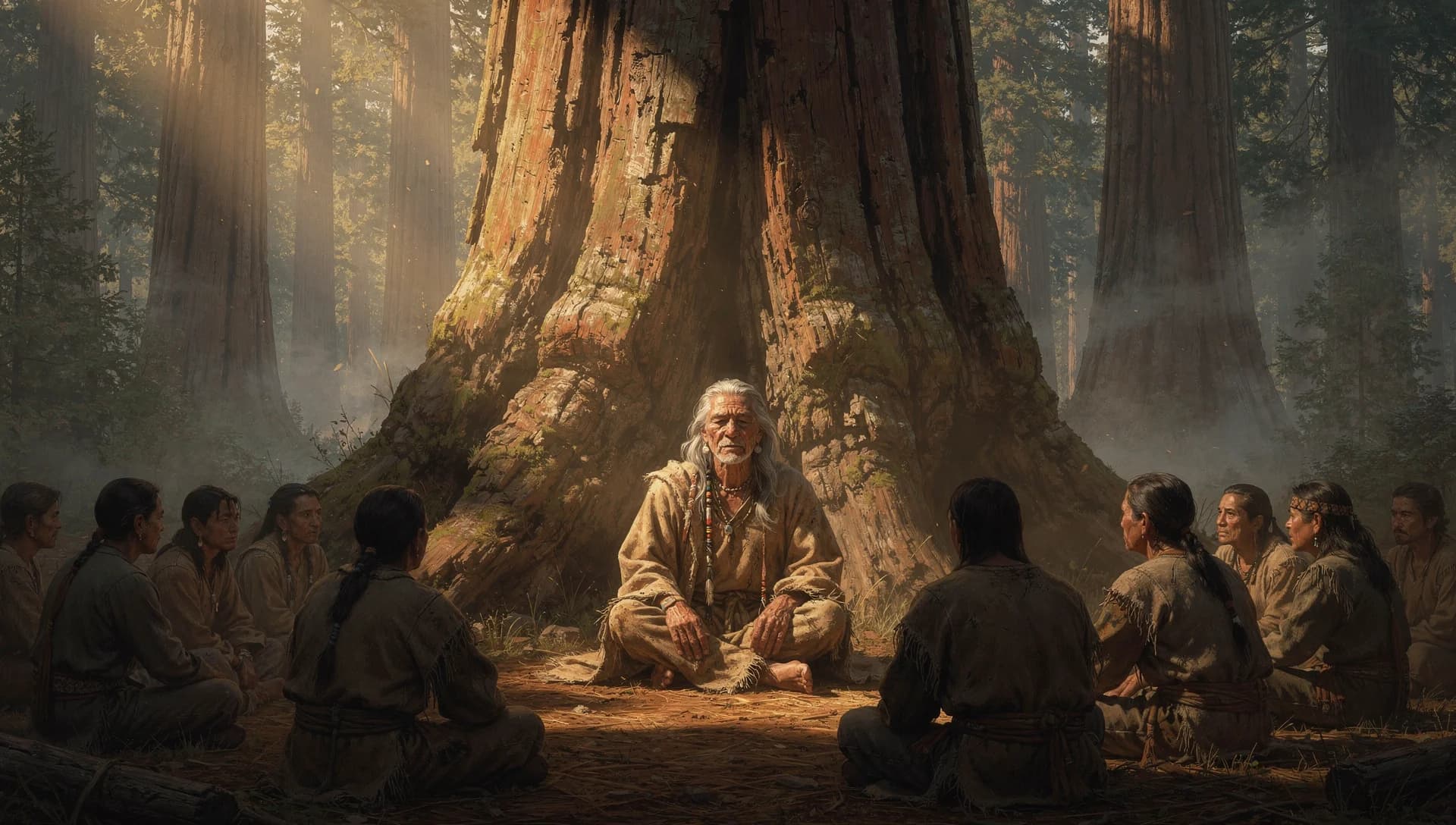
The Teacher Beneath the Redwoods: Onamonalonton and the Great Spirit Tradition
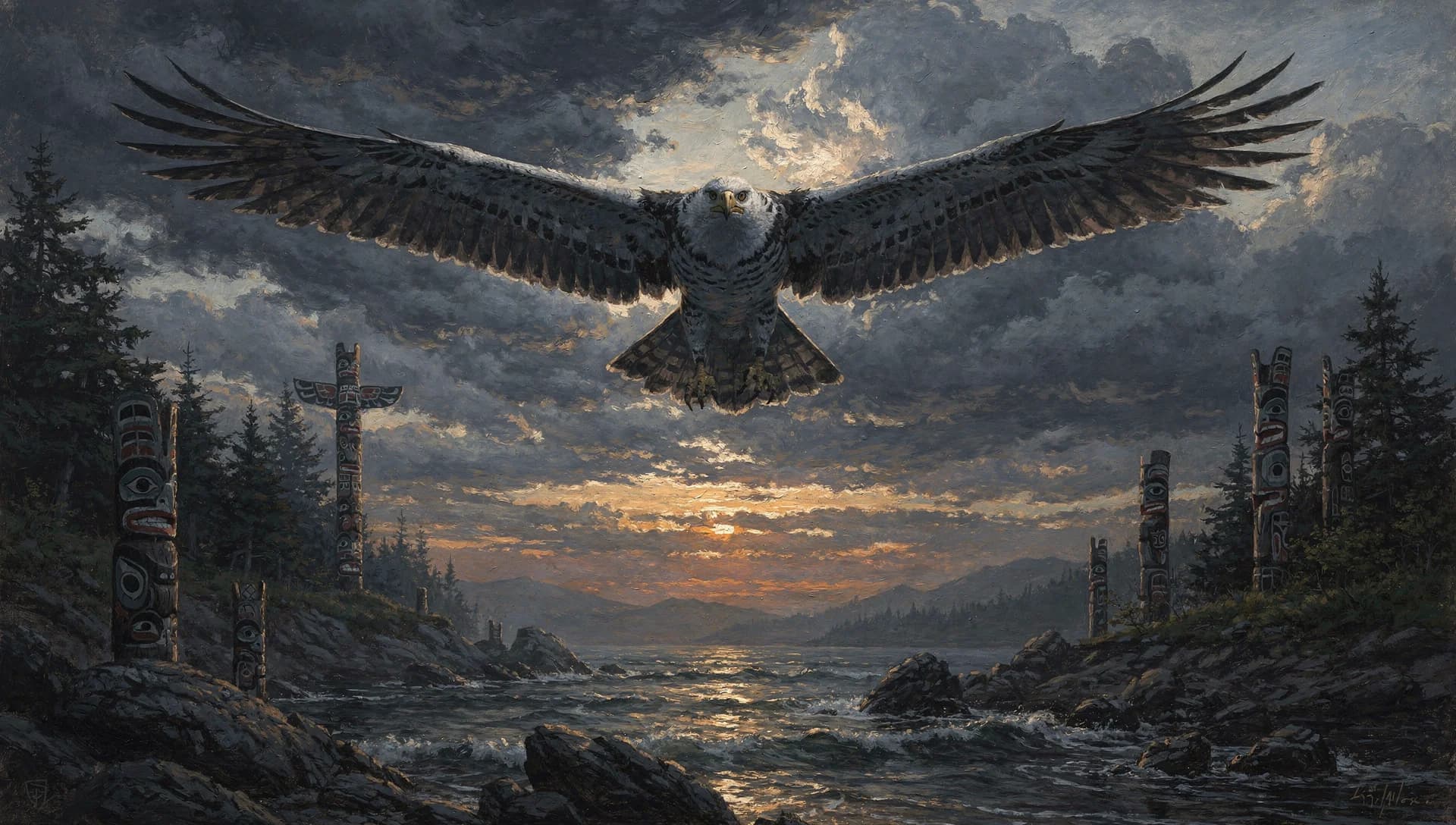
The Thunderbird Was Real: Fandors and the Indigenous American Giant Bird Tradition
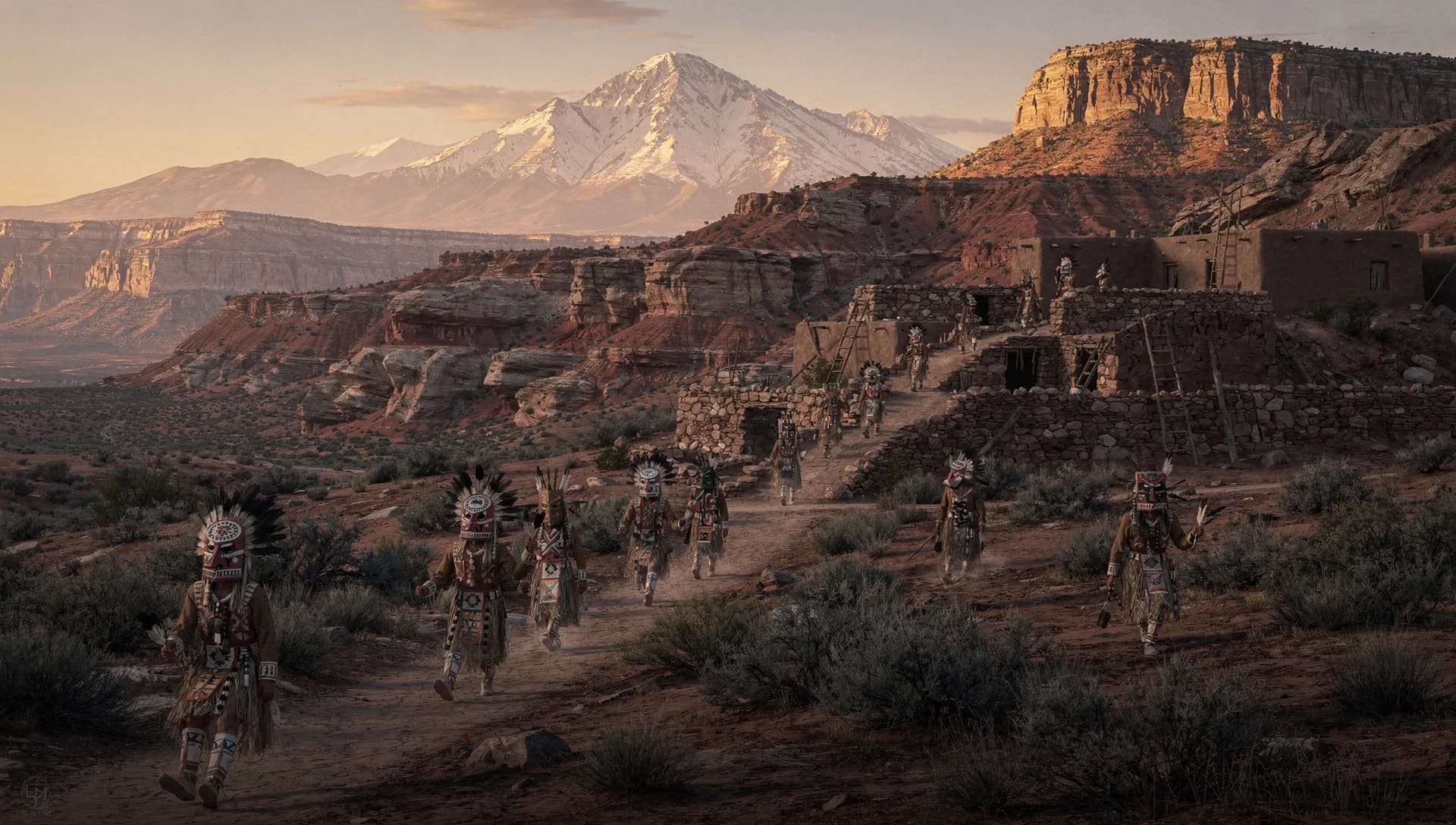
The Invisible Mediators: Urantia Midwayers and the Hopi Kachinas
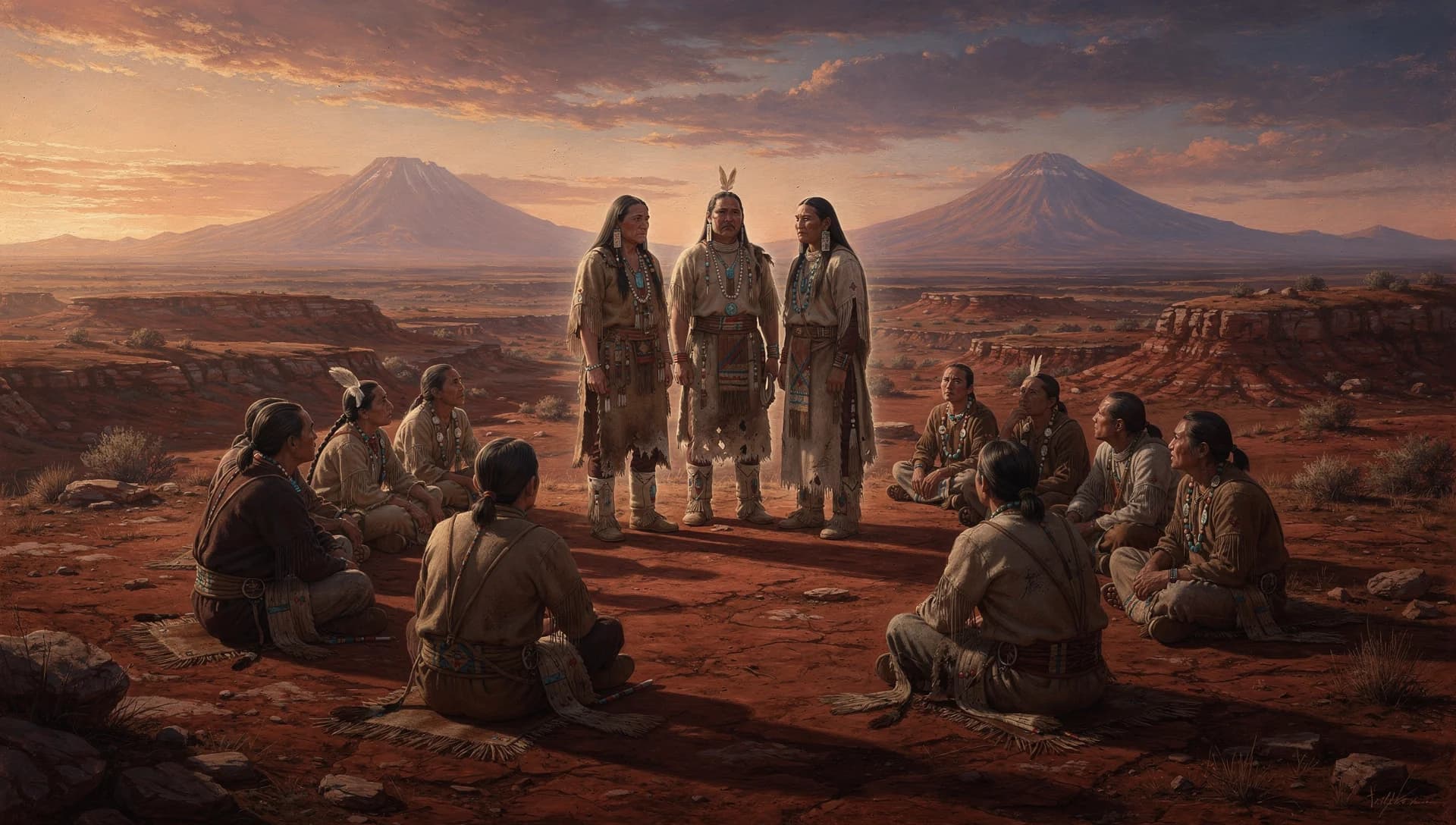
The Ones Who Came First: The Dalamatian Staff and the Navajo Holy People
The Newsletter
Get the research behind each piece
Free. New Urantia Book explorations, the sources behind the videos, and early looks. No spam, unsubscribe anytime.
Prefer video? Follow on YouTube and Facebook.
Delivered through Substack. You can also read past issues.