
 Mythic
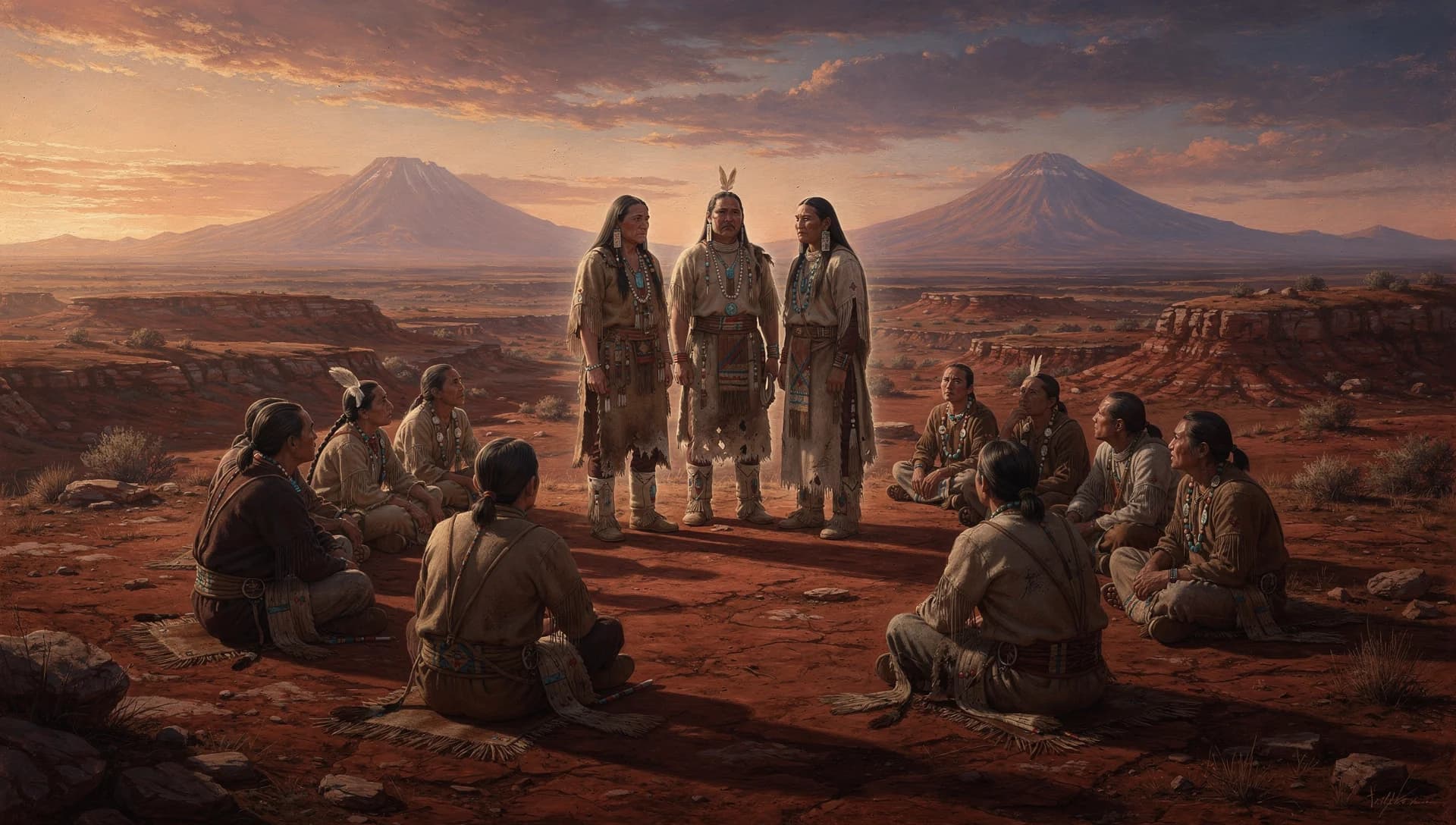
Navajo Holy People (Dine'é Diyini), the superhuman teachers who established the Diné way
 UB
UBThe corporeal staff of one hundred, teachers of civilization
Full Article
Read the deep-dive article on this connection
The corporeal staff of one hundred, teachers of civilization = Navajo Holy People (Dine'é Diyini), the superhuman teachers who established the Diné way
The Connection
Navajo cosmology centers on the Holy People, superhuman beings who emerged from the lower worlds, established the mountains of the four directions, taught agriculture, weaving, ceremony, and moral law, and then withdrew to their own realm, leaving the Diné with the instructions for right living. The pattern (superhuman teachers who arrive, establish cardinal geography and civilizational knowledge, and withdraw into invisibility) matches the UB account of the Prince's staff establishing Dalamatia and its ten councils of civilization.
UB Citation
UB 66:2-5, 66:5.1-14
Academic Source
Reichard, Navaho Religion (1950); Zolbrod, Diné bahane': The Navajo Creation Story (1984)
Historical Evidence(Moderate evidence)
Gladys Reichard's Navaho Religion documented the Diyin Diné as a distinct category of being, neither gods nor ancestors but superhuman teachers responsible for the original Blessingway. Paul Zolbrod's Diné bahane' preserves the creation narrative in which the Holy People emerge, establish the four sacred mountains, teach the human twins, and withdraw. The four-mountain cardinal structure and the organized teaching of specific civilizational domains (ceremony, weaving, agriculture) mirror the UB's ten councils of the corporeal staff governing ten discrete civilizational domains.
Deep Dive
In the high desert of the Four Corners region of the American Southwest, the Diné (Navajo) people maintain one of the most intricate and theologically articulated cosmologies in Indigenous North America. The Diné Bahane', the Navajo creation story (preserved in Paul Zolbrod's 1984 reconstruction working with Diné cultural authorities), describes the emergence of the people through a series of underworlds, each with its own conditions and lessons, until the present world is reached. In this present world, the Diyin Diné, the Holy People, established the four sacred mountains of the cardinal directions: Sis Naajiní (Blanca Peak) to the east, Tsoodzil (Mount Taylor) to the south, Dook'o'oosliid (the San Francisco Peaks) to the west, and Dibé Nitsaa (Hesperus Peak) to the north. These four mountains define the sacred geography within which the Diné life is lived. The Holy People taught the human beings, particularly the Hero Twins (Naayéé' Neizghání and Tobadzistsini), the proper ways of living: the Blessingway, the Enemyway, the various healing ceremonies, the songs and prayers that maintain hozho, the harmony and beauty that is the right state of human and cosmic life.
After establishing the geography, teaching the ceremonies, and instructing the people, the Holy People withdrew. They remain present-but-invisible, accessible through the proper ceremonies, the medicine people who serve as their human contacts, and the ritual specialists who maintain the songs and the sand paintings that make the Holy People temporarily visible during healing rites. The withdrawal-but-continuing-presence pattern is the structural framework of contemporary Diné religious life, with the entire ceremonial cycle understood as ongoing communication with the Holy People who taught the way and remain accessible through proper practice.
The Urantia Book describes the corporeal staff of the Planetary Prince in Papers 66:5.1-14. One hundred corporeal members, organized into ten autonomous councils of ten members each, served as the teaching faculty of the Dalamatian civilization for three hundred thousand years. The ten councils governed specific civilizational domains: the food council under Ang, the council on the conquest of predatory animals under Bon, the council on the dissemination and conservation of knowledge under Fad, the commission on industry and trade under Nod, the college of revealed religion under Hap, the guardians of health and life under Lut, the planetary council on art and science under Mek, the governors of advanced tribal relations under Tut, the supreme court of tribal coordination and racial cooperation under Van, and the supreme council of co-ordination chaired by Van. Daligastia, the associate Prince, presided over joint sessions of two or more councils.
The structural fit between the Diné Holy People and the corporeal staff is precise on several points. First, the organizational structure: the Diné cosmology is organized around a specific corps of superhuman teachers, not a generic class of spirits, mirroring the UB's specific corporate staff of one hundred. Second, the cardinal-geography element: the Diné Holy People establish the four sacred mountains as the foundation of sacred geography, paralleling the way the UB's corporeal staff established Dalamatia as the planetary headquarters with its surrounding regions of teaching and influence. Third, the teaching content: the Holy People taught the specific civilizational arts (agriculture, weaving, healing, ceremony, song) in ways that parallel the UB's corporeal-staff teaching of food production, medicine, art, science, religion, and tribal coordination. Fourth, the withdrawal pattern: the Holy People withdrew but remain accessible through proper practice, paralleling the UB's account of the corporeal staff as having departed but with their teaching legacy continuing through the loyal lineage Van preserved.
Gladys Reichard's 1950 monograph Navaho Religion remains the foundational academic survey of Diné religious tradition. Reichard documented the Diyin Diné as a distinct category of being, neither gods in the polytheistic sense nor ancestors, but specifically superhuman teachers responsible for the original Blessingway and the foundational instruction of the people. Paul Zolbrod's 1984 Diné Bahane' provides the most accessible English presentation of the creation narrative, working closely with Diné cultural authorities. Both scholars converge on the basic structural feature: the Holy People are a specific corporate teaching presence, not a generic spirit class.
The strongest counterargument is that the Diné cosmology is integral to its specific cultural and ecological context, and external comparative frameworks should not be imposed without invitation. This is a fair point and the UB framework should be applied carefully. The reply is that the structural parallel is a claim about the underlying historical reality, not a claim about the cultural ownership of the ceremonial content. The Diné people have preserved a remarkable cultural memory of a real planetary teaching mission. The specific ceremonial elaboration belongs to them. The underlying historical reality, if the UB account is correct, is shared across all peoples whose ancestors received Dalamatian-period teaching.
What the parallel implies is that the Diné cosmology preserves, with unusually clear structural fidelity, real cultural memory of the Dalamatian teaching period. The four-mountain cardinal structure, the organized teaching of specific civilizational domains, the withdrawal of the teachers with continuing accessibility through proper practice, all are structural features that the UB attributes to the actual Dalamatian planetary administration. The Diné tradition is not a primitive cosmology to be replaced by Western religion. It is a sophisticated cultural-memory preservation of real planetary history, deserving the same respect and serious engagement as any other major fragmentary preservation of underlying revelation.
Key Quotes
“The one hundred were organized for service in ten autonomous councils of ten members each. When two or more of these ten councils met in joint session, such liaison gatherings were presided over by Daligastia.”
“None of the Prince’s staff would present revelation to complicate evolution; they presented revelation only as the climax of their exhaustion of the forces of evolution. But Hap did yield to the desire of the inhabitants of the city for the establishment of a form of religious service. His group provided the Dalamatians with the seven chants of worship and also gave them the daily praise-phrase and eventually taught them “the Father’s prayer,” which was:”
“Reichard documents the Diyin Diné as a distinct category of being, neither gods nor ancestors, but specifically superhuman teachers responsible for the original Blessingway and the foundational instruction of the Diné people.”
“Zolbrod presents the Navajo creation narrative in which the Holy People emerge through the underworlds, establish the four sacred mountains of the cardinal directions, teach the human twins, and withdraw to their own realm while remaining accessible through proper ceremony.”
Cultural Impact
The Diné cosmology and its associated ceremonial complex constitute one of the most elaborate Indigenous American religious systems still in active practice. The Blessingway, the Nightway, the Enemyway, and the dozens of other major ceremonial cycles are performed continuously across the Navajo Nation, with traditional medicine people maintaining the inherited knowledge through apprenticeship and direct practice. The sand-painting tradition, in which intricate ritual designs are created with colored sands during healing ceremonies and dispersed at ceremony's end, is one of the most sophisticated ephemeral art forms in any culture. The Navajo silver and turquoise jewelry tradition, the rug-weaving tradition, and the contemporary Diné painting and ceramic traditions all carry forward the cultural inheritance of the Holy People. Beyond the Navajo Nation, Diné spiritual concepts have entered broader American consciousness through Tony Hillerman's mystery novels, through documentary films, and through the work of Diné writers like Luci Tapahonso and Sherwin Bitsui. The Diné concept of hozho (harmony, balance, beauty as the proper state of life) has shaped American environmental and ecospiritual thinking. The four-direction sacred-geography framework has influenced American Indigenous architecture, landscape design, and ceremonial practice across multiple tribal traditions.
Modern Resonance
The Diné tradition's preservation of a specific corps of superhuman teachers, with cardinal-geographic organization and specific civilizational instruction, offers one of the cleanest cultural-memory parallels to the UB's account of the Dalamatian period available in any contemporary religious tradition. For contemporary readers wrestling with the question of whether ancient cultural memories can preserve real historical content across millennia of oral transmission, the Diné case offers significant evidence: the structural specifics are too precise to be generic mythology, and the parallel to the UB account is too detailed to be coincidental convergence. The Diné people have preserved real cultural memory of real planetary history. For Indigenous American spiritual leaders working to defend the traditional knowledge against external dismissal, the UB framework offers strong external validation that takes the antiquity, sophistication, and historical accuracy of the traditions seriously. For non-Indigenous readers, the framework offers a way to engage respectfully with Diné spiritual tradition without flattening it into generic spirituality or appropriating it for non-Diné use. The tradition belongs to the Diné people. The underlying historical reality belongs to all of humanity, and the Diné have preserved one of its clearest cultural memories.
Related Mappings
Onamonalonton, spiritual leader of the red race (~65,000 BC)
= The "Great Spirit" tradition (Gitchi Manitou, Wakan Tanka)
Fandors, giant passenger birds (last died ~30,000 years ago)
= Thunderbird, giant supernatural bird
Midwayers, invisible planetary ministers who interact with the mortal realm
= Hopi Kachinas, ancestor-spirits who mediate between gods and humans
Red race migration from Asia to the Americas across the Bering land bridge
= Pan-Indigenous origin traditions: emergence from the north, the sea-crossing ancestors
Related Articles
Where to next
The free newsletter. The research behind each piece, no spam.