
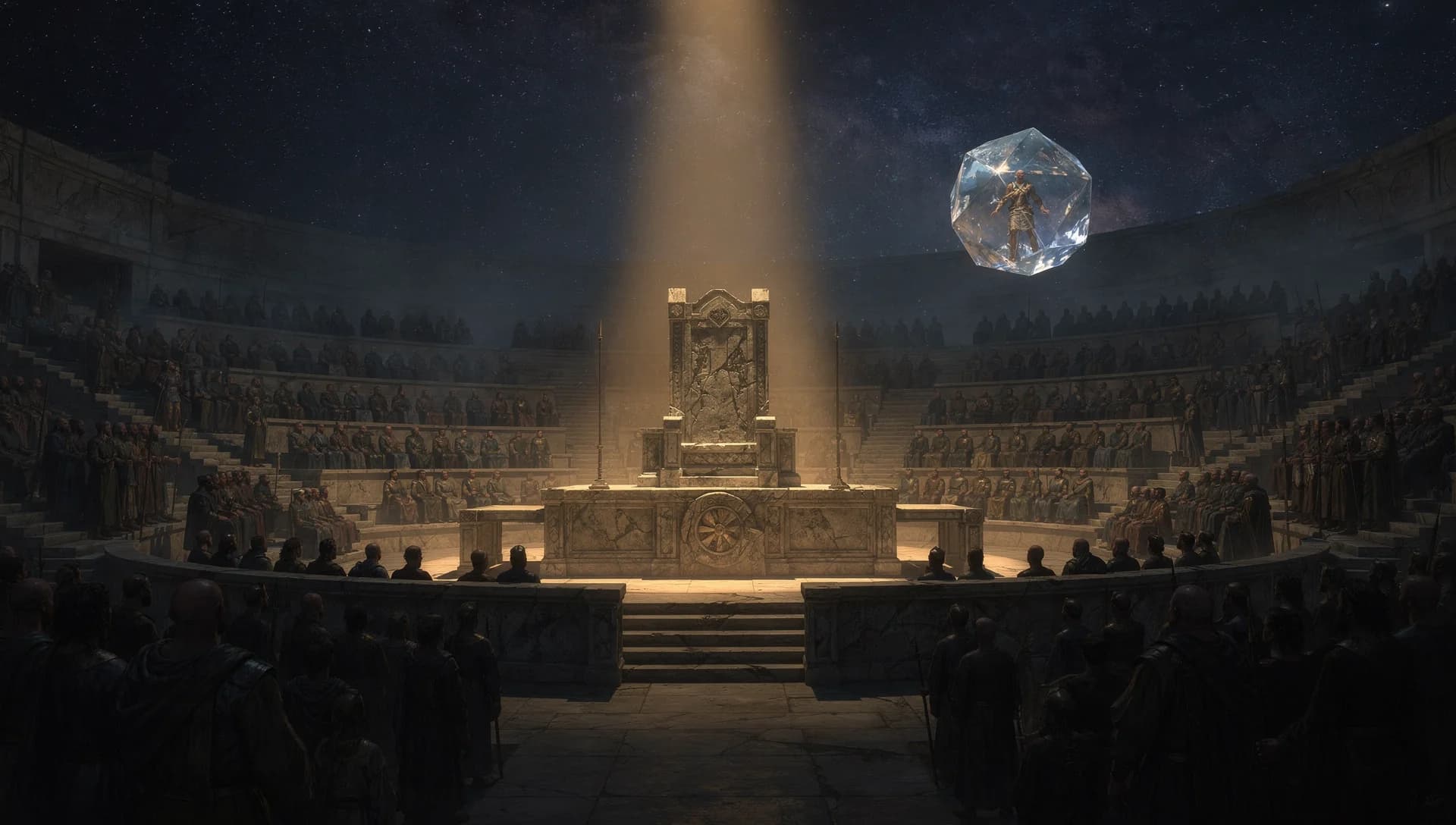
 Mythic
Ragnarok, the twilight of the gods and the renewal of the world
 UB
UBMichael's final adjudication of the Lucifer rebellion (the unresolved verdict)
Full Article
Read the deep-dive article on this connection
Michael's final adjudication of the Lucifer rebellion (the unresolved verdict) = Ragnarok, the twilight of the gods and the renewal of the world
The Connection
Ragnarok is the Norse prophecy of a final cosmic battle in which the bound rebel Loki is released, the old gods and their enemies destroy each other, the sun darkens, and a new world emerges from the sea with surviving gods and a renewed human pair. The UB states that the Lucifer rebellion awaits a final adjudication whose verdict has been delayed while mercy is extended, after which the cosmic account will be closed. The structural elements (released rebel, final battle, cosmic darkening, renewed world) appear in both traditions as the same underlying eschatological expectation.
UB Citation
UB 54:5, 53:8.6-8
Academic Source
Völuspá 45-66 (Poetic Edda); Gylfaginning 51-53 (Sturluson); Turville-Petre, Myth and Religion of the North (1964)
Historical Evidence(Moderate evidence)
E.O.G. Turville-Petre documented Ragnarok as the central Norse eschatological narrative, with its precise structural elements: rebel's release, final battle, cosmic darkening, rebirth of the world. Völuspá 57-59 describes the sun turning black and the stars falling, language the book of Revelation also uses. The UB places the final verdict on the rebellion as still-pending but certain, with Urantia entering "a new era" after its resolution. The shared "bound rebel released for final battle followed by cosmic renewal" structure across Norse, Christian, and UB traditions is the kind of trans-cultural persistence the decoder is built to document.
Deep Dive
The Voluspa, the first poem of the Poetic Edda, gives the most fully articulated Ragnarok prophecy in Norse literature. The vala (seeress) describes the end of the age in stanzas 45 through 66. The bonds of Loki break. The wolf Fenrir runs free. Heimdall blows his horn. The world-tree shudders. The army of the dead sails on the ship Naglfar from the east. Odin rides out at the head of the Aesir to meet his fate. He falls to Fenrir; Fenrir is killed by Vidar. Thor falls to the world-serpent Jormungand and the serpent dies of his wounds. The fire-giant Surt sets the world ablaze. The sun turns black; the stars fall from heaven; the earth sinks into the sea. Then a new earth rises, green and renewed; the surviving gods (Vidar, Vali, Magni, Modi, Baldr returned from the dead) gather in Idavoll; a new sun appears; a human pair (Lif and Lifthrasir) emerges from where they had been hidden in the wood Hoddmimir to repopulate the world.
This is one of the most fully developed eschatological narratives in any pre-Christian religious tradition. E. O. G. Turville-Petre, in Myth and Religion of the North (1964), documented its place at the center of Norse religious imagination. The structure is precise: bound rebel released, final battle, cosmic darkening, rebirth of the world. It is also strikingly close to the Christian Apocalyptic structure recorded in Revelation 6, 19, and 20-22: the unsealing of the rebel, the final battle, the darkening of the sun and the falling of the stars, the new heaven and new earth. The structural convergence between Norse Ragnarok and Christian Apocalyptic has been a long-standing topic of comparative religion scholarship.
The Urantia Book records that the Lucifer rebellion is awaiting a final adjudication whose verdict has been delayed while mercy is extended. Paper 54:5 lists seven reasons why Lucifer and his confederates were not sooner interned or adjudicated. Paper 54:5.2: "Mercy requires that every wrongdoer have sufficient time in which to formulate a deliberate and fully chosen attitude regarding his evil thoughts and sinful acts." Paper 54:5.3: "Supreme justice is dominated by a Father's love; therefore will justice never destroy that which mercy can save. Time to accept salvation is vouchsafed every evildoer." Paper 54:5.4: "No affectionate father is ever precipitate in visiting punishment upon an erring member of his family. Patience cannot function independently of time." Paper 54:5.5: "While wrongdoing is always deleterious to a family, wisdom and love admonish the upright children to bear with an erring brother during the time granted by the affectionate father in which the sinner may see the error of his way and embrace salvation."
Paper 54:5.6 adds the structural reason: "Regardless of Michael's attitude toward Lucifer, notwithstanding his being Lucifer's Creator-father, it was not in the province of the Creator Son to exercise summary jurisdiction over the apostate System Sovereign because he had not then completed his bestowal career, thereby attaining unqualified sovereignty of Nebadon." Paper 54:5.7 records the Ancients of Days' deferral: "The Ancients of Days could have immediately annihilated these rebels, but they seldom execute wrongdoers without a full hearing. In this instance they refused to overrule the Michael decisions." Paper 54:5.8 closes the list: "It is evident that Immanuel counseled Michael to remain aloof from the rebels and allow rebellion to pursue a natural course of self-obliteration. And the wisdom of the Union of Days is the time reflection of the united wisdom of the Paradise Trinity."
So the UB account places the resolution of the rebellion as a pending but certain final adjudication. The case of Gabriel versus Lucifer is on the records of the Uversa supreme court. The principal rebels are in custody. The final disposition is awaiting the proper adjudicative procedure, which in the universe administration involves time and mercy and the full formal hearing rather than summary annihilation. The Urantia rebellion is one component of a broader system rebellion whose final settlement will close a long cosmic chapter and inaugurate, in the UB's language, a "new era" for the affected worlds.
The structural match with Norse Ragnarok is dense at multiple points. First, the released-rebel motif. The Norse tradition has Loki and Fenrir breaking their bonds at the end of the age. The UB tradition has Satan released for periodic visits to the apostate worlds during the long deferred period (described in Paper 53:9.3-4). The released-rebel feature is consistent across both traditions, even if the timing differs (Norse: at Ragnarok itself; UB: during the long pre-Ragnarok deferral). Second, the final battle. Norse Ragnarok has the cosmic battle on the plain of Vigrid, with the gods and their adversaries destroying each other. The UB account describes the rebellion's resolution as a juridical-administrative final adjudication rather than a literal battle, but the structural unit (final reckoning at the end of the long deferred period) is shared. Third, the cosmic-darkening motif. Voluspa 57-59 describes the sun turning black and the stars falling. The Christian Apocalyptic preserves the same imagery in Revelation 6:12-14 and elsewhere. The UB account describes the Lucifer rebellion's resolution as ushering in a "new era" rather than literal cosmic darkening, but the broader pattern of "old order ends, new order begins" is shared.
Fourth, the cosmic renewal. Norse Ragnarok ends with a new earth rising, the surviving gods gathering, and the human pair emerging to repopulate the world. The Christian Apocalyptic ends with the new heaven and new earth, the surviving redeemed populating the new Jerusalem. The UB account does not specify the post-adjudication conditions in detail but does describe the affected worlds entering "a new era" after the resolution. The structural pattern (cosmic renewal after the final adjudication) is consistent across all three traditions.
Fifth, the unspecified timing. Norse Ragnarok is prophesied as certain but not dated. Christian Apocalyptic resists specific dating ("of that day or hour, no one knows"). The UB account treats the final adjudication as pending but does not give a specific timeline. The structural feature of "certain but not dated" final reckoning is shared across all three traditions.
The strongest counterargument is the source-influence position: Christian Apocalyptic shaped the Norse Ragnarok tradition through the long missionary contact period. The reply is that the structural specificity of the convergence goes beyond what surface borrowing would explain, and the pre-Christian Norse poetic material preserves elements (the specific binding of Loki, the specific structure of the released-rebel sequence) that fit the UB account at points where simple Christian-Norse borrowing would not predict. The deeper explanation is common derivation from underlying cultural memory of the actual cosmic-administrative reality.
What the parallel implies is that three traditions, the Norse Ragnarok, the Christian Apocalyptic, and the UB doctrine of the final adjudication of the Lucifer rebellion, preserve cultural memory of the same pending cosmic event. The event is the resolution of the original system rebellion, deferred during a long period of mercy, eventually to be adjudicated formally with the resolution opening a new era for the affected worlds. The decoder's job is to make the convergence visible and to point at the actual referent.
Key Quotes
“Mercy requires that every wrongdoer have sufficient time in which to formulate a deliberate and fully chosen attitude regarding his evil thoughts and sinful acts.”
“Supreme justice is dominated by a Father’s love; therefore will justice never destroy that which mercy can save. Time to accept salvation is vouchsafed every evildoer.”
“It is evident that Immanuel counseled Michael to remain aloof from the rebels and allow rebellion to pursue a natural course of self-obliteration. And the wisdom of the Union of Days is the time reflection of the united wisdom of the Paradise Trinity.”
Cultural Impact
Ragnarok has been one of the most generative eschatological narratives in Western cultural imagination. Through the Eddic poetry and Snorri's medieval Icelandic synthesis, the tradition shaped Scandinavian religious imagination for centuries. The Romantic recovery, especially through Wagner's Ring (where Gotterdammerung, the Twilight of the Gods, dramatizes the Ragnarok narrative), brought the tradition into European cultural consciousness on a grand scale. Twentieth-century literature and film returned to Ragnarok repeatedly: the long Norse-influenced fantasy genre, contemporary popular cinema (Marvel's Thor: Ragnarok, the various Vikings television series), video games (the recent God of War: Ragnarok), and contemporary speculative fiction. The contemporary climate-apocalyptic and broader end-of-the-world cultural anxiety often draws on Ragnarok imagery (the cosmic catastrophe, the destruction-and-renewal cycle, the surviving remnant). The UB account, by identifying the historical referent in the pending final adjudication of the Lucifer rebellion, restores a parsimonious source for what would otherwise be a peculiarly persistent and structurally specific eschatological pattern.
Modern Resonance
Contemporary readers approaching Ragnarok or Christian Apocalyptic often find themselves caught between literalist readings (an actual cosmic battle at the end of the age) and dismissive readings (mythological imagery with no real referent). The UB framework offers a sober middle position: the rebellion is real, the deferred adjudication is real, the resolution will be real, and the multiple traditions preserve cultural memory of the underlying reality. For modern readers attempting to develop a usable eschatology, the UB account provides specific structural content (the deferral for mercy, the formal Uversa adjudication, the inauguration of a new era after resolution) without committing to the literal cosmic-battle imagery of the mythological tradition. The decoder's job is to clarify the structural convergence across Norse, Christian, and UB traditions and to point at what each tradition is preserving in its own cultural form. Ragnarok is real, but it is not literally a battle on the plain of Vigrid; it is the long-pending final adjudication of the system rebellion, currently in process, certain in outcome, certain to inaugurate a new era for Urantia and the other isolated worlds.
Related Mappings
Andite military commander (~5000 BC)
= Thor, Norse god of thunder and warfare
Van, sustained by the Tree of Life for 150,000 years
= Odin, self-hung on Yggdrasil, the World Tree (Norse)
Tree of Life, the Edentia shrub at the center of the Father's temple
= Yggdrasil, the World Tree sustaining all realms (Norse)
The staff split: loyal vs. rebel members of the Prince's corps
= The Aesir-Vanir War, the first conflict among the gods (Norse)
Related Articles
Where to next
The free newsletter. The research behind each piece, no spam.