
 Mythic
Osiris and Isis, dying/rising god mystery cult
 UB
UBMachiventa Melchizedek's Salem teaching, corrupted in Egypt
Full Article
Read the deep-dive article on this connection
Machiventa Melchizedek's Salem teaching, corrupted in Egypt = Osiris and Isis, dying/rising god mystery cult
The Connection
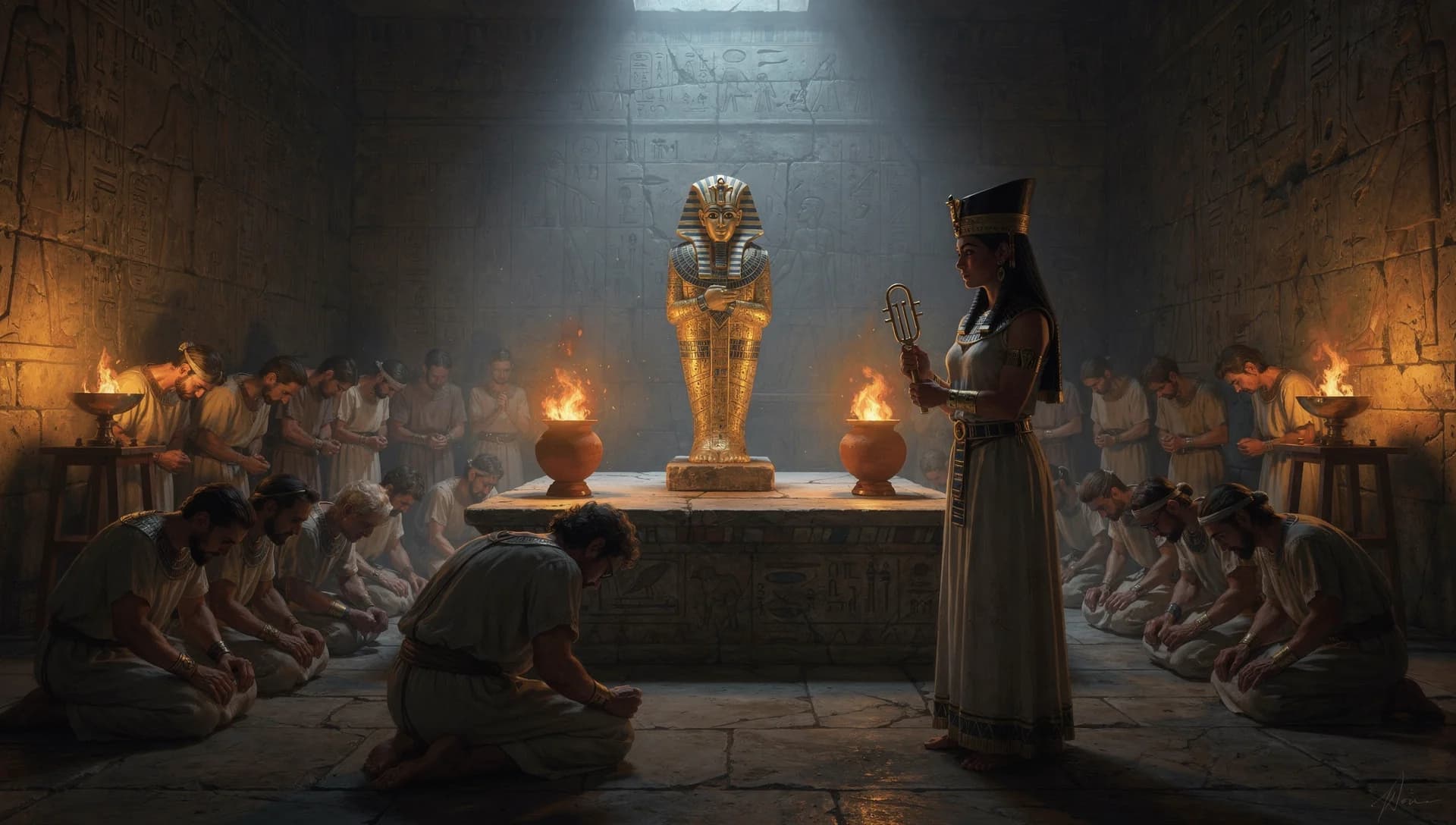
The UB traces the Osiris/Isis cult back to corrupted Salem missionary teaching. The original Salem message of one God and salvation through faith was gradually transformed into an elaborate death-and-resurrection mystery religion. Osiris became the dying and rising god whose story promised immortality to initiates, replacing the simpler Salem gospel with ritual complexity.
UB Citation
UB 98:4.4, 95:5.12
Academic Source
Plutarch, De Iside et Osiride; Griffiths, The Origins of Osiris (1980)
Historical Evidence(Moderate evidence)
The UB states that the Salem teaching was progressively distorted in Egypt, eventually contributing to the Osiris mystery tradition. J. Gwyn Griffiths traces Osiris worship from simple agricultural deity to elaborate mystery cult over centuries. Plutarch's account describes the full-blown mystery religion with death, resurrection, and promise of afterlife. The transformation from simple monotheistic teaching to complex ritual cult follows the pattern the UB describes for Salem missionary influence worldwide.
Deep Dive
Plutarch's De Iside et Osiride, written in the late first or early second century CE, gives the fullest classical account of the Osiris myth. Osiris was the rightful king of Egypt, who taught his people agriculture and civilization. His brother Set, jealous of his rule, tricked him into a beautifully crafted chest, sealed it, and threw it into the Nile. The chest washed up at Byblos, where a great tree grew around it. Isis, Osiris's sister-wife, traveled to recover the body, returned with it to Egypt, and concealed it in the marshes. Set discovered the body and dismembered it into fourteen pieces, scattering them across Egypt. Isis searched, found thirteen of the pieces (the fourteenth, the phallus, was eaten by a fish), reassembled the body, and conceived from it the child Horus. Osiris descended to become king of the underworld, where he judged the souls of the dead. Horus eventually defeated Set and avenged his father, becoming the rightful king of the upper world. Each year, the cycle of Osiris's death and resurrection was reenacted in temple ritual, and initiates into the mysteries received the promise of personal immortality through identification with Osiris.
The Osiris cult was one of the most elaborate and influential mystery religions of the Mediterranean world. By the Hellenistic and Roman periods, it had spread throughout the empire, producing the Isis cult that competed with Christianity in the early centuries of the common era. Apuleius's The Golden Ass, written in the second century CE, gives a vivid portrait of Isis devotion from the inside. The Isis-and-child iconography of Egyptian art, with Isis nursing the infant Horus, almost certainly influenced the early Christian iconography of Mary and the Christ child. The cultural penetration of the Osiris cult into the Mediterranean world was vast.
The Urantia Book's account of the Osiris cult, brief but specific, traces it back to the corruption of the Salem teaching. UB 95:5.12 records that after Akhenaten's monotheistic reform was reversed by the Amun priesthood, "the rank and file of the agricultural laborers never really grasped his gospel and were, therefore, ready to return with the priests to the old-time worship of Isis and her consort Osiris, who was supposed to have been miraculously resurrected from a cruel death at the hands of Set, the god of darkness and evil." UB 98:4.4 lists "the Egyptian cult of Osiris and his mother Isis" among the major mystery cults that competed with early Christianity in the Mediterranean world.
The structural pattern that the UB identifies is one it traces across multiple cultures: a simple Salem teaching of one God, salvation through faith, and personal moral relationship with the divine, gets progressively elaborated into a complex mystery religion with ritual, sacrifice, dying-and-rising god, and esoteric initiation. The same pattern produces the Cybele-Attis cult in Phrygia, the Mithras cult in Persia and Rome, the Adonis cult in Phoenicia, and the Tammuz cult in Mesopotamia. In each case, the underlying Salem teaching that humanity has direct access to the one God through faith is replaced by ritual mediation through priestly hierarchies and mystery initiations.
The Osiris case is particularly interesting because the dying-and-rising god structure is so prominent. UB tradition does not directly identify Osiris with any particular UB figure (unlike the Marduk-Adam mapping in the Sumerian section). Instead, the Osiris narrative is understood as a composite, drawing on multiple sources: the agricultural cycle of death and rebirth that any farming culture observes; the cultural memory of the Lucifer rebellion's destruction of the original planetary administration (Set as the rebel god of darkness and evil destroying the rightful king); fragments of memory of Adam's tragic fate (the rightful king brought low through betrayal); and the proto-Christological intuition that resurrection from death is the appropriate end of the divine king. The Osiris cult cobbles these elements together with Egyptian agricultural and royal imagery to produce a powerful mystery religion that promised immortality through ritual identification with the dying-and-rising god.
The competition between the Osiris cult and the Salem-Hebrew-Christian tradition continued for centuries. UB 95:5.12 notes that Akhenaten's reform was reversed in part because the agricultural laborers preferred the Osiris cult's ritual structure. The Roman period saw the Isis cult flourishing in Italy and across the empire, and the early Christian church had to compete directly with it for converts. The Christian incorporation of certain Osirian motifs (the dying and rising god, the Madonna and child iconography, the autumn-equinox feast) is partly the result of this competition: Christianity adopted forms that resonated with people who had been formed by the older mystery religions, while preserving the substantive monotheistic and historical claims that distinguished it from them.
The strongest counterargument is that the Osiris cult is documented in Egyptian sources from the third millennium BCE, long before the Melchizedek incarnation around 2000 BCE that would have introduced Salem teaching. If Osiris is a corruption of Salem teaching, the chronology fails. The reply is that the UB account does not claim Osiris originated as a corrupted Salem teaching. The Osiris figure has older roots in Egyptian agricultural and royal religion. What the UB attributes to Salem missionary influence is the eschatological elaboration of the Osiris cult: the doctrine of personal immortality through identification with the resurrected god, the theological structure that turned an agricultural deity into the figure of a mystery religion. UB 95:5.12 refers specifically to the post-Akhenaten Osiris cult as the form in which Egyptian religion absorbed and corrupted Salem-derived monotheistic and immortality teachings. Earlier Osiris is a different and simpler phenomenon.
Key Quotes
“The weakness of Ikhnaton's doctrine lay in the fact that he proposed such an advanced religion that only the educated Egyptians could fully comprehend his teachings. The rank and file of the agricultural laborers never really grasped his gospel and were, therefore, ready to return with the priests to the old-time worship of Isis and her consort Osiris, who was supposed to have been miraculously resurrected from a cruel death at the hands of Set, the god of darkness and evil.”
“The Egyptian cult of Osiris and his mother Isis.”
“Osiris was the rightful king of Egypt, who taught the Egyptians agriculture and civilization, and was killed through the treachery of his brother Typhon (Set) but was restored to life by the devotion of his sister-wife Isis.”
Cultural Impact
The Osiris-Isis cult is one of the most consequential religious complexes in Mediterranean history. Through its Hellenistic and Roman expansion, it shaped imperial-era spirituality across an enormous geographic range. Through its iconographic influence, it shaped early Christian visual tradition: the Isis-Horus image is the direct iconographic ancestor of the Madonna-and-child, the most pervasive image in Western religious art. Through its theological influence, it shaped late antique and medieval Christian thought about resurrection, sacramental identification with the dying-and-rising god, and the role of the divine feminine in mediating salvation. The Marian devotion that developed in medieval Catholicism, with its emphasis on Mary as Mother of God and intercessor, owes some of its theological depth to the Isis tradition that Christianity displaced and partially absorbed. The Renaissance hermetic tradition, with its romanticized vision of Egyptian wisdom, kept Isis alive as a symbol of esoteric knowledge through figures like Athanasius Kircher and into the eighteenth-century Egyptian revival (the Isis imagery in Mozart's The Magic Flute is a famous example). Through these channels, the Osiris-Isis tradition has remained one of the most culturally fertile of all ancient religious complexes.
Modern Resonance
Joseph Campbell's The Hero with a Thousand Faces and Sir James Frazer's The Golden Bough used the dying-and-rising god pattern, with Osiris as a paradigmatic example, to argue that the Christ narrative is structurally one instance of a universal mythological motif. The argument has been influential in modern comparative religion and in popular skepticism about the historicity of Christianity. The UB account inverts the Frazerian reading. The dying-and-rising god pattern is not a universal mythological structure that the Christ story instantiates. It is a corruption of the Salem teaching of personal salvation through faith, refracted through the agricultural and royal religion of multiple Mediterranean cultures, that produced the Osiris cult, the Tammuz cult, the Adonis cult, and the rest. The genuine historical event of Michael's bestowal as Jesus, including the literal death and resurrection, occurred against this background of accumulated mystery-cult expectations and partly fulfilled them while substantively transcending them. The cultural pattern that Frazer identified is real, but its origin is not Jungian archetype; it is the diffuse Salem tradition refracted through agricultural and royal religion. The Christian gospel is not just one more instance of the pattern; it is the historical event the pattern was anticipating.
Related Mappings
Machiventa Melchizedek's Salem missionaries
= Ikhnaton / Akhenaten, pharaoh who proclaimed one God
Amenemope, Egyptian conscience teacher
= "Son of Man," source for Proverbs and Psalm 1
Thought Adjuster, indwelling divine fragment
= Egyptian Ka, the divine spirit-double
Evolving mortal soul
= Egyptian Ba, the soul-bird
Related Articles
Where to next
The free newsletter. The research behind each piece, no spam.