
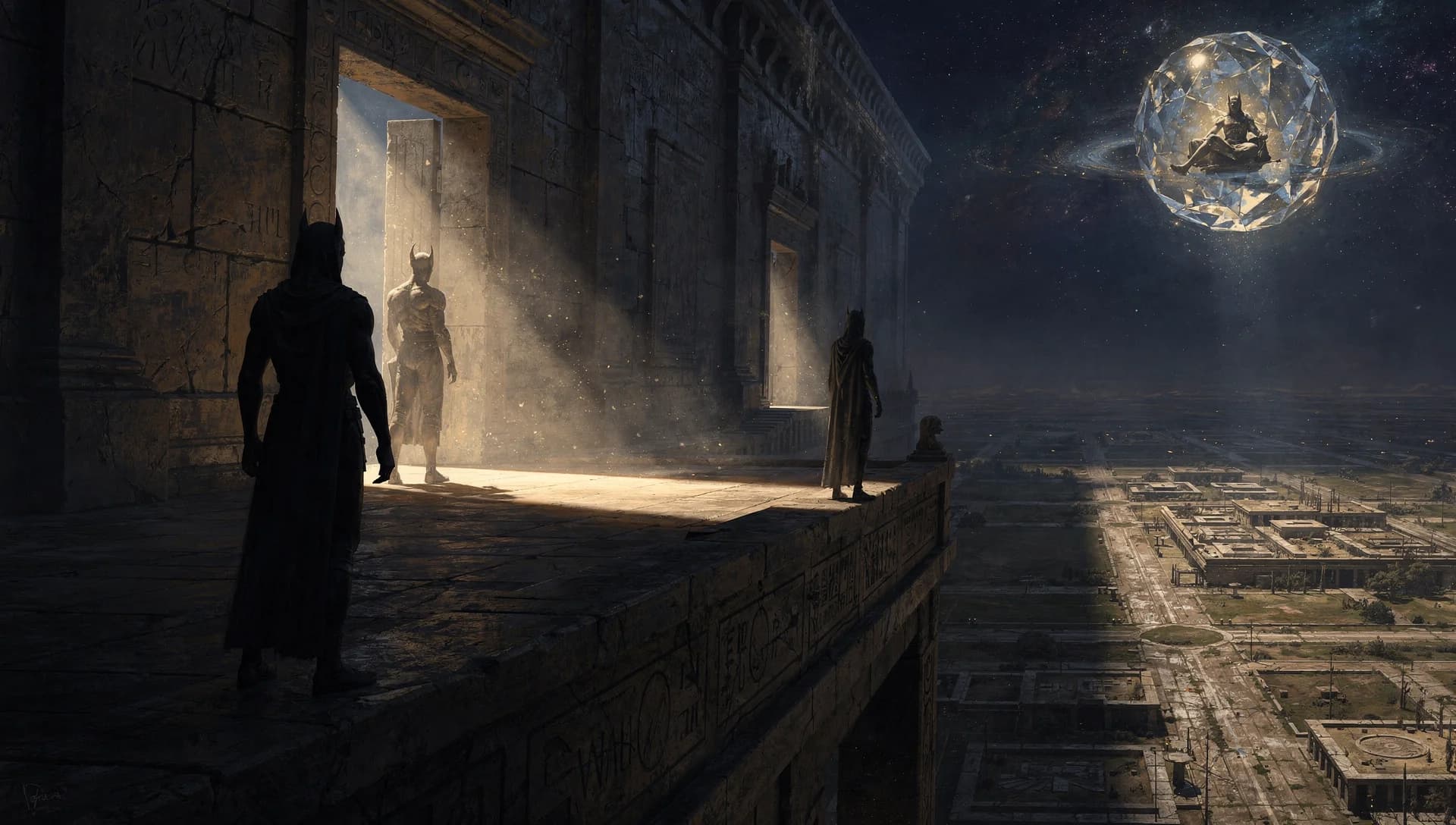
 Mythic
The Devil / The Dragon / The Adversary, theological confusion of six rebel leaders
 UB
UBLucifer, Satan, Caligastia: three distinct beings confused as one "Devil"
Full Article
Read the deep-dive article on this connection
Lucifer, Satan, Caligastia: three distinct beings confused as one "Devil" = The Devil / The Dragon / The Adversary, theological confusion of six rebel leaders
The Connection
Christian theology collapses Lucifer, Satan, the Devil, Beelzebub, and Abaddon into a single entity. The UB reveals these are six distinct beings in a rebel command chain: Lucifer (deposed System Sovereign), Satan (his lieutenant), Caligastia/"the Devil" (Planetary Prince), Daligastia (Caligastia's assistant), Abaddon (chief of staff), and Beelzebub (leader of disloyal midwayers). Each has a different role, status, and current fate.
UB Citation
UB 53:1.4-5, 53:8.6, 53:9.2-4
Academic Source
Revelation 12, 20; Isaiah 14:12; Pagels, The Origin of Satan (1995)
Historical Evidence(Moderate evidence)
The UB provides specific current status for each rebel: Lucifer is "a prisoner on satellite number one" of Jerusem since Michael's bestowal, mapping to Revelation 20:2, "the dragon was bound for a thousand years." Satan was free to visit Urantia periodically but is now "unqualifiedly detained on the Jerusem prison worlds." Caligastia remains "free on Urantia to prosecute his nefarious designs, but he has absolutely no power to enter the minds of men." Revelation 9:11 names "Abaddon" specifically; the UB confirms this is a real being, Caligastia's chief of staff. The theological merger of these distinct personalities into one "Devil" is itself a documented scholarly puzzle that the UB resolves.
Deep Dive
Walk through the medieval cathedrals of Europe and look at the carvings of demons, devils, and fallen angels above the doors and around the choir stalls. Read Dante's Inferno, with Lucifer at the bottom of hell chewing Judas in his three-mouthed jaws. Watch Milton's Paradise Lost, with Satan as the magnificent fallen archangel rallying his troops on the burning lake. Read the standard Western Christian theological treatment of the devil from Augustine through Aquinas through Calvin and beyond. In all of these traditions, one figure dominates: the singular adversary of God, variously named Lucifer, Satan, the devil, Beelzebub, Abaddon, or the dragon. The names are treated as titles of one personality.
The biblical texts that contribute the names point in different directions. Lucifer (Latin "light-bringer," translating Hebrew helel ben shahar, "shining one, son of the dawn") appears in Isaiah 14:12 in a taunt-song against the king of Babylon. Satan (Hebrew "adversary, accuser") appears in Job 1-2, Zechariah 3, 1 Chronicles 21, and various New Testament passages. The Greek diabolos (devil, slanderer) is the Septuagint and New Testament rendering of Hebrew satan. Beelzebub appears in 2 Kings 1 (as "Baal-zebub of Ekron") and in the Synoptic Gospels (where he is identified as the prince of demons). Abaddon (Hebrew "destruction") appears in Revelation 9:11 specifically: "The angel of the bottomless pit; his name in Hebrew is Abaddon, and in Greek he is called Apollyon." The dragon appears in Revelation 12 and 20.
The biblical texts themselves do not equate all of these figures. The systematic equation is the work of post-biblical theological tradition, primarily late antique and medieval Christianity. The Isaiah 14 Lucifer was originally about a human Babylonian king and was reread as the fall of Satan only later (by Tertullian and Origen, in the early third century). The Job satan was originally a member of the divine council, an accuser-figure in the heavenly court, not a cosmic adversary. The Synoptic Beelzebub was identified by Jesus's opponents as the prince of demons, but the equation with the singular cosmic adversary is post-canonical. The Abaddon of Revelation 9 is a specific named figure with a specific role; the equation with the figure described in Revelation 20 is a theological consolidation. The dragon, the beast, the false prophet, the harlot of Babylon: each is a distinct Apocalyptic figure that later tradition merged into the singular devil.
The Urantia Book restores the distinct personalities and their distinct roles. Paper 53:1.4 records: "Very little was heard of Lucifer on Urantia owing to the fact that he assigned his first lieutenant, Satan, to advocate his cause on your planet. Satan was a member of the same primary group of Lanonandeks but had never functioned as a System Sovereign; he entered fully into the Lucifer insurrection. The 'devil' is none other than Caligastia, the deposed Planetary Prince of Urantia and a Son of the secondary order of Lanonandeks. At the time Michael was on Urantia in the flesh, Lucifer, Satan, and Caligastia were leagued together to effect the miscarriage of his bestowal mission. But they signally failed."
Paper 53:1.5 adds: "Abaddon was the chief of the staff of Caligastia. He followed his master into rebellion and has ever since acted as chief executive of the Urantia rebels. Beelzebub was the leader of the disloyal midway creatures who allied themselves with the forces of the traitorous Caligastia."
Six distinct beings are named with six distinct roles. Lucifer is the deposed System Sovereign of Satania, the highest-ranking rebel. Satan is his first lieutenant, of the same Lanonandek primary order. Caligastia is the Planetary Prince of Urantia, of the secondary Lanonandek order, the figure most directly involved with mortal affairs and the one identified as "the devil" in the strict UB usage. Daligastia is Caligastia's immediate assistant. Abaddon is Caligastia's chief of staff among the rebel angelic ranks. Beelzebub is the leader of the disloyal midway creatures. The hierarchy is precise and the roles are functionally distinguished.
Paper 53:8.6 records the current status of Caligastia: "The last act of Michael before leaving Urantia was to offer mercy to Caligastia and Daligastia, but they spurned his tender proffer. Caligastia, your apostate Planetary Prince, is still free on Urantia to prosecute his nefarious designs, but he has absolutely no power to enter the minds of men, neither can he draw near to their souls to tempt or corrupt them unless they really desire to be cursed with his wicked presence."
Paper 53:9.2 records Lucifer's status: "The archdeceiver has never been on Urantia since the days when he sought to turn back Michael from the purpose to complete the bestowal and to establish himself finally and securely as the unqualified ruler of Nebadon. Upon Michael's becoming the settled head of the universe of Nebadon, Lucifer was taken into custody by the agents of the Uversa Ancients of Days and has since been a prisoner on satellite number one of the Father's group of the transition spheres of Jerusem. And here the rulers of other worlds and systems behold the end of the unfaithful Sovereign of Satania. Paul knew of the status of these rebellious leaders following Michael's bestowal, for he wrote of Caligastia's chiefs as 'spiritual hosts of wickedness in the heavenly places.'"
Paper 53:9.4 records that "Satan is now unqualifiedly detained on the Jerusem prison worlds." So as of the time of the UB's revelation in the early twentieth century, Lucifer is in custody on Jerusem satellite number one, Satan is detained on the Jerusem prison worlds, and Caligastia is still on Urantia though without the power to enter human minds without invitation. Three different places, three different statuses, three different beings.
The mainstream scholarly tradition has documented the gradual merger of these distinct biblical figures into one. Elaine Pagels's The Origin of Satan (Random House, 1995) traces the development of Satan from his original biblical role as one of the members of the heavenly court through the cosmic-adversary figure of post-biblical Christianity. Jeffrey Burton Russell's four-volume history of the devil (The Devil, Satan, Lucifer, Mephistopheles, Cornell, 1977-1986) gives the comprehensive treatment. The merger of distinct figures into one is a documented historical process. The UB account adds that the original distinct figures referred to real distinct beings, and that the merger involved a substantial loss of theological precision.
The cost of the merger has been doctrinal. Treating the devil as one being makes the spiritual situation simpler than it actually is. It collapses the cosmic-political situation (the System Sovereign Lucifer's rebellion against the universe of Nebadon) into the local-planetary situation (Caligastia's continued mischief on Urantia). It obscures the role of the rebellion's resolution through Michael's bestowal (Lucifer is in custody, Satan is detained, and the case is pending final adjudication). It encourages a flattened cosmic dualism in which a singular devil opposes God in a way that the actual cosmic situation does not support. The medieval Christian doctrine of the devil developed in directions that the original biblical material does not require and that the UB account corrects.
The strongest counterargument is the doctrinal investment in the singular devil. Most popular Christian preaching, devotional literature, and apologetic writing assumes the devil as a single entity. The reply is that the biblical material itself does not require the singular reading, and the mainstream scholarly recognition of the gradual merger of distinct figures is well established. The UB account is more demanding (six specific named beings with specific current statuses) but it fits the biblical material more precisely than the singular-devil collapse. The doctrinal cost of recovering the distinctions is mostly the loss of a flattened cosmic dualism that was always a theological reach beyond what the biblical texts actually said.
What the parallel implies is that one of the most influential bodies of Christian doctrine, the doctrine of the devil, is a post-biblical theological construction that conflated distinct biblical figures into one and obscured the actual structure of the spiritual situation. The decoder's job is to recover the distinctions and to let the biblical figures stand in their original distinctness. Lucifer, Satan, the devil, Beelzebub, Abaddon, the dragon: each name has a specific referent, and the cosmic-spiritual situation is more articulated than the medieval merger allowed.
Key Quotes
“Very little was heard of Lucifer on Urantia owing to the fact that he assigned his first lieutenant, Satan, to advocate his cause on your planet. Satan was a member of the same primary group of Lanonandeks but had never functioned as a System Sovereign; he entered fully into the Lucifer insurrection. The “devil” is none other than Caligastia, the deposed Planetary Prince of Urantia and a Son of the secondary order of Lanonandeks.”
“Abaddon was the chief of the staff of Caligastia. He followed his master into rebellion and has ever since acted as chief executive of the Urantia rebels. Beelzebub was the leader of the disloyal midway creatures who allied themselves with the forces of the traitorous Caligastia.”
“The last act of Michael before leaving Urantia was to offer mercy to Caligastia and Daligastia, but they spurned his tender proffer. Caligastia, your apostate Planetary Prince, is still free on Urantia to prosecute his nefarious designs, but he has absolutely no power to enter the minds of men, neither can he draw near to their souls to tempt or corrupt them unless they really desire to be cursed with his wicked presence.”
Cultural Impact
The medieval Christian doctrine of the devil, with its singular cosmic adversary opposing God, shaped Western religious imagination for over a thousand years. Through Augustine's De Civitate Dei, Aquinas's treatment in the Summa, and the long tradition of demonology and witch-trial discourse, the singular devil became a fixture of Western theological vocabulary. The Reformation traditions, Catholic and Protestant alike, preserved the doctrine in various forms. Through Milton's Paradise Lost, Goethe's Faust, and the long literary tradition of devil-figures (Bulgakov's Master and Margarita, C. S. Lewis's Screwtape Letters), the singular devil entered Western literature as one of its most reliable archetypes. Through medieval and modern visual art (Hieronymus Bosch, Bruegel, William Blake), through opera (Gounod's Faust, Boito's Mefistofele), through film (countless devil-figure films from The Exorcist to Constantine), the singular devil has been one of the most reproduced figures in Western culture. The cultural inheritance is dense and ongoing. The UB account does not displace this inheritance but reframes it: the figures the medieval tradition merged were originally distinct, and recovering the distinctions clarifies the actual spiritual situation without diminishing the cultural force of the inherited imagery.
Modern Resonance
Contemporary readers wrestling with the doctrine of the devil often find the singular cosmic adversary difficult to reconcile with mainstream theology of God's sovereignty. The dualism implicit in the medieval doctrine (a powerful evil being permanently opposing God) is hard to defend systematically. The UB framework offers a coherent alternative. The rebellion was real but bounded: a System Sovereign and his lieutenants rebelled against the universe administration; the rebellion was contained and is being adjudicated; the principal rebels are in custody; the local representative (Caligastia) remains active on Urantia but without power over human minds without explicit invitation. The cosmic situation is not a permanent dualism but a contained rebellion in process of resolution. For modern readers attempting to develop a usable theology of evil, the UB account preserves what is real in the tradition (real rebel personalities, real consequences, real spiritual struggle) while removing what is theologically unsustainable (a singular cosmic adversary equipotent with God). The decoder's job is to make the distinctions visible and to let each figure stand in its proper role.
Related Mappings
Serapatatia, well-meaning Nodite leader
= The Serpent in the Garden of Eden
Eve's mating with Cano the Nodite
= "Eating the Forbidden Fruit" / Original Sin
Cain receiving a Thought Adjuster
= The "Mark of Cain," divine protection
Three Noahs: Historical, Regional, and Literary
= Biblical Noah, composite figure
Related Articles
Where to next
The free newsletter. The research behind each piece, no spam.