
 Mythic
Atlantis / Dilmun, a paradise civilization lost beneath the sea
 UB
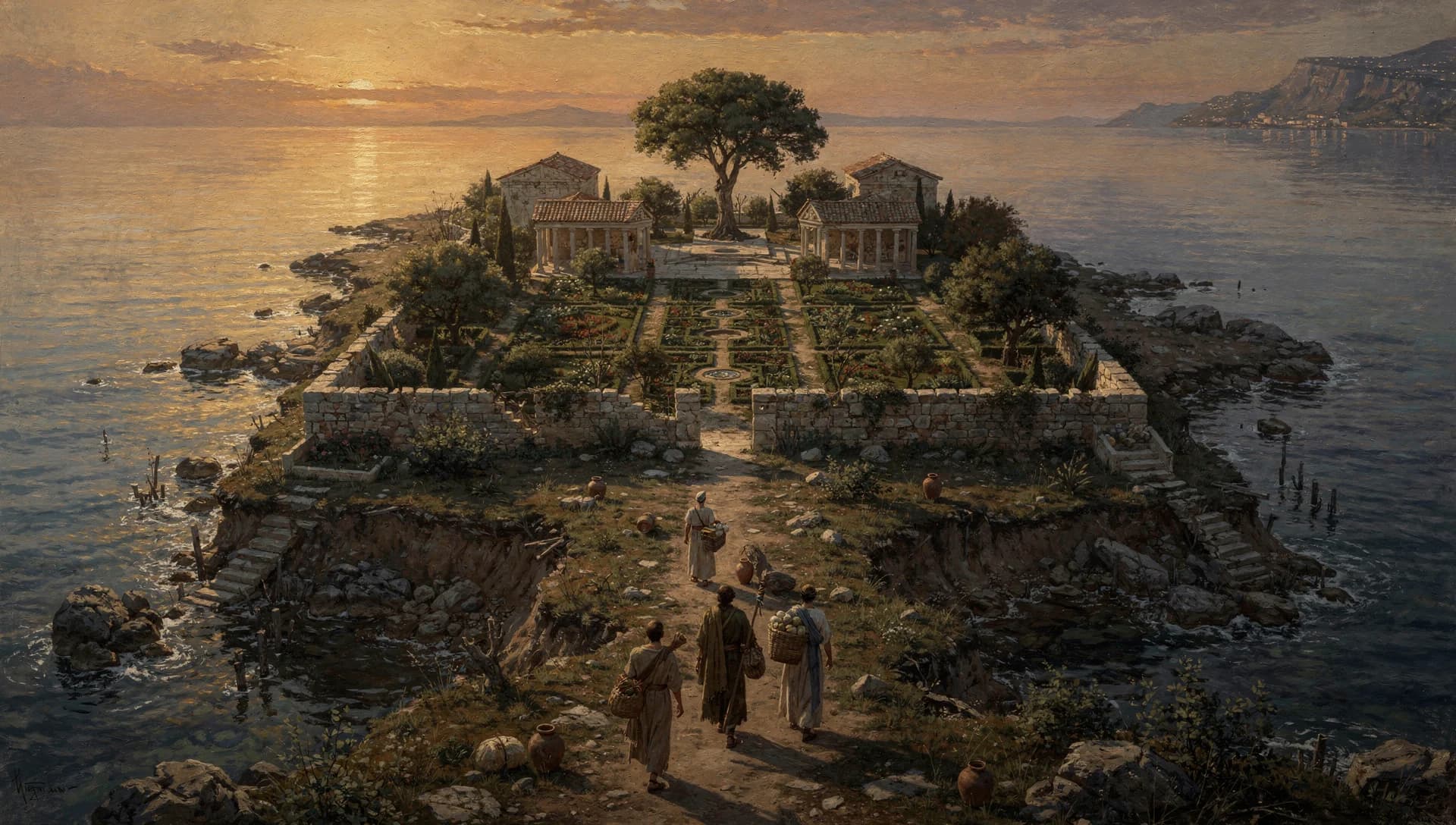
UBGarden of Eden, peninsula that sank into the eastern Mediterranean
Full Article
Read the deep-dive article on this connection
Garden of Eden, peninsula that sank into the eastern Mediterranean = Atlantis / Dilmun, a paradise civilization lost beneath the sea
The Connection
The UB describes Eden as "a long narrow peninsula, almost an island, projecting westward from the eastern shores of the Mediterranean Sea." It sank approximately 34,000 years ago due to volcanic activity. "The first Eden lies submerged under the eastern end of the Mediterranean Sea." Plato's Atlantis, the Sumerian Dilmun, and other sunken-paradise traditions may preserve cultural memory of this literal submergence.
UB Citation
UB 73:3.1, 73:7.1, 78:7.7
Academic Source
Plato, Timaeus and Critias; Kramer, "Dilmun: Quest for Paradise" (1944)
Historical Evidence(Moderate evidence)
Plato's Atlantis (Timaeus, c. 360 BCE) describes an advanced island civilization that sank "in a single day and night." While most scholars treat Atlantis as allegory, the motif of a paradise-island that sinks appears independently in Sumerian (Dilmun), Egyptian, Celtic (Hy-Brasil), and Hindu (Dwarka) traditions. The UB provides a literal candidate: a Mediterranean peninsula with advanced culture that actually sank due to tectonic activity. Robert Ballard's Black Sea research (National Geographic, 2000) has confirmed catastrophic ancient submergence events in the region. The cultural memory of "paradise lost beneath the waves" may encode multiple real events, with Eden's sinking being the oldest.
Deep Dive
Plato wrote his account of Atlantis in two dialogues, the Timaeus and the unfinished Critias, around 360 BCE. The story is presented as historical: a great island civilization in the western ocean, advanced in arts and sciences, that fought a war against ancient Athens and was destroyed in a single day and night by violent earthquakes and floods, sinking beneath the sea. Plato attributes the account to the lawgiver Solon, who supposedly heard it from Egyptian priests at Sais who told him that Greek cultural memory had forgotten what Egyptian records preserved. The Atlantis story has provoked twenty-five centuries of speculation, scholarship, and pseudoscholarship. Most academic classicists treat it as a Platonic invention, an allegorical or didactic fiction designed to illustrate political-philosophical points. A minority position has always held that some historical core lies behind the dialogue.
The Sumerian Dilmun tradition is independent of Plato. Dilmun appears in cuneiform texts going back to the Early Dynastic period (c. 2900-2350 BCE) as a paradisiacal land, sometimes identified with the modern Bahrain region but described in mythological texts (especially Enki and Ninhursag) as a place of perpetual peace, agricultural abundance, and immortality. The Sumerian Dilmun is a paradise that is both real (a real trading partner) and mythological (the dwelling of the immortals, the place where the flood survivor Ziusudra was settled). Samuel Noah Kramer's classic article "Dilmun: Quest for Paradise" (1944) explored the layered character of the tradition.
Other paradise-island traditions appear independently. The Celtic Hy-Brasil, off the western coast of Ireland, was reportedly visible only on certain days. The Hindu Dwarka, the city of Krishna, was said to have sunk into the sea. The Greek tradition of the Hesperides, the Isles of the Blessed, the Elysian Fields, and various other paradisiacal lost lands. The Polynesian Hawaiki. The cultural pattern of a paradise-island lost beneath the sea is widely distributed.
The Urantia Book provides what may be the original referent behind multiple of these traditions. Paper 73:3.1 records the committee report on possible Edenic locations: "The committee on location was absent for almost three years. It reported favorably concerning three possible locations: The first was an island in the Persian Gulf; the second, the river location subsequently occupied as the second garden; the third, a long narrow peninsula, almost an island, projecting westward from the eastern shores of the Mediterranean Sea." Paper 73:3.2 records the choice of the third site: the Mediterranean peninsula. Paper 73:7.1 records the eventual fate of this site: "After the first garden was vacated by Adam, it was occupied variously by the Nodites, Cutites, and the Suntites. It later became the dwelling place of the northern Nodites who opposed co-operation with the Adamites. The peninsula had been overrun by these lower-grade Nodites for almost four thousand years after Adam left the Garden when, in connection with the violent activity of the surrounding volcanoes and the submergence of the Sicilian land bridge to Africa, the eastern floor of the Mediterranean Sea sank, carrying down beneath the waters the whole of the Edenic peninsula. Concomitant with this vast submergence the coast line of the eastern Mediterranean was greatly elevated. And this was the end of the most beautiful natural creation that Urantia has ever harbored. The sinking was not sudden, several hundred years being required completely to submerge the entire peninsula."
Paper 78:7.7 confirms the location: "But still older vestiges of the days of Dalamatia exist under the waters of the Persian Gulf, and the first Eden lies submerged under the eastern end of the Mediterranean Sea."
So the UB account places a real ancient civilization on a Mediterranean peninsula that really did sink due to tectonic activity. The submergence took several hundred years rather than a single day, but the end result was the disappearance of the peninsula beneath the eastern Mediterranean. Cultural memory of this event, propagating through the post-Edenic populations across thousands of years, would naturally combine with memories of other regional submergences (the Sicilian land bridge mentioned in the UB account, the various Mediterranean and Black Sea inundations documented archaeologically) to produce the layered mythological tradition we have.
Plato's Atlantis fits the UB account at multiple points. The location, in the Mediterranean and adjacent regions, is plausible if the original referent was the Edenic peninsula and the cultural memory was filtered through Egyptian priestly tradition. The character of the lost civilization (advanced in arts and sciences, possessing sophisticated culture and technology) fits the Edenic high-civilization phase. The mode of destruction (volcanic and seismic activity, submergence) matches the UB account. The chronological depth (Plato says nine thousand years before Solon, putting the sinking around 9600 BCE in calendar terms) is too recent for the UB Edenic dating (around 36,000 BCE for the original sinking) but the order-of-magnitude error is the kind of thing one would expect from cultural memory propagating across thirty thousand years through multiple priestly hands.
Robert Ballard's underwater archaeology in the Black Sea, beginning in 1999, documented at least one significant ancient flooding event in the broader region. Ryan and Pitman's 1998 Black Sea hypothesis (popularized in their book Noah's Flood) proposed a catastrophic Mediterranean breach into the Black Sea around 5600 BCE that submerged inhabited coastlines. Whether or not the specific Black Sea event is the one underlying any particular tradition, the broader pattern of catastrophic Mediterranean and adjacent submergences across the late Pleistocene and Holocene is well documented, and the UB's specific claim about a Mediterranean peninsula sinking due to tectonic activity over several hundred years fits comfortably into this archaeological picture.
The Sumerian Dilmun tradition fits as a separate strand of the same broader cultural memory. The Persian Gulf island candidate, mentioned by the UB committee and rejected in favor of the Mediterranean peninsula, may have been the original Dilmun in Sumerian cultural memory. Paper 78:7.7's reference to "still older vestiges of the days of Dalamatia exist under the waters of the Persian Gulf" suggests that there really was a submerged ancient site in the Persian Gulf preserving cultural memory from the Dalamatian era, and that Sumerian Dilmun preserves that memory. So Dilmun and Eden, in the UB account, refer to two different submerged ancient sites, each preserving a different layer of cultural memory.
The strongest counterargument is the academic-classicist position that Plato's Atlantis is straightforwardly a literary invention with no historical referent, and that the UB's identification with a real submerged Mediterranean peninsula is uncritical reception of Platonic fiction. The reply is that Plato's specificity (the location, the mode of destruction, the character of the civilization) is more detailed than the literary-invention reading easily explains. Plato had no obvious reason to invent the Atlantis story with the level of geographic and chronological detail he provides; the literary-invention reading has to treat the details as decorative rather than substantive. The UB's account provides a parsimonious historical referent that fits Plato's details and that is independently consistent with the broader pattern of Mediterranean catastrophic submergence the archaeology documents.
What the parallel implies is that one of the most contested traditions in classical scholarship has a real historical referent, and that the cultural memory of multiple submerged ancient sites (the Edenic peninsula in the eastern Mediterranean, an older site in the Persian Gulf, possibly other regional submergences) was synthesized by Egyptian priestly tradition into the Atlantis story Plato received. The decoder's job is to recover the historical referents and to clear the mythological superstructure from the actual events.
Key Quotes
“The committee on location was absent for almost three years. It reported favorably concerning three possible locations: The first was an island in the Persian Gulf; the second, the river location subsequently occupied as the second garden; the third, a long narrow peninsula, almost an island, projecting westward from the eastern shores of the Mediterranean Sea.”
“The peninsula had been overrun by these lower-grade Nodites for almost four thousand years after Adam left the Garden when, in connection with the violent activity of the surrounding volcanoes and the submergence of the Sicilian land bridge to Africa, the eastern floor of the Mediterranean Sea sank, carrying down beneath the waters the whole of the Edenic peninsula.”
“But still older vestiges of the days of Dalamatia exist under the waters of the Persian Gulf, and the first Eden lies submerged under the eastern end of the Mediterranean Sea.”
Cultural Impact
The Atlantis tradition has produced one of the most enduring cultural fascinations in Western imagination. From Plato's dialogues through Renaissance speculations (Francis Bacon's New Atlantis, 1626), through nineteenth-century theosophical and occult traditions (Madame Blavatsky's Secret Doctrine), through Edgar Cayce's twentieth-century readings, through endless modern documentaries, films, and popular books, Atlantis has been one of the most repurposed symbols in Western culture. The pseudoscientific Atlantis tradition (Ignatius Donnelly's Atlantis: The Antediluvian World, 1882) launched a long stream of speculative geography that continues today. Modern fantasy literature and gaming (Atlantis as a setting in dozens of franchises from Tolkien's Numenor to Disney's Atlantis: The Lost Empire) draw on the same mythic substrate. The cultural appetite for a lost advanced civilization beneath the sea has been remarkably durable. The UB account preserves what is real in the tradition (a real submerged peninsula, a real Adamic civilization) while clearing the mythological accretions (no extraterrestrial visitors, no advanced technology beyond the high civilization the UB independently describes, no apocalyptic geographic claims about America or Antarctica). The decoder's job is to honor what is real in the tradition while marking the layers of mythological elaboration.
Modern Resonance
Contemporary popular culture continues to engage Atlantis enthusiastically. Television documentaries, fiction series, video games, and popular pseudoscience books continue to generate new variations. Most academic classicists continue to treat Atlantis as Platonic fiction. The UB account offers a sober middle position: a real submerged ancient civilization, geographically locatable in the eastern Mediterranean, sunk through documented geological processes, preserved in cultural memory across many millennia in increasingly elaborated form. For contemporary readers attracted to the Atlantis tradition but wary of pseudoscientific elaborations, the UB framework restores a parsimonious historical core. The first Eden is not a metaphor or an extraterrestrial colony or a lost technological civilization in any sense modern science fiction would recognize; it was a real Adamic settlement on a real Mediterranean peninsula, real enough to sink and real enough to leave cultural memory of its sinking in the cultural deposits of the surrounding civilizations. The decoder's job is to point at the actual referent.
Related Mappings
Serapatatia, well-meaning Nodite leader
= The Serpent in the Garden of Eden
Eve's mating with Cano the Nodite
= "Eating the Forbidden Fruit" / Original Sin
Cain receiving a Thought Adjuster
= The "Mark of Cain," divine protection
Three Noahs: Historical, Regional, and Literary
= Biblical Noah, composite figure
Related Articles
Where to next
The free newsletter. The research behind each piece, no spam.