
The Thunderbird Was Real: Fandors and the Indigenous American Giant Bird Tradition
Indigenous American traditions from the Pacific Northwest to the Great Plains preserve a remarkably consistent image: a giant bird whose wings generate thunder, whose eyes flash lightning, and who is large enough to carry off whales and bison. The Urantia Book identifies the species the tradition remembers: the fandor, a giant passenger bird the Dalamatian staff trained for human use, extinct roughly thirty thousand years ago.
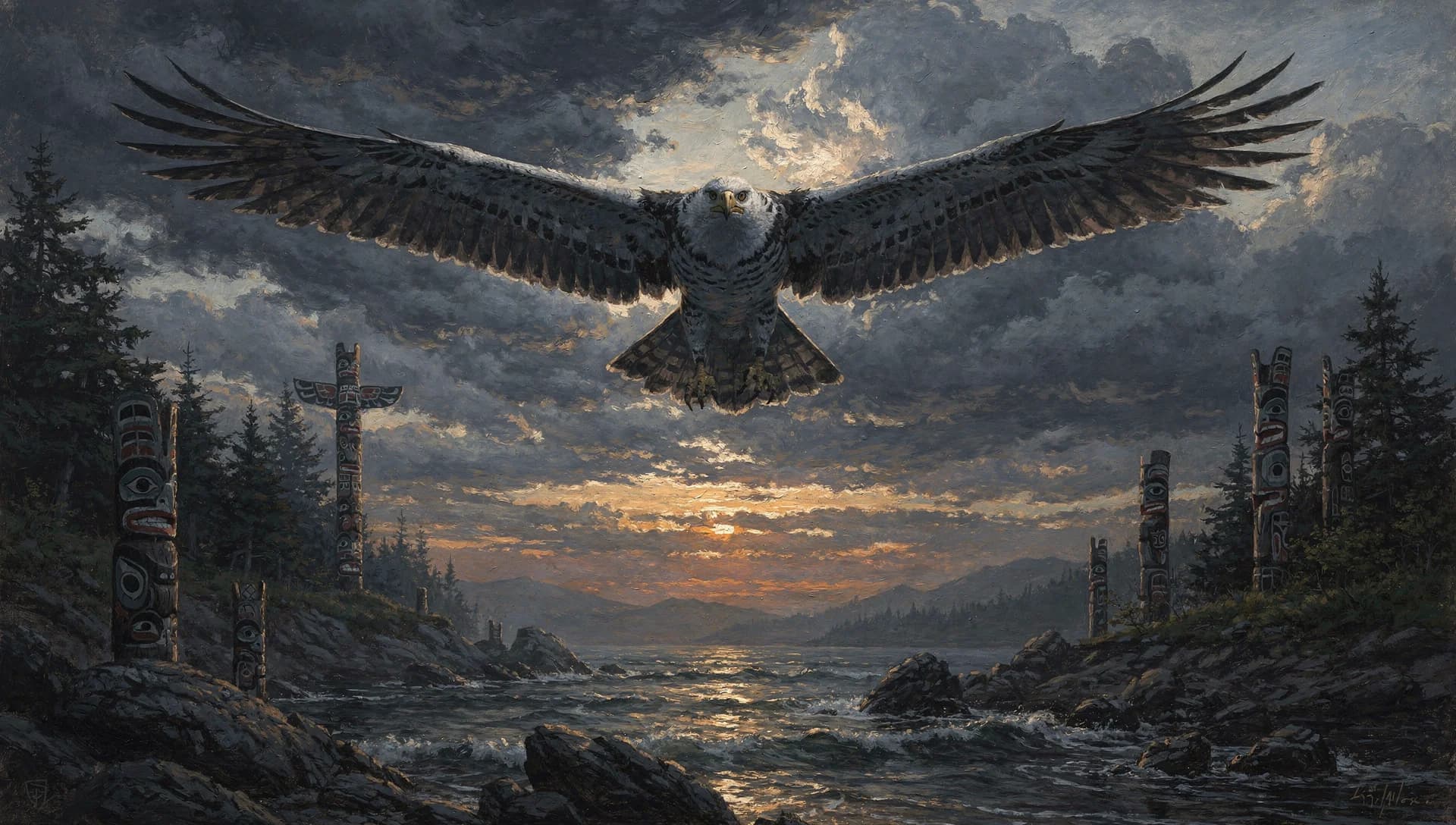
Fandors, giant passenger birds (last died ~30,000 years ago) = Thunderbird, giant supernatural bird
This article expands on the decoder mapping. For the side-by-side card and quick reference, see the mapping page.
The Consistent Image Across an Entire Continent
The Thunderbird tradition is pan-Indigenous in North America, attested from the Pacific Northwest (Haida, Tlingit, Kwakwaka'wakw) through the Great Plains (Lakota, Anishinaabe, Ojibwe) to the Southeast (Cherokee, Creek). The image is remarkably consistent across the cultural range: an enormous bird, large enough to carry off substantial prey (whales in the Northwest tradition, bison in the Plains tradition), associated with storm phenomena (thunder as the beating of its wings, lightning as the flashing of its eyes), often depicted as the sky's counterpart to the underworld-serpent.
The scholarly question of why this image recurs across the continent with such consistency has been a recurring topic in comparative Indigenous religious studies. Most local traditions have locally adapted animal totems; the Thunderbird's pan-continental consistency is unusual. The Urantia Book identifies the specific species the tradition preserves.
What the Urantia Book Says
The fandor species is described in Paper 66:
"It was in these days that carrier pigeons were first used, being taken on long journeys for the purpose of sending messages or calls for help. Bon's group were successful in training the great fandors as passenger birds, but they became extinct more than thirty thousand years ago." (UB 66:5.6)
The fandors were real historical animals. They were trained by the Caligastia staff's animal-domestication council (led by Bon, whose role is treated in the companion Sumerian-staff articles). They served as aerial carriers for messages and, later, as passenger transport for individuals. The species went extinct approximately thirty thousand years ago, within the range of human oral-tradition memory.
The fandors' use by Adam and Eve at the Garden reception is attested (UB 74:3.4). The scale of the fandor species is not quantified precisely but the Sumerian parallel iconographic tradition (Anzu bird, Imdugud Relief) preserves the image of a bird of sufficient scale to carry off large animals, which is the scale the Indigenous American Thunderbird tradition also preserves.
The distribution of fandor memory across world traditions is a feature of the Urantia account. The Mesopotamian Anzu preserves the wild-fierce aspect (treated in the companion Fandor-Anzu decoder article). The Hindu Garuda preserves the trained-mount aspect (treated in the companion Adamson-Fandor-Garuda article). The Indigenous American Thunderbird preserves the storm-associated aspect.
The red race's arrival in North America was approximately eighty-five thousand years ago (UB 64:6.5). At that time fandors were still living, though the species was already in decline (they would go extinct some fifty thousand years after the red race reached North America). The red race's memory of fandors in the Asian homeland, combined with possible direct observation of surviving North American fandor populations, would have produced the preserved Thunderbird tradition.
What the Ancient Sources Say
The Thunderbird tradition is attested across essentially the full continental range of North American Indigenous cultures. Franz Boas's Kwakiutl Tales (Columbia University, 1910) and Tsimshian Mythology (Bureau of American Ethnology, 1916) document the Pacific Northwest preservation. Christopher Vecsey's Imagine Ourselves Richly (Harper & Row, 1988) treats the pan-continental distribution.
The consistent structural features include: a giant bird, supernaturally associated with storms, capable of carrying off large animals, typically the counterpart to a water-serpent or underworld-creature adversary, serving as a messenger or intermediary between the sky world and humanity. The local elaborations differ (Pacific Northwest Thunderbirds hunt whales; Plains Thunderbirds carry off bison; Southeast Thunderbirds are associated with lightning-producing storm deities) but the underlying template is consistent.
The size claim is especially interesting. Indigenous oral traditions consistently describe the Thunderbird as larger than any living North American bird. This is not a modest exaggeration; it is a persistent claim of scale exceeding any extant species. The largest known North American raptor is the bald eagle (wingspan approximately 2 meters). The Thunderbird descriptions suggest wingspans of 3-6 meters or more.
The paleontological record contains evidence consistent with this. Teratornis merriami and related teratorn species (larger relatives of modern vultures and condors) had wingspans of up to 4 meters and persisted in North America until approximately 10,000 years ago, coinciding with the end of the Pleistocene and early human presence on the continent. Paul S. Martin's work on Pleistocene megafauna (Twilight of the Mammoths: Ice Age Extinctions and the Rewilding of America, University of California Press, 2005) documents the overlap of human populations with teratorn species. The Haast's Eagle of New Zealand (Hieraaetus moorei, wingspan up to 3 meters, extinct circa 1400 CE) is another example of a genuinely giant raptor that persisted into the range of human memory.
The Urantia Book's fandor is distinct from these paleontological species; it is a trained domesticated giant bird, introduced by the Dalamatian staff. But the paleontological record establishes that giant birds did persist into human-observation range, that North American Indigenous populations would have encountered such birds directly, and that the Thunderbird tradition is not merely a mythological invention but a cultural memory of actually observed species.
Whether the Thunderbird tradition preserves memory of fandors specifically (as the Urantia account implies) or of teratorns (as the paleontological record supports) or of some combination of both is not narrowly decidable. What is clear is that the pan-continental Thunderbird distribution preserves memory of real giant birds within the range of Indigenous American oral tradition.
Why This Mapping Matters
The Thunderbird tradition is one of the best-preserved cases of cross-cultural religious-mythological continuity within the Indigenous American world. The consistency of the image across the continent is especially useful for studying how oral tradition preserves zoological and historical memory across tens of thousands of years.
The Urantia Book's contribution is to identify the species the tradition preserves. The fandor, as a trained domesticated giant bird species deliberately propagated by the Dalamatia staff, would have been distributed across the Pleistocene Old World. Some fandor population fragments likely persisted after the Dalamatian administrative collapse, and the red race would have encountered them both in the Asian homeland before the migration and possibly in post-migration North America. The Thunderbird tradition preserves this encounter.
The companion Fandor-Anzu (Sumerian) and Adamson-Fandor-Garuda (Hindu) decoder articles establish that the fandor memory was pan-Eurasian. The Thunderbird mapping extends the pattern to the Americas. The pan-continental distribution of giant-bird traditions (Anzu, Garuda, Thunderbird, and possibly others including Simurgh, Huma, and various African giant-bird traditions) is consistent with a single real species whose memory was preserved by multiple independent cultural traditions after its extinction.
The mapping does not require that the Thunderbird be exclusively the fandor. The paleontological record confirms that other giant bird species (teratorns, Haast's Eagle ancestors) persisted into Indigenous American observation range. The Thunderbird may be a composite preservation combining fandor memory with direct teratorn observation. What the mapping claims is that the scale, the storm association, and the role as mount or carrier of the Thunderbird image trace back to the fandor tradition the Urantia Book records.
Sources
- The Urantia Book, Paper 64 (The Evolutionary Races of Color), Paper 66 (The Planetary Prince's Staff), Paper 74 (The Garden of Eden). Urantia Foundation, first printing 1955. Cited passages: 64:6.5, 66:5.6, 74:3.4.
- Boas, Franz. Kwakiutl Tales. Columbia University Press, 1910.
- Boas, Franz. Tsimshian Mythology. Bureau of American Ethnology, Bulletin 31, 1916.
- Vecsey, Christopher. Imagine Ourselves Richly: Mythic Narratives of North American Indians. Harper & Row, 1988.
- Hultkrantz, Åke. The Religions of the American Indians. University of California Press, 1979.
- Martin, Paul S. Twilight of the Mammoths: Ice Age Extinctions and the Rewilding of America. University of California Press, 2005.
- Worthy, Trevor H. and Richard N. Holdaway. The Lost World of the Moa: Prehistoric Life of New Zealand. Indiana University Press, 2002.
- Campbell, Kenneth E. and Eduardo P. Tonni. "Size and Locomotion in Teratorns," The Auk 100 (1983), pp. 390-403.
Confidence and Evidence
- Confidence: INFORMED SPECULATION
- Evidence rating: STRONG
- Basis: The pan-Indigenous Thunderbird tradition preserves features (giant scale, storm association, carrier/mount function) that match the Urantia fandor description. The paleontological record confirms that giant birds persisted into Indigenous American observation range. The Urantia account supplies a historical species whose distribution and timing is consistent with the tradition's features.
Related Decoder Articles
- Fandor, Giant Passenger Bird = Anzu / Zu Bird
- Adamson Riding Fandor = Krishna / Vishnu Riding Garuda
- Onamonalonton = The Great Spirit Tradition
By Derek Samaras
Connecting Articles
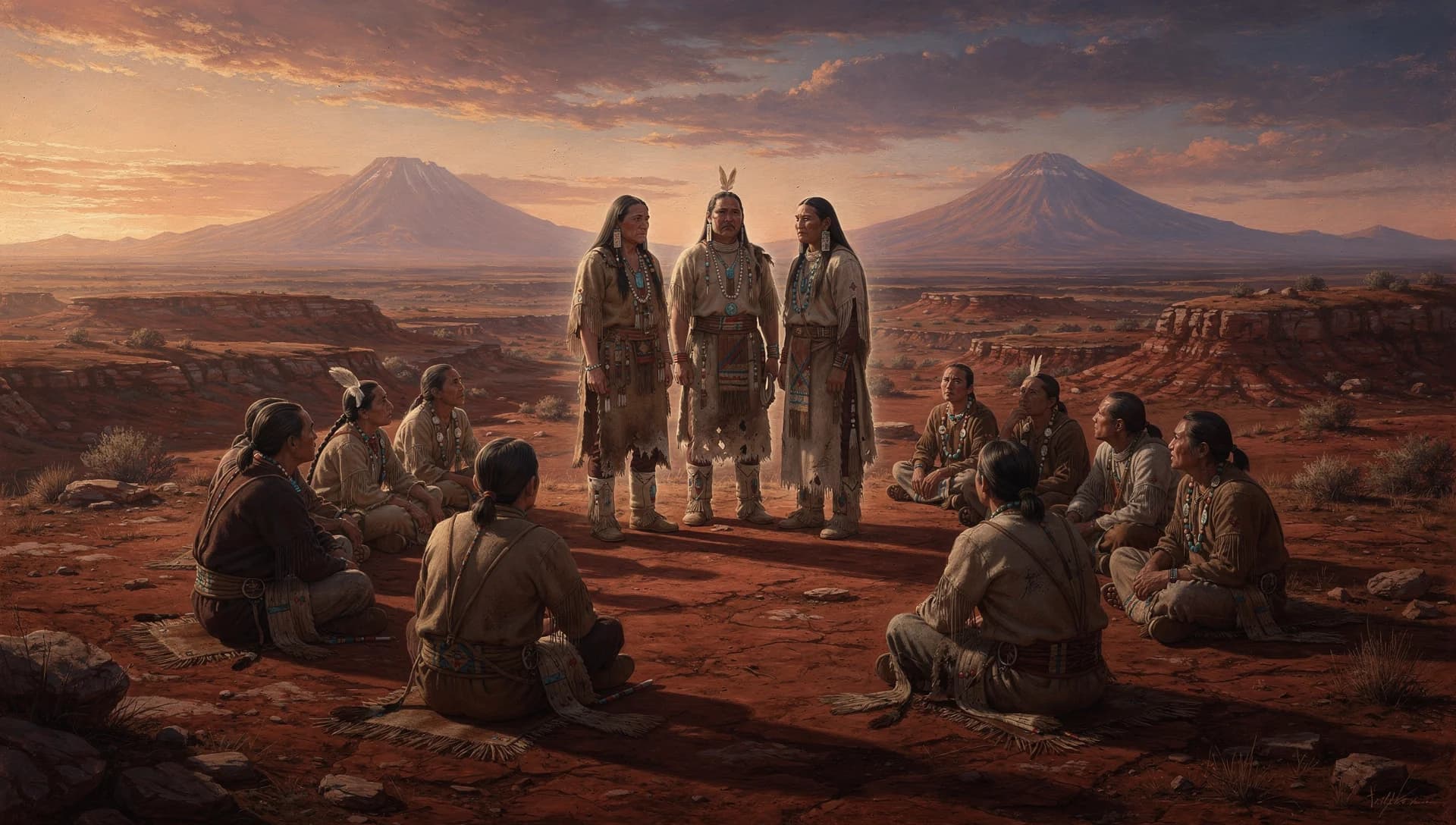
The Ones Who Came First: The Dalamatian Staff and the Navajo Holy People
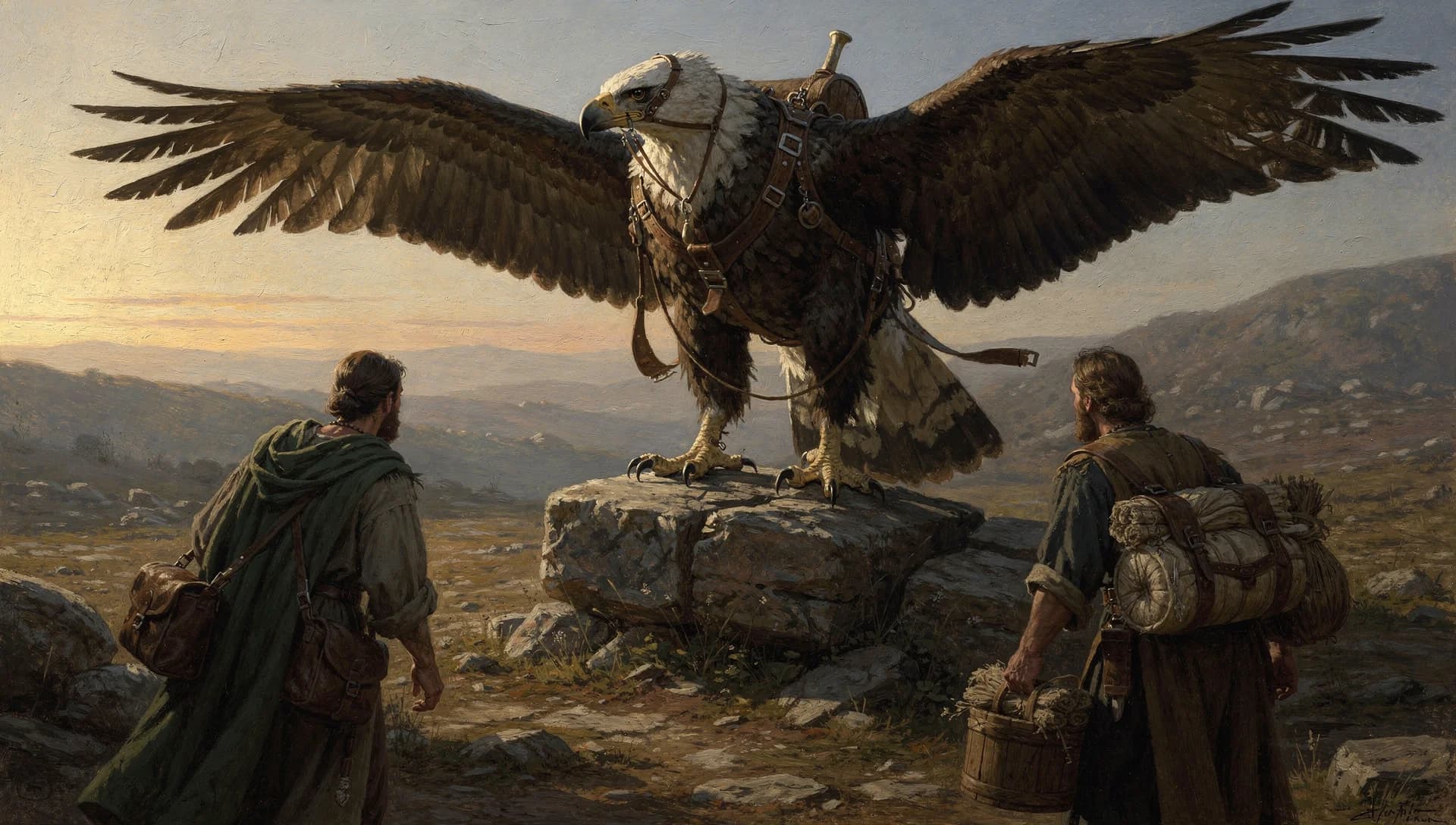
The Bird That Carried the Bull: Fandors and the Mesopotamian Anzu
Two Dilmuns, Not One: Bahrain, the Nodite Headquarters, and the Confused Sumerian Paradise
The Giant Bird That Carried Men: Pouakai, Te Hokioi, and the Fandor Memory in New Zealand
The Newsletter
Get the research behind each piece
Free. New Urantia Book explorations, the sources behind the videos, and early looks. No spam, unsubscribe anytime.
Prefer video? Follow on YouTube and Facebook.
Delivered through Substack. You can also read past issues.