
By Easy Stages Across the Pacific: Polynesian Voyaging Ancestors and the Andite Sailor Tradition
Polynesian oral tradition preserves the memory of voyaging ancestors who arrived from the west in great canoes, taught navigation, fishing, and agriculture, and left lasting lineages. The Urantia Book documents Andite sailors crossing the Pacific 'by easy stages, tarrying on the many islands' that were then 'more numerous and larger than now'. The match between the sailor-teachers the Urantia Book describes and the voyaging ancestors of Polynesian tradition is one of the most direct euhemerist candidates in Pacific mythology.
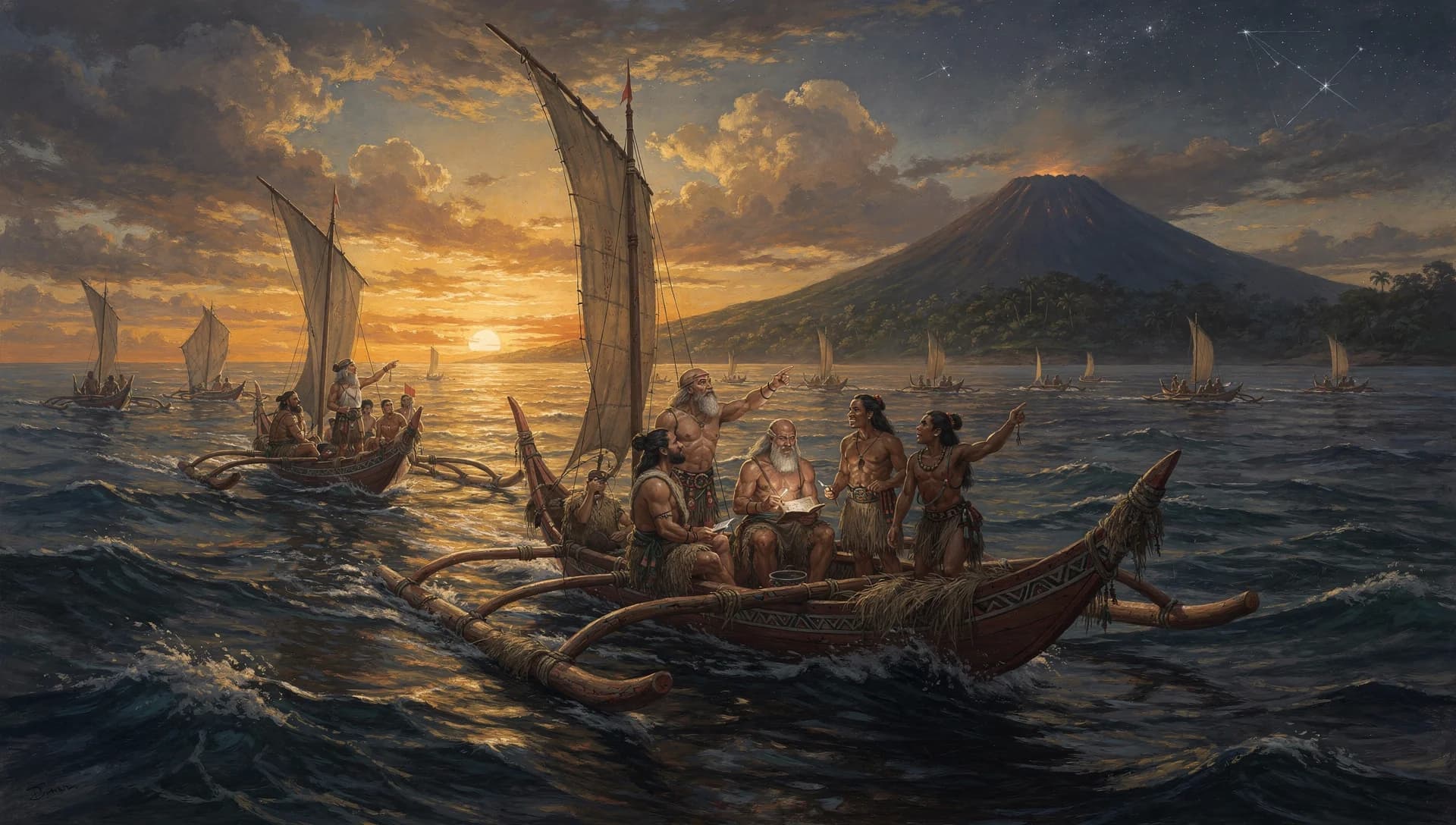
Andite Pacific sailor-teachers = Polynesian voyaging ancestor-heroes
This article expands on the decoder mapping. For the side-by-side card and quick reference, see the mapping page.
The Pacific Voyaging Tradition
Polynesian oral tradition runs from Hawai'i through New Zealand to Rapa Nui, and the same memory surfaces wherever you look. Voyaging ancestors arrived from the west in great canoes. The names and details vary. Hawaiian tradition centers on the Hawaiki homeland and the voyaging chief Hawai'iloa. Maori tradition remembers the Great Fleet, with named canoes such as Arawa, Tainui, and Te Arawa. Rapa Nui preserves Hotu Matu'a as the founding ancestor from a western homeland.
The shared frame is consistent. Arrival from a western or northwestern homeland. Skilled use of voyaging canoes. Navigation taught to the people on landing. Knowledge of farming and fishing brought from elsewhere. Royal and priestly lineages that trace back to the voyagers themselves.
The Urantia Book documents the historical substrate underneath all of this.
What the Urantia Book Says
The Urantia Book's account of the 132 Andite sailors and their Pacific crossing is unusually detailed.
"One hundred and thirty-two of this race, embarking in a fleet of small boats from Japan, eventually reached South America and by intermarriage with the natives of the Andes established the ancestry of the later rulers of the Incas." (UB 78:5.7)
The Pacific crossing itself is given in a single dense sentence:
"They crossed the Pacific by easy stages, tarrying on the many islands they found along the way. The islands of the Polynesian group were both more numerous and larger then than now, and these Andite sailors, together with some who followed them, biologically modified the native groups in transit." (UB 78:5.7, adapted)
The geographic detail matters. The Urantia Book says the Pacific islands were larger and more numerous in that era. This points to a period when sea levels stood lower, exposing land that has since gone under. Holocene sea-level rise of roughly one to two meters across the last several thousand years has reduced the island area available for the kind of stepping-stone crossing the text describes.
The phrase "biologically modified" indicates more than passage. The sailors married into the populations they met. That is the mechanism the Urantia Book identifies for the elevated cultural and biological substrate that the archaeological and genetic record of Pacific Oceania reflects.
What the Ancient Sources Say
The Polynesian voyaging-ancestor tradition is documented across the full ethnographic record of Pacific cultures. Martha Beckwith's Hawaiian Mythology (Yale University Press, 1940; reprinted University of Hawai'i Press, 1970) is the definitive synthesis of the Hawaiian voyaging-ancestor cycle. Beckwith records the Hawaiki homeland tradition, the named voyaging chiefs (Hawai'iloa, Mo'ikeha, Pa'ao), and the narrative content surrounding each.
Te Rangi Hīroa (Sir Peter Buck) covered the Maori side in The Coming of the Maori (Whitcombe and Tombs, 1949). He treats the Great Fleet, the named canoes, and the founding lineages that contemporary iwi still trace to the voyagers.
The archaeological reconstruction of Austronesian Pacific expansion has matured into a substantial literature. Patrick V. Kirch's On the Road of the Winds: An Archaeological History of the Pacific Islands before European Contact (University of California Press, 2000; revised 2017) is the standard synthesis. Kirch traces the Austronesian movement out of a Southeast Asian and Taiwanese homeland roughly 5,000 years ago, into the western Pacific by about 3,500 years ago, and on to Hawai'i, New Zealand, and Rapa Nui across the first millennium of the common era.
Ben Finney's voyaging research, written up in Voyage of Rediscovery: A Cultural Odyssey through Polynesia (University of California Press, 1994), established the technical reality of pre-modern Polynesian navigation. The Hōkūle'a project, launched in 1976, reconstructed a traditional double-hulled voyaging canoe and sailed it across the Pacific using only stars, waves, wind, and bird tracking. The Polynesian tradition turned out to preserve genuinely sophisticated navigational craft.
The question of where the voyaging tradition came from has played out across several decades. The mainstream model traces it to the Asian mainland through the Austronesian expansion. Thor Heyerdahl's Kon-Tiki expedition in 1947 proposed a South American origin. Later archaeological and genetic work overturned Heyerdahl's specific hypothesis, but it also confirmed some contact between Polynesia and South America. Sweet potato DNA and recent Rapa Nui to Ecuadorian genetic analysis both point that way. The bidirectional pattern fits the Urantia Book's route, which sends Andite sailors from Japan through Polynesia to South America rather than along either single-direction migration the older debate proposed.
The submerged-islands detail in the Urantia Book has archaeological correlates as well. Recent paleogeographic reconstruction of the Holocene Pacific, built from coral-reef dating, sediment cores, and sea-level modeling, shows that levels 6,000 to 8,000 years ago sat substantially below present, exposing more island land than exists today. The Oeno and Ducie banks in the Pitcairn group, the Robbie Bank, Rocas Alijos, and many other submerged atolls preserve a late-Holocene land pattern that has since gone under.
Geoffrey Irwin's The Prehistoric Exploration and Colonisation of the Pacific (Cambridge University Press, 1992) treats the navigation strategies behind the Austronesian expansion. Irwin describes an island-hopping or stepping-stone strategy in which the Pacific was opened up through serial use of intermediate stations. That matches the Urantia Book's "tarrying on the many islands they found along the way" closely. The greater number of islands available in the earlier Holocene period made the strategy more workable than the standard Austronesian model has typically assumed.
Why This Mapping Matters
The scholarly question of where Polynesian voyaging came from, and how capable it really was, has largely been settled in favor of indigenous Polynesian achievement. Hōkūle'a established the technical sophistication of the navigation. The archaeological record traces the peopling out of Southeast Asia. The genetic evidence confirms an Austronesian substrate, with limited secondary contact with both Southeast Asia and South America.
The Urantia Book's framework does not contradict any of this. The Andite Pacific crossing it describes is an earlier and smaller event than the Austronesian expansion that mainstream archaeology documents. The 132 Andite sailors represent an early cultural and biological input into the Pacific. The larger Austronesian wave came later and carried that inheritance forward.
The voyaging-ancestor tradition that Polynesian cultures preserve holds the memory of both events together. The early Andite input and the later Austronesian movement crystallized across millennia of oral tradition into one shared narrative shape. The western homeland of Hawaiki, in Maori and Hawaiian tradition, lines up geographically with the Southeast Asian, Taiwanese, and western-Pacific homeland that both the Urantia Book's Andite route through Japan and the mainstream model identify.
The cultural content of the voyaging tradition matches what the Andite sailors would have carried. Navigation. Agriculture. Fishing. Royal and priestly lineage. The Urantia Book describes the Andites as carrying elevated navigational knowledge, advanced farming techniques from the violet race, and the institutional shape of Adamic lineage. The Polynesian preservation of exactly these elements in the voyaging-ancestor tradition reflects the substrate the Urantia Book attributes to those sailors.
The biological-modification detail has population-genetic correlates. Polynesian populations show intermediate features between Asian-mainland and Melanesian populations, with evidence of multiple admixture events across the Pacific peopling. That fits the Urantia Book's account of sailors marrying into native groups in transit and contributing Adamic and Andite biological content to the populations the later expansion absorbed.
The mapping's significance is this. The Polynesian voyaging tradition should not be read as folkloric memory of ordinary migration. It is preserved cultural memory of an actual sailor-teacher input, exactly as the Urantia Book describes. The fact that the same content survives across the widely separated Polynesian archipelagos points to a shared pre-dispersal substrate. The Andite influence carried through the later Austronesian expansion and crystallized into the voyaging-ancestor tradition that the ethnographic record documents today.
Sources
- The Urantia Book, Paper 78 (The Violet Race After the Days of Adam). Urantia Foundation, first printing 1955. Cited passage: 78:5.7.
- Beckwith, Martha. Hawaiian Mythology. Yale University Press, 1940; reprinted University of Hawai'i Press, 1970.
- Buck, Peter (Te Rangi Hīroa). The Coming of the Maori. Whitcombe and Tombs, 1949.
- Kirch, Patrick V. On the Road of the Winds: An Archaeological History of the Pacific Islands before European Contact. University of California Press, 2000; revised 2017.
- Finney, Ben. Voyage of Rediscovery: A Cultural Odyssey through Polynesia. University of California Press, 1994.
- Irwin, Geoffrey. The Prehistoric Exploration and Colonisation of the Pacific. Cambridge University Press, 1992.
- Craig, Robert D. Handbook of Polynesian Mythology. ABC-CLIO, 2004.
- Howe, K. R. (editor). Vaka Moana: Voyages of the Ancestors. University of Hawai'i Press, 2007.
Confidence and Evidence
- Confidence: UB CONFIRMED
- Evidence rating: STRONG
- Basis: The Urantia Book directly documents the 132 Andite sailor Pacific crossing at UB 78:5.7, with detail about the route, the island-stepping strategy, and the biological modification of native groups. Polynesian voyaging-ancestor tradition preserves the memory of sailor-teacher ancestors arriving from the west. The mainstream Austronesian-expansion record is consistent with the Urantia Book's account once the Andite input is read as preceding the larger expansion. The submerged-islands detail matches late-Holocene paleogeographic evidence.
Related Decoder Articles
- The 132 Andite Sailors = Quetzalcoatl
- Maui = Pan-Polynesian Culture-Hero
- Io Maori = Salem High-God Hidden Tradition
Byline: Derek Samaras | Urantia Book Network | April 2026
Connecting Articles
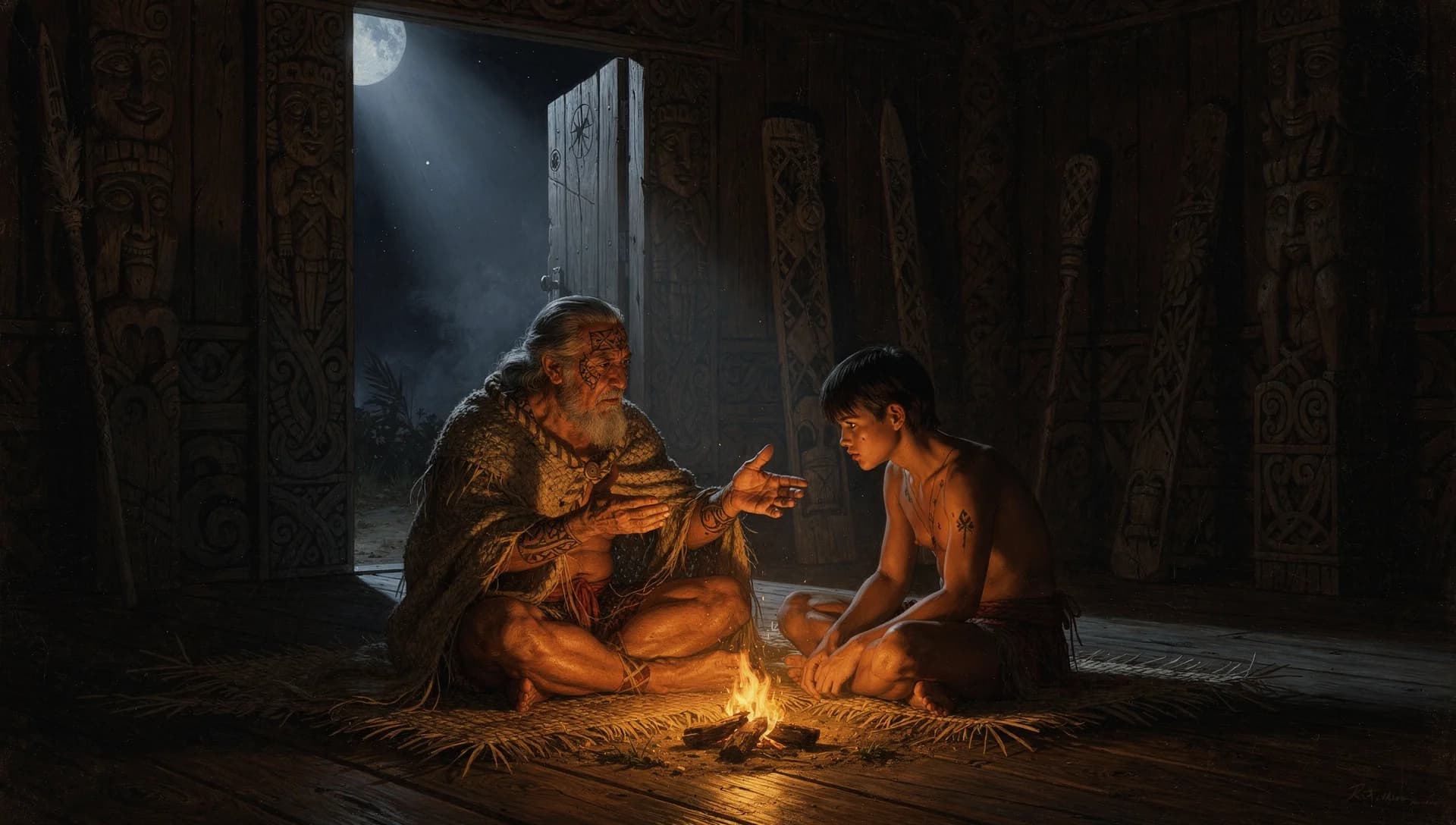
Io the Parentless: The Maori Supreme Being and the Hidden Salem Layer in Polynesian Religion
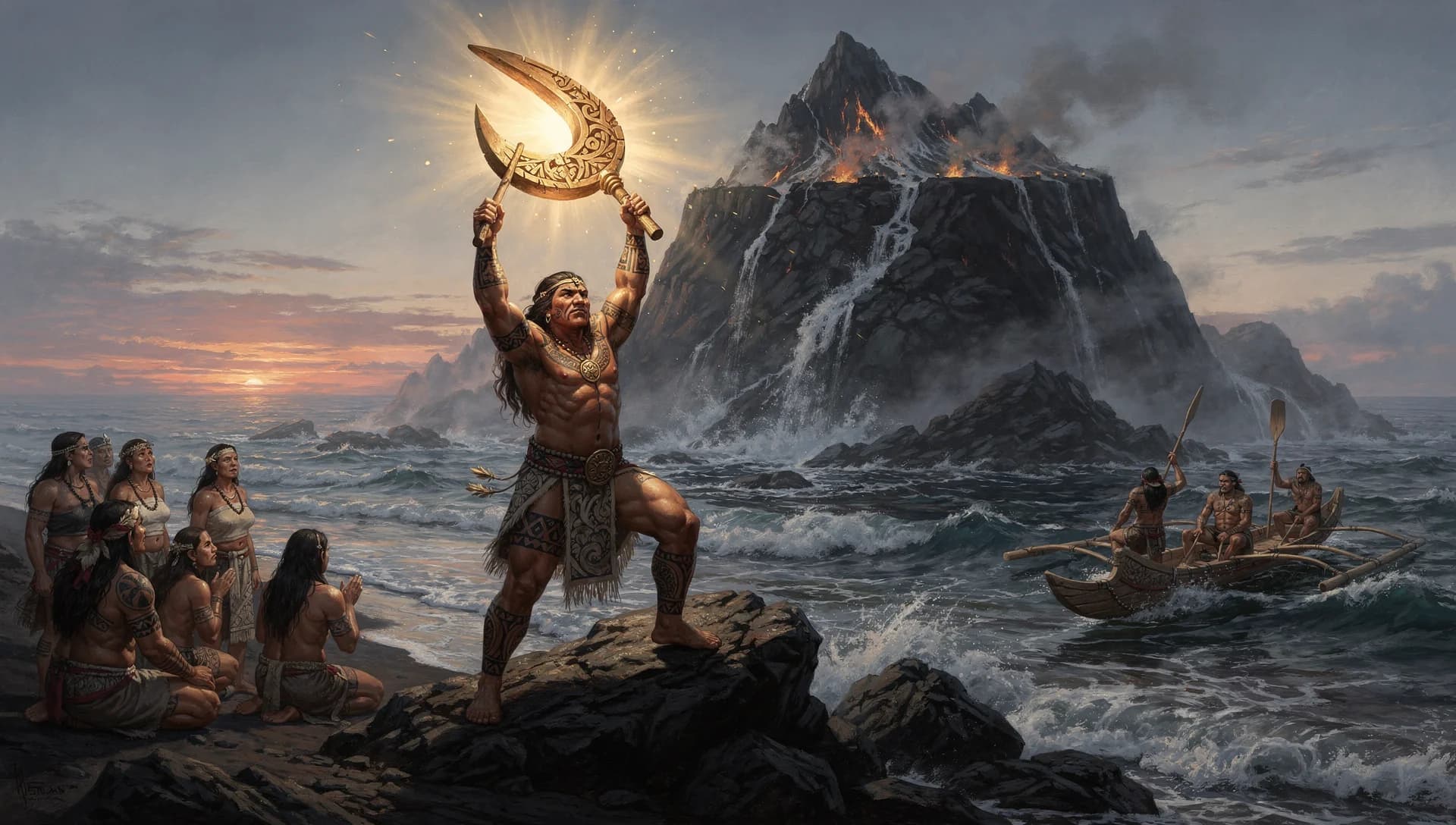
The Demigod Who Fished Up Islands: Maui and the Andite Culture-Hero Memory
The Longest Memory: Australian Aboriginal Dreamtime and the Primordial Teaching-Ancestors
The Final Adjudication: Ragnarok and the Pending Verdict
The Newsletter
Get the research behind each piece
Free. New Urantia Book explorations, the sources behind the videos, and early looks. No spam, unsubscribe anytime.
Prefer video? Follow on YouTube and Facebook.
Delivered through Substack. You can also read past issues.