
The Demigod Who Fished Up Islands: Maui and the Andite Culture-Hero Memory
Maui appears across nearly every Polynesian tradition, Hawaiian, Maori, Tahitian, Tongan, Samoan, as a demigod hero who lifts islands from the sea, lassoes the sun to slow its passage, steals fire for humanity, and establishes the arts of navigation and agriculture. The Urantia Book documents 132 Andite sailors carrying advanced navigational, agricultural, and metallurgical knowledge across the Pacific. Maui preserves the memory of these culture-bringing superhuman teachers.
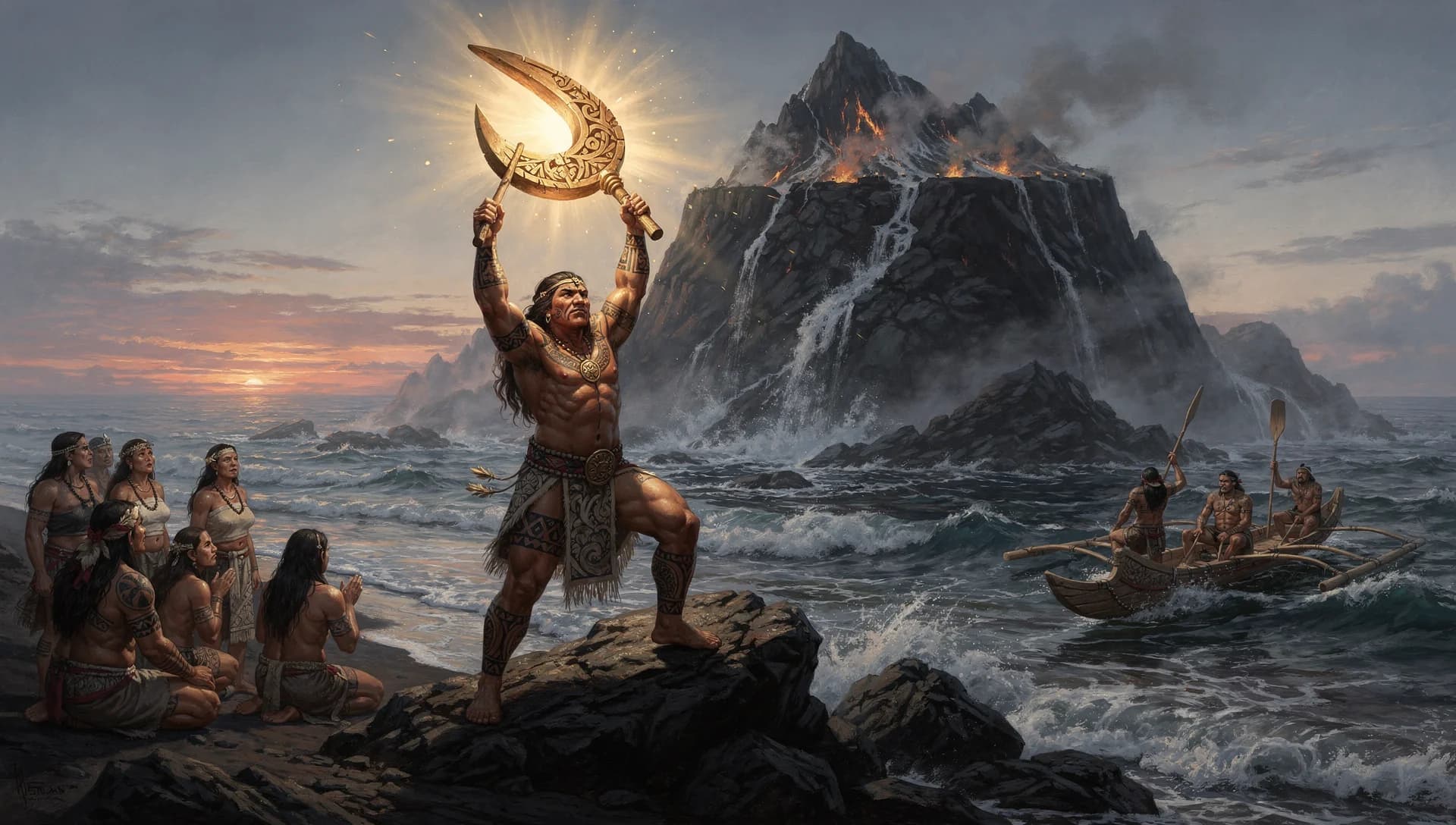
Andite sailor culture-bringer memory = Maui, Pan-Polynesian demigod who fishes up islands and establishes human arts
This article expands on the decoder mapping. For the side-by-side card and quick reference, see the mapping page.
The Pan-Polynesian Maui
Maui shows up almost everywhere in Polynesia, with the same basic story told in every archipelago. In Hawaii, he is the demigod who lassoed the sun at Haleakalā to slow its journey across the sky, fished the islands up from the ocean floor with his magical hook, and stole fire from the mudhens to give to humanity. In New Zealand, the Maori know him as Maui-tikitiki-a-Taranga, who fished up the North Island (still called Te Ika-a-Maui, "the fish of Maui"), slowed the sun, and tried but failed to win immortality for humanity from the goddess Hine-nui-te-pō. Tahitian tradition gives him the same role: island-raiser and sun-tamer. Tongan and Samoan versions tell parallel cycles with the same core elements.
That consistency, across thousands of miles of open ocean, is what makes Maui interesting to scholars. The shared content runs deep: fishing islands out of the sea, slowing the sun, bringing fire, attempting to conquer death, voyaging alongside older brothers. A pattern that uniform across widely separated archipelagos points to a shared inheritance from before the Polynesians dispersed, not parallel invention in each place. Maui is the archetypal Polynesian culture-hero, and his story organizes a great deal of the Pacific religious imagination.
The Urantia Book offers a candidate for who that culture-hero actually was.
What the Urantia Book Says
The Urantia Book describes a fleet of Andite sailors who crossed the Pacific in stages, leaving cultural traces across the islands as they went:
"One hundred and thirty-two of this race, embarking in a fleet of small boats from Japan, eventually reached South America and by intermarriage with the natives of the Andes established the ancestry of the later rulers of the Incas." (UB 78:5.7)
"They crossed the Pacific by easy stages, tarrying on the many islands they found along the way. The islands of the Polynesian group were both more numerous and larger then than now, and these Andite sailors, together with some who followed them, biologically modified the native groups in transit." (UB 78:5.7, adapted)
What the Andites carried with them was, by the standards of the time, technologically and culturally advanced. Paper 78 describes their inheritance: skilled navigation drawn from the pre-rebellion Dalamatian astronomical tradition (treated in the companion Maya Calendrical article), refined agricultural practice from the violet race, advanced fishing and maritime craft, working knowledge of metals (bronze and early iron at the right period), and the institutional patterns of an organized priest-king society.
The teaching role those sailors would have played among the indigenous Pacific populations lines up with the Maui cycle almost point for point. Navigation and island-finding. Mastery of the sun and the seasons. Fire and the technologies that depend on it. Agriculture and fishing technique. The founding of royal lines (Maui appears as the genealogical headwater of many Polynesian ruling families).
The demigod character of Maui is also worth noticing. He is neither fully human nor fully divine. He is a superhuman ancestor whose blood confers royal legitimacy. That is exactly what the Urantia Book says the Andite stock was: elevated above ordinary humanity through the Adamic biological inheritance, but mortal, and embedded through intermarriage in the genealogies of the people they taught.
What the Ancient Sources Say
The Maui cycle is well documented in Polynesian ethnography. Martha Beckwith's Hawaiian Mythology (Yale University Press, 1940; reprinted University of Hawai'i Press, 1970) records the Hawaiian version in full: Maui the son of Hina, fishing the islands up with his hook Manai-a-ka-lani, slowing the sun at Haleakalā with ropes woven from his sister's hair, stealing fire from the mudhens and from the underworld.
Te Rangi Hīroa (Sir Peter Buck) covers the Maori version in The Coming of the Maori (Whitcombe and Tombs, 1949) and Vikings of the Sunrise (Stokes, 1938). The narrative beats are striking: Maui as the rejected infant cast into the sea and saved by his mother, returning as a young man to outdo his older brothers, fishing up the North Island as Te Ika-a-Maui, slowing the sun, and finally dying in his attempt to defeat death itself by passing through the body of Hine-nui-te-pō.
Robert D. Craig's Handbook of Polynesian Mythology (ABC-CLIO, 2004) brings the cycle together across the whole Polynesian range. The shared core (fishing up islands, slowing the sun, bringing fire) appears in Hawaiian, Maori, Tahitian, Tongan, Samoan, Marquesan, and Cook Islands traditions, with local elaborations in each.
Comparative work has long treated this distribution as evidence of a shared substrate carried out of a common homeland. Adrienne Kaeppler and Douglas Oliver's Polynesia: The Oceanic Arts (University of Hawai'i Press, 1977) calls the Maui cycle one of the most widely shared elements of Polynesian culture. Beckwith's earlier comparative work had already established the basic shape: a young or junior hero, working alongside older brothers, performs culture-bringing feats through clever technical tricks.
The teaching content of the cycle maps onto every major domain of Polynesian life. The island-fishing strand belongs to the voyaging-ancestor tradition (treated in the companion Polynesian Andite Sailors article); Maui is the discoverer who set the geographic frame of Polynesian existence. The sun-slowing strand belongs to the calendar; Maui's intervention sets the temporal frame for agriculture and ritual. The fire-bringing strand belongs to cooking, craft, and metallurgy; Maui is the technological founder.
The death story in the Maori version carries real theological weight. Maui tries to win immortality for humanity by reversing birth itself, entering the sleeping body of Hine-nui-te-pō to pass through her and defeat death. The attempt collapses when a fantail bird laughs and wakes the goddess, who crushes him. The failure preserves a tragic awareness of human mortality, and the limit of what even an extraordinary ancestor can give. The Urantia Book locates that same loss specifically in the failure of the Tree of Life tradition, the extended biological life that the Adamic and Andite line was meant to bring to humanity but could not preserve through the Edenic default.
Why This Mapping Matters
Of all the Polynesian preservations of culture-hero memory, the Maui cycle is the most fully developed. Its presence across the entire Polynesian range points to a shared substrate that the Austronesian expansion carried with it as it spread. And its core content (island-fishing, sun-slowing, fire-bringing, the failed bid for immortality) lines up precisely with what the Urantia Book describes as the Andite sailors' cultural input.
The Urantia Book gives the underlying history. A small fleet of 132 Andite sailors crossed the Pacific in stages, teaching and intermarrying with the indigenous Austronesian populations as they went. Over the millennia that followed, the memory of that contact crystallized into the figure of Maui, preserved across the archipelagos because it was already embedded in the shared inheritance before the dispersion began.
Maui's demigod status preserves the Andite condition. The Andites were elevated above ordinary humanity through the Adamic line, but they were not divine in the way the pre-default Edenic stock had been. They were superhuman, but mortal, and woven into human genealogies through marriage. That is exactly what Maui is.
The death story carries even more weight in the Urantia framework. The Urantia Book locates the failure of human immortality in the Edenic default, when Adam and Eve failed to preserve the Tree of Life that was meant to extend Adamic longevity to the wider human population (UB 73-75). The Maori story of Maui's tragic, interrupted attempt to defeat death on humanity's behalf preserves the same shape: a superhuman hero tries to cross a forbidden boundary on behalf of his people, and the attempt fails through an untimely accident. The Adamic tragedy that the Urantia Book describes, remembered in the Maori cycle.
The universal Polynesian distribution also matters for chronology. For Maui to be embedded in the shared substrate that the Austronesian expansion carried forward, the Andite contact had to come early and reach widely. That fits the Urantia Book's dating, which places the Andite Pacific crossing well before the mainstream timeline for Austronesian expansion. The Andite input preceded the expansion and seeded it; the expansion then carried the memory outward across the Pacific.
The point of the mapping, then, is this. The Maui cycle is not best read as folklore that grew up independently in each Polynesian island group. It is the pan-Polynesian preservation of a real historical encounter. Sailor-teachers came across the Pacific, taught the people they found, married into them, and left behind a cultural memory that the Polynesians have been retelling ever since. The Urantia Book names the visitors and dates the visit. The Maui cycle remembers them.
Sources
- The Urantia Book, Paper 78 (The Violet Race After the Days of Adam). Urantia Foundation, first printing 1955. Cited passage: 78:5.7.
- Beckwith, Martha. Hawaiian Mythology. Yale University Press, 1940; reprinted University of Hawai'i Press, 1970.
- Buck, Peter (Te Rangi Hīroa). The Coming of the Maori. Whitcombe and Tombs, 1949.
- Buck, Peter (Te Rangi Hīroa). Vikings of the Sunrise. J. B. Stokes, 1938.
- Craig, Robert D. Handbook of Polynesian Mythology. ABC-CLIO, 2004.
- Kaeppler, Adrienne and Douglas Oliver. Polynesia: The Oceanic Arts. University of Hawai'i Press, 1977.
- Luomala, Katharine. Maui-of-a-Thousand-Tricks: His Oceanic and European Biographers. Bernice P. Bishop Museum Bulletin, 1949.
- Best, Elsdon. Maori Religion and Mythology. Dominion Museum Bulletin, 1924.
Confidence and Evidence
- Confidence: INFORMED SPECULATION
- Evidence rating: MODERATE
- Basis: The Urantia Book directly documents the 132 Andite sailor Pacific crossing and the biological modification of Pacific native groups at UB 78:5.7. The pan-Polynesian Maui cycle, with its shared core content, points to a common pre-dispersal substrate consistent with formative Andite cultural input. The teaching-ancestor figure of the demigod culture-hero matches the role the Urantia Book assigns to the Andite sailors.
Related Decoder Articles
- Polynesian Voyaging Ancestors = Andite Sailors
- The 132 Andite Sailors = Quetzalcoatl
- Io Maori = Salem High-God Hidden Tradition
Byline: Derek Samaras | Urantia Book Network | April 2026
Connecting Articles
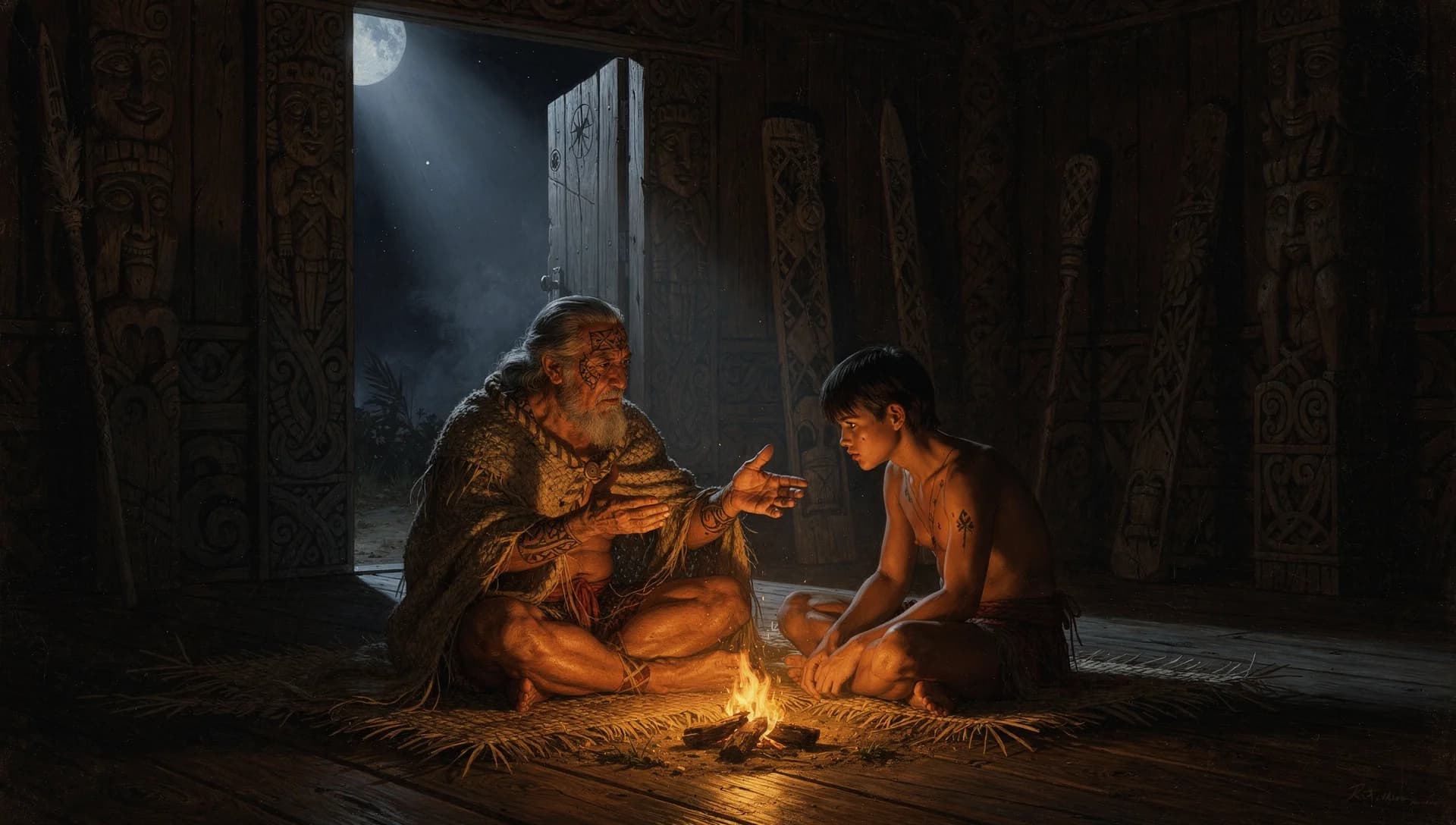
Io the Parentless: The Maori Supreme Being and the Hidden Salem Layer in Polynesian Religion
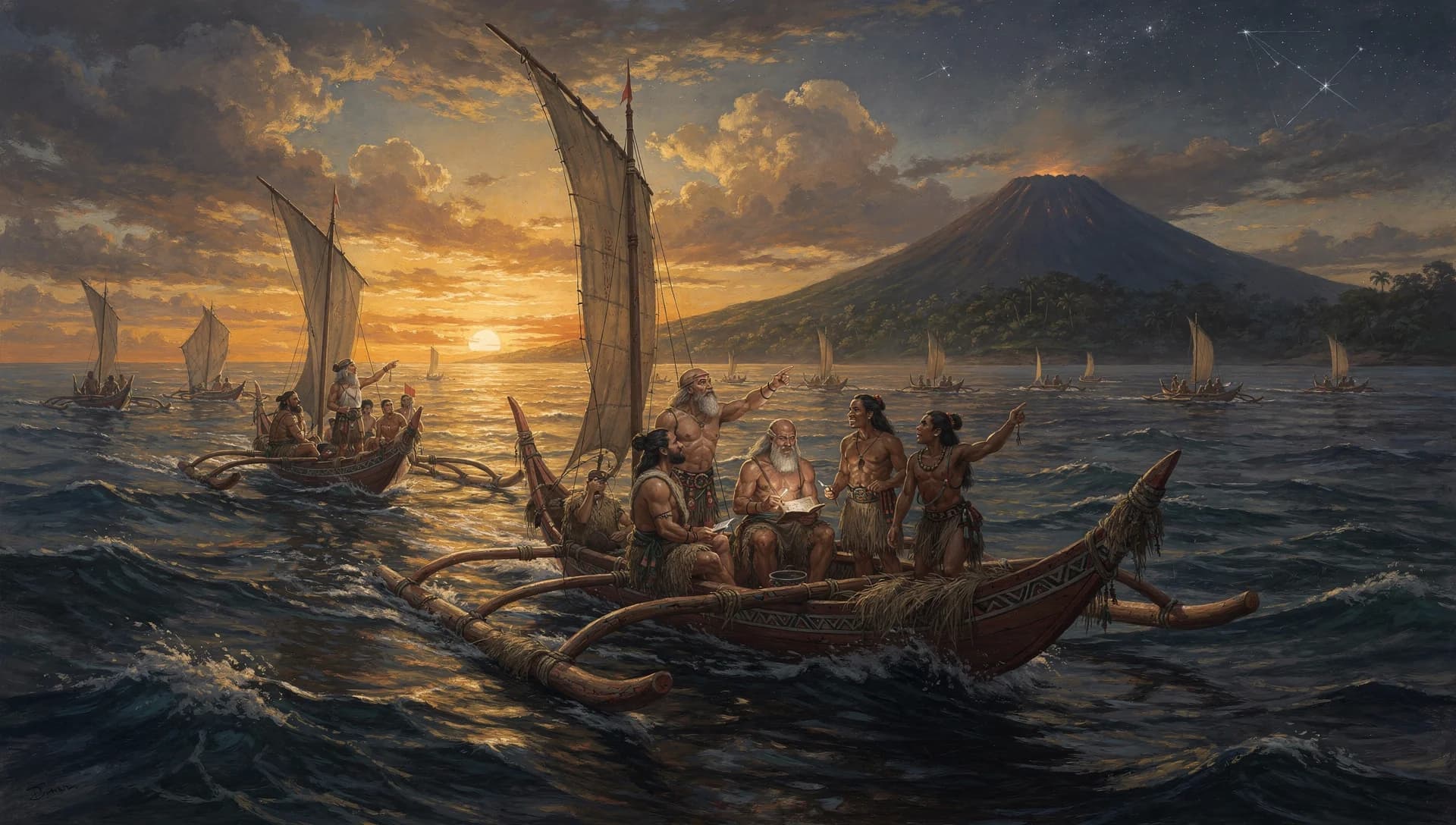
By Easy Stages Across the Pacific: Polynesian Voyaging Ancestors and the Andite Sailor Tradition
The Longest Memory: Australian Aboriginal Dreamtime and the Primordial Teaching-Ancestors
The Final Adjudication: Ragnarok and the Pending Verdict
The Newsletter
Get the research behind each piece
Free. New Urantia Book explorations, the sources behind the videos, and early looks. No spam, unsubscribe anytime.
Prefer video? Follow on YouTube and Facebook.
Delivered through Substack. You can also read past issues.