
The Hero Who Became a God: The Historical Thor of the Somme
The Norse god of thunder and warfare was a specific historical individual. The Urantia Book names him directly: Thor, the victorious commander of the northern Andite armies in the final battle of the Somme valley, who was later revered as a god by the northern white tribes he led.
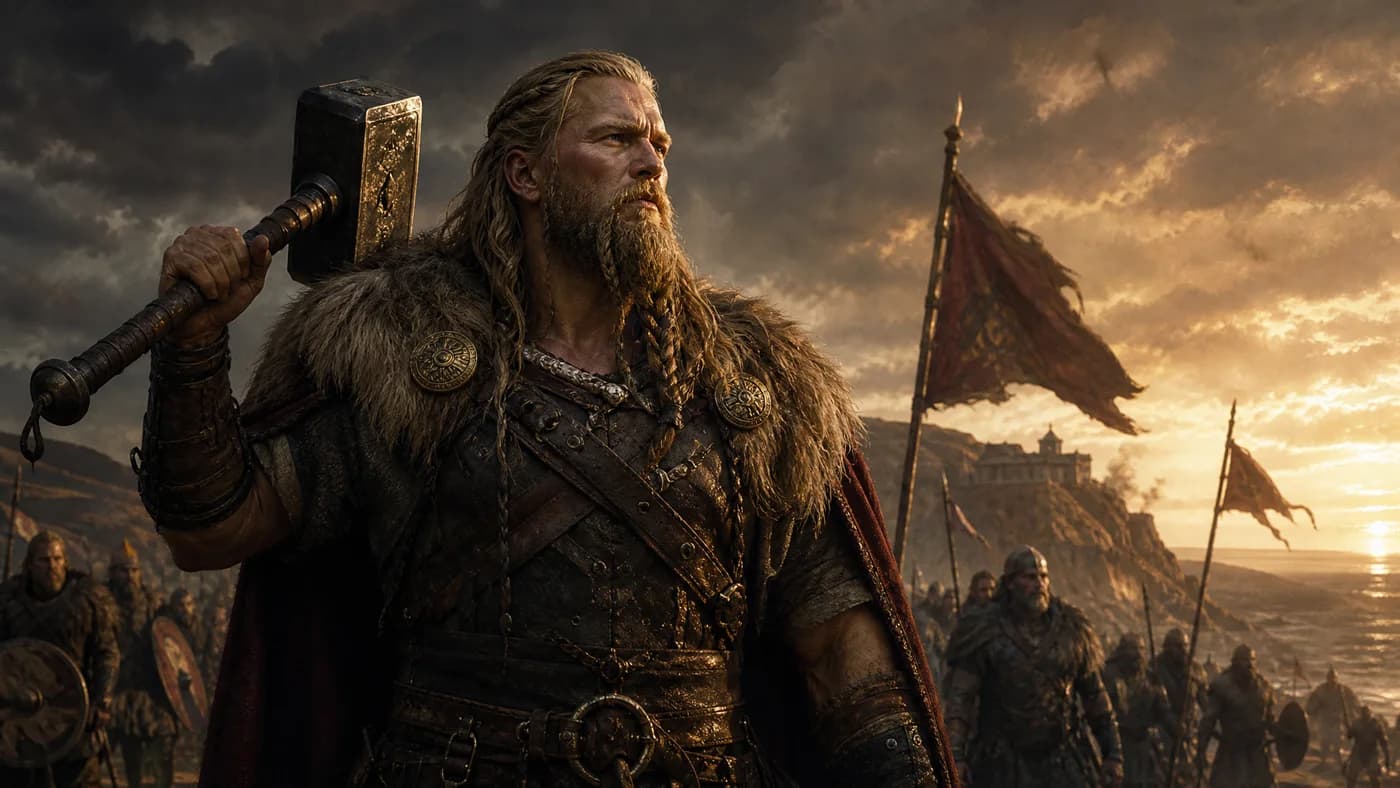
Andite military commander (~5000 BC) = Thor, Norse god of thunder and warfare
This article expands on the decoder mapping. For the side-by-side card and quick reference, see the mapping page.
The Named Commander
Among the Urantia Book's many comparative religious claims, the Thor identification is one of the most historically specific. The text does not merely suggest that the Norse thunder god might have had a human antecedent; it names the commander, places him in a specific battle at a named river, identifies his opponents, and describes the subsequent process by which his tribes deified him.
The passage is compact:
"The decisive struggles between the white man and the blue man were fought out in the valley of the Somme. Here, the flower of the blue race bitterly contested the southward-moving Andites, and for over five hundred years these Cro-Magnoids successfully defended their territories before succumbing to the superior military strategy of the white invaders. Thor, the victorious commander of the armies of the north in the final battle of the Somme, became the hero of the northern white tribes and later on was revered as a god by some of them." (UB 80:5.4)
Four historical claims: the commander's name (Thor), the geographic locus (Somme valley), the duration of the conflict he concluded (five hundred years of Cro-Magnon resistance), and the subsequent deification process. The Urantia Book's Thor is not the thunder god. The Urantia Book's Thor is the human historical individual whose victory in a specific battle produced the memory that was later expanded into the thunder god mythology.
What the Urantia Book Says
The broader context of Thor's Andite commander status is described in Paper 80:
"The tribes of northern Europe were being continuously reinforced and upstepped by the steady stream of migrants from Mesopotamia through the Turkestan-south Russian regions, and when the last waves of Andite cavalry swept over Europe, there were already more men with Andite inheritance in that region than were to be found in all the rest of the world." (UB 80:5.1)
"For three thousand years the military headquarters of the northern Andites was in Denmark. From this central point there went forth the successive waves of conquest, which grew decreasingly Andite and increasingly white as the passing centuries witnessed the final blending of the Mesopotamian conquerors with the conquered peoples." (UB 80:5.2)
The subsequent blending of Andite military elite with the indigenous populations produced the Nordic racial and cultural substrate:
"The Cro-Magnoid blue man constituted the biologic foundation for the modern European races, but they have survived only as absorbed by the later and virile conquerors of their homelands. The blue strain contributed many sturdy traits and much physical vigor to the white races of Europe, but the humor and imagination of the blended European peoples were derived from the Andites." (UB 80:5.7)
The Nordic racial composition is described with precision:
"The northern white race. This so-called Nordic race consisted primarily of the blue man plus the Andite but also contained a considerable amount of Andonite blood, together with smaller amounts of the red and yellow Sangik. The northern white race thus encompassed these four most desirable human stocks." (UB 80:9.2)
Thor, in this context, was the named military leader of the decisive phase of the Andite military conquest of Europe. He was not a Norse god who had descended from heaven; he was a superior Andite commander of Mesopotamian ancestry who led the final campaigns that consolidated Andite military dominance in northern Europe. His victory at the Somme produced the cultural memory that the successor Germanic-Norse civilization mythologized into the thunder god tradition three or four millennia later.
The Urantia Book's treatment of this process is euhemeristic in the technical sense: it identifies specific historical individuals as the referents of later mythological figures. The Thor mapping is not a vague suggestion; it is a named historical identification.
What the Ancient Source Says
The Norse Thor is attested across the full range of Norse religious literature. Thor is the most frequently invoked of the Aesir in surviving runic inscriptions from the Viking Age. John Lindow's Norse Mythology: A Guide to Gods, Heroes, Rituals, and Beliefs (Oxford University Press, 2001) catalogues the figure's mythological attestations. The Prose Edda's Gylfaginning and Skáldskaparmál, Snorri Sturluson's systematic treatment of Norse mythology (c. 1220 CE), provide the principal narrative sources.
Thor's characteristic features in the mythological tradition are well-defined: he wields the hammer Mjöllnir, rides a chariot drawn by two goats, kills giants, protects humanity from cosmic threats, and is associated with thunder and lightning. His martial competence is the defining feature. He is the god who defends the divine order through direct physical combat rather than through cunning (Odin) or beauty-magic (Freyja) or law (Tyr).
The euhemeristic reading of Thor is not a modern imposition. Snorri Sturluson's own Prose Edda Prologue explicitly presents the Norse gods as originally human Trojan warriors who migrated north after the fall of Troy. Anthony Faulkes, in his introduction to the Everyman edition of Edda (1987), discusses Snorri's deliberate use of euhemerism as a strategy for preserving pre-Christian material in a thirteenth-century Christian cultural context. Snorri frames the Norse gods as exceptional human ancestors who were deified by their descendants, which allowed him to treat the mythology as quasi-historical human prehistory rather than competing pagan theology.
Modern scholarship on the historical Thor has explored several lines of inquiry. Jens Peter Schjødt's Initiation Between Two Worlds (University Press of Southern Denmark, 2008) treats Thor's mythological functions. Rudolf Simek's Dictionary of Northern Mythology (Brewer, 1993) catalogues the comparative Indo-European background. The broader Indo-European thunder-god tradition (Greek Zeus, Roman Jupiter, Vedic Indra, Celtic Taranis, Baltic Perkūnas, Slavic Perun) establishes that Thor belongs to an Indo-European religious template that is considerably older than the Norse tradition's Viking-Age articulation of it.
The question of whether a specific named human individual lies behind the Indo-European thunder-god figure has been explored in comparative linguistics and archaeology. The Corded Ware culture of the Neolithic European steppe, the Proto-Indo-European thunder god perk-, and the subsequent Bronze Age and Iron Age military cultures all contribute to the thunder-god tradition. The Urantia Book's identification of Thor with an Andite commander at the Somme places the decisive mythologization event in a definite historical moment at the end of the fifth millennium BCE, which corresponds geographically and chronologically to the documented Neolithic-to-Bronze-Age transition in northern France and northwestern Europe.
Why This Mapping Matters
The scholarly question of whether Norse gods had human historical antecedents has recurred across two centuries of Norse studies. Snorri's thirteenth-century euhemeristic framing was the medieval working assumption. Nineteenth-century Romantic-nationalist Norse studies often treated the gods as pure mythological constructions without historical referents. Twentieth-century comparative religion (Dumézil, Eliade) treated the gods as Indo-European structural positions rather than historical individuals. The most recent scholarship has been more cautious about exclusive commitments to any of these framings.
The Urantia Book's contribution is a specific historical identification. Thor was a historical Andite commander who led the decisive campaigns of the northern Andite military expansion into Europe, winning the conclusive battle at the Somme against the indigenous Cro-Magnon blue race. His military success produced the cultural memory that later Germanic-Norse civilization expanded into the thunder-god mythology. The identification is not available from independent historical records (the name Thor as a personal name is not attested in surviving Bronze Age European epigraphy), but the general process (exceptional military leader → cultural hero → deified mythological figure) is the standard euhemeristic pattern that Snorri himself acknowledged.
The broader significance of the Thor mapping is that it establishes the Urantia Book's interpretive approach to multiple traditions of deified human ancestors. The Norse tradition's Odin, Thor, and other figures are not mythological constructions with no historical substrate. They are, on the Urantia account, the mythologized memories of particular named historical individuals whose exceptional careers produced the cultural substrate from which the later mythology was drawn.
This is consistent with the broader Urantia treatment of other traditions. Adamson and Ratta as the substrate of Cronus and Rhea (treated in the companion decoder article). Van as the substrate of Enki and Odin. Singlangton as the substrate of Chinese high-god tradition. Amenemope as the substrate of Egyptian wisdom tradition. In each case, the revelation identifies a particular human historical individual as the referent of what later traditions mythologized into divine or semi-divine figures.
The Thor mapping is particularly clear because the Urantia Book is most explicit about it. The text names the figure, the battle, the geographic locus, the opponents, and the deification process in a single compact passage. Few other comparative identifications receive this level of direct textual attention. The claim is testable in the modest way such claims can be tested: against the archaeological evidence for the Andite military expansion into Europe at the end of the fifth millennium BCE, against the documented Neolithic-to-Bronze-Age cultural transition in northern France, and against the preserved Norse tradition's own euhemeristic self-understanding in Snorri's Prose Edda Prologue.
Sources
- The Urantia Book, Paper 80 (Andite Expansion in the Occident), Paper 85 (The Origins of Worship). Urantia Foundation, first printing 1955. Cited passages: 80:5.1, 80:5.2, 80:5.4, 80:5.7, 80:9.2.
- Sturluson, Snorri. Edda. Translated by Anthony Faulkes. Everyman, 1987.
- Lindow, John. Norse Mythology: A Guide to Gods, Heroes, Rituals, and Beliefs. Oxford University Press, 2001.
- Simek, Rudolf. Dictionary of Northern Mythology. Translated by Angela Hall. D. S. Brewer, 1993.
- Schjødt, Jens Peter. Initiation Between Two Worlds: Structure and Symbolism in Pre-Christian Scandinavian Religion. University Press of Southern Denmark, 2008.
- Ellis Davidson, H. R. Gods and Myths of Northern Europe. Penguin, 1964.
- West, M. L. Indo-European Poetry and Myth. Oxford University Press, 2007.
Confidence and Evidence
- Confidence: UB CONFIRMED
- Evidence rating: STRONG
- Basis: The Urantia Book explicitly names Thor as a historical Andite military commander, the victor at the final battle of the Somme, whose deification by the northern white tribes is described directly in Paper 80:5.4. Snorri's own Prose Edda Prologue independently presents the Norse gods as euhemeristically derived from exceptional human ancestors. The archaeological and genetic evidence for Andite / steppe-pastoralist military expansion into northern Europe at the end of the fifth millennium BCE is well-documented in contemporary scholarship.
Related Decoder Articles
- Van, Sustained by the Tree of Life = Odin on Yggdrasil
- The Staff Split = Aesir-Vanir War
- 16 Children of Adamson + Ratta = Olympian Gods
By Derek Samaras
Connecting Articles
The Final Adjudication: Ragnarok and the Pending Verdict
The Insider Who Betrayed: Caligastia and the Norse Loki
The First War Among the Gods: The Staff Split and the Aesir-Vanir Conflict
The Cosmic Tree: The Tree of Life and Norse Yggdrasil
The Newsletter
Get the research behind each piece
Free. New Urantia Book explorations, the sources behind the videos, and early looks. No spam, unsubscribe anytime.
Prefer video? Follow on YouTube and Facebook.
Delivered through Substack. You can also read past issues.