
Rebellion Tested: What Jesus’ Final Week Knows About Being Destroyed for Refusing a Role
Before there was a trial there was a walkout. Nineteen men left the Sanhedrin rather than agree, and the court that convicted Jesus was what remained. Part two reads his last week as what happens to a person who will not play the part a system has assigned him.
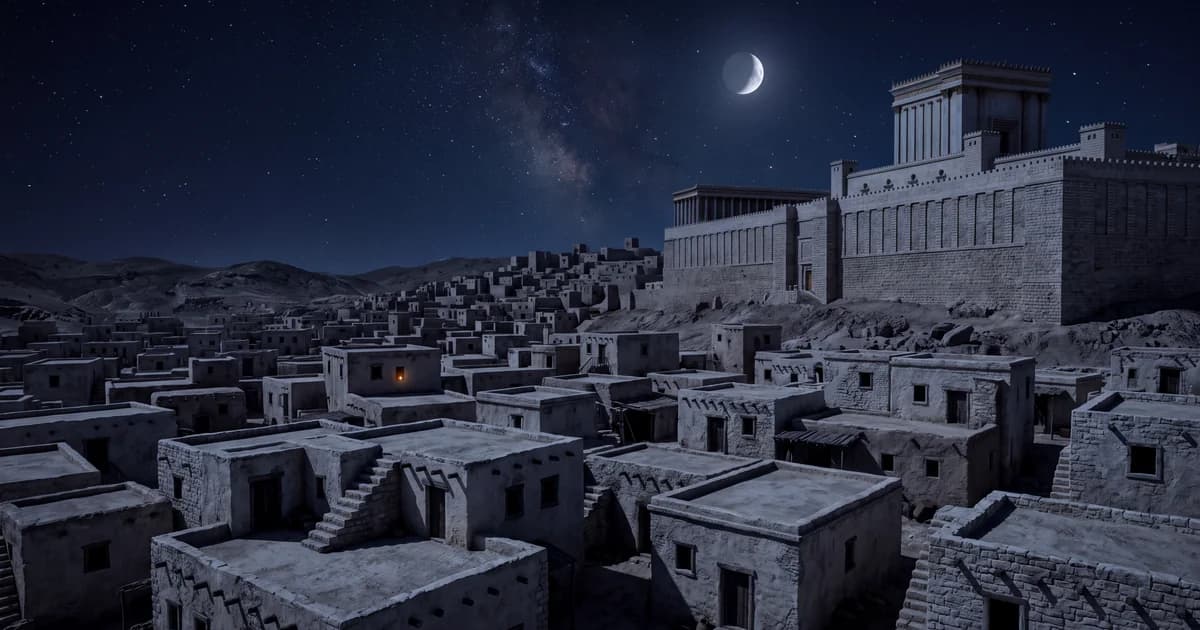
Rebellion Tested: What Jesus’ Final Week Knows About Being Destroyed for Refusing a Role
Derek Samaras | Urantia Book Network | August 2026
Part two of the Rebellion Tested series. Part one is here.
Before there was a trial, there was a walkout.
A resolution came before the Sanhedrin proposing that Jesus be sentenced to death without a trial at all. It never reached a vote.
"They had once before even gone so far as to declare he should die, but this was the first time the Sanhedrin had gone on record as desiring to decree his death in advance of a trial. But this resolution did not come to a vote since fourteen members of the Sanhedrin resigned in a body when such an unheard-of action was proposed." (168:3.3)
Fourteen men stood up and left rather than let it happen. Then, over the following weeks, the body dealt with the vacancy in its own way.
"When these resignations were subsequently acted upon, five other members were thrown out because their associates believed they entertained friendly feelings toward Jesus. With the ejection of these nineteen men the Sanhedrin was in a position to try and to condemn Jesus with a solidarity bordering on unanimity." (168:3.3)
Read that last clause again, because it is doing something remarkable. It is the revelation telling you exactly how the unanimity was manufactured. Nineteen dissenters removed from a body of seventy one. And on the night itself, from what was left:
"Only those members were assembled who were strongly and openly opposed to Jesus and his teaching since it required only twenty-three to constitute a trial court." (184:0.2)
Twenty three was the quorum. About thirty showed up, hand picked. A court that had to empty itself of everyone who might disagree, in order to agree.
This article is about what happens to a person who will not play the part a system has assigned him, and about what that system does when it discovers it cannot make him.

A note before we start, carrying two loads at once. This piece discusses betrayal, desertion, and cruelty, and it is a reading of a revelatory text rather than clinical advice or a diagnosis of anyone. If you are in danger, your safety comes first. And a limit on the reading itself: the pages ahead describe a faction, a purged court, and several named men. They do not describe a people, and this article will never use one to mean the other. The revelation is emphatic on the point, and we will get to exactly how emphatic.
Why They Moved
The trigger was not theology. The book is unusually direct about this, and the person it lets answer the question is Jesus.
Asked plainly why the authorities wanted him dead, he does not answer with anything about the Jewish heart, the Jewish character, or the Jewish soul. He answers with an institution protecting its own existence.
"They seek to kill me because they well know that, if you honestly believe and dare to accept my teaching, their system of traditional religion will be overthrown, forever destroyed. Thus will they be deprived of authority over that to which they have devoted their lives since they steadfastly refuse to accept this new and more glorious gospel of the kingdom of God." (162:2.2)
Notice the phrase the text grants them: that to which they have devoted their lives. These were not cartoon villains lounging in a tower. They were men with careers, disciplines, decades of study, and a genuine conviction that the institution they served was the vessel of God's covenant. The threat was not that Jesus was wrong. The threat was that he was about to be believed.
"No matter what the source of his wonder-working power, these Jewish leaders were persuaded that, if he were not immediately stopped, very soon all the common people would believe in him; and further, that serious complications with the Roman authorities would arise since so many of his believers regarded him as the Messiah, Israel's deliverer." (168:3.5)
That second clause matters and it is usually skipped. Rome was real. The fear of Roman reprisal was not a neurosis, it was a political calculation with a body count attached, and forty years later it turned out to be correct. Anyone who wants to read his last week as pure malice has to explain away a genuine and reasonable terror.
But the men most exposed to that terror were also the men most enriched by the arrangement, and the book does not let that pass.
"Annas, enriched by the temple revenues, his son-in-law the acting high priest, and with his relations to the Roman authorities, was indeed the most powerful single individual in all Jewry. He was a suave and politic planner and plotter." (184:1.1)
And then the sentence that names the actual trigger, which was not a sermon:
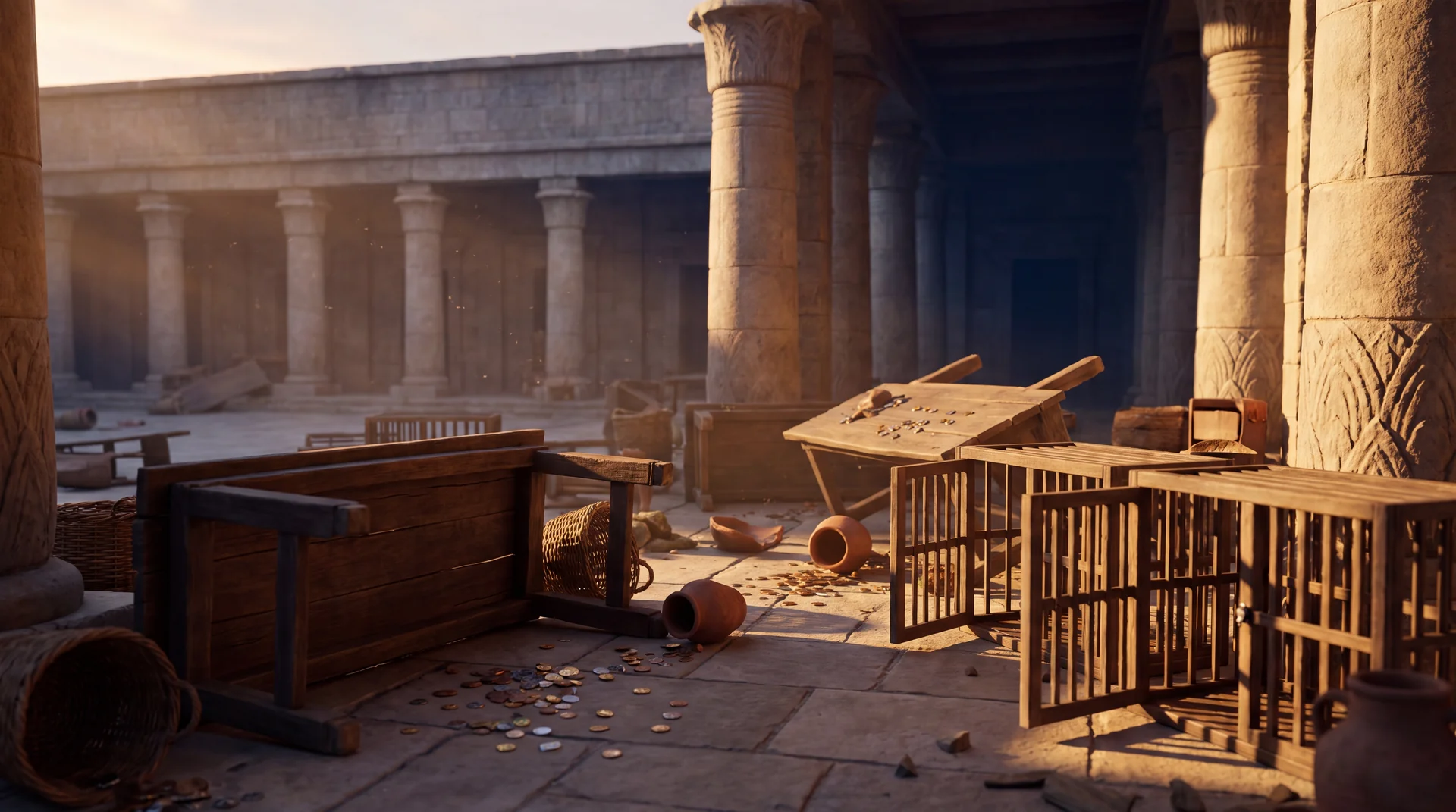
"When Jesus was young, Annas had taken a great interest in him, but now his revenues were threatened by what Jesus had so recently done in driving the money-changers and other commercial traders out of the temple. This act had aroused the enmity of the former high priest far more than had Jesus' teachings." (184:1.3)
Far more than had Jesus' teachings. He could tolerate the doctrine. He could not tolerate the loss of the concession.
Keep one more thing about Annas, because the article would be cheaper without it:
"He was reluctant to participate in the murder of a good man and had reasoned that Jesus might choose to leave the country rather than to suffer death." (184:1.2)
He did not want to kill him. He wanted him gone. He was willing to find out, late and by degrees, that those were the same thing.
The Man in the Room
For any of the next eleven sections to land, you have to know what was standing there.
Part one spent its length on a being who had no self, only a defense. Lucifer "denied that personality was a gift of the Universal Father" (53:3.2), and then spent the age that followed proving what a person becomes who believes nothing was given to them. Part two is about the opposite case, and the contrast is the whole point of putting them in one series.
"He was truly sincere; there was nothing of the hypocrite in him. He was free from affectation; he was always so refreshingly genuine. He never stooped to pretense, and he never resorted to shamming." (100:7.2)
"He was gentle and unassuming in his personal life, and yet he was the perfected man of a universe. His associates called him Master unbidden." (100:7.17)
Unbidden. Nobody was required to. That single word separates authority from the demand for it, and the demand for it was the entire content of the Lucifer manifesto.
Then the sentence that makes this everyone's problem and not a story about somebody unreachably better than you:
"Jesus was now passing through the great test of civilized man, to have power and steadfastly refuse to use it for purely selfish or personal purposes." (136:8.6)
The book calls that the great test of civilized man. Not the great test of divine Sons. The reason his last week reads the way it does is that a person who has already passed that test cannot be moved by the things that move everyone else, and a system that only knows how to apply those things has nothing left to try.
"Jesus had acquired that type of human character which could preserve its composure and assert its dignity in the face of continued and gratuitous insult. He could not be intimidated." (186:2.5)
Hold onto assert its dignity. This is not passivity, and the article will come back to the distinction at the exact moment it matters most.
The Part He Would Not Play
Every system that has captured a person has a role for them, and the role is never announced. It is simply assumed, and the person discovers its existence by failing to perform it.
The role assigned to Jesus was national deliverer. It was inherited, it was sincere, and it was genuinely unfillable.
"He well knew that his earth mission could not possibly fulfill the Messianic expectations of the Jewish people; the olden prophets had portrayed a Messiah which he could never be." (157:6.6)
Before that sentence can be misread, understand what produced the expectation, because the same people who held it are the people who had spent longer and paid more for God than anyone on the planet. This is Jesus, speaking of his own:
"Our forefathers gave themselves up to the persistent and passionate search for God, and they found him as no other whole race of men have ever known him since the times of Adam, who knew much of this as he was himself a Son of God." (155:6.10)
And, in the same breath, what it cost them:
"For weary generations the Jews have not ceased to toil, sweat, groan, travail, and endure the sufferings and experience the sorrows of a misunderstood and despised people, all in order that they might come a little nearer the discovery of the truth about God." (155:6.10)
A people who had been conquered, deported, occupied, and ruled by foreigners for five hundred unbroken years had built a hope shaped like rescue. Of course they had. Any group would. The expectation was not a defect of character, it was the natural shape of a wound that had been kept open for centuries by other people's armies.
The trouble is what the hope had been narrowed into by the time he arrived. The original commission was outward facing. The Hebrew people were selected, in the book's words, "not for special indulgence and monopoly of divine favor, but for the special service of carrying the truth of the one God over all to every nation" (97:10.1). A conduit, not a fortress. Our companion article The Sabotage of Michael's Bestowal traces in detail how that commission was overwritten, and it is the better place for that argument.
What matters here is narrower. He would not take the role. And when his own friends tried to hand it to him a final time, on the last night, he declined even their protection:
"You mean well, but you err in that you fail to understand that the Son of Man needs no one to defend him." (177:0.3)
That refusal was the offense. Not blasphemy, which the court could never make stick, and never even formally voted on. The offense was that a man they could not use declined to be used, in public, where the common people could see it.
The First Failure: A Ledger Kept in Private
There are three distinct failures in his last week, and anyone who has come through this kind of thing, anyone who has been on the receiving end of a person or a system that would not stop, tends to collapse all three into a single word. The text keeps them apart, and so should we, because they are three different things and only one of them is betrayal.
Start with the assumption everyone brings and the book removes immediately.
"Be assured that Judas was always financially loyal to his Master and his fellow apostles. Money could never have been the motive for his betrayal of the Master." (139:12.5)
Not the money. So what, then. The book's answer is a slow accumulation, kept entirely out of sight, over years.
"Judas did not realize it at this time, but he had been a subconscious critic of Jesus ever since John the Baptist was beheaded by Herod. Deep down in his heart Judas always resented the fact that Jesus did not save John." (177:4.11)
A grievance from an event years earlier, which Jesus was never told about. And a second one, hours before the arrest, so petty and so human that it is almost unbearable to read:
"He was suddenly overcome with indignation that Peter, James, and John should have been honored with close association with Jesus, and at this time, when he was on the way to the high priest's home, he was bent on getting even with Peter, James, and John more than he was concerned with any thought of betraying Jesus." (177:4.4)
He was not primarily trying to destroy Jesus. He was trying to get even with three colleagues, and Jesus was in the way of it.
Then the mechanism, stated plainly, and this is the sentence that ought to stop anyone who has ever nursed a private ledger:
"He disliked to discuss his personal problems with his immediate associates; he refused to talk over his difficulties with his real friends and those who truly loved him. In all the years of their association he never once went to the Master with a purely personal problem." (193:4.10)
Not once. In years. He had a live grievance against the most approachable person in the historical record and never once raised it. That is not a story about an unusually wicked man. It is a description of how ordinary resentment becomes catastrophe: privately, slowly, and without ever giving the other party a chance to answer.
And this is where the pattern from part one reappears in human scale. The resentment did not build because Jesus wronged him. It built because Jesus repeatedly failed to be what Judas had decided he would be.
"Every time Judas allowed his hopes to soar high and Jesus would do or say something to dash them to pieces, there was always left in Judas's heart a scar of bitter resentment; and as these scars multiplied, presently that heart, so often wounded, lost all real affection for the one who had inflicted this distasteful experience upon a well-intentioned but cowardly and self-centered personality." (177:4.11)
Read that again with the word inflicted in view. Nothing cruel is happening. A man is simply declining to be a fantasy, and the fantasy's owner experiences the decline as injury. If you have ever been told that you hurt someone by failing to be who they needed, this paragraph is about that, and it was written in 1955.
The book then states the general law, in its own voice, about everybody:
"And every mortal man knows full well how love, even when once genuine, can, through disappointment, jealousy, and long-continued resentment, be eventually turned into actual hate." (177:4.11)
What he expected afterward tells you what the whole thing had really been about:
"He anticipated being called before the full meeting of the Sanhedrin and there hearing himself eulogized while they conferred upon him suitable honors in token of the great service which he flattered himself he had rendered his nation." (186:1.2)
He thought there would be a ceremony.
One legal detail is worth knowing, because it says something about the tradition being abused that night. The faction could not put Judas on the stand.
"Judas could not be used as a witness against Jesus because the Jewish law specifically forbade the testimony of a traitor." (184:3.6)
The law they were working around had a protection built into it against exactly this kind of informant. The system was not the problem. The men suspending it were.
And then the arrest, and six words that contain the entire ethic of this article:
"Friend, is it not enough to do this! Would you even betray the Son of Man with a kiss?" (183:3.5)
Friend. Not monster, not devil, not traitor. The accurate word, spoken at the worst possible moment, without contempt and without pretending nothing was happening.
The Second Failure: The Ones Who Ran
The apostles are the second category and it is not betrayal. It is flight, and the difference matters enormously to anyone still angry at people who went quiet.
Here is Jesus, hours earlier, appraising the men who were about to scatter:
"These men are weak and frail, but I know we can trust them; I have proved them; they love me, even as they reverence you." (182:1.5)
He classified them as trustworthy before the failure, knowing it was coming. Then, in the garden, finding them asleep at the worst hour of his life:
"Father, you see my sleeping apostles; have mercy upon them. The spirit is indeed willing, but the flesh is weak." (182:3.4)
Not one word of reproach. He asks for mercy on them while they are actively failing him.

And at the arrest, he negotiates their release:
"I have told you that I am he. If, therefore, you seek me, let these others go their way. I am ready to go with you." (183:3.6)
Then they ran, and the text is careful about why. It was not cowardice in the abstract. It was a specific, credible, immediate threat:
"the soldiers were not quick enough since, having overheard the captain's orders to arrest them, Jesus' followers fled in haste back into the ravine." (183:3.9)
They heard the order to arrest them, and they went.
Here is the honesty this section requires, and the article would be more satisfying without it. They had been instructed to preserve their lives. He had just publicly secured their release. This piece cannot use the desertion as a clean picture of abandonment while also quoting the man authorizing it. Both are true.
Which is, in the end, the more useful thing to tell anyone who has been left alone: some of the people who went quiet were following rules you yourself gave them. That does not make the room less empty. It makes the emptiness less of a verdict.
The line the book eventually draws between the two failures is drawn by Jesus himself, after the resurrection, and it is drawn at trust rather than at performance:
"Judas is no more with you because his love grew cold, and because he refused to trust you, his loyal brethren." (193:3.2)
The apostles failed and stayed. Judas did not fail more spectacularly. He withdrew his trust, privately, years before anything visible happened.
The Third Failure: A Man Who Could Not Be Laughed At
Peter is the third category, and his failure has a mechanism so specific it deserves its own section.
He did not fold under threat. Nobody threatened him. He folded under teasing.
"He felt very much out of place here among the enemies of Jesus, and indeed he was out of place. The Master had not instructed him to keep near at hand as he had admonished John." (184:2.2)
He was not supposed to be there. He came anyway, out of love, and put himself in the one environment his particular weakness could not survive.
"After more than an hour of this isolation, the gate-keeper and her sister chanced to meet him, and both of them again teasingly charged him with being a follower of Jesus." (184:2.8)
Teasingly. A servant girl at a gate, needling him. Part one established the pattern at length and will not repeat it here: this man could withstand assault and could not withstand ridicule. What part one did not have room for is what the failure felt like from inside, which is the part that will be familiar to anyone who has ever managed their way through a room instead of standing in it.
"Until the crowing of the cock brought Peter to his better senses, he had only thought, as he walked up and down the porch to keep warm, how cleverly he had eluded the accusations of the servants, and how he had frustrated their purpose to identify him with Jesus." (184:2.11)
He thought he was winning. Each denial felt like a small tactical success. That is the horror of it, and it is why the book follows with a general observation rather than a rebuke:
"Having taken the first step along the path of compromise and least resistance, there was nothing apparent to Peter but to go on with the course of conduct decided upon. It requires a great and noble character, having started out wrong, to turn about and go right." (184:2.12)
And then the look, which is the most economical piece of characterization anywhere in the passion narrative:
"Peter never forgot that look as long as he lived. It was such a glance of commingled pity and love as mortal man had never beheld in the face of the Master." (184:2.8)
Not anger. Not disappointment. Pity and love, from the man currently on trial, for the friend currently denying him.
Five Trials and the Silences
What follows is not a legal process. The book itemizes the failure with a precision that reads like a prosecutor's summary, and every clause is a separate violation:
"He was arrested without indictment; accused without evidence; adjudged without witnesses; punished without a verdict; and now was soon to be condemned to die by an unjust judge who confessed that he could find no fault in him." (185:8.1)
The evidence phase collapsed under its own weight:
"More than a score of false witnesses were on hand to testify against Jesus, but their testimony was so contradictory and so evidently trumped up that the Sanhedrists themselves were very much ashamed of the performance." (184:3.6)
They were embarrassed by their own witnesses. And on the one charge that might have worked:
"The only point the court could have consistently judged him on was that of blasphemy, and that would have rested entirely on his own testimony. Even concerning blasphemy, they failed to cast a formal ballot for the death sentence." (184:5.7)
No formal vote was ever taken. Even inside the purged court, three men walked out rather than proceed:
"When this was done, three of the Pharisees took their leave; they wanted to see Jesus destroyed, but they would not formulate charges against him without witnesses and in his absence." (184:5.8)
Men who wanted him dead still would not do it that way.
Through most of it he said almost nothing, and the book takes care that the silence is not misread:
"When Jesus was arrested, he knew that his work on earth, in the likeness of mortal flesh, was finished. He fully understood the sort of death he would die, and he was little concerned with the details of his so-called trials." (186:2.1)
And the crucial gloss, delivered from inside Pilate's own head:
"Pilate was confused in mind, fearful of the Jews in his heart, and mightily stirred in his spirit by the spectacle of Jesus' standing there in majesty before his bloodthirsty accusers and gazing down on them, not in silent contempt, but with an expression of genuine pity and sorrowful affection." (185:2.16)
Not in silent contempt. The revelation goes out of its way to block the reading in which the silence is a power move. He was not freezing them out. He was looking at them with affection, which is a far harder thing and a far stranger one.
Rome, meanwhile, held the actual power, and the book files the actual blunder accordingly:
"A worthy Roman governor who had not become disadvantageously involved with the rulers of the Jews would never have permitted these bloodthirsty religious fanatics to bring about the death of a man whom he himself had declared to be innocent of their false charges and without fault. Rome made a great blunder, a far-reaching error in earthly affairs, when she sent the second-rate Pilate to govern Palestine." (185:1.9)
The method was Rome's too:
"Crucifixion was not a Jewish mode of punishment." (187:1.5)
And the thing that actually broke Pilate was not an argument. It was a career threat, delivered by one named man:
"Pilate was just about ready to release Jesus when Caiaphas, the high priest, approached the cowardly Roman judge and, shaking an avenging finger in Pilate's face, said with angry words which the entire multitude could hear: 'If you release this man, you are not Caesar's friend, and I will see that the emperor knows all.' This public threat was too much for Pilate." (185:7.5)
A governor with an innocent verdict already formed folded because someone threatened to write to his boss.
As for the crowd in the courtyard, the book identifies exactly who was in it:
"In the multitude which now clamors for the Master's death are to be found only his sworn enemies and the easily led and unthinking populace." (185:6.1)
Sworn enemies, and people who go along. Both categories are available in any city on earth on any given morning.
What They Could Not Reach, They Struck
Then the beatings start, and the revelator does something unusual. He stops narrating and asks a question:
"What is this trait of the animal in man which leads him to want to insult and physically assault that which he cannot spiritually attain or intellectually achieve? In the half-civilized man there still lurks an evil brutality which seeks to vent itself upon those who are superior in wisdom and spiritual attainment." (184:4.5)
That is close to the question many readers arrive with, though it is worth being precise about the answer given. The text does not say people hate goodness because it is good. It says they strike at what they cannot reach. The impulse is envy with a fist, and the target is chosen for being above rather than for being innocent.
Jesus asked a narrower version himself, the night before, in the upper room:
"And what have I done to these men that they should hate me with such a terrible hatred? Nothing, save to offer them fellowship on earth and salvation in heaven." (180:3.2)
Now note who actually did the striking, because the distribution is the strongest argument in this article. Inside eighteen hours, three entirely separate populations abused him: the temple guards and servants of the high priest, then Roman soldiers, then a street crowd. Jew and gentile, religious and secular, official and civilian. The failure is not tribal. It is human, and it recruited from everyone available.
The book also traces how permission spread:
"who had been stimulated to abuse him by the example of the members of this so-called Sanhedrist court." (184:4.3)
This so-called Sanhedrist court. Even mid narrative, the revelator declines to grant the body its own name.
And here is the sentence this entire series has been walking toward, eleven words that separate a choice from a defeat:
"As these insults, taunts, and blows fell upon Jesus, he was undefending but not defenseless. Jesus was not vanquished, merely uncontending in the material sense." (184:4.5)
Undefending but not defenseless. Not vanquished, merely uncontending. If you have ever declined to fight back and had that read as weakness, that distinction was written down for you two thousand years after the fact and it has never been improved on.
The Roman soldiers, for their part, could not make sense of him:
"astonished at the Master's tolerant regard of their ridicule and mocking." (187:3.4)
And for the ones who had gone hardest, the book offers something bleaker than condemnation:
"But nothing can appeal to the unfeeling hearts of those who are victims of intense emotional hatred and slaves to religious prejudice." (185:6.4)
Victims of and slaves to. Even here, at the worst hour, the revelation describes the perpetrators as people who have been captured by something.
The Mirror
Now the turn, and it needs to be a section rather than a footnote, because everything above becomes poison without it.
The error that killed him is not Jewish. It is a standing danger of every religion that has ever organized itself, and the book lists it among the ordinary occupational hazards of institutional faith:
"The dangers of formalized religion are: fixation of beliefs and crystallization of sentiments; accumulation of vested interests with increase of secularization; tendency to standardize and fossilize truth; diversion of religion from the service of God to the service of the church; inclination of leaders to become administrators instead of ministers; tendency to form sects and competitive divisions; establishment of oppressive ecclesiastical authority; creation of the aristocratic 'chosen-people' attitude" (99:6.3)
That is a general law with no defendant, written for the twentieth century. Every item on it is a mechanism you can find running in a church, a mosque, a temple, a political movement, or a company this afternoon.
The critique also came from inside the tradition, centuries early, from its own prophets:
"For the first time since the days of Melchizedek the ears of man heard the denunciation of the double standard of national justice and morality... This was a direct attack on the egoistic doctrine of the 'chosen people,' and many Hebrews of those days bitterly resented it." (97:4.2)
The tradition produced its own sharpest critics and then had to survive them. That is not a mark against it. It is a mark of seriousness, and few traditions can claim it.
And the Sanhedrin was never the monolith the story usually needs it to be. On the Tuesday of that very week, in a room full of people listening to him teach:
"In this room now are a full score of men who were once members of the Sanhedrin, or who were high in the councils of the nation, albeit even some of you still shrink from open confession of the truth lest they cast you out of the synagogue." (174:5.3)
Twenty former members of the council, in the audience, in his last week. Earlier:
"Here were gathered together some twenty-five Jewish leaders who believed Jesus' teaching. Among this group were fourteen men who were then, or had recently been, members of the Sanhedrin." (164:2.1)
And:
"It was a fact that many of the members of the Sanhedrin either secretly believed in Jesus or else were decidedly averse to arresting him during the feast" (162:1.5)
Which is exactly why nineteen of them had to go before a verdict was possible.
Then the revelators do something that ought to be much better known. Immediately after telling this story, in the same paper, they stop and address the reader about what is going to be done with it. Not a modern editor's disclaimer. The book's own words, from 1955:
"The fact that the spiritual leaders and the religious teachers of the Jewish nation onetime rejected the teachings of Jesus and conspired to bring about his cruel death, does not in any manner affect the status of any individual Jew in his standing before God. And it should not cause those who profess to be followers of the Christ to be prejudiced against the Jew as a fellow mortal." (175:2.1)
And in the same passage, the fact that settles the whole question of who this story is about:
"Jesus of Nazareth, who was, himself, a Jew by natural birth." (175:2.1)
Then the accusation turns, and it does not turn toward the Sanhedrin:
"Many times has this unreasoning and un-Christlike hatred and persecution of modern Jews terminated in the suffering and death of some innocent and unoffending Jewish individual whose very ancestors, in the times of Jesus, heartily accepted his gospel and presently died unflinchingly for that truth which they so wholeheartedly believed." (175:2.2)
The revelation is harder on Christians than on the court. It says so again about the institution that grew out of all this:
"And the genuine lovers of truth will be slow to forget that this powerful institutionalized church has often dared to smother newborn faith and persecute truth bearers who chanced to appear in unorthodox raiment." (195:10.13)
The church built on the man killed for threatening a religious establishment went on to become a religious establishment that killed people for threatening it. If you want the pattern in this article demonstrated rather than argued, that is the demonstration, and it is our own house.
Finally, the principle that makes collective blame impossible in this cosmology at all:
"Sin is wholly personal as to moral guilt or spiritual consequences, notwithstanding its far-flung repercussions in administrative, intellectual, and social domains." (67:7.7)
Guilt does not travel through membership. It does not travel through descent. Jesus applied that standard himself, to the Roman holding the death warrant:
"You could have no power over me except it were permitted from above. You could exercise no authority over the Son of Man unless the Father in heaven allowed it. But you are not so guilty since you are ignorant of the gospel. He who betrayed me and he who delivered me to you, they have the greater sin." (185:7.2)
He graded the guilt in the room, by knowledge and by act, person by person, while standing in front of the man who could still release him.
What the Cross Actually Did
A great many people have been handed a version of this in which the Father required a death. It is worth knowing that the book rejects that account completely, and rejects it in the same breath in which it rejects inherited guilt.
"Jesus is not about to die as a sacrifice for sin. He is not going to atone for the inborn moral guilt of the human race. Mankind has no such racial guilt before God. Guilt is purely a matter of personal sin and knowing, deliberate rebellion against the will of the Father and the administration of his Sons." (186:5.7)
"It was man and not God who planned and executed the death of Jesus on the cross. True, the Father refused to interfere with the march of human events on Urantia, but the Father in Paradise did not decree, demand, or require the death of his Son as it was carried out on earth." (186:5.2)
"There was nothing in the cross which the Father required—only that which Jesus so willingly gave, and which he refused to avoid." (188:5.11)
And then the counterfactual, which quietly removes the entire logic that made the deicide charge possible in the first place:
"The salvation of God for the mortals of Urantia would have been just as effective and unerringly certain if Jesus had not been put to death by the cruel hands of ignorant mortals." (186:5.9)
Sit with what that does. If the death was not required, then nobody performed a cosmic service by causing it, and nobody bears a cosmic guilt for it beyond the ordinary personal guilt of the individuals who did it. The killing accomplished nothing that was not already secured. It was not a mechanism. It was a murder, and the salvation stood without it.
The doctrine that says otherwise gets filed by the book among humanity's oldest errors, made by everyone:
"The doctrine of original sin, or racial guilt, started every person out in serious debt to the spirit powers." (89:4.6)
Our articles The Sabotage of Michael's Bestowal and What They Changed go further into how the substitution theory got attached to a gospel that never contained it. What belongs here is only where the book locates the actual triumph, because it is not where most readers expect:
"The triumph of the death on the cross is all summed up in the spirit of Jesus' attitude toward those who assailed him." (188:5.6)
Not in the suffering. Not in the blood. In how he regarded the people doing it.
Their Real Trouble Had Just Begun
The destruction did not work, and what happened next is more revealing than the killing was.
"They had dared to think they were through with Jesus. They were about to discover that their real trouble with the man of Nazareth had just begun." (190:3.3)
The response was not reflection. It was containment:
"It was at this meeting that action was taken to throw out of the synagogues any person who made mention of Jesus' resurrection. It was even suggested that anyone claiming to have seen him should be put to death; this proposal, however, did not come to a vote since the meeting broke up in confusion bordering on actual panic." (190:3.3)
A second lethal proposal, and a second time it failed to reach a vote. The pattern from the opening repeats exactly: when the body is asked to formalize the thing it is doing, it cannot.
And earlier, in committee, the reasoning had already been stated out loud:
"If we should permit this to happen, this mistake would be far worse than to have allowed him to live." (188:2.2)
That is not the language of men defending a covenant. It is the language of men managing exposure.

Meanwhile, the men who had kept quiet stopped keeping quiet. Joseph of Arimathea and Nicodemus, the two Sanhedrists who had not consented, came forward publicly to bury him, and afterward:
"From now on they were the most outspoken disciples of Jesus in all Jerusalem." (188:1.2)
Seven weeks later, Peter preached in the temple and more than two thousand people joined in a single day, in that city, among those people (194:1.2). The gospel was not carried out of Jerusalem by outsiders. It was carried by Jews, out of the same city, within weeks.
For Anyone Who Was Destroyed for Refusing a Role
Peter had denied him, repeatedly, in public, in a courtyard, while congratulating himself on his cleverness. Here is the first message sent after the resurrection:
"But go, all of you, now and tell my apostles—and Peter—that I have risen, and that you have talked with me." (189:4.12)
And Peter. Two words, inserted so the one man certain he had disqualified himself would hear his own name read aloud.
And when they finally spoke:
"I knew it was not from the heart that you disowned me; therefore I forgave you even before you asked; but now must you cease to think about yourself and the troubles of the hour while you prepare to carry the good news of the gospel to those who sit in darkness." (191:1.2)
Forgiven before asking, and then immediately handed work. Not absolution as a closing ceremony. Absolution as a way of getting somebody's attention off themselves and back onto something worth doing.
Now the limit, stated plainly rather than buried, because this section could otherwise be used against the very people it is for.
Everything in those two quotations comes from a resurrected being with complete knowledge of another person's heart. He could say it was not from the heart because he knew. You cannot know that, and nobody is entitled to tell you to assume it. These passages model what a survivor might one day receive. They do not describe a duty a survivor owes. Anyone who quotes them at you to hurry you along has inverted them.
What the book does say about forgiveness, in its own voice, is not a transaction at all:
"Divine love does not merely forgive wrongs; it absorbs and actually destroys them." (188:5.2)
Absorbs and destroys. Not files, not excuses, not forgets. Something happens to the wrong itself.
And about the man who engineered the whole thing, the book records a gap that will be familiar to anyone whose friends have been angrier on their behalf than they were themselves:
"Jesus regarded the betrayer only with pity. The worlds have found it difficult to forgive Judas." (139:12.14)
The injured party got there. The onlookers still have not. Bystanders are frequently more committed to your grievance than you are, and their commitment is not the same thing as your healing.
Which returns us to the room we started in.
A council of seventy one could not convict him until it had removed nineteen of its own members. It could not vote for his death before the trial, could not vote for it at the trial, and could not vote to suppress his resurrection afterward. Three times it was asked to make its intention official and three times it could not do it. The verdict was reached by subtraction, by night, by quorum, by a faction that had to hollow out its own body to find agreement.
That is what a system does when it meets a person it cannot capture. It does not defeat him. It rearranges itself until his destruction becomes procedurally possible, and then it discovers, quite soon afterward, that the destruction accomplished nothing it was for.
If you have been on the receiving end of something like that, the useful thing here is not the resurrection. It is the arithmetic. You were not outvoted by everyone. You were outvoted by a room that had to be emptied first.
Part three of Rebellion Tested is in preparation. Part one, What the Lucifer Rebellion Knows About Narcissistic Abuse, reads the original insurrection as the same pattern at the scale of a solar system. The full series and its cast live at Rebellion Tested.
Further reading on this site: The Sabotage of Michael's Bestowal, adapted from the research of Chuck Thurston, traces how the preparation for the bestowal was undermined across centuries. The Jubilee of Jubilees covers what happened seven weeks later on Salvington. The War in Heaven Was Real and The Adjudication of Urantia cover the rebellion itself and the verdict still pending at Uversa.
The framing of acceptance over forgiveness that runs through this series comes from David Ades, who publishes at youtube.com/@CoachDavidAdes. His account of how a person becomes a wounder simply by refusing to fulfil someone else's fantasy is the observation part two is built on, and he arrived at it from clinical experience rather than from a revelation.
Connecting Articles




The Newsletter
Get the research behind each piece
Free. New Urantia Book explorations, the sources behind the videos, and early looks. No spam, unsubscribe anytime.
Prefer video? Follow on YouTube and Facebook.
Delivered through Substack. You can also read past issues.